
Ever wondered why so many people lose money in online trading?
It’s not always bad luck. Sometimes, it’s a carefully planned trap.
Trading scams have become alarmingly common in India. Moreover, the Reserve Bank of India warns that unregulated trading platforms are targeting young investors aggressively.
Let’s break down how these scams actually work.
How Trading Scams Work in India?
Now, trading is no longer tedious. Multiple trading apps & platforms make the journey of a trader easier.
But wait!
Is the trading app you are using reliable?
Well, you cannot say it surely!
Many fraudulent platforms operate without SEBI registration. They look professional with fancy websites. However, they lack proper licenses.
Here, with a proper understanding of how scammers exploit trading demand and the lack of awareness of beginners, you recognize scams early.
Here’s the exact operational flow:
Stage 1: Target Acquisition
Scammers scrape profiles from LinkedIn, Facebook, and Instagram, looking for keywords like “investor,” “trading interest,” or “passive income”.
They run targeted ads on Google and Facebook promising high returns, collecting leads through fake registration forms.
Stage 2: Trust Building
Create fake trading platforms using templates from dark web marketplaces (costing just ₹15,000-₹50,000).
Display forged SEBI registration numbers, fake office addresses, and photoshopped certificates.
Stage 3: The Hook
Provide rigged demo accounts where all trades show profits through manipulated algorithms.
Share fabricated testimonials with morphed bank statements and WhatsApp screenshots.
Stage 4: Initial Investment
Encourage investing ₹5,000-₹10,000 initially to “test the waters”.
Allow withdrawing the initial amount plus a small profit to establish credibility.
Stage 5: The Big Push
Account managers repeatedly urged larger investments for “VIP plans” or “limited-time opportunities”. Promise 10x leverage or bonus credits to multiply deposits.
Send urgent messages about “market opportunities closing in 24 hours”.
Stage 6: Exit Strategy
Extract additional ₹20,000-₹50,000 through multiple fee demands before disappearing.
Account managers stop responding, the website goes offline, or shows “maintenance mode”.
Red Flags of Trading Scams in India
Here are some of the common tactics and red flags of trading scams in India:
- The “Guaranteed Returns” Promise
Scammers often promise fixed returns. Sounds tempting, right?
They claim things like “earn ₹50,000 weekly guaranteed.” Real trading involves risk. No legitimate platform guarantees profits.
For example, fake forex and crypto platforms frequently use this tactic on Telegram groups. These scammers specifically target young professionals and students with promises of passive income.
Red Flag: Any platform promising guaranteed daily or weekly returns
- The Fake Demo Success
Here’s how it works:
- First, they offer a demo account
- You see profits quickly
- Meanwhile, the system is rigged
- However, when you deposit real money, withdrawals become impossible
The demo account is deliberately programmed to show only winning trades to build false confidence.
- Social Media and Telegram Traps
Fraudsters create WhatsApp and Telegram groups. They share fake trading profit screenshots. Moreover, they use attractive names like “Stock Market Champions” or “Forex Kings India.”
Common Telegram fraud indicators:
- Groups with 1000+ members instantly
- Admins never show their real identity
- Pressure to invest quickly
- Links to unknown trading apps
These groups often have paid actors posing as successful traders sharing testimonials.
- Celebrity Endorsement Fakes
Scammers create deepfake videos. They show celebrities like Mukesh Ambani or Ratan Tata recommending platforms. However, these are completely fabricated.
According to Press Information Bureau fact-checks, multiple such fake videos circulated in 2024. These videos are strategically shared during market peaks when investment interest is high.
- The Recovery Scam
After losing money, victims search for help online. Scammers pose as recovery agents or lawyers. They promise to recover lost funds for an upfront fee.
However, this is another scam layer. Once you pay the “recovery fee,” they disappear too. Essentially, victims get scammed twice by the same network operating under different names.
- Clone Trading Platforms
Fraudsters create exact copies of legitimate trading apps. They use similar names and logos to confuse users.
For example, they might clone “Zerodha” as “Zerodh4” or “Upstox” as “Upst0x.” Users download these fake apps thinking they’re genuine.
Their money goes straight into scammer accounts instead of actual trading markets.
How Trading Scams Trap Users: Real Experiences
Here are few real cases of trading scams resulting in huge losses.
Let’s get into the detail to understand how exactly it works.
Case 1: Bengaluru Man – Rs 6.54 Crore Loss (October 2024)
A Bengaluru resident named Kumar lost Rs 6.54 crore after being added to a WhatsApp group called “Nuuama Elite Group” in August 2024.
He was promised 1,500% returns and made 22 transactions to various accounts between August and October.
This demonstrates how scammers use planted members sharing fake success stories to build credibility before executing large-scale theft.

Case 2: Alexa Global Scammed People on Telegram
The Alexa Global case reads like a familiar yet unfortunate story in today’s digital investing world.
It began like any other social media fraud these days.
The tone was friendly and sounds from trading experts on social media, offering free tips and showcasing impressive success stories. Slowly, trust was built through active trading groups filled with fake profiles celebrating big profits.
Once confidence was established, the investor was encouraged to upgrade to a “VIP” account, promising higher returns.
Believing the opportunity was genuine, the victim transferred ₹1,10,000 through online payments. Soon after, communication stopped — messages went unanswered, and the platform disappeared entirely.
What seemed like a professional investment opportunity turned out to be a carefully orchestrated scam built on manipulation and fake credibility.
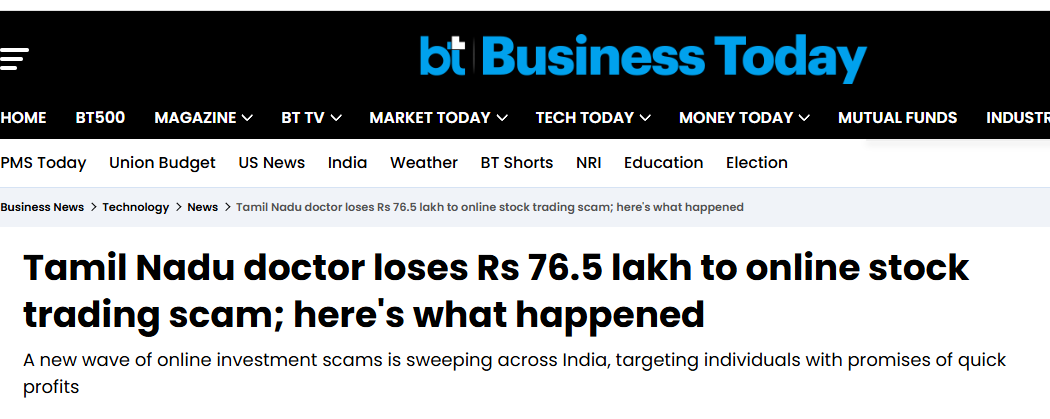
Case 3: Tamil Nadu Doctor – Rs 76.5 Lakh Loss (October 2024)
A government medical college associate professor clicked on a YouTube ad promoting stock tips.
He was redirected to a WhatsApp group where scammers posed as investors. Over three weeks in October, he transferred Rs 76.5 lakh.
This reveals how scammers exploit trusted platforms like YouTube to appear legitimate and target educated professionals.
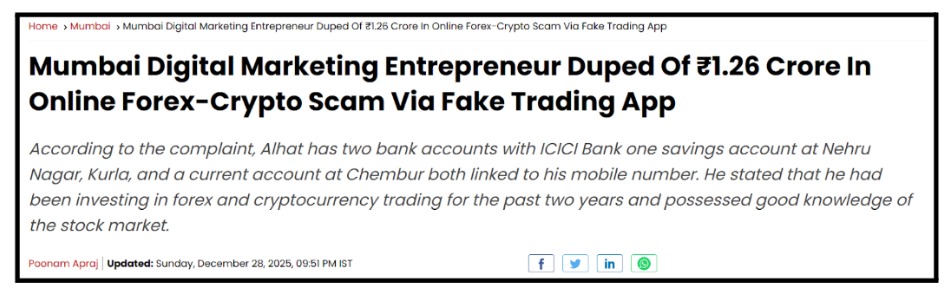
Case 4: Mumbai Digital Marketer – Rs 1.26 Crore Loss (February 2024)
Emmanuel Deepak Alhat, founder of Faith Media Works, received a WhatsApp call from an international number in February 2024.
The caller “Watson” convinced him to download the app. Between February 2024 and December 2025, he transferred Rs 1.26 crore to various accounts before the app stopped working.
This shows the long-term psychological manipulation scammers employ to extract maximum funds.
How to Spot Trading Scams?
Every scam comes with some signs and warnings.
Below are the ways to spot such fraud at the initial phase to protect yourself from financial distress later:
1. Unregulated Platform – Not registered with SEBI or RBI
- Check SEBI’s official website for registered brokers
- Legitimate platforms display registration numbers prominently
2. Unrealistic Promises – Returns that sound too good
- Even if the platform is SEBI registered and promising a sure-shot profit, take a pause.
- Real trading involves market risk
- No one can guarantee specific percentages
3. Unknown Payment Methods – Asking for crypto, gift cards, or personal account transfers
- According to RBI guidelines, registered platforms use secure payment gateways
- Never transfer to personal bank accounts
4. No Physical Address – Can’t verify their office location
- SEBI-registered entities have verifiable addresses
- Visit the office if possible
5. Poor Website Quality – Grammar mistakes, broken links
- Professional platforms invest in quality
- However, some scams have professional-looking sites too
How to Report Trading Scams?
If you’ve been scammed, act quickly:
- For investment-related frauds
- SEBI investigates unauthorized platforms
2. Reserve Bank of India
- For payment fraud issues
- Use their complaint management system
Need Help?
Have you lost money to a trading scam? You’re not alone. Thousands face this daily.
What our team offers:
- Complete End-to-End Solution – We handle everything from complaint filing to fund recovery. You don’t have to navigate the complex legal process alone.
- Expert Representation – We attend exchange counseling sessions on your behalf. Represent you in SEBI arbitration proceedings.
- Personalized Guidance – Every scam case is different. We provide tailored support based on your specific situation. Ensure your rights are protected at every stage.
- Dedicated Support Team – We guide you through every step and keep you updated on progress.
Need Help?
Register with us. Our team will call you back.
Don’t wait and let the scammers get away. Every day counts in financial fraud cases.
The sooner you act, the better your chances of trading scams recovery.
Conclusion
Trading frauds in India work by exploiting trust and greed. They promise quick wealth but deliver financial loss. Remember, legitimate trading involves risk, not guarantees.
Always verify SEBI registration. Never invest based on social media messages. Moreover, if something sounds too good to be true, it probably is.
According to financial experts, education is your best defense. Research thoroughly before investing even ₹1.
Stay informed. Stay safe. Protect your hard-earned money.