
Quick Summary
Anand Rathi unauthorised trading complaints jumped from a measly 0.54% of total complaints in 2024-25 to 42.20% in 2025-26. Behind that spike sits a real SEBI adjudication order dated January 30, 2025, covering an inspection period from April to October 2021. SEBI found 28 trades with no call recording or email proof of client consent, a ₹20.45 lakh margin reporting mismatch to NSE, misuse of client funds through G-negative and J-positive balances, and 6 of 21 sampled orders missing their required records entirely. The broker’s COVID-19 excuse was explicitly rejected. This blog covers the full order, what it means for your own account, and exactly what evidence protects you if a similar trade shows up in yours.
Twenty-eight trades. Zero proof that any of them were authorised. That’s not a customer’s allegation; it’s what SEBI itself found when it opened Anand Rathi’s books.
Anand Rathi Share and Stock Brokers Limited operates over 90 branches across 54 cities, with online platforms including Trade Mobi and AR Invest.
Reputation and branch count don’t make a firm immune to this problem, and the numbers below show exactly how it’s been playing out on real client accounts.
What does account handling actually mean? It refers to how a broker oversees your funds, margins, orders, and trades, essentially acting as the guardian of your money once it’s in their system.
When that job is done properly, it’s invisible, margin calls happen on time, trades execute as instructed, and statements match reality.
When it’s handled poorly, the cracks show up exactly the way the SEBI order below documents: misused funds, mismatched reports, and trades nobody can prove you approved.
What Counts as Anand Rathi Unauthorised Trading?
Unauthorised trading is when a broker uses your funds to invest or trade on their platform without your permission.
If the broker has to make trades on your behalf, it should have your explicit consent to do so.
However, as the order below shows, that isn’t always the case.
Anand Rathi Unauthorised Trading Complaints
The table below shows the trend of total clients, complaints, and how that share breaks down specifically for unauthorised trading.
| Financial Year | Total Clients | No. of Complaints | % of Complaints w.r.t. Clients | Resolved | % Resolved | Arbitrations |
|---|---|---|---|---|---|---|
| 2022-23 | 1,25,264 | 51 | 0.04% | 48 | 94.11% | 1 |
| 2023-24 | 1,25,264 | 69 | 0.05% | 67 | 97.10% | 1 |
| 2024-25 | 1,46,319 | 185 | 0.13% | 185 | 100% | 0 |
| 2025-26 | 1,45,667 | 154 | 0.10% | 147 | 95.45% | 0 |
Complaints on the platform increased even when the client base initially stayed the same, and the sharp rise in users later also came with a higher number of complaints.
Although the resolution rate stayed above 90% throughout, the recurring arbitration cases in the earlier years raise real questions about overall user experience.
But how much of that is actually unauthorised trading specifically?
Here’s the breakdown:
| Financial Year | No. of Complaints | Unauthorised Trading Complaints | % of Complaints |
|---|---|---|---|
| 2022-23 | 51 | 16 | 31.37% |
| 2023-24 | 69 | 20 | 28.98% |
| 2024-25 | 185 | 1 | 0.54% |
| 2025-26 | 154 | 65 | 42.20% |
The number regarding unauthorised trading isn’t negligible in any year, except perhaps 2024-25, when there was only a single complaint of this kind.
But that’s exactly what makes 2025-26 stand out so sharply.
The 65 complaints that year, well over a third of everything filed against the broker, represent close to a 42% jump from the near-zero figure the year before.
That kind of swing doesn’t happen by accident, and it lines up closely with the timing of the SEBI order below.
For the full picture on how Anand Rathi’s complaint volume has moved overall, our page on Anand Rathi complaints covers the year-by-year data across every category, not just this one.
Anand Rathi SEBI Order on Unauthorised Trading
There had been several complaints against Anand Rathi regarding how they managed their clients’ accounts, and how their funds and trades were being handled behind the scenes.
SEBI decided to investigate through a formal adjudication process.
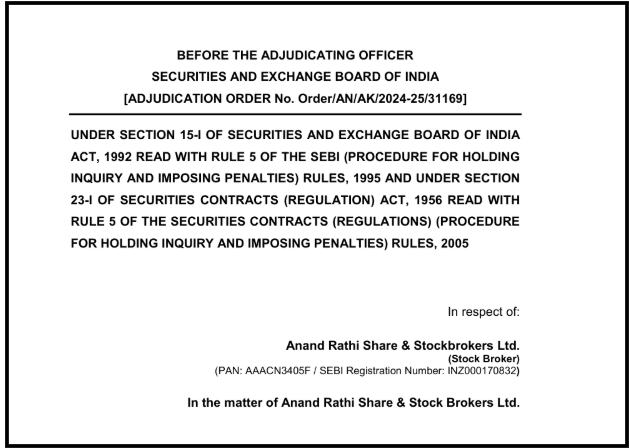
The order was passed on January 30, 2025, following a joint inspection by SEBI, the stock exchange, and the depository, covering the period from April to October 2021.
Here’s what that investigation actually found:
1. Unauthorised Trades With No Consent Evidence
SEBI looked at a sample of trades and found 28 cases where the broker couldn’t show any evidence, a phone recording, an email, or anything else, to prove the client had permitted to trade on their behalf.
In many of these cases, when SEBI asked for the legally required “order placement” logs, the broker simply couldn’t produce them either.
2. Missing Order Records
Beyond the 28 unauthorised trades specifically, SEBI’s broader sample found 6 out of 21 orders with no timestamps or client confirmation on record at all, no call, no email, no SMS, nothing tying the trade back to an actual client instruction.
3. Misuse of Client Funds
SEBI found the broker using credit balance clients’ funds to cover debit clients or proprietary trades, a direct violation of client fund segregation requirements under Section 23D of SCRA.
In SEBI’s own terminology, this showed up as G-negative and J-positive balances, essentially one client’s money quietly covering another’s shortfall.
4. Incorrect Margin Reporting
Margin reports submitted to NSE were found to be off by ₹20.45 lakh, a mismatch serious enough on its own to raise questions about how carefully the broker’s internal reporting systems were actually being checked before submission.
5. Ledger Errors in Daily Statements
Daily statements clients actually received didn’t match the broker’s own internal ledgers, meaning what you saw on your screen may not have reflected what the broker’s own books showed about your account.
The broker’s defence, and why SEBI rejected it: Anand Rathi argued that COVID-19 had forced staff to work from home, making it harder to record calls properly.
SEBI didn’t accept this. Many of the unauthorised trades in question happened before pandemic-related work-from-home rules even began, which meant the excuse simply didn’t line up with the timeline of the violations.
Penalty Imposed on Anand Rathi
Because the broker failed to follow the rules and didn’t fully cooperate with the investigation, SEBI imposed a ₹5,00,000 fine, split into two parts.
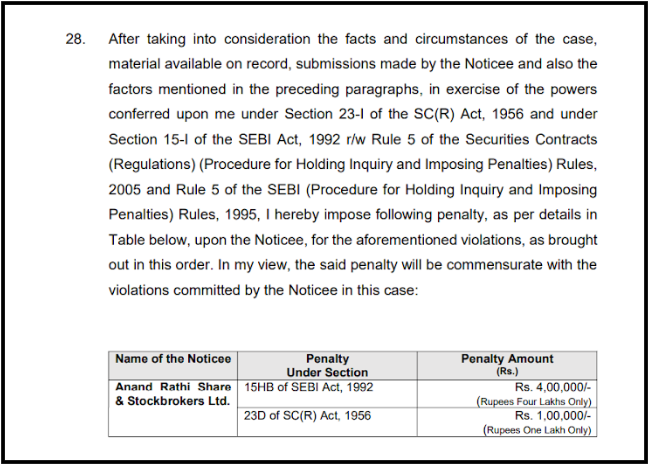
₹4,00,000 under Section 15HB of the SEBI Act, covering the broader pattern of rule-breaking, including the unauthorised trades and the failure to maintain proper records.
₹1,00,000 under Section 23D of SCRA, specifically for failing to segregate client funds and securities as required by law.
SEBI also noted this wasn’t the broker’s first time facing scrutiny for issues like these, which is part of why a financial penalty was considered necessary rather than a warning alone.
The broker was given 45 days to pay through SEBI’s portal or face recovery with interest.
Found a trade in your Anand Rathi account you never approved?
Our team will review your contract notes and communication records, map the exact evidence gap the broker needs to answer for, and help you file a complaint built to get a real response.
Why the Anand Rathi SEBI Order Matters for Your Own Account?
SEBI has strict rules specifically to stop brokers from playing loosely with your money, and this order shows what happens when those rules aren’t followed.
A broker must keep a record of your order. This can be a signed paper, a recorded phone call, an email from your registered ID, or a digital log if you used their app.
If you claim a trade was unauthorised, it is not your job to prove you didn’t authorise it. It’s the broker’s legal responsibility to prove that you did.
Three takeaways worth holding onto:
- If a trade shows up you didn’t make, the broker carries the burden of proof, not you, and this order shows SEBI enforces that seriously.
- “Missing recordings” isn’t a technicality SEBI overlooks. The regulator fined the broker specifically because it couldn’t produce the evidence it’s legally required to keep.
- Check your contract notes within 24 hours of every trade. If something looks wrong, complain immediately, so the broker can’t later claim you silently accepted it.
When Can You Take Action Against Anand Rathi?
Take action as soon as you discover that funds in your account may have been used without your consent. Acting quickly helps prevent further losses and strengthens your position if a dispute arises.
Check your emails and SMS alerts from the last 24 hours for any trade confirmations or notifications related to transactions you did not explicitly approve.
Not every unusual moment in your account needs escalation, but certain situations clearly do. Here’s exactly when to act.
- Trades executed without your permission. A position appears in your account you don’t recall approving, in any form.
- The broker refuses to provide trade confirmations or call recordings. As the SEBI order above shows, this refusal is itself a red flag, not just an inconvenience.
- The broker ignores your complaint or fails to resolve it. Silence after a formal complaint is its own signal.
- Clear misuse of trading authority or account access. A relationship manager or dealer acting beyond what you actually instructed.
- Trades happening very frequently without your consent. Especially when this generates unnecessary losses or high brokerage charges rather than serving your actual strategy.
In any of these situations, immediately gather all relevant records: contract notes, account statements, emails, SMS alerts, and any call recordings or written communication with the broker.
Where Do You Report Anand Rathi Unauthorised Trading?
Finding out your own money was used without consent is stressful, and it will most definitely make it harder to trust your broker the way you once did.
Here’s exactly what to do about it, step by step:
Gather your evidence first. Account statements, contract notes, transaction records, email correspondence, SMS alerts, call recordings if you have them, and screenshots of your trading account. Proper documentation is what actually decides these disputes, as the SEBI order above makes clear.
Contact your broker immediately. As soon as you notice unauthorised transactions, inform them in writing, preferably by email, and request a clear explanation for the trades.
If the broker’s reply is unsatisfactory or the matter stays unresolved, a SEBI SCORES complaint lets you raise the issue directly with the regulator, with all your evidence attached.
Where the dispute involves financial loss or negligence and remains unresolved, you can move it forward through SMART ODR portal, which provides a formal mechanism for resolving disputes between investors and market intermediaries before matters escalate further.
If it isn’t resolved through either of those, arbitration in share market is the next step; an independent arbitrator reviews the evidence from both sides and issues a binding decision.
Conclusion
The key takeaway here is simple: stay alert about what’s happening in your trading account, even with a broker that’s been around for decades.
This SEBI order proves that unauthorised trading isn’t a theoretical risk; it’s something regulators found actually happening, backed by a real fine and a rejected excuse.
Regularly check your contract notes, keep track of your trades, and report anything suspicious immediately. Being informed and acting quickly can make a real difference in protecting both your money and your rights as an investor.
Report. Recover. Stay Fraud Free.
Frequently Asked Questions
SEBI found 28 trades with no proof of client consent, a ₹20.45 lakh margin reporting mismatch, misuse of client funds, ledger errors, and 6 of 21 sampled orders missing required records entirely.
₹5,00,000 total, split as ₹4,00,000 under Section 15HB of the SEBI Act and ₹1,00,000 under Section 23D of SCRA for failing to segregate client funds.
No. SEBI rejected it, noting many of the unauthorised trades occurred before pandemic-related work-from-home rules had even begun.
From just 0.54% in 2024-25 to 42.20% in 2025-26, a sharp jump that lines up closely with the timing of the SEBI order.
The broker does. If they can't produce a call recording, email, or order log proving your consent, that gap works significantly in your favour.



 Add us as a preferred source on Google »

