

Quick Summary
Anand Rathi complaints rose from 51 in 2022-23 to 185 in 2024-25, a 262% jump, while the client base grew only around 17% over the same period. A separate reporting subset shows excess charges making up nearly half of all complaints in 2024-25. Four real user reviews point to KYC update failures, hidden charges paired with missing orders, login failures during live trades, and forced app upgrades that broke existing features with no support response. This blog covers the full data, what brokerage churning actually looks like on this platform, and exactly how to escalate if your own account shows the same pattern.
Anand Rathi complaints have nearly tripled in two years, and the client base didn’t grow anywhere near that fast to explain it.
You’ve probably landed here because something already feels off, a charge you can’t trace, a support ticket sitting unanswered, or you’re simply doing the homework most investors skip before they open an account.
Either way, this blog gives you the actual numbers instead of a brand reputation, real exchange data, four named user reviews, the excess charges and churning pattern, and exactly what to do if your own experience matches any of it.
Anand Rathi Complaints Review
Most investors pick a broker based on brand name or a referral. They rarely check the complaint history before opening an account. That is exactly where the problem begins.
According to Anand Rathi’s official website, the firm holds SEBI Registration No. INZ000170832.
On paper, those credentials look solid. However, a long registration history does not automatically mean a clean complaint record.
Anand Rathi’s primary platform for retail clients is the AR Trade Mobi app, allowing investors to access markets and manage trades through their phones.
Types of Complaints Against Anand Rathi
Most Anand Rathi broker complaints follow a set of recurring patterns. These issues do not appear randomly. Instead, they repeat across different accounts and different geographies.
Exchange-level Anand Rathi investor complaints are not informal grievances. These are structured, documented disputes filed through official channels.
The following complaint types are officially handled:
- Non-receipt of funds or securities after trade settlement.
- Unauthorized trades executed without client consent, a pattern with its own full breakdown on our Anand Rathi unauthorised trading page, including the SEBI order that came out of it.
- Disputes over margin calls and forced position square-offs.
- Non-receipt of contract notes and trade confirmations.
- Failure to transfer securities or funds to client accounts.
- Misconduct by sub-brokers or authorized persons acting under the broker’s name.
- Non-execution of client orders at the requested price or time.
According to BSE’s official investor grievance page, any investor having a grievance against a trading member can register a complaint with respect to transactions executed.
Anand Rathi Exchange Complaint Data
Most investors never check complaint data before choosing a broker. They focus on app features, brokerage pricing, or brand reputation.
However, complaint data reveals something far more important: how often investors face serious issues and how the broker actually handles them.
Here is the year-by-year exchange-reported breakdown for Anand Rathi:
| Financial Year | Total Clients | No. of Complaints | % of Complaints | Resolved Complaints | % Resolved | Arbitration |
|---|---|---|---|---|---|---|
| 2022-23 | 1,25,264 | 51 | 0.04% | 48 | 94.11% | 1 |
| 2023-24 | 1,25,264 | 69 | 0.05% | 67 | 97.10% | 1 |
| 2024-25 | 1,46,319 | 185 | 0.13% | 185 | 100% | 0 |
| 2025-26 | 1,45,667 | 154 | 0.10% | 147 | 95.45% | 0 |
A note on the 2025-26 figure: this table uses 154 total complaints for the most recent year, reconciled against the same number reported independently in the broker’s unauthorised trading and excess charges data. An earlier version of this table showed 174, a discrepancy worth flagging rather than quietly carrying forward.
Do not read this table as just numbers. Here is what it is actually telling you.
Complaints nearly tripled in two years. From 51 in 2022-23, the number jumped to 185 in 2024-25. That is a 262% increase.
Meanwhile, the client base grew by only about 17%. Complaints are growing far faster than the client base, and that gap is a clear warning sign.
Complaints remain unresolved even now. As of 2025-26, several complaints are still open with real investors waiting on real money. In trading, unresolved disputes mean ongoing financial exposure with no clear end date.
Arbitration in two consecutive years signals a real breakdown. Arbitration is not a casual escalation step. Reaching it in both 2022-23 and 2023-24 means the broker’s internal resolution process failed those investors completely.
Anand Rathi Reviews
Real users. Real money.
The Google Play reviews for AR Trade Mobi reflect investor experiences that go far beyond a simple star rating.
Here is what clients are actually reporting:
1. App Does Not Allow Income Detail Updates
A user reported being completely unable to update income details through the AR Trade Mobi app.
The reviewer specifically noted that the platform fails at even basic KYC update functionality, something competitors manage effortlessly.
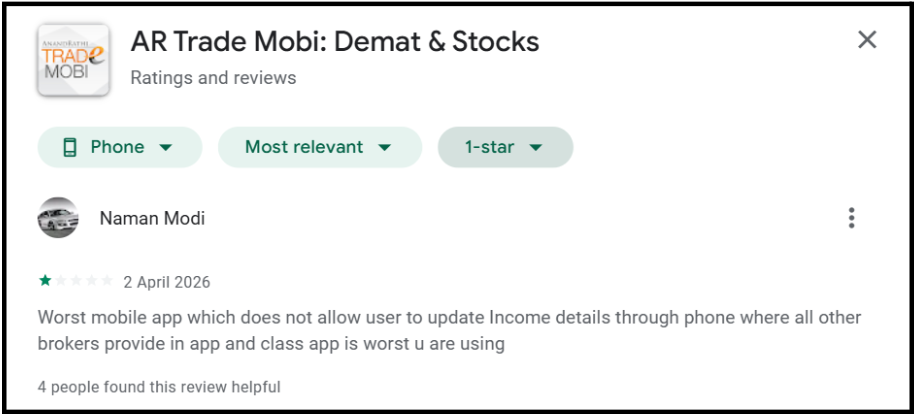
This is not a minor inconvenience. Inability to update income details can restrict a client’s trading access in certain segments.
Moreover, it creates downstream compliance problems that directly impact trading eligibility. This indicates a fundamental gap in basic platform functionality that the broker has reportedly left unaddressed.
2. Hidden Charges, Capital Decrease, and Missing Orders
A user flagged multiple simultaneous problems: excess charges appearing without explanation, capital decreasing without traceable trades, orders not appearing on the orders page, and last-day trades going entirely missing from the interface.
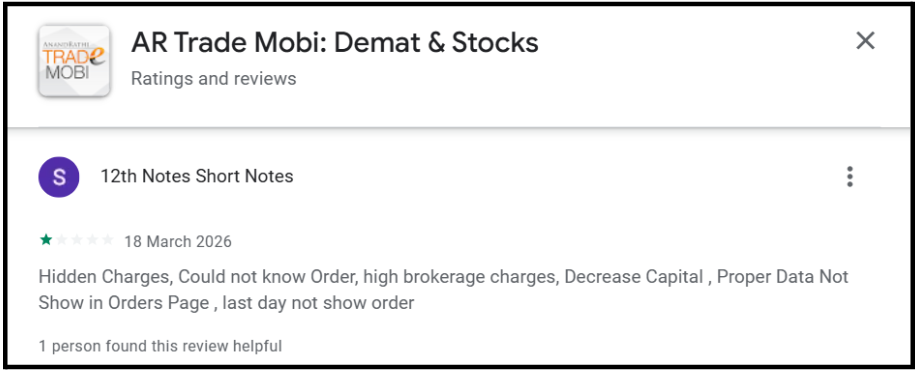
This points to a serious transparency failure. When you cannot see your own orders clearly, you lose the ability to track your positions and your money.
Furthermore, capital reduction without visible trade records is especially alarming.
3. Login Failures Causing Direct Trading Losses
One of the most widely upvoted reviews highlighted a recurring login failure despite a high-speed internet connection.
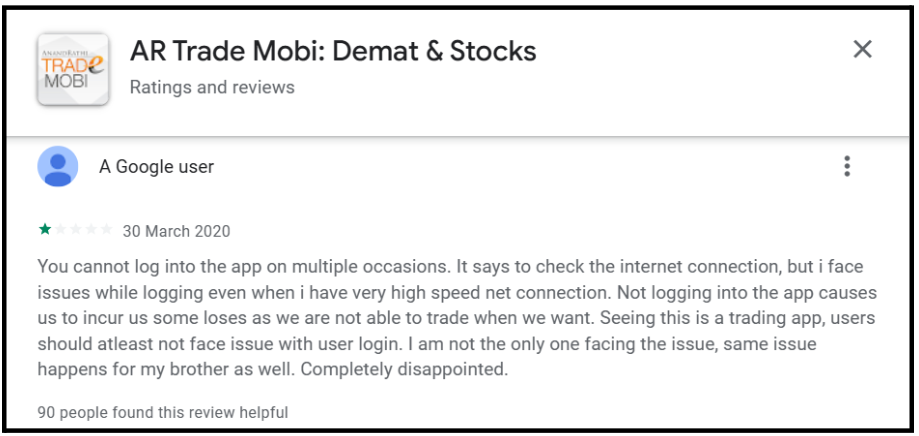
The user explicitly stated that these login failures caused direct financial losses because trades could not go through during the required market windows.
In equity and F&O trading, missing an execution window by even a few minutes can mean significant losses.
4. Forced Upgrades Breaking Features, No Support Reply
A user described the app as completely unpredictable, functioning inconsistently and failing at critical moments.
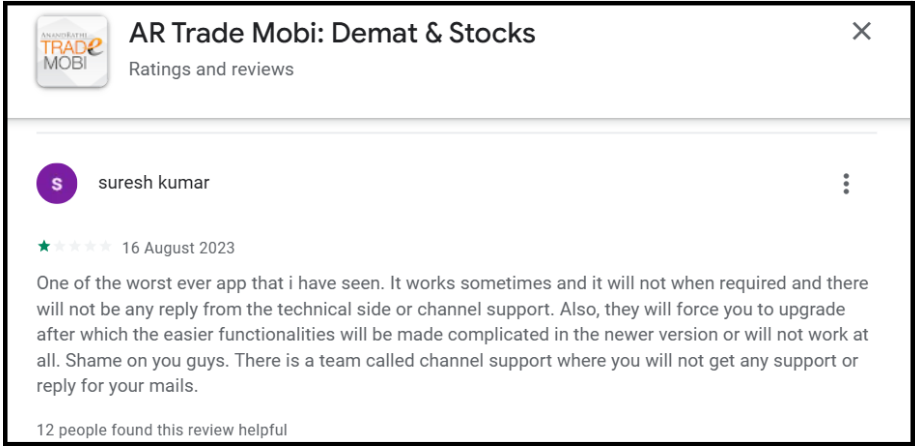
After a forced upgrade, previously working features either stopped functioning entirely or became unnecessarily complicated to navigate.
Moreover, the user sent multiple emails to both the technical team and channel support without receiving a single response.
Anand Rathi Excess Charges and Brokerage Churning
Many investors trust brokerage firms to manage their trading accounts and investments. However, sometimes investors notice unusually high charges in their accounts.
These charges often happen due to frequent trading activities that mainly generate brokerage fees rather than benefiting the investor. In many cases, this practice is known as brokerage churning.
Here’s what a separate reporting subset shows specifically for Anand Rathi excess charges:
| Year | No. of Active Clients | No. of Complaints | Complaints Against Excess Charges |
|---|---|---|---|
| 2021-22 | 1,04,677 | 47 | Around 16 |
| 2022-23 | 1,07,378 | 51 | Around 6 |
| 2023-24 | 1,25,264 | 69 | Around 35 |
| 2024-25 | 1,46,319 | 185 | Around 87 |
| 2025-26 | 1,45,667 | 154 | Around 57 |
Worth being upfront about: NSE doesn’t maintain a dedicated “excess charges” complaint category, so these figures reflect charges-related grievances identified within the broader complaint data, not an official classification.
Treat them as approximate, not exact.
Even with that caveat, the pattern is hard to ignore. In 2024-25, roughly 87 of 185 complaints, nearly half, involved excess charges.
The client base grew from around 1.04 lakh to 1.46 lakh over these years, but complaints grew at a noticeably faster rate, especially after 2023-24, pointing to something beyond simple growth.
When can brokerage churning actually be suspected?
It becomes noticeable when there is unusually high trading activity in an account without a clear investment objective.
Common signs include:
- Unauthorised trading: trades executed without your proper approval.
- Account handling for commission: the broker or RM encourages excessive buying and selling mainly to generate brokerage fees.
- Account manipulation: frequent trades placed even when they don’t benefit the investor.
- Too many unnecessary transactions: trading activity far exceeding what your stated strategy calls for.
If you notice frequent trades, high brokerage deductions, or trades you didn’t approve, it may be a sign of brokerage churning rather than a routine cost of investing.
Also Read: For the most direct version of this violation, where unauthorised trades and excess charges overlap almost completely, our page on JM Financial brokerage churning covers a case built entirely around that pattern.
When Should You Take Action Against Anand Rathi?
Most investors delay action. That delay, however, creates bigger problems.
Act immediately in the following situations:
- Unauthorized Trades: If you suspect a trade you never approved, do not assume it is a glitch. Check instantly and raise a formal written complaint.
- Execution Issues: Your order executes at a significantly different price from what you intended. Verify against market data and question it in writing immediately.
- Unexplained Charges: Deductions from your account do not match your understanding of applicable charges. Review your statement and escalate if you do not receive a clear, documented explanation.
- Margin-Related Forced Square-Offs: Your position gets squared off and you do not understand why. Check whether the action was justified and escalate in writing if it was not.
- Capital Decreasing Without Visible Trades: Your account balance drops without corresponding trade records explaining why. This is a serious red flag that demands immediate escalation.
- No Response from Support: You contact the broker through multiple channels but receive no meaningful reply. If your issue is specifically about the app itself freezing or failing during market hours, our page on Anand Rathi app not working covers the exact SEBI framework brokers are required to follow when that happens.
The core principle here is simple. Do not wait for the issue to look big. Act the moment something feels wrong.
Even a small unauthorized trade demands the same attention as a large one. Delay costs you both time and evidence, and both are critical when you take the complaint forward.
Dealing with an unresolved Anand Rathi complaint, a charge you can’t explain, or an account that’s been mishandled?
Our team will review your trading records, document the issue properly, and help you draft a complaint built to get a real response.
How To Complaint Against Anand Rathi?
There’s no need to guess your way through this.
SEBI and the exchanges have laid out a fixed sequence for exactly this situation, and each step exists for a reason: either it resolves your issue, or it builds a documented record for the next one.
Here’s the order that actually works:
1. Contact Anand Rathi Directly
Put everything in writing. Include your account number, trade details, dates and times, and the specific nature of your complaint. Attach screenshots, contract notes, and account statements.
Avoid relying on phone calls alone; written records are what matter when you escalate further.
2. File Through SEBI SCORES
If that doesn’t resolve things, file through the SEBI SCORES complaint portal, providing your name, PAN, address, mobile number, and email ID, with all relevant documents uploaded to support your case.
SEBI tracks the broker’s response and may step in if it fails to resolve the issue within the specified timeline.
3. Escalate to NSE or BSE
If the matter still isn’t resolved, escalate it further to the stock exchange; investors can lodge a complaint with NSE or BSE as part of the official grievance mechanism.
The exchange examines your complaint, communicates with the broker, and works toward a resolution, adding real accountability to the process.
4. File Through SMART ODR
Where the dispute needs a more structured, conciliation-first path, a SMART ODR portal filing moves your case into that process before it needs to go further.
5. Move to Stock Market Arbitration
If the issue continues despite all of this, stock market arbitration is the final step. An independent arbitrator evaluates the evidence submitted by both parties and issues a decision based on the facts.
As per NSE’s investor grievance framework, arbitration fees for claims up to ₹10 lakhs are typically covered by the exchange, and the Investor Protection Fund may offer interim relief while the case is being resolved.
For the complete process laid out end to end, our guide on complaint against broker to SEBI walks through every stage in detail.
Conclusion
Anand Rathi Share and Stock Brokers is a SEBI-registered firm with a long-standing presence and proper exchange memberships. That legitimacy is real.
However, legitimacy and reliability are two very different things, and the data makes that distinction impossible to ignore.
Complaints have nearly tripled over two years. A significant share of those trace back to excess charges and brokerage churning.
User reviews consistently flag app failures, hidden charges, and a support system that does not respond. Meanwhile, arbitration cases appeared in two consecutive financial years.
If you are an existing client, stay alert. Verify every charge. Document every communication. Act immediately if something feels wrong. If you are evaluating this broker, weigh these reported issues carefully before committing your capital.
Your money deserves a broker that resolves issues, not one that multiplies them.
Report. Recover. Stay Fraud Free.
Complaints rose from 51 in 2022-23 to 185 in 2024-25, a 262% increase, while the client base grew only around 17% over the same period. Within a specific reporting subset, excess charges made up around 87 of 185 complaints in 2024-25, nearly half, though NSE doesn't maintain this as an official category. KYC update failures, hidden charges paired with missing orders, login failures causing trading losses, and forced app upgrades that broke existing features without a support response. Yes, in two consecutive years, 2022-23 and 2023-24, which signals the broker's internal complaint resolution process failed those investors completely. Pull your contract notes and account statement, compare deductions against your brokerage plan, and raise a written complaint with specific trade dates if anything doesn't match.Frequently Asked Questions


 Add us as a preferred source on Google »

