

Quick Summary
Nuvama’s own exchange data shows complaints nearly doubled from 142 in 2023-24 to 268 in 2024-25, before settling at 241 in 2025-26, with resolution rates slipping from 100% to around 91% in the most recent year. Technical glitch complaints tripled over the same window. A separate reporting subset shows excess charges making up as much as two-thirds of complaints in certain years. This blog covers all of it: the exchange numbers, four real user reviews explained individually, what’s actually behind app reliability issues, the excess charges and churning pattern, and exactly how to escalate if your own experience matches.
Nuvama complaints rarely start with the company name. They start with a trade that didn’t execute the way you expected, or a charge on your statement that doesn’t add up.
Nuvama positions itself as a wealth management and full-service broker, not a bare-bones discount platform. That positioning raises the bar.
Clients expect clarity, support, and proper guidance, not just execution.
This blog pulls together the real exchange data, four detailed user reviews, the app reliability pattern, and the excess charges trend, so you know exactly what you’re dealing with before you file anything.
Nuvama Complaints Overview
Nuvama is not a small or unknown broker. It positions itself as a wealth management plus full-service broker, offering advisory, portfolio management, and relationship-based services on top of regular trading.
Because of that positioning, expectations run higher than they would on a discount platform. When someone uses Nuvama, they don’t just expect execution. They expect clarity, support, and proper guidance.
That’s where complaints usually start. To be clear, complaints themselves aren’t unusual.
Every broker in India, Zerodha, ICICI, IIFL, deals with them, and complaint volume naturally rises as the client base grows.
So the real question isn’t whether Nuvama has complaints. It’s what kind of complaints come up, how often, and how the company actually handles them.
In Nuvama’s case, most issues reported by users fall into a handful of recurring patterns: delays in support response, confusion around fees, platform or execution issues during critical market hours, gaps between what advisory promised and what was delivered, and instances where trades appeared in a ledger without clear client consent.
Apart from user-level complaints, the company has also faced regulatory scrutiny, including a SEBI order on Nuvama Wealth that touched on compliance processes rather than fraud
That doesn’t automatically make the broker unreliable, but it does mean staying aware rather than assuming everything runs smoothly by default.
What Does NSE Data Reveal About Nuvama Complaints?
Opinions and reviews only tell part of the story. Exchange-level data is more objective, since it reflects complaints raised through official, tracked channels rather than informal venting.
Here’s what NSE’s own records show:
| Financial Year | Total Clients | No. of Complaints | % of Complaints | Resolved Complaints | % Resolved | Arbitration |
|---|---|---|---|---|---|---|
| 2023-24 | 3,12,448 | 142 | 0.045% | 138 | 97.18% | 2 |
| 2024-25 | 3,89,772 | 268 | 0.069% | 268 | 100% | 1 |
| 2025-26 | 3,65,981 | 241 | 0.066% | 220 | 91.29% | 0 |
At first glance, these numbers look under control. The complaint percentage stays below 0.07% across every year, and on paper that reads as strong.
But don’t get too comfortable with a low percentage on its own.
Even a small share can hide real issues when the client base is this large, and in absolute terms, complaints nearly doubled from 142 to 268 before coming back down.
Look closely at resolution too. A full 100% resolution rate in 2024-25 sounds impressive, but it drops to around 91% the following year.
That shift matters, because as an investor, you don’t care about average performance. You care about what happens if your complaint is the one that doesn’t get resolved.
Arbitration numbers stay low throughout, a genuinely good sign, though arbitration cases aren’t always publicly detailed, so this alone doesn’t tell the complete story.
Nuvama Wealth Reviews
Numbers show scale. Real reviews show what those numbers actually feel like from the inside.
The pattern behind a complaint matters more than the emotion in it, so here’s what four specific reviews reveal.
1. Poor Customer Support Experience
One recurring theme in user feedback centers on customer support. One reviewer described repeated attempts to reach support, only to be routed through IVR systems with missed callbacks and no real resolution.
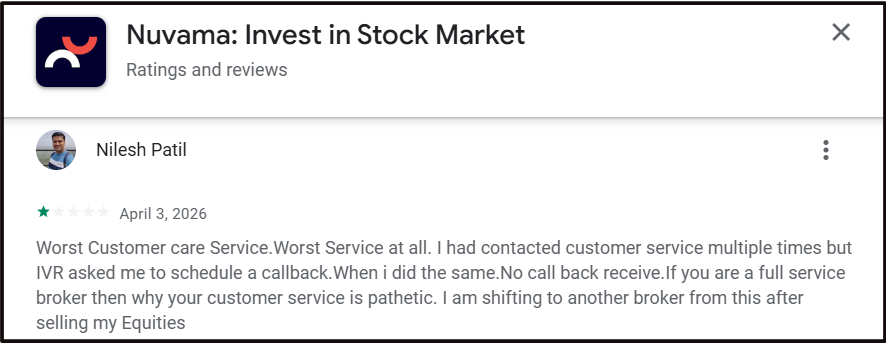
The frustration here isn’t just the original issue; it’s the lack of a timely response on top of it. When your money is involved, delayed support turns even a small problem into something that feels much bigger.
This kind of feedback usually points to response delays or support inefficiency during peak periods.
2. Issues Related to Brokerage Plans and Charges
A separate set of complaints centers on brokerage plans and how charges get applied.
One review reflected dissatisfaction with an advanced brokerage plan, where the user felt the terms weren’t clearly communicated and didn’t match expectations going in.
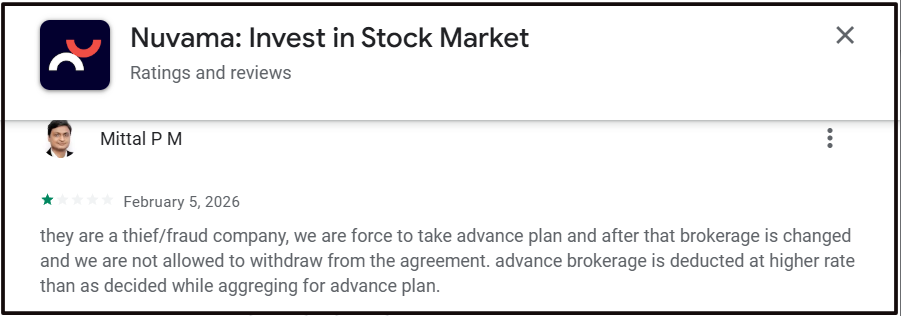
In many cases, issues like this stem from a misunderstanding of plan terms, but that doesn’t remove the broker’s responsibility to communicate clearly upfront.
Before committing to any plan, read the details properly, confirm charges in writing, and avoid agreeing to anything unclear, since reversing a commitment afterward is far harder than avoiding it in the first place.
3. Serious Allegations of Fraud
Some reviews go beyond service complaints into stronger territory, using words like “fraud” and “scam.” These are serious claims, and they deserve caution rather than automatic acceptance.
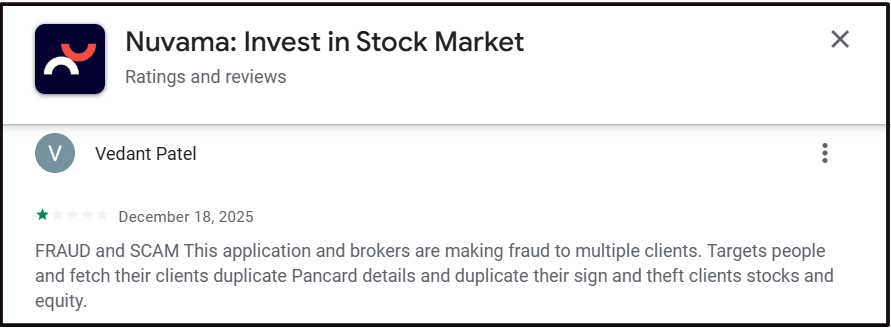
Such statements reflect a user’s experience or perception, not a verified finding, and there’s no publicly established pattern of large-scale fraud in the exchange data covered above.
Still, the concern shouldn’t be dismissed outright.
If you ever notice trades resembling Nuvama Wealth unauthorised trading, account activity you don’t recognise, treat it seriously and escalate without delay.
4. Trading App and Feature Limitations
A fourth set of complaints focuses on the trading experience itself, particularly for active traders.
One user pointed to incorrect profit and loss display, poor fund visibility, and features that were missing or hard to find, an option chain being one specific example.
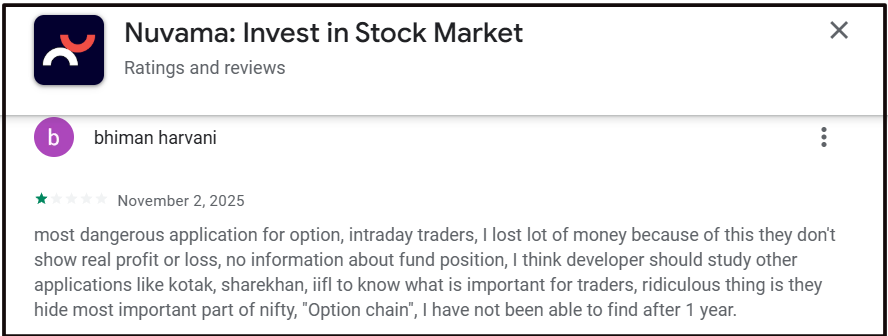
Beyond interface issues, technical glitches can lead to execution failures too, a frustration that comes up repeatedly among traders who depend on real-time data.
From your perspective, this points to one thing worth internalising: Nuvama positions itself as a wealth-focused platform, not a trader-first one. If you’re an intraday or options trader specifically, test the platform properly before depending on it for fast-moving trades.
Don’t treat every review as absolute truth, and don’t dismiss them either. Look for the pattern: support delays, communication gaps, platform friction.
Extreme allegations deserve verification before you draw conclusions from them.
Dealing with an unresolved issue on Nuvama, a frozen app during a live trade, or charges you can’t explain?
Our team will review your trading records, document the incident properly, and help you draft a complaint built to get a real response.
Is Nuvama App Not Working a Common Complaint?
Most people rely heavily on their trading app, a few taps to check prices, track a portfolio, or place a trade in seconds. Because everything happens so quickly, it’s easy to assume the system will always run smoothly.
But a trading platform is still a piece of technology, and like any digital system, it can slow down, stop responding, or behave unpredictably.
When that happens during market hours, it leaves traders confused, sometimes genuinely worried about what’s happening behind the scenes.
Why do these glitches happen in the first place? Trading platforms rely on complex infrastructure, servers, databases, trading engines, and network connections, that all need to run continuously without interruption.
If any part of that chain fails or slows, a server crash or a network issue, the platform can stop working or start showing delays.
Security systems built to prevent fraud or hacking can also trigger sudden logouts, order rejections, or temporary access blocks while verifying platform safety.
Brokers are required to maintain strong technology systems, and if the exchange notices frequent glitches from the same broker, it can step in, inspect, or ask for infrastructure fixes.
Exchanges keep detailed logs of every technical glitch specifically so that when a trader claims they couldn’t place or exit a trade because of a system problem, NSE can verify what actually happened.
Here’s what the data shows specifically for Nuvama Wealth Management Ltd.
| Year | No. of Technical Glitches |
|---|---|
| 2023-24 | 1 |
| 2024-25 | 3 |
Statistically, glitches tripled year over year. That figure shouldn’t be brushed aside. Over the same period, Nuvama’s user base grew by 14%, roughly 73 additional users added.
Not every user trades during every market session, but as the base keeps growing, more people are exposed to whatever glitches exist, not fewer.
Nuvama Wealth Excess Charges
Many investors choose a brokerage platform expecting transparent pricing and fair trading practices.
Unexpected fees and unusual trading activity, when they show up, raise real concerns, and when they happen repeatedly, they chip away at both investor confidence and overall returns.
One specific practice worth understanding here is churning in the stock market, where a broker executes excessive trades in a client’s account primarily to generate brokerage or commissions rather than to serve the client’s actual goals.
Churning drives up transaction costs, adds unnecessary risk exposure, and quietly reduces overall portfolio returns, which is exactly why regulators and investors both watch for it closely.
Here’s what a separate reporting subset shows for Nuvama:
| Financial Year | Total Clients | No. of Complaints | % of Complaints | Resolved | % Resolved | Arbitrations |
|---|---|---|---|---|---|---|
| 2022-23 | 526 | 2 | 0.3% | 2 | 100% | 0 |
| 2023-24 | 526 | 3 | 0.5% | 3 | 100% | 0 |
| 2024-25 | 599 | 25 | 4.1% | 25 | 100% | 0 |
| 2025-26 | 613 | 8 | 1.3% | 8 | 100% | 0 |
A note on this table before you read too much into it: the client counts here (526 to 613) are far smaller than the client base in the exchange complaint table earlier in this blog (3,12,448 to 3,89,772), which means this reflects a narrower reporting segment, not Nuvama’s full client base.
Treat the percentages as directional for this specific subset rather than a broker-wide figure.
Within that subset, complaints stayed low in 2022-23 and 2023-24, then jumped sharply in 2024-25 even though the client count barely moved.
That’s worth sitting with. A jump in complaints without a matching jump in clients usually points to something operational changing, not organic growth.
Now here’s the share of those complaints tied specifically to excess charges:
| Financial Year | No. of Complaints | Excess Charges Complaints | % of Total |
|---|---|---|---|
| 2022-23 | 2 | 0 | 0% |
| 2023-24 | 3 | Around 2 | 66.66% |
| 2024-25 | 25 | Around 14 | 56% |
| 2025-26 | 8 | Around 3 | 37.5% |
Worth being upfront about: NSE doesn’t maintain a dedicated “excess charges” complaint category, so these figures reflect charges-related grievances identified within the broader complaint data for this subset, not an official classification.
Treat them as approximate.
Even with that caveat, the pattern holds across every year measured: in 2023-24, roughly two out of three complaints in this subset involved excess charges, and even at its lowest point, in 2025-26, the share still sat above a third.
That’s a persistent pattern, not a one-time spike.
When should you actually suspect excess charges on your own account?
Watch for unrecognised fees that were never clearly explained, an unusually frequent trading pattern that doesn’t match your own strategy, and mismatches between your contract notes and what you actually approved. If these signs appear together, verify every charge directly with the broker rather than assuming it’s a one-off.
When Should You Take Action Against Nuvama?
Not every issue needs escalation. Delays happen. Charges get misunderstood. In many cases, a simple follow-up resolves things without any formal process.
But there are moments where waiting or ignoring the issue actively works against you.
Act when the problem starts touching your money, your trades, or your ability to make timely decisions.
- When the broker delays your complaint without a reason: If days pass after you’ve raised something with no clear response, don’t keep waiting indefinitely. A genuine issue shouldn’t require endless follow-up.
- When you don’t get a proper explanation: If a charge doesn’t make sense or a transaction looks unclear, you’re entitled to a specific answer, not a vague, generic reply.
- When there are unauthorised trades or transactions: This is serious. If you notice trades you didn’t place, or funds moving without your knowledge, act immediately rather than waiting to see if it resolves itself.
- When your funds or securities don’t match: If your account balance or holdings don’t reflect correctly, don’t assume it’s a temporary glitch. Verify, then escalate if the mismatch persists.
- When the same issue keeps repeating: A one-time problem can happen to anyone. A repeated one shows a deeper pattern, and that’s when relying on support alone stops being enough.
- When the broker stops responding entirely: No response is itself a response. If communication breaks down completely, escalate beyond the broker rather than continuing to wait.
Don’t panic over small issues, but don’t stay passive when something genuinely feels wrong either. Once money is involved, delay and inaction tend to cost more than early action would have.
How To File a Complaint Against Nuvama?
If your issue doesn’t resolve at the broker level, don’t stop there. Too many investors either give up early or jump straight to an extreme step without following the proper sequence, which usually weakens their case rather than strengthening it.
There’s a clear system in place for this.
Follow it step by step, keep proper records throughout, and your chances of a real resolution improve significantly.
Start by contacting Nuvama’s support team directly through official channels, customer care, email support, or the in-app help section.
Explain the issue clearly, with trade IDs, dates, amounts, and screenshots wherever possible. A vague complaint tends to get a vague response, and many issues genuinely do resolve at this stage if you give the broker reasonable time to respond.
If that doesn’t work, escalate through the SEBI SCORES complaint portal, which brings the regulator directly into the process and puts real accountability on the broker’s side.
Since Nuvama is a member of both exchanges, a direct NSE complaint is also worth filing where your trades were actually executed on that exchange.
If your complaint still doesn’t reach a satisfactory outcome, move to the SMART ODR portal, SEBI’s Online Dispute Resolution mechanism.
It gives both you and the broker a structured, digital way to present your case, more formal than a standard complaint but still accessible without needing legal representation.
If the dispute continues even after that, the final step is arbitration through the stock exchange, where an independent arbitrator reviews the evidence from both sides and issues a legally binding decision.
Keep every document, communication record, and proof organised throughout, since this stage depends entirely on what you can show.
For the complete process laid out end to end, our guide on complaint against broker to SEBI walks through every stage in detail.
Don’t skip steps or escalate randomly. Each level exists for a reason, and following the sequence in order is what actually strengthens your case.
Conclusion
Nuvama, like any broker of its size, does receive complaints, and the exchange data shows the overall percentage staying low relative to its client base, a genuinely positive sign on its own.
At the same time, the raw number of complaints has grown, resolution rates haven’t stayed consistent, technical glitches have tripled, and excess charges make up a real, persistent share of grievances within the reporting subset available.
None of that makes the broker good or bad by itself. It means issues do happen, and you should be prepared for them.
Your focus as an investor shouldn’t be finding a broker with zero complaints; that broker doesn’t exist. It should be understanding how problems get handled, and knowing exactly what to do the moment something feels off.
Stay aware, keep proper records, and follow the right escalation process. Most issues, handled this way, do get resolved.
Report. Recover. Stay Fraud Free.
Frequently Asked Questions
142 in 2023-24, rising to 268 in 2024-25, then settling at 241 in 2025-26, with resolution rates ranging from 91% to 100% across those years.
Recorded technical glitches tripled from 1 in 2023-24 to 3 in 2024-25, a small absolute number but a fast-growing trend worth watching as the user base expands.
Within a specific reporting subset, excess charges made up as much as 66.66% of complaints in 2023-24, dropping to 37.5% by 2025-26, still a substantial, persistent share.
Yes, including a SEBI order addressing compliance process gaps rather than fraud allegations. Regulatory scrutiny doesn't automatically mean the broker is unsafe, but it's worth staying informed about.
Document everything, screenshots, trade IDs, dates, and contact Nuvama's official support channels directly before escalating to SEBI SCORES or the exchange.


 Add us as a preferred source on Google »

