

Quick Summary
SEBI has acted against Nuvama Wealth twice. A 2023 order addressed suspicious transactions tied to dormant accounts and forged documents, resulting in a regulatory censure rather than the suspension originally recommended. A December 2025 order found multiple client communication and KYC failures, 63 clients never received contract notes, 27 email IDs were shared across unrelated clients, but ended in zero penalty. Separately, order rejections on Nuvama commonly stem from margin shortfalls, market timing rules, or technical glitches, not regulatory failures. This blog walks through both SEBI cases in full and explains exactly why your own orders might be getting rejected.
Sometimes SEBI catches a broker red-handed and still lets them walk away without paying a single rupee.
Sound impossible?
Nuvama Wealth’s case proves it isn’t.
Sixty-three clients never got their contract notes. Email IDs were shared across total strangers. Consent forms that should’ve existed simply didn’t. And after all of that? Zero penalty.
If you trade with Nuvama Wealth, or you’re thinking about opening an account, here are both of SEBI’s actions against them laid out in full, what each one actually found, why your own orders might get rejected on this platform, and whether any of it should change how much you trust them with your money.
Nuvama Wealth and Investment Limited
Nuvama Wealth and Investment Limited is a SEBI-registered stock broker offering trading services across equity, derivatives, currency, and commodity segments.
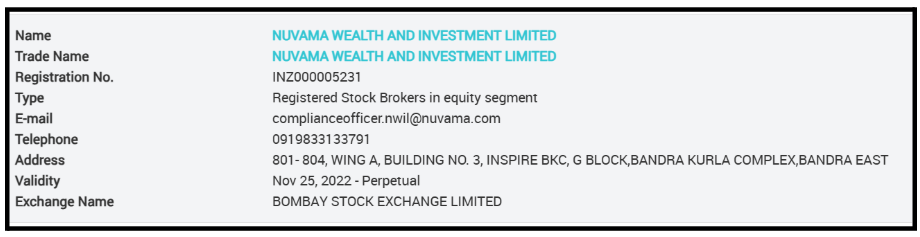
The company was earlier known as Edelweiss Broking Limited before its rebrand.
Key Nuvama Group SEBI registrations:
- Broking (NWIL): INZ000005231
- Clearing (NCSL): INZ000177437
- Research Analyst (NWIL): INH000011103
- Asset Management: INP000007207
- Merchant Banker: INM000013004
- Depository Participant: IN-DP-656-2021
- AMFI-registered Mutual Fund Distributor: ARN-70892
Nuvama is not a discount broker like Zerodha or Groww. It positions itself as a full-service wealth management firm, offering advisory, portfolio management, and relationship-based services alongside regular trading.
That positioning raises the bar on both service and technology, which is exactly why the two cases below matter more than they might on a bare-bones platform.
SEBI Order on Nuvama Wealth and Investment Limited
This case has roots going back from 2009 to 2013, though SEBI’s formal order came on June 20, 2023, Order No. QJA/AB/MIRSD/MIRSD3/27592/2023-24.
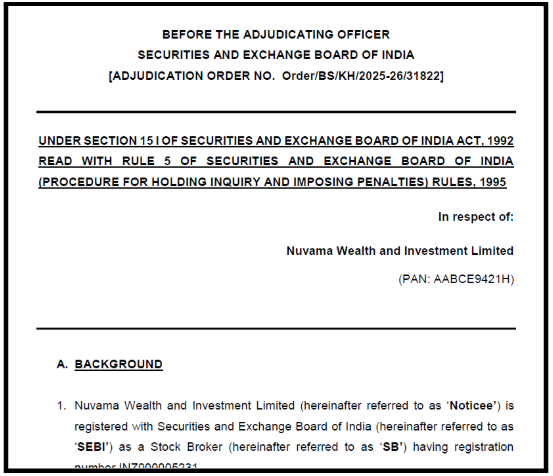
SEBI investigated fraud involving the dematerialisation and sale of shares from dormant accounts using forged documents.
The investigation covered shares of 14 listed companies allegedly transferred through 26 bogus entities.
One of those entities’ clients, a person named Mr. Yatin Vasantrai Parekh, held a trading account with Edelweiss Broking Limited, now Nuvama.
The broker faced two allegations. First, that its dealer failed to properly verify Mr. Parekh’s identity when he placed orders telephonically.
Second, and more serious, that Nuvama failed to report certain transactions to the Financial Intelligence Unit (FIU), even though those transactions didn’t line up with Mr. Parekh’s declared annual income.
On six separate trading days, Mr. Parekh’s daily trading turnover nearly matched or exceeded his declared annual income of ₹10 to 15 lakhs.
| Trade Date | Daily Trading Turnover (₹) | Declared Annual Income (₹) |
|---|---|---|
| 30/03/2010 | 8,44,971 | 10-15 Lakhs |
| 31/03/2010 | 5,84,800 | 10-15 Lakhs |
| 05/01/2011 | 14,30,951 | 10-15 Lakhs |
| 17/01/2011 | 12,00,000 | 10-15 Lakhs |
| 21/05/2012 | 20,32,440 | 10-15 Lakhs |
| 24/05/2012 | 23,05,670 | 10-15 Lakhs |
SEBI’s Designated Authority initially recommended suspending Nuvama’s broker registration for three months.
But after a full hearing, and considering the number of instances was relatively small and the trades occurred years earlier, the final order from Executive Director Anand R. Baiwar took a more measured route.
Instead of a suspension, SEBI issued a regulatory censure, a formal warning to be more careful and diligent, particularly around recognising and reporting suspicious transactions.
This case wasn’t about order rejections.
But it reveals something that matters regardless: a broker’s internal due diligence and monitoring processes directly affect how your own account gets managed.
When brokers aren’t vigilant about unusual activity, the consequences can trickle down to regular traders through disrupted accounts, compliance blocks, or order restrictions.
SEBI Order on Nuvama Wealth: The December 2025 Compliance Violations Case
SEBI conducted a comprehensive inspection of Nuvama Wealth and Investment Limited from August 4 to August 10, 2023, and the adjudication order was passed on December 1, 2025.
This one hits closer to home for everyday investors, since the violations were about basic client communication and account management, the exact systems that affect whether you even receive correct information about your own trades.
Here’s exactly what SEBI found:
1. Contract Notes Not Delivered to 63 Clients
Contract notes are official documents confirming your trades, price, quantity, charges, everything. SEBI found that 63 client codes simply never received physical contract notes.
Without these, you have no proper proof of your trade details, no way to verify the broker executed trades at the correct prices, and no clean record for tax filing.
2. Electronic Contract Notes Sent to Shared Email IDs
Regulations prohibit mapping one email address to multiple clients unless they’re family members as defined under SEBI circulars. SEBI found 27 client codes where a single email ID was mapped to multiple unrelated clients.
That means one person’s inbox may have received another person’s trade details, a real privacy breach, and there’s no confirmation that those clients actually received their own notes at all.
3. 322 Bounce Instances Not Logged
When broker emails fail to deliver due to invalid addresses, full mailboxes, or server issues, responsible firms maintain bounce logs to track and fix the problem.
SEBI found 322 instances across 63 client codes where emails bounced, and Nuvama’s system simply didn’t capture it properly.
No alternative communication method was followed. Clients never received their contract notes, and nothing was done to fix it.
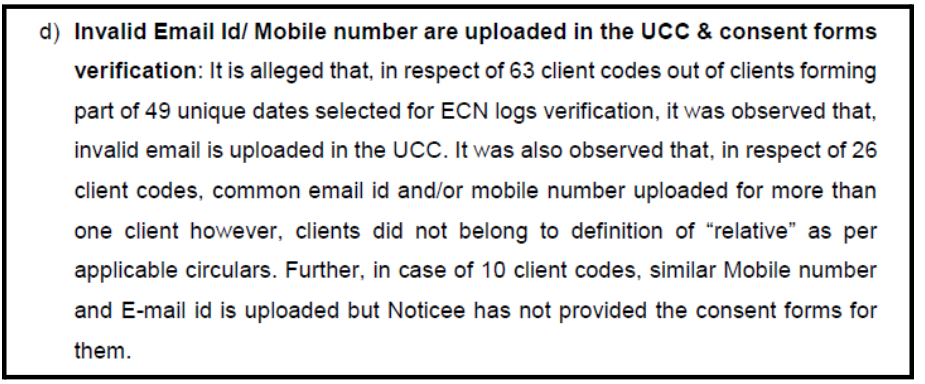
4. Invalid Contact Details in KYC
SEBI examined consent forms and Unique Client Code records.
63 client codes had invalid email IDs uploaded, another 26 shared common contact details without qualifying as relatives under SEBI’s definition, and 10 client codes had similar mobile numbers and email IDs with no consent forms proving clients had agreed to share that information.
5. Trade Exposure Not Matching Declared Income
One client, UCC 50074875, had trading exposure that didn’t match their declared income in the Exchange UCC database, suggesting inadequate risk management checks on Nuvama’s side.

Despite all five findings, Adjudicating Officer Biju S. decided on zero monetary penalty.
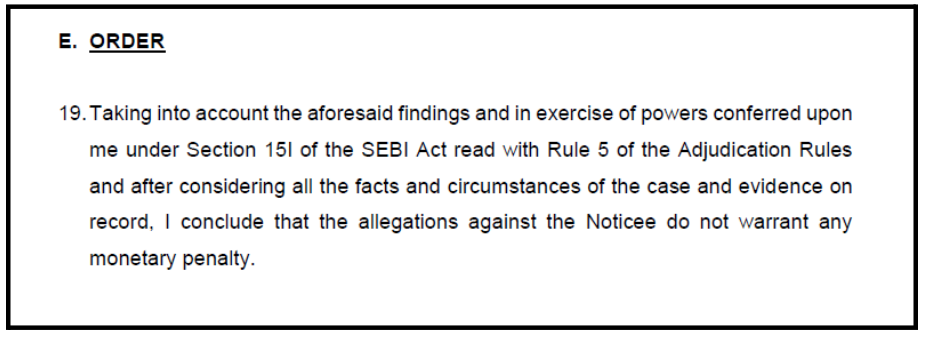
The reasoning: no allegations of fraud existed, the matter arose from a routine inspection rather than investor complaints, and the lapses weren’t considered serious enough to trigger the maximum Section 15HB penalty.
Also Read: Bonanza Portfolio SEBI Order, 10 violations, confirmed after a formal personal hearing.
What Retail Investors Should Learn From Nuvama Wealth Case?
Even though SEBI chose not to fine Nuvama in the second case, both orders together are worth pausing on.
The real story here isn’t whether the broker paid a fine.
It’s how easily serious compliance failures can quietly affect everyday investors, even at a large, well-known, SEBI-registered firm.
1. Never Assume Your Broker Is Sending You Everything
Check whether you’re actually receiving daily contract notes, trade confirmations, margin statements, and periodic account statements.
If you don’t see them, something is already wrong, even if the broker insists everything is fine.
2. Your Contact Details Matter More Than They Seem
If your email or mobile number is wrong in your broker’s records, you might never receive contract notes, margin calls, or regulatory alerts, meaning you could be trading without knowing what prices you got or what charges applied.
3. Documentation Is Your Protection
When disputes arise, contract notes and email records are what actually protect you. If they’re missing, your ability to prove your case weakens, even when the broker was genuinely at fault.
4. Regulatory Action Doesn’t Automatically Mean Investor Compensation
SEBI can observe real violations and still choose not to penalise.
That doesn’t undo the harm to affected investors, which is exactly why you can’t rely on regulators alone to keep you safe.
Why Does Order Rejection in Nuvama Happen?
Have you ever been ready to place a trade, clicked confirm, and seen those two words staring back, “Order Rejected”?
If you’ve traded on Nuvama, there’s a decent chance you’ve faced this. An order rejection during a live market move isn’t just a minor inconvenience; it can mean a missed entry, a failed exit, or a loss you never planned for.
Order rejections on Nuvama typically come from a mix of user-side issues and system-driven checks, not regulatory failures like the ones covered above.
The most frequent reason is insufficient margin. If your account doesn’t meet real-time requirements set by the Risk Management System, the order gets blocked before it even reaches the exchange.
Placing orders outside standard market hours, or using the wrong order type during pre-market or post-market sessions, commonly triggers automatic rejection too.
Restrictions on specific stocks or contracts play a role as well. Securities under surveillance, in the Trade-to-Trade segment, or during F&O ban periods can’t be traded freely regardless of your margin.
Beyond that, price mismatches beyond circuit limits or incorrect lot sizes in derivatives frequently cause failed orders, and sometimes the issue genuinely isn’t on your end at all; technical glitches, server delays, or platform errors can interrupt execution, especially during high market activity.
There are also cases where your account gets flagged due to margin shortfalls or existing positions, which restricts new trades until the underlying issue is resolved.
If your rejections keep happening with no clear explanation, our page on Nuvama complaints breaks down the full exchange complaint trend, useful context for telling whether you’re dealing with a widespread technical issue or something specific to your account.
If the standard troubleshooting steps don’t resolve it, reaching out to support with your specific rejection code is the fastest way to get a real answer rather than a generic response.
Has Nuvama Faced Action Over Unauthorised Trading Too?
Order rejections and compliance gaps are one level of concern. Sometimes the underlying issue goes further, into trades executed without a client’s actual permission.
Our dedicated page on Nuvama Wealth unauthorised trading covers a real, decided arbitration case in full, including the award amount and exactly what evidence decided the outcome, along with the year-by-year data showing how this specific complaint category has trended over time.
If your concern is less about a rejected order and more about a trade you never authorised in the first place, that page is the better starting point.
What Should You Do If Nuvama’s Compliance Failures Affected You?
The two SEBI cases above aren’t hypothetical.
If you were one of the 63 clients who never got a contract note, or your email was shared with someone who isn’t a relative, or an order got rejected with no real explanation, you have a specific problem, not a general one, and it deserves a specific complaint, not a template.
Start by checking which category your situation actually falls into.
Missing or undelivered contract notes: Pull up your account and confirm whether you’ve been receiving them consistently. If Nuvama’s own response doesn’t resolve a confirmed gap, a SEBI SCORES complaint puts the regulator on record with a case that mirrors one it has already investigated once.
Shared or invalid contact details: Log into your account settings and verify your registered email and mobile number are correct and unique to you. If they’re wrong, get them fixed first, then raise the historical gap through Nuvama’s compliance officer directly, referencing the December 2025 order by name.
A rejected order with no clear reason: Save the exact rejection code and timestamp before it disappears from your order history. If the rejection cost you a specific, quantifiable loss and Nuvama can’t explain it, an NSE complaint lets the exchange itself pull the order logs and verify what actually happened, since NSE can check this independently of whatever Nuvama tells you.
If none of these resolve things through direct escalation, a SMART ODR portal filing moves your case into structured conciliation rather than leaving it stuck in back-and-forth emails.
And for cases involving real financial loss, arbitration in share market is worth pursuing directly, it’s the forum best equipped to weigh documented evidence like a missing contract note against whatever the broker claims happened.
For the complete process laid out from the very first written complaint through to final escalation, our guide on complaint against broker to SEBI covers that end to end, so it doesn’t need repeating here.
Conclusion
The Nuvama Wealth case leaves a mixed impression. Multiple violations were proven across two separate regulatory actions: dormant accounts misused, contract notes undelivered, invalid emails, and missing consent.
One ended in censure, the other in zero penalty.
That outcome isn’t especially encouraging for retail investors on its own. Regulations exist to protect you, but protection without consistent enforcement is just words on paper.
The lesson isn’t that Nuvama got away with anything specific. It’s that you can’t depend entirely on regulatory oversight. Check your contract notes.
Verify your contact details. Maintain proper documentation. Question anything that doesn’t look right, including a rejected order with no clear explanation.
Your vigilance is your primary protection, regardless of how large or reputable the broker is.
Report. Recover. Stay Fraud Free.
SEBI took two separate actions. A 2023 order resulted in a regulatory censure over suspicious transactions. A December 2025 order found multiple compliance failures but resulted in zero monetary penalty. The adjudicating officer noted no fraud allegations existed, the case arose from a routine inspection rather than investor complaints, and the lapses weren't serious enough to trigger the maximum penalty under Section 15HB. Most rejections stem from insufficient margin, trading outside market hours, restricted securities under surveillance or F&O bans, incorrect lot sizes, or occasional technical glitches during high market activity. No. Order rejections are typically system-driven checks tied to margin or trading rules. The SEBI orders covered here relate to separate issues, client communication failures and suspicious transaction monitoring. Note the exact rejection message, check your available margin immediately, and if the issue persists, raise a written complaint with Nuvama referencing your order ID and the rejection code shown.Frequently Asked Questions


 Add us as a preferred source on Google »

