
Quick Summary
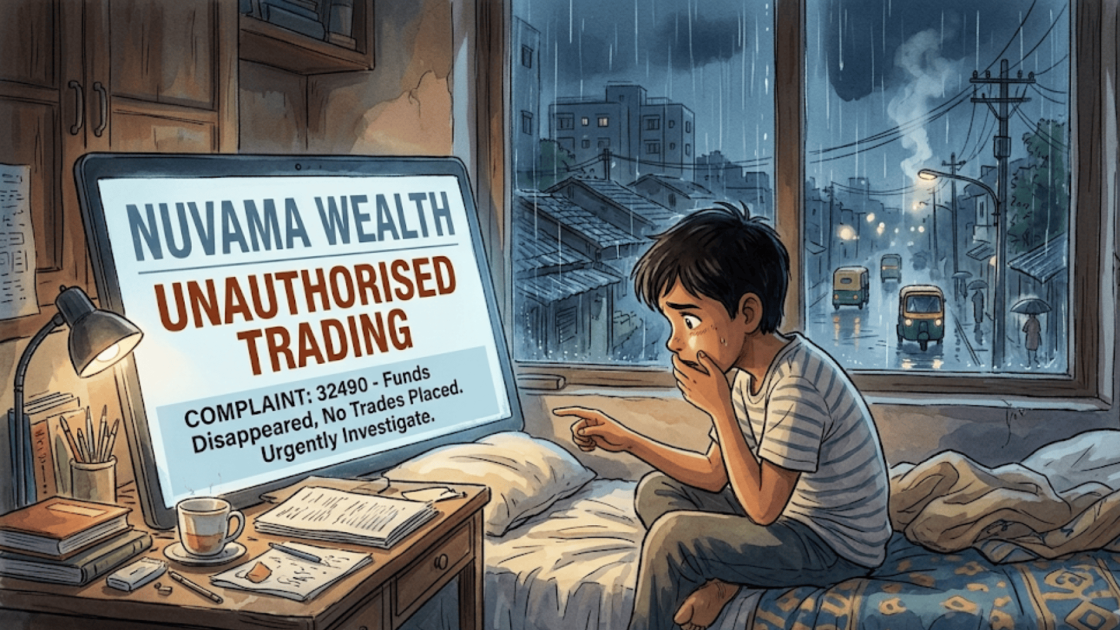
Nuvama Wealth unauthorised trading complaints have climbed from 13.45% of total complaints in 2021-22 to 29.81% in 2025-26, more than doubling as a share even as raw numbers fluctuated year to year. One arbitration case, involving a claimed loss of ₹41,66,000, ended with the Appellate Panel directing Nuvama to pay ₹31,57,155 after the broker couldn’t produce evidence the trades were authorised. This blog walks through that case in full, the year-by-year trend behind it, when you actually have grounds to challenge a trade, and what to do if your own account shows something similar.
Most investors open a trading account with one simple assumption: a trade happens only when they decide to place it. You log in, choose the stock, confirm the quantity, and execute it yourself.
Mrs. Chhaya Bajpai had that same assumption until she found ₹41,66,000 worth of trades in her Nuvama account that she says she never approved.
Her case went all the way to appeal, and the outcome tells you exactly what evidence actually decides these disputes, whether you’re dealing with something similar right now or just want to know what you’re up against before it happens.
What Counts as Nuvama Wealth Unauthorised Trading?
Unauthorised trading happens when a broker, dealer, or any financial professional executes a trade in your account without obtaining your explicit permission first.
That sounds obvious in principle.
In practice, it gets murky fast, especially when a relationship manager is involved and some level of trust or shared access already exists between you and them.
Nuvama offers access through its mobile app, a web platform, and dealer or relationship-manager-assisted trading for certain clients.
That last channel is exactly where things get complicated, because “assisted” trading can quietly slide into “the RM is now trading on my behalf without checking every time,” and that gap is where disputes like the one below start.
If your account is also missing contract notes or showing other communication gaps, that’s a separate but related pattern; our page on the SEBI order on Nuvama Wealth covers a real regulatory finding on exactly that issue.
How Common Is Unauthorised Trading in Nuvama Wealth Complaints?
Numbers help separate a one-off bad experience from an actual pattern.
Here’s what the data shows:
| Year | Total Complaints | Unauthorised Trading Complaints | % of Total |
|---|---|---|---|
| 2021-22 | 171 | 23 | 13.45% |
| 2022-23 | 149 | 22 | 14.77% |
| 2023-24 | 115 | 15 | 13.04% |
| 2024-25 | 204 | 46 | 22.55% |
| 2025-26 | 104 | 31 | 29.81% |
A note on these figures: this table reflects a specific reporting window, and you’ll notice the totals here don’t match the broader NSE complaint data on our main Nuvama complaints page.
Different reporting periods and data sources can produce different absolute counts.
What matters more than the raw totals is the trend within this dataset itself, and that trend is consistent: unauthorised trading’s share has more than doubled, from roughly 1 in 8 complaints to nearly 1 in 3.
That shift, especially the jump from 13.04% in 2023-24 to 22.55% the very next year, is the kind of change worth asking questions about, not dismissing as noise.
Beyond the numbers, the real cost isn’t only financial.
Unexpected trades can trigger margin calls or force an exit from a position you never intended to take, sometimes before you even realise what happened.
Some investors respond by reducing how much they trade. Others stop entirely, because the sense of control that made online trading appealing in the first place is gone.
The Chhaya Bajpai Case: A ₹31.57 Lakh Arbitration Award
Numbers on a table only go so far. A real, decided case shows you what actually happens when this dispute plays out.
Mrs. Chhaya Bajpai raised concerns about losses totalling ₹41,66,000 in her Nuvama trading account.
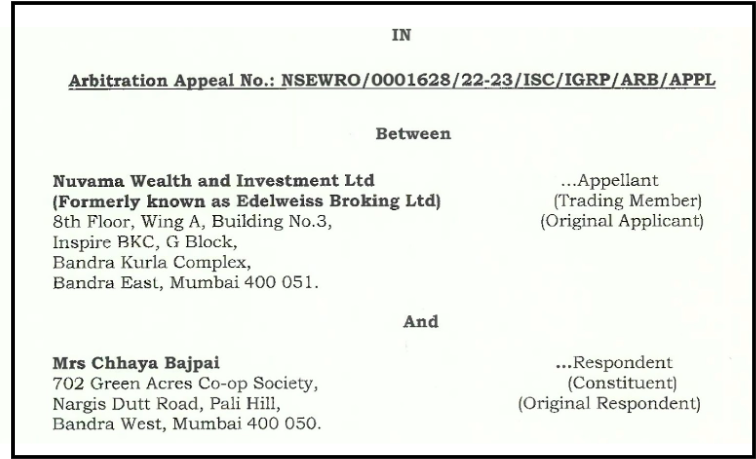
Nuvama Wealth and Investment Ltd., then still operating under the Edelweiss Broking name, appealed the resulting decision, which is how the case reached the Appellate Panel.
What happened: Bajpai claimed two relationship managers at the brokerage executed trades in her account without her explicit permission, after she had shared her login credentials with them for what she believed were purely operational reasons, not a blank check to trade freely.
Nuvama’s defence: the broker argued it shouldn’t be held responsible, since the client had shared her password, technically violating the account agreement, and the trades had gone through the online system rather than some off-books channel.
What the Tribunal actually found: the firm had earned considerable brokerage and interest from those very trades. More importantly, the broker couldn’t produce clear evidence that Bajpai had authorised the transactions beforehand. The dispute ultimately came down to one question: can a brokerage firm be held responsible for what its own employees do with a client’s account?
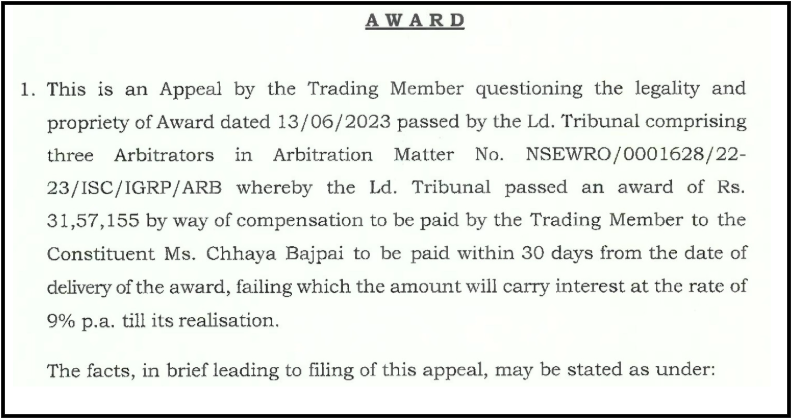
The outcome: the Appellate Panel rejected Nuvama’s appeal and upheld the earlier decision. The firm was directed to pay ₹31,57,155 to the investor, with interest if the amount wasn’t paid within the specified time.
Four things worth pulling out of this case if you’re evaluating your own situation:
- A firm can’t dodge liability just by pointing at its employees. Dismissing staff after the fact doesn’t undo a firm’s responsibility for trades that benefited it financially.
- Proof of authorisation sits with the broker, not you. If a dispute reaches this stage, the broker has to show clear evidence you approved the trades, not the other way around.
- Sharing your password is a bad idea, but it’s not a blank cheque. Even where a client technically breached account terms by sharing credentials, that alone didn’t give the broker’s staff licence to trade however they wanted.
- Client instructions have to be followed, not interpreted. Brokers are expected to act on what you actually told them, not what seemed like a reasonable extension of it.
When Do You Actually Have Grounds to Challenge a Trade?
Many investors assume that once a trade shows up in their account, they have to simply accept it.
That’s not correct; brokers carry real obligations here under regulatory rules.
- No proof the order was placed. No call recording, no email, no order log, no message from your number, no evidence at all. That trade can be challenged.
- The trade went beyond what you agreed to. You approved one trade. The broker placed more, or bigger ones, without asking again.
- An employee crossed the line. Your RM or dealer acted on their own, not on your actual instructions. The firm is still responsible, even if they later fire that employee.
- Records go missing after you complain. No proof of authorisation once a dispute is filed usually means a stronger case for you.
Found a trade in your Nuvama account you don’t remember approving?
Our team will review your order history and communication records, build the evidence gap the broker needs to answer for, and helps you file a claim that actually holds up.
What Should You Do If You Suspect Unauthorised Trading?
The instinct when you spot a trade you don’t recognise is to panic, call your RM, and demand an explanation on the spot. Resist that for a moment.
What actually protects you isn’t a heated phone call; it’s a calm, documented trail that a regulator or arbitrator can look at later and immediately understand.
Here’s the order that actually works:
- Review your trading records first. Check contract notes, trade history, and account statements. Note the exact dates, quantities, and order details for anything you believe wasn’t authorised.
- Save every piece of related evidence. Emails, SMS alerts, app notifications, and screenshots of your trade history all matter once a dispute escalates, so gather them before anything disappears.
- Put your complaint in writing to Nuvama’s compliance officer specifically, not the relationship manager involved, and ask them directly to produce proof of authorisation for each disputed trade. This is exactly the evidence gap that decided the Bajpai case above, and it’s the same gap you want to expose early.
If Nuvama’s written response doesn’t produce that proof, a SEBI SCORES complaint puts the regulator on record and forces a formal response within a set window, rather than leaving you dependent on the broker’s goodwill.
Where the trade in question ran through a specific exchange, an NSE complaint lets that exchange’s own grievance desk pull the order logs directly and verify what actually happened, independent of whatever the broker tells you.
If the matter still isn’t resolved, a SMART ODR portal filing moves things into structured conciliation before you need to go further.
And if it comes down to a genuine dispute over authorisation with real money at stake, arbitration in share market is exactly the forum that decided Bajpai’s case: an independent arbitrator weighing your evidence against the broker’s, with the burden of proof sitting on Nuvama, not you.
Conclusion
Nuvama Wealth unauthorised trading complaints don’t represent every investor’s experience with the platform.
But the trend behind them, and the Bajpai case in particular, shows exactly why staying involved with your own account matters more than trusting that everything is fine by default.
Check your contract notes regularly. Understand what’s actually being traded in your name. Question anything unfamiliar the moment you see it, not weeks later once evidence has started to disappear.
Investing should feel transparent and within your control.
If that control ever feels uncertain, investigate early. Waiting rarely makes the picture clearer.
Report. Recover. Stay Fraud Free.
From 13.45% of total complaints in 2021-22 to 29.81% in 2025-26, more than doubling in proportion even as raw complaint numbers moved up and down. The Appellate Panel directed Nuvama to pay ₹31,57,155 after finding the broker couldn't prove the disputed trades, worth ₹41,66,000 in claimed losses, were authorised by the client. No. The Bajpai case specifically found that sharing credentials, while inadvisable, doesn't automatically authorise a broker's staff to execute trades on their own judgment. The broker does. If they can't produce a call recording, written instruction, or order log proving your consent, that gap works in your favour during any dispute. No. The Tribunal in the Bajpai case held the firm liable regardless, since it had financially benefited from the trades its employees placed.Frequently Asked Questions


 Add us as a preferred source on Google »

