
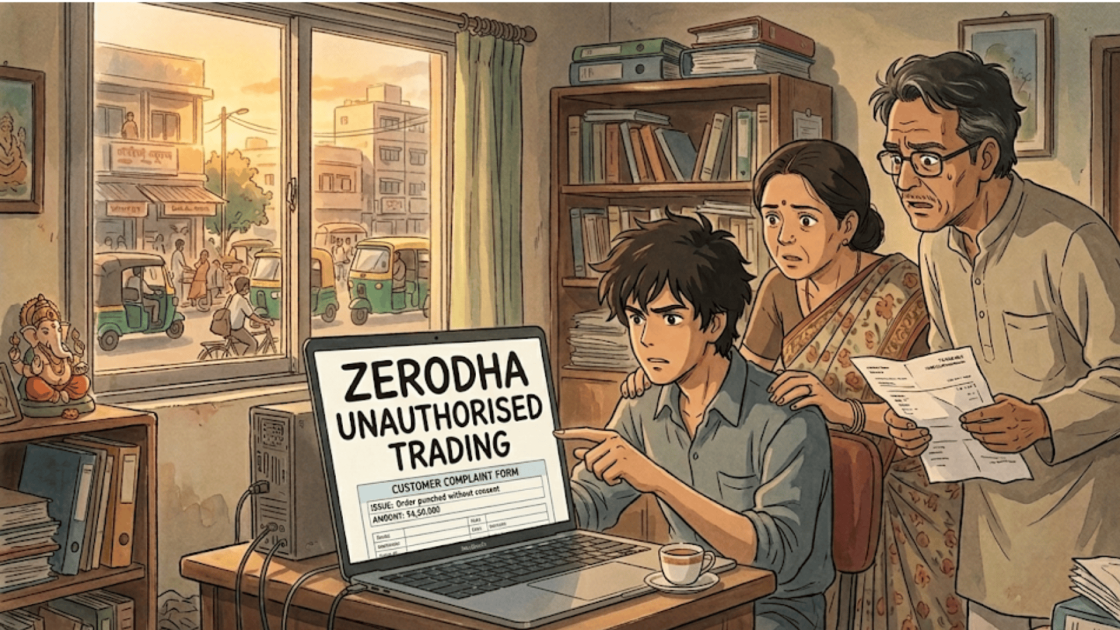
You log into your Zerodha account and notice trades you never placed. Your money is gone, and you have no idea how.
This is not a rare glitch. In 2024–25 alone, 129 complaints were filed against Zerodha specifically for unauthorised trading, and that number is rising.
A significant portion of these issues stems from Zerodha Account Handling without consent, where unauthorised third parties gain access to manage or execute trades on a user’s portfolio
If this has happened to you, you are not helpless. This guide walks you through exactly what to do, from securing your account to escalating your complaint to SEBI and initiating arbitration to recover your losses.
Zerodha Unauthorised Trading Complaints
One major risk investors face is unauthorised trading by stockbroker.
Unauthorised trading refers to transactions executed in an investor’s trading or demat account without their explicit knowledge or consent.
In simple terms, if a buy or sell order is placed from your account and you did not approve or initiate it, that is considered unauthorised trading.
As illustrated in the table below, the total number of complaints recorded relates to unauthorised trading cases.
The data tells a clear story: unauthorised trading complaints are not declining.
| Year | No. of complaints | No. of complaints for unauthorised trading | Percentage of unauthorised trading |
| 2025-26 | 734 | 89 | 12.12% |
| 2024-25 | 1075 | 129 | 12% |
| 2023-24 | 567 | 43 | 7.5% |
| 2022-23 | 446 | 40 | 8.9% |
Market losses are a normal part of investing. But if trades are executed without proper approval or if risk exposure is increased without a clear understanding, that becomes a serious concern.
Despite fluctuations in total complaints, the share attributed to unauthorised trading has actually grown, from 7.5% in 2023–24 to over 12% in the last two years.
This is concerning because unauthorised trading directly affects investor control over their accounts and can lead to unexpected financial exposure or losses.
When Can Action Be Taken Against a Broker?
Action can be taken against a broker when trades are executed without the client’s clear consent or when proper authorisation, such as OTP or TPIN verification, was not obtained before placing the order.
If a broker fails to issue contract notes within the prescribed time or does not maintain proper trade confirmation records, it may amount to regulatory non-compliance.
Serious action may also arise if there is evidence of manipulation, unauthorised use of client funds or securities, or any misuse of trading authority.
Additionally, if a broker fails to respond appropriately to a client’s complaint or ignores a grievance within a reasonable time, the investor has the right to escalate the matter.
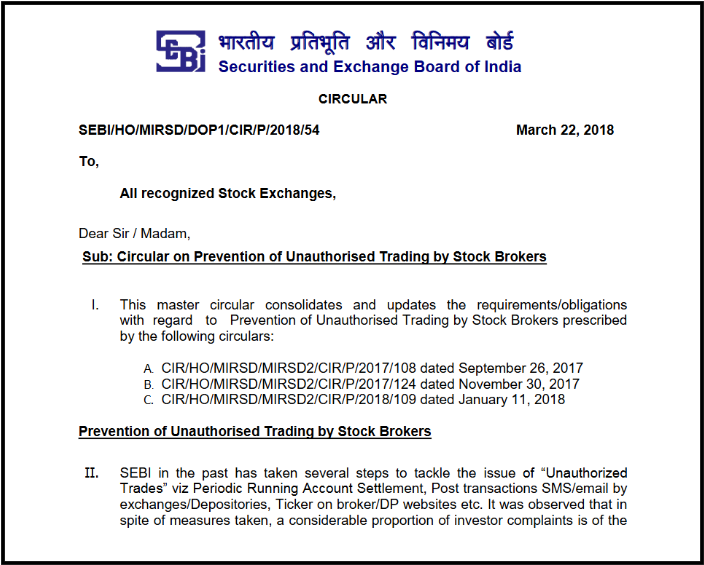
In 2018, SEBI issued a formal circular consolidating broker responsibilities around preventing unauthorised trading, making it clear that brokers, not just investors, are accountable.
This circular consolidates earlier guidelines and lays down the responsibilities of stock brokers to prevent unauthorised trading in client accounts.
It also clarifies when and how action can be taken.
How to Complain Against a Stock Broker?
If you identify or suspect unauthorised trading activity in your account, it is important to act promptly and follow a structured approach to protect your interests.
The following steps outline the recommended course of action:
Step 1: Gather All Evidence
Begin by collecting all relevant documents and records that can support your case.
This includes account statements, contract notes, transaction records, email communications, SMS alerts, call recordings (if available), and screenshots of your trading account.
Proper documentation is crucial, as it serves as proof when raising a complaint or pursuing further action.
Step 2: Contact Your Broker Immediately
Reach out to your broker or trading member as soon as you notice any unauthorised transactions.
Notify them in writing (preferably via email) and request a formal explanation.
In some cases, the issue may result from a misunderstanding or operational error that can be resolved directly at this stage.
Step 3: File a Complaint in SCORES
If the broker’s response is unsatisfactory or the issue remains unresolved, you can lodge a complaint in the SEBI Complaints Redress System (SCORES) platform.
SCORES is an online grievance redressal mechanism that allows investors to file complaints against listed companies and registered intermediaries.
Ensure that you provide all supporting documents to strengthen your complaint.
Step 4: Escalate the Matter and File for Arbitration
If the complaint is not resolved through SCORES or at the broker level, you may escalate the matter by initiating arbitration in the relevant stock exchange.
If your complaint involves financial loss or negligence and remains unresolved, you may initiate arbitration proceedings by filing a complaint with SMART ODR.
Need Help?
Fighting a complaint alone can be overwhelming, especially when you’re up against a large broker with legal resources.
At Fraud Free, we help victims of unauthorised trading build airtight cases. From organising contract notes and ledger statements to drafting your complaint and representing you in arbitration, we handle the process so you can focus on recovery.
A well-documented, professionally presented case significantly improves your chances of a fair outcome. Get in touch with us today.
Conclusion
Unauthorised trading is serious, but it is not the end of the road. SEBI has established clear mechanisms for investors to seek redress, and a well-documented complaint can go a long way.
While Zerodha operates under SEBI regulation, unauthorised trading incidents remain a documented concern that investors must take seriously.
The key is to act fast, document everything, and not let the matter rest at the broker level alone.
If you need help navigating this process, we are here.
Frequently Asked Questions
1. What should I do immediately if I notice an unauthorised trade in my Zerodha account?
Change your password and revoke any third-party app access immediately. Then download your contract notes and ledger statement as evidence, and send a written complaint to Zerodha support via email. Prompt action preserves your legal position.
2. Will Zerodha refund my money if trades were placed without my consent?
Zerodha may acknowledge the issue, but a refund is not automatic. If your complaint is not resolved satisfactorily at the broker level, you can escalate to SEBI via SCORES or initiate arbitration through SMART ODR to formally claim your losses.
3. What is the time limit for filing a complaint against a broker with SEBI?
SEBI generally expects investors to first approach the broker and then escalate within a reasonable timeframe. For arbitration at stock exchanges, the limitation period is typically three years from the date of the disputed transaction.
4. Can I get professional help to file a complaint against Zerodha?
Yes. Services like aseemjuneja.in help you organise your evidence, draft a structured complaint, and represent your case in arbitration proceedings, significantly improving your chances of a fair outcome.
5. Is arbitration against Zerodha expensive or complicated?
Arbitration through SMART ODR is designed to be accessible for retail investors. However, having a professional assist with documentation and case presentation can make the process faster and more effective, especially when significant money is at stake.


 Add us as a preferred source on Google »

