
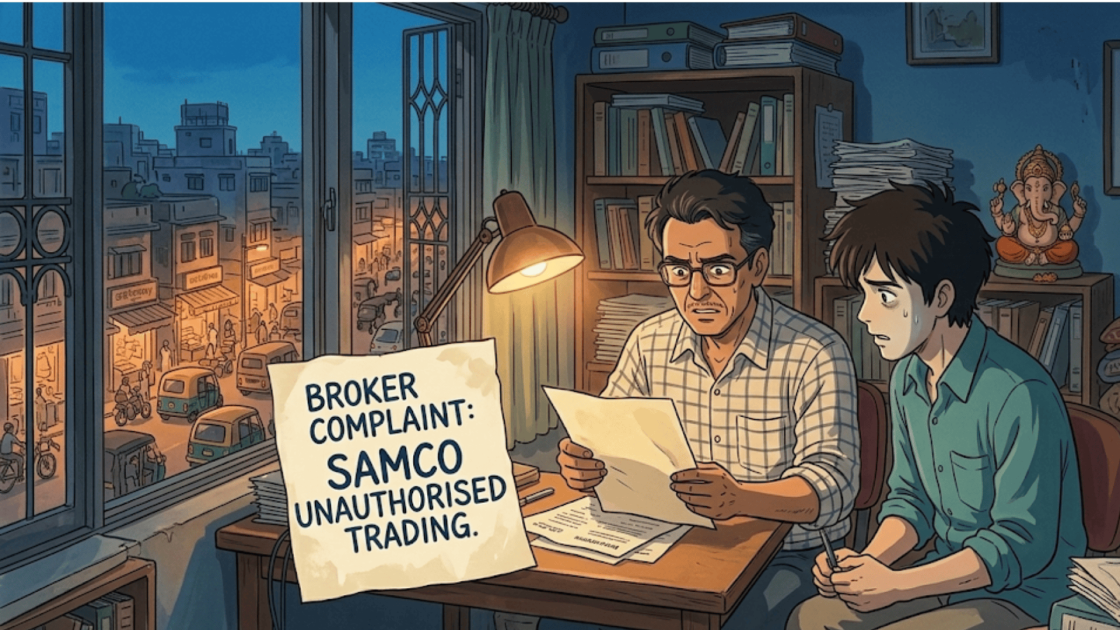
Quick Summary
Unauthorised trading complaints against Samco have climbed from 14.58% of total complaints in 2021-22 to 28.57% in 2025-26, nearly doubling as a share of everything filed against the broker. SEBI requires brokers to keep verifiable proof of a client’s consent before executing any trade, and the burden of proving that consent existed sits with the broker, not the investor. This blog walks through the year-by-year numbers, the specific situations that actually qualify as unauthorised trading, and the steps to take if you suspect it’s happened to you.
Stockbrokers are supposed to be a bridge, not a decision-maker. You place the order; they carry it out. That’s the whole deal.
Sometimes that arrangement breaks, and trades happen in an account that the person who owns it never actually approved.
With Samco Securities, this isn’t a rare, isolated worry anymore. It’s grown into close to a third of everything investors complain about.
This blog looks at how big that share has actually gotten, what counts as unauthorised trading under SEBI’s own rules, and what you can do if you’re staring at a trade in your account that you’re pretty sure you never placed.
What Is Samco Unauthorised Trading?
Samco Securities offers the usual mix, equity, derivatives, commodities, mutual funds, through an online trading platform that lets clients place orders and track their own portfolios.
Like most discount brokers, the whole model leans on the client doing the driving. You decide, you click, you’re responsible for the outcome.
Unauthorised trading is what happens when that setup gets bypassed, when a trade shows up in your account that you didn’t place or knowingly consent to.
That could mean a dealer acting on their own judgement, a system quietly executing something without your input, or a trade that technically ran through your account but nobody actually asked you first.
The reason this matters more than it might seem is simple.
Once a trade happens, you own the result.
If it loses money, that loss is sitting in your account whether you approved it or not, and untangling that after the fact is far harder than preventing it in the first place.
What Share of Samco Complaints Is Unauthorised Trading?
Raw complaint counts move around for all sorts of reasons: more users, a bad quarter, a system change.
What tells you something more specific is the proportion: how much of the total is this one category, year after year.
| Year | Total Complaints | Unauthorised Trading Complaints | Share of Total |
|---|---|---|---|
| 2021-22 | 48 | 7 | 14.58% |
| 2022-23 | 42 | 1 | 2.38% |
| 2023-24 | 58 | 7 | 12.06% |
| 2024-25 | 74 | 21 | 28.37% |
| 2025-26 | 49 | 14 | 28.57% |
That 2022-23 number is worth pausing on. A single complaint out of 42, barely over 2%. If you’d only looked at that one year, you’d walk away thinking this was a non-issue.
Then look at what happened after.
Two years later, the share jumped more than tenfold, to over 28%, and it’s held there since.
Whatever changed between 2022-23 and 2024-25, more volume, weaker internal checks, something else entirely, the outcome is that roughly one in every four or five complaints against Samco today involves a trade someone says they never approved.
For anyone still deciding whether to trust this broker with real money, that trend matters more than any single year’s snapshot. A one-off spike is noise. A share that climbs and then stays elevated for two straight years is a pattern.
For the fuller picture of every complaint category, not just this one, our page on Samco Securities complaints covers the full breakdown.
What Does SEBI Actually Require Before a Broker Can Trade for You?
This isn’t left to a broker’s discretion or good faith.
SEBI has specific requirements around what counts as valid authorisation, and they exist precisely because verbal understandings are too easy to dispute later.
- There has to be actual, verifiable proof of consent. A recorded phone call, a written instruction, an order placed through your own login, something concrete tied to you specifically, not a general sense that you’d probably be fine with it.
- Permission for one trade doesn’t extend indefinitely. If you agreed to a specific transaction, that agreement covers that transaction. It doesn’t hand the broker or a dealer standing authority to keep trading on your behalf without checking in again.
- The broker has to be able to produce records on demand. If a dispute comes up and Samco can’t show call logs, order confirmations, or some other trail proving you actually authorised the disputed trade, the absence of that record works against them, not you.
- Blaming a system glitch doesn’t automatically clear anyone. If someone with access to your account misused it, whether that’s a dealer or a technical failure, the broker is still on the hook for making sure that access was properly controlled in the first place.
There’s a common misconception worth clearing up here too. People sometimes assume a complaint only counts if the trade actually lost money. It doesn’t work that way.
A trade you never approved is still unauthorised even if it happened to turn a profit, because the issue isn’t the outcome; it’s the missing consent.
Found a trade in your Samco account that you’re sure you never placed?
Our team will review your trading records, pinpoint exactly where the authorisation gap is, and help you put together a complaint that actually holds up.
What Is the Real Cost of Samco Unauthorised Trading?
The financial hit is the obvious part. Money moves without your say-so, and sometimes it moves in the wrong direction.
But there’s a second layer that’s easy to underestimate until you’re actually living through it.
A position you didn’t choose can carry risk you never signed up for, margin exposure you didn’t plan around, or a strategy that has nothing to do with what you were actually trying to do with your money.
And then there’s the part that doesn’t show up on any statement: the erosion of trust in the platform itself.
Once you’ve found one trade you didn’t authorise, you start second-guessing every entry in your account, which is its own kind of exhausting, on top of whatever the financial damage actually was.
For smaller investors especially, working with tighter capital and less room to absorb a surprise, this kind of disruption can throw off an entire plan, not just one trade.
How To Protect Yourself From Samco Unauthorised Trading?
Most of what actually prevents this isn’t complicated. It’s just easy to skip when everything’s going fine, and by the time it matters, it’s too late to start.
A few habits, kept up consistently, close off most of the openings that lead to this kind of dispute in the first place.
- Never share your login credentials, OTP, or trading PIN with anyone, not a dealer, not a relationship manager, not even someone claiming to be Samco support. No legitimate request ever needs this.
- Check your contract notes the same day they’re issued, not once a week or once a month. A trade caught within hours is far easier to dispute than one you notice three weeks later.
- Turn on SMS and email alerts for every single trade if they aren’t already active. Real-time notification is the single fastest way to catch something that shouldn’t be there.
- Put every dealer instruction in writing, and make it specific. “Handle it for me” is exactly the kind of vague authorisation that leaves room for dispute later.
- Periodically review who actually has access to your account, and revoke anything you’re not using anymore: an old advisor connection, a dealer relationship you’ve since dropped, anything sitting there unused.
How To Report Samco Unauthorised Trading?
Speed matters here more than people expect going in. The longer a disputed trade sits unaddressed, the harder it becomes to reconstruct exactly what happened.
Reach out to Samco directly, right away. Tell them clearly what you’re seeing and ask for a specific explanation of how and why that trade went through.
Put it in writing too; don’t rely on a phone call alone. Email or use the broker’s formal grievance channel, and lay out the date, the trade details, and exactly what’s wrong with it.
Go back through your contract notes and statements yourself.
Compare the dates, times, quantities, and prices against what you actually remember instructing. Anything that doesn’t line up with your own trading pattern deserves a second look.
If Samco doesn’t give you a satisfactory answer, you have four separate options, and which one applies depends on your situation:
- A SEBI SCORES complaint is the right move when you want the regulator directly involved and a response within a fixed deadline.
- A BSE complaint applies specifically when the disputed trade ran through BSE, and lets that exchange investigate on its own.
- SMART ODR registration is a structured, evidence-based process you can use if the dispute is still unresolved and you want something more formal than an exchange complaint but faster than a full arbitration.
- Share market arbitration through NSE or BSE is for cases involving a significant loss, where you want a binding decision from an independent panel after weighing the evidence.
For the full details on how each of these actually works, our guide on complaint against stock broker SEBI covers every stage.
Conclusion
Unauthorised trading complaints against Samco haven’t just persisted; they’ve grown into a genuinely large share of everything investors are raising against the broker, nearly doubling over the past several years.
Brokers carry real, specific obligations here, and those obligations don’t bend just because a trade happened to work out, or because proving what happened feels inconvenient months later.
If something in your account doesn’t match what you actually instructed, don’t sit with the doubt.
Check it properly, and if it genuinely doesn’t add up, escalate it before the trail gets any colder than it already is.
Report. Recover. Stay Fraud Free.
From 14.58% of total complaints in 2021-22 to 28.57% in 2025-26, nearly doubling, with the sharpest jump happening between 2022-23 and 2024-25. No. A trade you never approved is unauthorised regardless of whether it made or lost money, since the issue is the missing consent, not the financial outcome. The broker does. If Samco can't produce a call recording, written instruction, or order log tied to you, that gap works in your favour, not theirs. No. Consent for a specific transaction doesn't extend to future trades. A broker or dealer needs fresh authorisation each time, not a standing assumption based on one earlier approval. Contact Samco in writing immediately, request a specific explanation, and pull your own contract notes to compare against what you actually remember instructing.Frequently Asked Questions


 Add us as a preferred source on Google »