

Most investors don’t pay attention to small issues in their trading accounts.
A charge looks slightly off. An order executes differently than expected. Sometimes, a trade appears that the investor doesn’t fully understand. Instead of questioning it, they move on.
That’s where the problem starts. In the stock market, ignoring small issues can lead to bigger losses. What looks like a minor confusion today can turn into a serious dispute later.
Many beginners often wonder, can a stock broker be trusted?
When they see these discrepancies, the answer lies in your own vigilance.
Religare Broking, like any full-service broker, receives complaints from investors. These complaints usually relate to trade execution, communication gaps, or account-level concerns.
The important question is not whether complaints exist, but what kind of issues investors face and how they handle them.
In this article, we will look at the complaint patterns, review actual exchange data, understand a real arbitration case, and walk through what you should do if something goes wrong.
The idea is simple. Stay aware, act early, and protect your money.
Religare Complaints Overview
Most complaints against Religare Broking Limited follow a few common patterns. Investors report similar issues again and again.
These issues don’t appear randomly. They repeat across different accounts.
Many investors report problems with trade execution. They feel that the system executed trades differently from what they intended. Sometimes timing creates the issue.
Sometimes, price movement confuses. In some cases, the investor simply does not get full clarity during order placement.
Investors also report cases of Religare Securities unauthorised trading.
In these situations, they claim that someone placed trades in their account without clear approval. These cases often turn serious because they directly impact capital.
Charges and margin-related issues also create confusion. Many investors do not fully understand brokerage, margin requirements, or square-off rules.
When a user noticesReligare Securities excess charges, they often question the action and raise complaints.
In full-service brokers like Religare Broking Limited, advisory expectations also play a role. Investors rely on suggestions or relationship managers.
When trades result in losses, they question the advice and the communication.
You should understand one thing clearly.
These complaints come from multiple factors. Miscommunication creates issues. Lack of clarity adds to the problem. Market risk plays its role. In some cases, operational mistakes also lead to disputes.
That is why you should always stay alert and question anything that does not feel right in your account.
Religare Exchange Complaint Data
Most investors don’t check complaint data before choosing a broker.
They focus on pricing, features, or app experience. But complaint data tells you something more important: how often users face issues and how the broker handles them.
If you want to understand the real picture, you have to look at exchange-level data. This data shows how many complaints investors raised and how the broker responded to them.
Now let’s look at the actual numbers for Religare Broking Limited.
| Financial Year | Total Clients | No. of Complaints | % of Complaints | Resolved Complaints | % Resolved | Arbitration |
|---|---|---|---|---|---|---|
| 2022–23 | 312,774 | 148 | 0.047% | 142 | 95.95% | 3 |
| 2023–24 | 312,774 | 156 | 0.049% | 150 | 96.15% | 2 |
| 2024–25 | 368,551 | 274 | 0.074% | 274 | 100% | 1 |
| 2025–26 | 351,228 | 249 | 0.071% | 227 | 91.16% | 0 |
At first glance, the complaint percentage looks very low. Even in 2024–25, complaints remain below 0.1% of total clients. But don’t stop there.
The number of complaints increased from 148 in 2022–23 to 274 in 2024–25. The client base also grew during this period, so part of the increase comes from scale. Still, the rise is noticeable.
Now look at how the broker handled these complaints.
Religare resolved 100% of complaints in 2024–25. That shows strong resolution capability.
But in 2025–26, the resolution rate dropped to 91.16%. This shift matters. It shows that resolution performance can change over time.
You should read this data with the right perspective.
A low complaint percentage does not mean there are no issues. It only tells you that complaints remain low compared to the total number of clients. What matters more is how frequently issues appear and how efficiently the broker resolves them.
Arbitration numbers also remain very low across all years. This usually means most cases get resolved before escalation. At the same time, it can also mean that not every investor takes the dispute to the final stage.
The takeaway is simple.
Complaints exist. They increased with scale. Resolution remains mostly strong, but not consistent every year.
Religare Arbitration Case
Complaint data gives you a broad picture. Arbitration cases show you what actually happens when a dispute goes further.
Let’s look at one real case involving Religare Broking Limited.
An investor raised a complaint in July 2023 alleging unauthorized trading in the account. The investor claimed that trades were executed without approval and led to losses.
The issue did not get resolved at the initial level, so the investor escalated it to NSE arbitration. Before going into details, look at how the case appears in the official record.
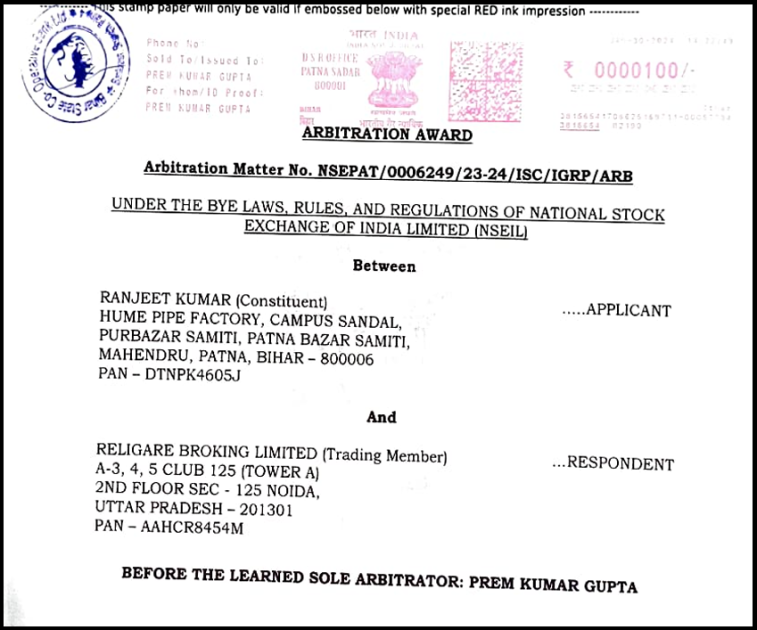
The front page confirms that the dispute reached formal arbitration. It shows that both the investor and the broker presented their sides, and the exchange accepted the case for review.
At this stage, the process becomes evidence-driven. Both sides submit records, and the case moves beyond claims.
The core issue remained simple: whether the trades were properly authorized.
The arbitrator reviewed:
- Order execution details
- Timeline of trades
- Communication between both parties
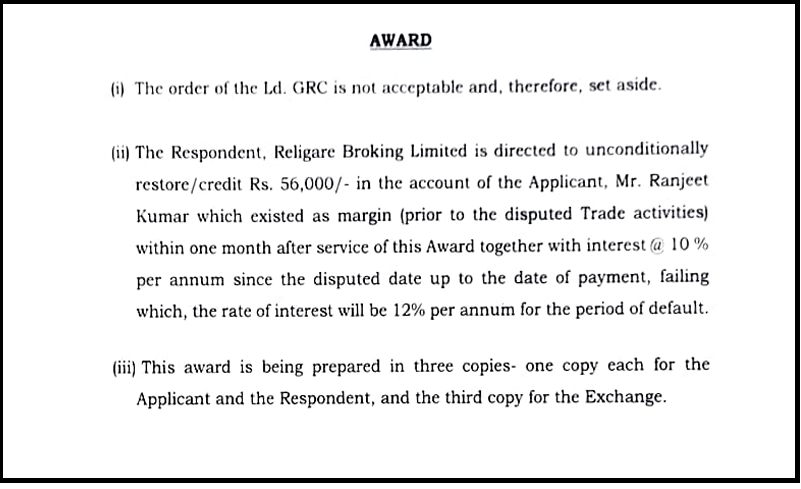
The Arbitral Tribunal directs restoration of ₹50,000 to Mr. Ranjeet Kumar within one month, along with 10% annual interest.
This part of the award highlights the key finding. The arbitrator focused on whether the broker could prove authorization. The decision depended entirely on records, not assumptions.
The arbitrator established an important point. If the broker cannot prove proper authorization and the investor suffers a loss, the broker cannot avoid responsibility.
This case addresses the common fear: Can a stockbroker steal your money in India?
Once a case reaches arbitration, the verdict depends entirely on the strength of your documentation, specifically order logs, communication records, and clear timelines, to prove your side and protect your capital.
If you notice anything unusual in your account, act immediately. Raise the issue and keep proper records.
Most disputes follow the same pattern: confusion, disagreement, and then escalation. Understanding this early helps you stay prepared.
Also Read: Moneylicious Securities complaint, 1,611 fund transfers that shouldn’t have happened, per SEBI.
Religare User Reviews
User reviews give you a ground-level view. They show what investors actually experience while using the platform.
Let’s look at a couple of real user concerns related to Religare Broking Limited and understand what they mean.
1. Issue with Real-Time Data Accuracy
One user highlighted a serious concern related to price accuracy on the trading platform. The user reported that the rates shown on the screen did not match actual market prices.
Sometimes the price appeared higher or lower than the real value, which directly affected trading decisions, especially in situations where the Religare Dynami app not working properly.
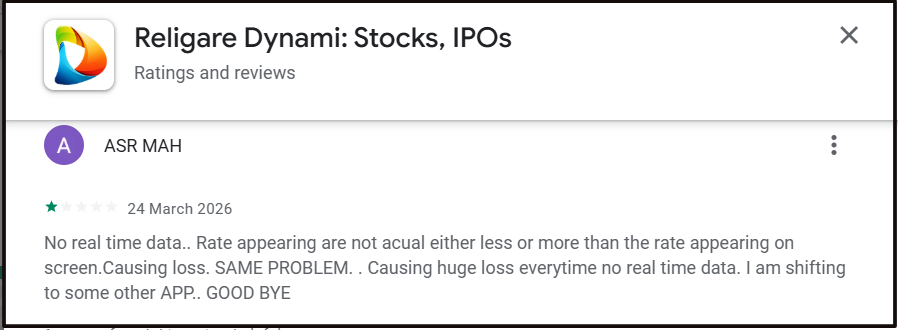
This kind of issue can create real problems.
When you place trades based on incorrect price data, you lose control over entry and exit points. Even small mismatches can lead to losses, especially in intraday or F&O trading where timing matters.
The user clearly expressed frustration and mentioned switching to another app. That tells you the impact of such issues.
From an investor’s perspective, this raises an important point.
You should always verify price movements, especially if something feels off. Do not rely blindly on a single screen. If you notice repeated mismatches, you need to act quickly and escalate the issue.
2. Poor Customer Support and Delayed Share Transfer
Another user shared a different type of problem. This one relates to customer support and service delays.
The user tried to contact the support team for several months regarding a share transfer request but did not receive proper assistance.
The delay created frustration, and the user felt that the company was not responding seriously to the issue.
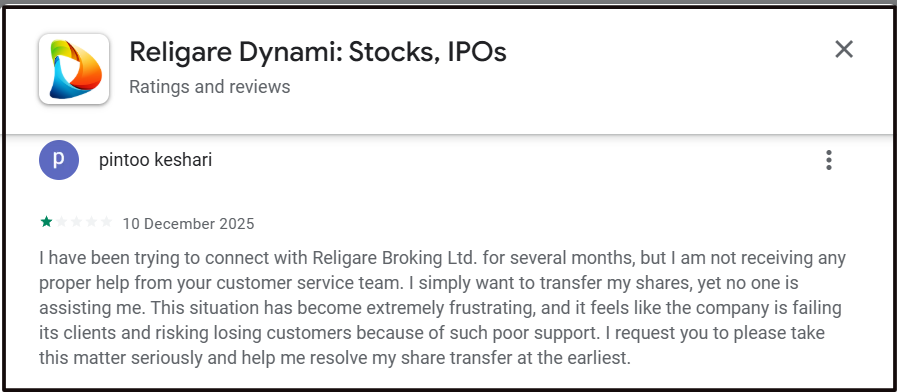
This highlights a different risk.
Not all problems come from trading. Some issues come from operations like account handling, transfers, or service requests. When support does not respond on time, even simple tasks can turn into long delays.
The user clearly pointed out the lack of response and the difficulty in getting help. This kind of experience affects trust more than anything else.
As an investor, you should take this seriously. If you raise a request and do not receive a response, follow up immediately. Keep records of your communication. If the issue continues, escalate it through proper channels instead of waiting.
These reviews highlight two important areas:
- Platform reliability
- Customer support responsiveness
Both matter equally. You can manage market risk, but you cannot control platform issues or service delays. That is why you should stay alert, track your activity, and take action whenever something does not work as expected.
When To Take Action Against Brokers?
Most investors delay action. That delay creates bigger problems.
You should act immediately in the following situations:
- Unauthorized trades: You notice a trade you did not place. Don’t assume anything. Check instantly and raise a complaint without delay.
- Execution issues: Your order executes at a very different price, or the system behaves inconsistently. Verify and question it.
- Unusual charges: Brokerage, penalties, or deductions do not make sense. Review them and raise the issue if you don’t get clarity.
- Margin-related actions: The system squares off your position, and you don’t understand why. Check margin requirements and escalate if needed.
- No response from support: You contact the broker, but don’t receive proper help. Don’t wait. Follow up and escalate.
Here’s what you should remember. You don’t act based on how big the issue looks. You act based on what the issue is.
Even a small unauthorized trade matters. If you delay, you lose time and evidence. And both matter when you take the complaint forward.
So keep it simple, and if something feels wrong, unclear, or delayed, take action immediately.
Where to Lodge a Complaint Against a Broker?
If you face an issue with Religare Broking Limited, you need to follow a clear process. Don’t jump steps. Each level gives the broker a chance to resolve the issue.
Here is how you can lodge a complaint against a stock broker:
Step 1: Contact the Broker
Start by raising a complaint directly with the broker.
Explain the issue clearly. Attach all relevant details:
- Trade details
- Dates and time
- Screenshots or statements
Keep everything in writing. Avoid only calling. Written records help you later.
Step 2: File a Complaint in SCORES
If the issue remains unresolved, move to the SEBI SCORES platform and file a SEBI complaint. SCORES is SEBI’s official complaint system.
SCORES is SEBI’s official complaint system.
Here, you:
- Submit your complaint
- Upload supporting documents
- Track the status of SEBI complaint
SEBI monitors the response and ensures that the broker addresses the issue.
Step 3: Lodge a Complaint in SMART ODR
If the issue is still not resolved, you can escalate it through the SMART ODR (Online Dispute Resolution) platform.
This system is provided by the stock exchanges and helps resolve disputes in a structured and time-bound manner.
At this stage:
- You submit your complaint on the ODR platform
- Both you and the broker present your case digitally
- The platform facilitates resolution through a neutral process
Step 4: Arbitration in Share Market
If you still don’t get a resolution, take the case to arbitration.
At this stage, an independent arbitrator reviews the case. Both sides present their evidence, and the arbitrator gives a final decision based on the records.
At this stage:
- An independent arbitrator reviews your case
- Both sides present evidence
- A final decision is passed
This is the final level of dispute resolution within the system. Follow the process step by step. Don’t skip directly to arbitration.
If you handle it correctly, the system gives you a fair chance to resolve the issue.
Need Help?
Handling a complaint against a broker can feel confusing, especially when you’re not sure what to do next.
Many investors delay action or miss the right steps. That makes even a valid complaint harder to resolve.
If you feel stuck at any stage, you don’t have to handle it alone. We can guide you through the process and help you take the right steps at the right time.
If you need support, register with us, and we’ll help you handle your complaint properly.
Conclusion
Complaints against a broker are not unusual. What matters is how you understand and handle them.
In the case of Religare Broking Limited, the data shows that complaints exist, they increase with scale, and most of them get resolved. At the same time, user experiences and arbitration cases highlight that issues can become serious if ignored.
You should not focus only on the number of complaints. You should focus on the type of issues and how quickly you act on them.
If something feels wrong in your account, don’t wait. Check it, question it, and take action. The system gives you a clear path, from broker support to exchange, to SEBI, and finally to arbitration.
What matters is whether you use it at the right time.
Stay alert, stay informed, and protect your money.




 Add us as a preferred source on Google »

