
Quick Summary
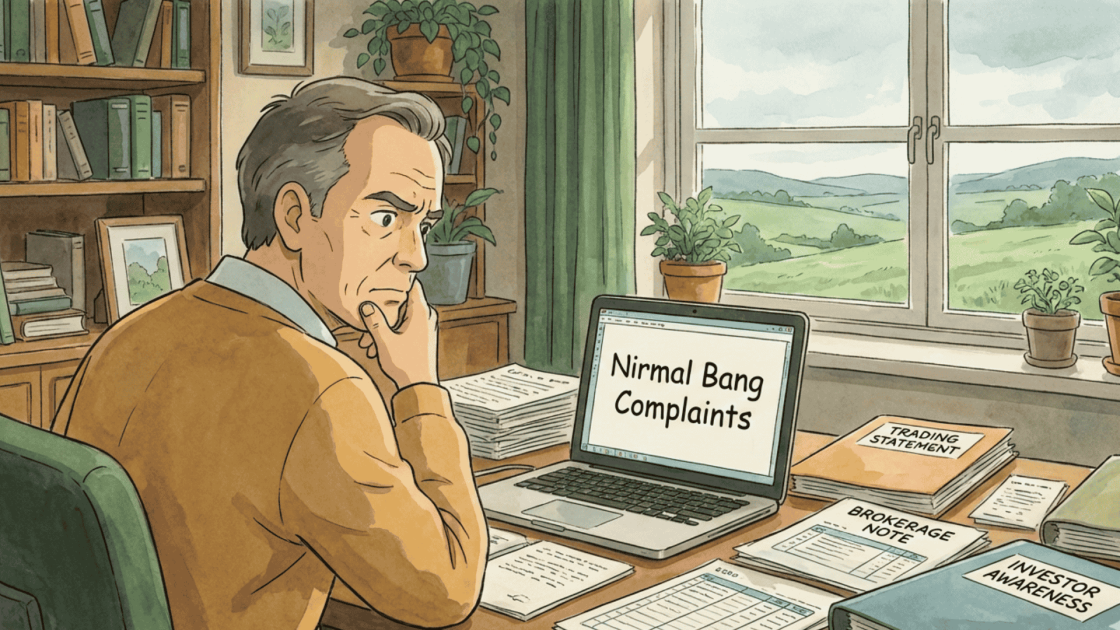
Nirmal Bang complaints more than doubled in a single year, from 49 in 2023-24 to 110 in 2024-25, a 124% jump that outpaced client growth by a wide margin. One investor won ₹1,84,365 in arbitration after the broker charged ₹100 per lot against an agreed rate of ₹60. Within that overall complaint volume, charges-related grievances have climbed steadily too, reaching as high as 37.5% of total complaints in one reporting window. Three named user reviews describe false profit displays, doubled order quantities, and an unexplained 200% brokerage hike. This blog covers all of it, the full year-by-year data, the arbitration case in detail, the real user experiences, and exactly how to escalate if your own account shows the same pattern.
You agree to pay ₹60 a lot. Your contract note shows ₹100.
Multiply that gap across hundreds of trades, and you start to understand why this specific complaint keeps showing up against Nirmal Bang, and why one investor took it all the way to arbitration and won.
Nirmal Bang Securities, established in 1986, carries nearly four decades of presence in Indian markets. That kind of history usually reads as reassurance.
But a long track record only tells you a firm has survived, not that it’s treated every client fairly along the way.
This blog lays out the actual complaint data, a decided arbitration case with real figures attached, three named user reviews, and the excess charges pattern that keeps surfacing year after year.
Nirmal Bang Overview
Nirmal Bang offers retail clients an online trading platform and a mobile app covering equity, derivatives, currency, and commodity segments, the usual full-service broker spread.
The firm holds SEBI Registration No. INZ000202536, which confirms it’s legally entitled to operate. It says nothing about how consistently it actually treats the people trading through it.
Can a stock broker be trusted based on registration alone?
Not really.
Registration and day-to-day conduct are two separate questions, and the complaint record below is where the second one actually gets answered.
The platform itself has drawn consistent complaints around real-time data sync failures, incorrect position displays, and order execution errors, the kind of issues that cost real money during a live session, not just inconvenience after the fact.
What Types of Complaints Are Investors Filing Against Nirmal Bang?
A broker’s complaint history rarely consists of random, one-off grievances.
The same handful of issues tend to repeat across different clients, different cities, different years, which is exactly what makes a pattern worth taking seriously rather than dismissing as bad luck.
Here’s what shows up most often against Nirmal Bang specifically:
- Unauthorised trades: The most serious category by far. Nirmal Bang unauthorised trading allegations involve trades executed in client accounts with no confirmation or consent, and this pattern has shown up across multiple segments and years.
- Brokerage charged above the agreed rate: Multiple clients report exactly this, and it’s not just a user complaint sitting unresolved; it was confirmed in a formal NSE arbitration award, covered in full below.
- Hidden charges and unexplained deductions: Clients have reported negative ledger balances with no clear explanation the broker was willing or able to provide.
- Incorrect order execution: Allegations of the platform executing more lots than the investor actually placed.
Nirmal Bang Exchange Complaint Data
Most investors skip straight past complaint data entirely, focusing instead on brand reputation or trading fees.
That’s understandable, but it skips the one dataset that’s actually tracked independently of the broker’s own marketing.
Here’s the complete year-by-year breakdown, as reported to the exchange:
| Financial Year | Total Clients | No. of Complaints | % of Complaints | Resolved | % Resolved | Arbitration |
|---|---|---|---|---|---|---|
| 2022-23 | 1,41,246 | 61 | 0.04% | 59 | 96.72% | 3 |
| 2023-24 | 1,41,246 | 49 | 0.03% | 46 | 93.88% | 4 |
| 2024-25 | 1,49,851 | 110 | 0.07% | 110 | 100% | 0 |
| 2025-26 | 1,35,784 | 49 | 0.036% | 42 | 85.71% | 1 |
Complaints more than doubled in 2024-25. Going from 49 the year before to 110 is a 124% jump in a single financial year, and the client base simply didn’t grow at anywhere near that pace.
Whatever drove that spike, it wasn’t just a bigger user base generating proportionally more noise.
Seven complaints sit unresolved right now. As of 2025-26, that’s real money tied up with no resolution date, and one arbitration case has already been filed this year on top of it.
2023-24’s arbitration count deserves its own attention. Four separate clients escalated all the way to formal arbitration that year, out of just 49 total complaints.
That’s roughly one in every twelve complaints ending in formal arbitration, a genuinely high ratio that suggests the broker-level resolution process wasn’t working for a meaningful share of people who tried it.
Nirmal Bang Arbitration Case
Exchange complaint data shows investor dissatisfaction.
However, SEBI enforcement orders and formal arbitration records reveal something more serious: documented regulatory violations and a proven case of excess brokerage charging that an NSE arbitrator ruled against.
Case Background
According to the NSE Arbitration Award, a client opened an account with Nirmal Bang Securities in December 2018 and alleged that unauthorized trading was carried out in his account alongside excess brokerage charges in the derivatives segment.
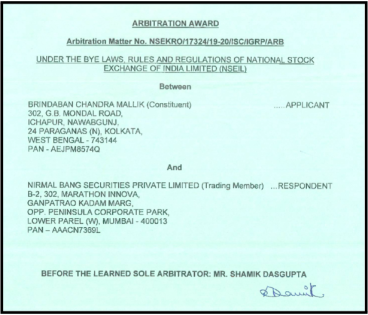
Poor account handling by Nirmal Bang left the client with no choice but to escalate formally to the exchange.
The client claimed that the mutually agreed brokerage rate for options contracts was ₹60 per lot. However, Nirmal Bang Securities had been consistently charging ₹100 per lot, significantly above the agreed rate.
The client filed an arbitration application to NSE seeking a claim of ₹9,65,000 toward unauthorised trades and excess brokerage.
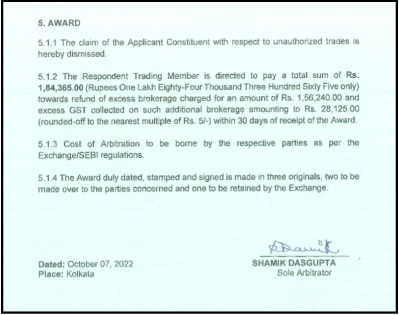
Final Award
The final award directed Nirmal Bang Securities to pay a total sum of ₹1,84,365, covering ₹1,56,240 as a refund of excess brokerage charges and ₹28,125 as a refund of excess GST collected on that additional brokerage, within 30 days of the award.
What to Learn from This Case?
- A broker cannot unilaterally raise brokerage rates without your written consent. Any increase requires mutual agreement in writing.
- Always obtain a written record of your agreed brokerage rate at the time of account opening. Keep it safe.
- If you notice your brokerage charges differ from what was agreed, calculate the difference across all your trades; the cumulative amount can be significant.
- Contract notes are your primary evidence. If the broker delays or denies providing them, escalate immediately.
- Arbitration is a real and effective mechanism. This case proves that investors can recover money when they document their claims properly and pursue the formal process.
Nirmal Bang Reviews
A one-star rating next to a broker’s name doesn’t actually say much on its own.
Plenty of people leave a bad rating over something small, a slow login, a confusing fee breakdown, nothing that would change your decision either way.
What changes the picture is reading what someone actually typed underneath that rating.
The specifics. The dates, the amounts, the exact thing that went wrong, and how the broker responded once it did.
Three reviews on Nirmal Bang’s own app listing do exactly that, and none of them read like a passing complaint.
Here’s what each one actually describes:
1. The App Showed a Profit That Was Never Real
A user reported needing to restart the app frequently just to sync with live market data. More seriously, while trading options, the app displayed the position as profitable.
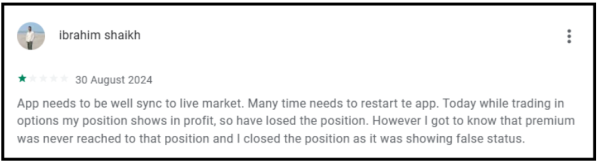
Only after closing the position did the user discover the premium had never actually reached the level the app had been showing throughout.
The user closed out based on that false profit status, and the resulting loss traced directly back to incorrect data on the platform, not a bad trading decision.
2. One Lot Ordered, Two Lots Executed
A separate user reported the app reflecting only stale, outdated positions rather than updating in real time.
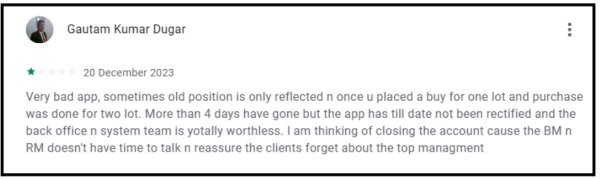
When they placed a buy order for one lot, the system executed two instead.
That error stayed uncorrected for more than four days, despite the client contacting both the back office and the system team directly, neither of which the reviewer described as helpful in any meaningful way.
Even the relationship manager and regional manager were reportedly unavailable to address or reassure the client during this window.
3. Brokerage Jumped 200% With No Warning
A third user reported their options brokerage rising from ₹10 per order to ₹30 per order, a straight 200% increase, with no prior notice and no written communication explaining why.
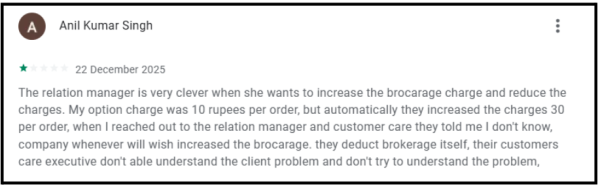
When they reached out to both the relationship manager and customer care, neither could explain the change, and both reportedly deflected responsibility rather than owning it.
This review lines up almost exactly with what the arbitration case above already confirmed through a binding decision: that Nirmal Bang has a documented pattern of charging brokerage beyond what clients actually agreed to.
Given that, it’s worth checking your own current rate against your original account opening paperwork now, not after you notice a problem.
Nirmal Bang Excess Charges: How Big Is the Pattern Within the Total?
Total complaint figures only tell part of the story.
What matters just as much is what share of that total traces back to charges specifically, since that’s the piece most directly tied to your own money.
| Financial Year | No. of Complaints | Excess Charges Complaints | % of Total |
|---|---|---|---|
| 2022-23 | 61 | Around 8 | 13.11% |
| 2023-24 | 49 | Around 16 | 32.65% |
| 2024-25 | 110 | Around 33 | 30% |
| 2025-26 | 40 | Around 15 | 37.5% |
Worth being upfront about two things here.
First, NSE doesn’t maintain a dedicated “excess charges” category the way it does for unauthorised trading, so these figures reflect charges-related grievances identified within the broader complaint data, not an official classification.
Second, the 2025-26 total of 40 complaints in this table doesn’t match the 49 shown in the exchange data table above for the same year, likely a different reporting window, but worth flagging rather than quietly glossing over.
Even accounting for that discrepancy, the trend itself is consistent and hard to dismiss.
The share of complaints tied to excess charges climbed from roughly 13% to over 37% across the years shown, meaning this specific pattern is becoming a larger slice of the overall problem, not a smaller one.
This connects directly to churning in the stock market, where trading activity in an account runs well beyond what the investor’s actual objectives or risk profile would call for.
A broker or relationship manager suggesting repeated trades that don’t genuinely benefit the client is exactly how this pattern shows up in practice, and it’s exactly what the arbitration case above confirmed happened here.
What this actually costs you, beyond the obvious: frequent buy-sell activity racks up brokerage and transaction fees fast, quietly eating into whatever gains the trades themselves produced.
Reviewing your own contract notes regularly, rather than once a year, is the single most effective habit for catching this early, before the cumulative gap becomes the kind of figure that only shows up once you’ve already lost real money to it.
Still watching your Nirmal Bang complaint sit unresolved with no real answer in sight?
Our team will review your contract notes and trade records, map the exact gap against what you actually agreed to, and help you build a complaint that holds up all the way to arbitration if it has to.
Register with us for a free consultation.
When Should You Actually Take Action Against Nirmal Bang?
Most investors wait too long before raising a formal complaint, and that delay works against them, not for them.
The longer a disputed charge or trade sits unaddressed, the harder it becomes to reconstruct exactly what happened.
Here’s when waiting stops being the safer option:
- Unauthorised trades. You notice a trade you never placed. Don’t assume it’s a glitch; check it immediately and raise a formal written complaint without delay.
- Brokerage above the agreed rate. Your contract note shows a rate higher than what was agreed in writing at account opening. Calculate the cumulative overcharge across every trade, not just the one you spotted, and escalate formally.
- Incorrect order execution. The system executes a different quantity, price, or instrument than what you actually placed. Document it in the same session, before the trading day ends.
- False data on the app. Your position or P&L display doesn’t match actual market prices. Screenshot the discrepancy with a visible timestamp immediately.
- Capital dropping with no visible trades. Your balance falls without matching trade records explaining why. This demands immediate escalation, not a wait-and-see approach.
- No response from support. You’ve contacted the broker across multiple channels and gotten nothing back. Don’t keep waiting; follow up in writing and escalate to the exchange directly.
Even a small excess brokerage charge is worth acting on. As the arbitration case above shows, a gap that looks minor on one trade compounds into something significant across hundreds of them.
How To File a Complaint Against Nirmal Bang?
Escalation isn’t something you have to improvise.
There’s a defined sequence here, and each level either resolves your issue directly or builds a stronger documented record for the one after it.
Step 1: Raise it Directly with the Broker
Start by raising your complaint formally with Nirmal Bang directly, through their official grievance channel.
Put everything in writing: your client ID, trade details, dates, and the specific nature of the issue, with screenshots, contract notes, and account statements attached.
Step 2: Request IGRC Review
If that doesn’t resolve things, request that your complaint be referred to the Investors’ Grievance Redressal Committee (IGRC, which reviews the matter independently.
If the committee rules in your favour, the exchange can block the claim amount directly from the broker’s own deposits.
Step 3: File SEBI SCORES complaint
If the broker’s response is still weak or missing entirely, a SEBI SCORES complaint puts the regulator directly on record.
Register with your name, PAN, address, mobile number, and email ID, attach every supporting document, and SEBI tracks whether the broker actually responds within its required timeline.
Step 4: File Complaint in BSE
If your trade ran specifically through BSE, file through the BSE complaint portal instead, which puts your dispute in front of that exchange’s own independent grievance process rather than SEBI’s broader system.
Step 5: File Complaint in SMART ODR
When you need something faster and more structured than back-and-forth emails, a SMART ODR portal filing shifts your case into conciliation, with both sides working from documented evidence rather than continuing an unresolved thread.
Step 6: Arbitration in the Share Market
If nothing above has settled it and real money is still on the table, arbitration in share market is the final formal step, the exact mechanism that delivered the ₹1,84,365 award covered earlier in this blog.
For claims up to ₹10 lakh, the exchange covers arbitration fees, and the Investor Protection Fund may offer interim relief while your case is still pending.
Conclusion
Nirmal Bang has operated since 1986 with real SEBI, NSE, BSE, MCX, and NCDEX credentials; that legitimacy isn’t in question. But legitimacy and reliability aren’t the same thing, and the record here proves it.
Complaints more than doubled in a year. An NSE arbitrator confirmed a quantified excess brokerage case: ₹100 charged against ₹60 agreed, with a ₹1,84,365 award.
SEBI separately penalised the firm over Authorized Person compliance gaps, and cancelled its commodities arm’s registration over NSEL paired contracts tied to ₹5,600 crore in investor losses.
Check your brokerage against your account opening paperwork today, and act the moment something feels off.
Report. Recover. Stay Fraud Free.
Complaints jumped from 49 in 2023-24 to 110 in 2024-25, a 124% increase, before settling back to 49 in 2025-26 with 7 still unresolved. Yes. An NSE arbitrator found the broker had charged ₹100 per lot against an agreed rate of ₹60, and directed a payment of ₹1,84,365 covering the excess brokerage and GST. Within a specific reporting window, excess charges complaints climbed from around 13% of total complaints to as high as 37.5%, though NSE doesn't track this as an official category. Yes, including action over Authorized Person compliance failures, and separately, the cancellation of its commodities arm's registration over illegal NSEL paired contracts tied to over ₹5,600 crore in investor losses. Pull your original account opening documents and compare the agreed rate against your recent contract notes, then calculate the cumulative gap across all affected trades before filing a complaint.Frequently Asked Questions


 Add us as a preferred source on Google »