

“You’ve been selected for a guaranteed IPO allotment.”
That’s how it usually begins.
A message pops up on WhatsApp. Or someone connects with you on LinkedIn claiming to be a research analyst.
They say there’s a “special pre-IPO opportunity” available only for a few investors.
The listing gain? 30%. Maybe 40%. And the best part? “Allotment confirmed.”
It sounds exciting. Exclusive. Almost lucky.
Because let’s be honest, genuine IPOs are hard to get. Many investors apply and still don’t receive shares. So when someone says they can guarantee it, it feels like an inside opportunity.
But here’s the uncomfortable truth. Real IPOs don’t work like that.
Over the past few years, IPO scams have quietly grown across India. Fake apps, WhatsApp groups, fabricated dashboards showing profits, everything is designed to look real.
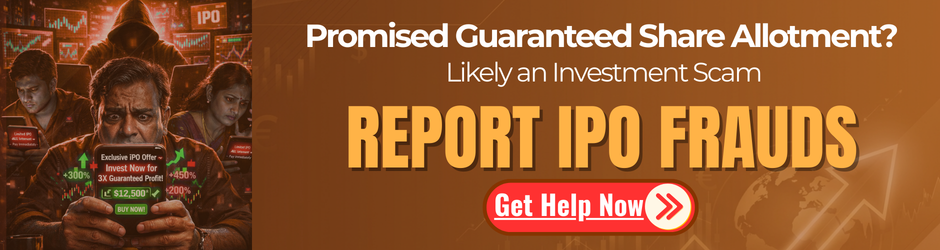
By the time investors realise something is wrong, the money has already moved.
This blog breaks down how IPO scams actually work, real cases from India, and what you can do if you’ve already been targeted.
Because in the stock market, risk is normal. But deception is not.
What are IPO Scams?
An IPO (Initial Public Offering) is when a company offers its shares to the public for the first time.
In a genuine IPO process, you apply through a SEBI-registered broker or your bank using the ASBA/UPI mandate system.
The allotment is decided by rules. It is never guaranteed. And the money stays blocked in your bank account until shares are allotted.
Now compare that with what scammers are offering, a pattern increasingly seen in financial scams in India.
They don’t ask you to apply through your broker. They don’t mention UPI mandates.
Instead, they say:
“You will get confirmed allotment.”
“This is a pre-IPO institutional quota.”
“High listing gain assured.”
And they ask you to transfer money directly to a bank account or through a private app.
That’s not investing. That’s bypassing the entire regulated system.
IPO scams are fraud schemes where criminals misuse the excitement around public issues to collect money from investors under the false promise of guaranteed allotment or high listing gains.
They often create:
- Fake trading platforms
- Fake allotment dashboards
- Fake profit screenshots
- Fake SEBI registration claims
Everything looks structured. Organized. Professional.
But the IPO either never existed, or you were never actually investing in it.
The scam works because it mixes something real. IPO investing, with something completely fake, guaranteed profits, and private allocation.
And that confusion is exactly what traps people.
For a real-world example of how these fake offers operate, see our detailed guide on how to spot fake Indo MIM ipo schemes before investing.
How Do IPO Scams Work?
Most IPO scams follow a pattern. Once you understand the pattern, you start noticing the red flags immediately, especially if you are familiar with the real IPO Process in India.
It usually doesn’t begin with “send money.” It begins with trust.
Step 1: The Approach
You’re added to a WhatsApp group. Or someone claiming to be a market expert contacts you directly.
They talk confidently about upcoming IPOs. They share market updates. Sometimes they even give small stock tips that seem accurate.
Slowly, they introduce a “special IPO opportunity.”
They might call it:
- Pre-IPO placement
- Institutional quota
- Anchor allocation
- Private placement
The language sounds sophisticated. That’s intentional.
Then comes the line that should immediately raise concern: “Allotment guaranteed.”
In real IPOs, allotment is never guaranteed. It depends on subscription levels and the regulatory process.
But scammers know that this is exactly what investors want to hear.
Step 2: The Fake Platform
Once you show interest, they send you:
- A link to download an app (often not from the official Play Store)
- Or login credentials to a professional-looking website
Inside the dashboard, everything looks legitimate.
You see:
- Your investment amount
- IPO shares “allocated” to you
- Listing gains displayed on screen
The numbers increase. The profit looks real.
But it’s only a controlled interface. You are not connected to any stock exchange.
Your money has already gone into the scammer’s bank account.
Step 3: The Bigger Push
After showing you profits, they encourage you to invest more.
“There’s another IPO closing today.”
“Premium category only for serious investors.”
“Last chance to block allotment.”
Sometimes they even allow a small withdrawal first, just to build confidence.
Once you invest a larger amount, the real trap begins.
Step 4: The Withdrawal Trap
When you try to withdraw profits, suddenly new conditions appear:
“Pay 18% tax before withdrawal.”
“Upgrade your account to VIP.”
“Clear margin difference.”
“Your account is temporarily frozen.”
Every time you pay, a new reason comes up.
And when you finally refuse?
The group disappears. The number becomes unreachable, and the app stops working.
By then, the damage is already done.
IPO Scams in India: Real Case Studies
These are not technical market frauds.
These are ordinary investors getting trapped by fake IPO offers.
In most of these cases, there was no real company going public.
The IPO itself was part of the scam.
Let’s look at how it happened.
1. ₹90 Lakh Lost Through a Fake IPO App
In one case, an investor was contacted online and told about “exclusive IPO opportunities.” The person sounded knowledgeable and professional.
He was asked to download a trading app through a private link. Inside the app, everything looked genuine, IPO shares were shown as allotted, profits were visible, and the portfolio value kept increasing.
Over time, the investor transferred money in multiple transactions. The total amount reached around ₹90 lakh.
When he tried to withdraw profits, he was told to pay “tax” first to release the funds. After paying more money, new excuses followed.
Eventually, the app stopped responding. The contacts disappeared.
There was no real IPO. The dashboard was completely controlled by scammers.
2. Fake IPO Shared in a WhatsApp Group
In another case, an investor was added to a WhatsApp group that regularly discussed stock market updates. The group felt active and convincing.
After a few days, the admin introduced a “high-return IPO” and claimed allotment was guaranteed for group members.
Investors were told to transfer money to a bank account to block their allocation. Screenshots of successful allotments were shared inside the group to create confidence.
Some investors even received login details to a web portal showing IPO shares and profits.
But when listing day came, and they tried to withdraw, the system suddenly showed errors. Soon after, the WhatsApp group was deleted.
The IPO application was never processed through any official exchange or bank system.
3. Fake 5paisa App IPO Scam
In one case, a victim lost around ₹24.6 lakh after being lured into a fake IPO investment through a fraudulent 5paisa-like app.
The scammers initially built trust using WhatsApp groups, fake profit screenshots, and small successful withdrawals.
Over time, the victim was encouraged to invest larger amounts, only to find that withdrawals were blocked and additional “charges” were demanded.
This highlights how sophisticated fake trading apps can manipulate users into repeated investments.
4. “Pre-IPO Placement” With Guaranteed Allotment
Another pattern involved offering shares before the IPO was officially launched.
The pitch sounded exclusive:
“This is pre-IPO institutional quota.”
“Retail investors normally don’t get this.”
“Allotment confirmed if you pay today.”
Money was transferred directly to private bank accounts instead of applying through a broker using ASBA or UPI mandate.
Later, investors realised that either:
- The company had no such retail pre-IPO offer, or
- The shares being promised did not exist at all
There was no official application record. No exchange confirmation. No real allotment.
Only a promise.
The names and numbers may differ. But the pattern is almost the same:
- Guaranteed allotment claims
- Direct bank transfers
- Private apps or websites
- Profits shown on fake dashboards
- Tax or fees are demanded before withdrawal
The scam doesn’t look aggressive. It looks organised.
It feels like a rare opportunity.
And that is exactly why people believe it.
How to Protect Yourself from IPO Scams?
Now, the first rule to protect yourself from an IPO fraud case is to never respond to Unknown WhatsApp messages.
Other than this, follow the tips below to stay away from such scams:
- Do proper research: IPO are issued in the stock market after getting approval from SEBI. Make sure you research the company details thoroughly before investing.
- Beware of Unrealistic Promises: These scammers lure people by showing them fake PnLs and promising high returns on investment. Protect yourself from falling for such tactics.
- Never download any App using Links: Trading apps are available on the Play Store, so avoid downloading the app from any other website or platform.
- Check SEBI Registration: In case someone provides you with investment advice, then make sure you check the SEBI registration of that person or a company.
What do I do if I got Scammed Online?
If you realise you’ve been trapped in a fake IPO scheme, the first reaction is usually shock.
Many people hesitate. Some feel embarrassed. Some hope the platform will respond again.
But time matters.
The faster you act, the better your chances of limiting damage.
Here’s what you should do:
1. Collect All Evidence
Before doing anything else, gather everything.
Save:
- Payment receipts and bank transfer details
- UPI transaction IDs
- Screenshots of the app or dashboard
- WhatsApp or Telegram chats
- Contact numbers and links shared
Do not delete the app immediately. Take proper screenshots first.
Clear documentation makes your complaint stronger.
2. Inform Your Bank Immediately
If the transfer was recent, contact your bank’s customer care and report it as a fraud transaction.
In some cases, banks can initiate a freeze request on the beneficiary account if action is taken quickly.
The earlier you report, the higher the possibility of intervention.
3. Report a Complaint in Cyber Crime
You can file an online complaint at the Government of India’s Cyber Crime Portal.
Choose the category related to financial fraud or online investment scam.
Provide:
- Transaction details
- Screenshots
- Account numbers
- Chat records
Be factual and clear. Avoid emotional narration. Stick to evidence.
The most important thing to remember:
IPO scams are not “market losses.” They are financial fraud.
And fraud should always be reported.
4. File a SEBI Complaint
If the fraud involves fake IPO allotment, trading platforms, or misuse of stock market claims, file a complaint with the Securities and Exchange Board of India (SEBI) through its SCORES grievance portal.
Many victims search online for an SEBI Complaint IPO Refund process after realizing they were misled, but the key is to submit a detailed and structured complaint through the official channel.
Provide complete details of the entity, bank accounts used, promotional messages, and any fake SEBI registration claims.
SEBI may not recover your money directly, but your complaint helps trigger regulatory action and prevent further victims.
Need Help?
Falling into a fake IPO trap can feel isolating. Many investors don’t know what to do next. Some delay action. Others file incomplete complaints and lose valuable time.
In one of the IPO scam cases documented earlier, the investor had invested through a WhatsApp-promoted IPO scheme and lost ₹55,000.
By the time he approached us, he had payment proofs and chat records, but was unsure how to structure his complaint.
We helped him:
- Organise transaction details properly.
- Draft a clear and structured complaint.
- File it through the appropriate cyber and banking channels.
- Escalate the matter where required.
Timely reporting and proper documentation made a difference in that case, and ₹55,000 was successfully recovered.
Recovery is never automatic. It requires speed, clarity, and correct procedure.
If you have been targeted in an IPO scam, don’t panic, but don’t delay either.
Register with us so we can review your case, help you organise your evidence correctly, and guide you through the reporting and escalation process step by step.
The right action at the right time can change the outcome.
Conclusion
IPO investing is meant to be a regulated, transparent process. Applications are routed through banks. Allotments are system-driven. Profits, if they come, depend on market performance.
But IPO scams distort that excitement.
They replace regulated platforms with private apps and replace random allotment with “guaranteed allocation.”
The most dangerous part is not the promise of high returns.
It’s the illusion of legitimacy.
Professional-looking dashboards. Confident advisors. Active WhatsApp groups. Everything is designed to make the opportunity feel real.
If someone promises confirmed IPO allotment outside the official system, pause.
Real IPOs do not require private transfers. They do not demand tax before withdrawal. And they do not operate through secret links.
In the stock market, risk is part of investing. But fraud is not.
Stay cautious. Verify before transferring money. And if something feels rushed or too certain, step back.
Because real opportunities don’t need pressure.




 Add us as a preferred source on Google »

