Have you ever looked at a forex profit screenshot and thought, “If they can do it, why not me?” That little spark is exactly what scammers and shady platforms target.
On one side, forex is a legitimate global market. On the other hand, in India, it is tightly controlled and often misused.
So, is forex trading safe?
The honest answer is: it depends on where and how you do it.
Let’s walk through the Indian rules, the legal line, and some real scam stories that feel uncomfortably close to home.
Is Forex Trading Safe in India?
This is where many people get trapped. They hear “forex is legal in India” and assume every forex app is allowed.
The truth is more nuanced. Forex trading is legal when:
- You deal with authorised persons like banks and licensed financial institutions.
- You trade permitted currency pairs like USD-INR, EUR-INR, GBP-INR, and JPY-INR through Indian exchanges as currency derivatives.
- You use a SEBI-registered broker who is a member of NSE, BSE, or MSE.
- You are not sending money abroad for leveraged online forex speculation.
Here, you are inside the RBI + SEBI fence. You may still lose money to the market, but you are not breaking the law.
RBI even keeps an Alert List of names that are not authorised to deal in forex or run platforms. If a name appears there, that is a giant red flag. If it does not appear, that still does not mean it is safe.
So, the legal summary is simple: Forex is legal only in the regulated lane. Everything else sits in a mix of illegal + unsafe.
Not only is it illegal, but if you are caught trading through unauthorised apps or foreign platforms can attract penalties under FEMA, and in serious cases, legal consequences.

There is no regulatory protection if things go wrong, no authority to complain to, and no guarantee your money even exists once it’s deposited.
In India, forex trading safety starts with one simple filter.
If the broker is not SEBI-registered, not linked to Indian exchanges, and not operating under RBI-approved rules, then it is not safe, legally or practically.
Forex Trading Scams in India
Now let’s talk about what is actually happening on the ground because this is where the rules meet real people.
Illegal forex trading is one of the fastest-growing scams today.
The pattern looks familiar:
- You get added to a WhatsApp or Telegram group.
- Someone shares daily “profit screenshots”.
- You are told to deposit a small amount first.
- You see fake profits on the screen.
- You are convinced to add much larger amounts.
- Then, withdrawals get blocked or a “tax” is demanded.
Let’s look at three real cases.
Case 1: ₹800 crore Illegal Online Forex Scam
In June 2025, the Enforcement Directorate in Mumbai conducted pan-India raids in an illegal forex trading case.
The fraud ran through the OctaFX trading app and website.
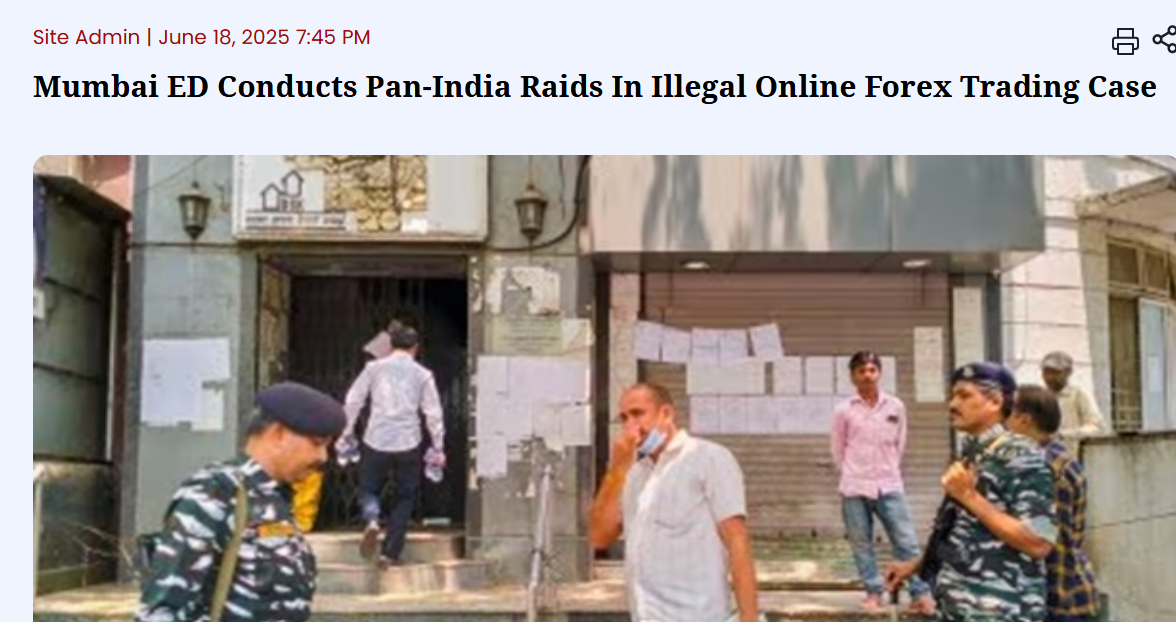
Hundreds of investors across India were cheated out of over ₹800 crore in the name of forex trading. OctaFX, along with an Indian company, operated without RBI authorisation.
Investor money was routed through mule accounts, fake e-commerce firms, and unauthorised payment gateways.
Think about that for a second.
These were not “careless gamblers”. They were normal people, trusting a polished app, believing it was just “online trading”.
Case 2: Karnataka Woman Duped of ₹11.5 lakh
In Mangaluru, a woman filed a complaint after losing ₹11.5 lakh in a forex trading fraud.
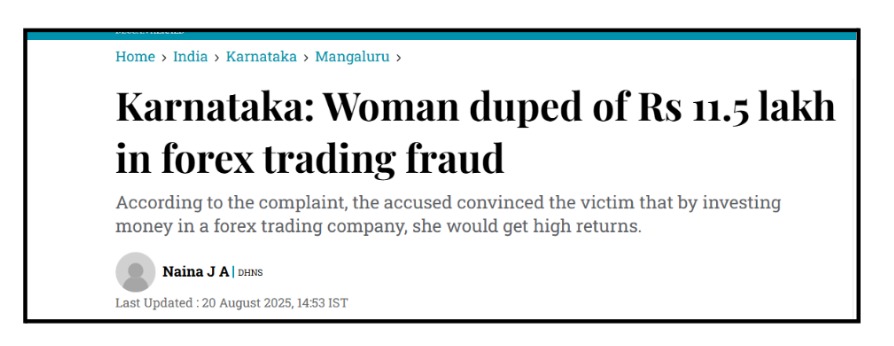
According to the report:
- The accused convinced her that investing in a “forex trading company” would give her very high returns.
- She kept depositing money across multiple transactions, believing the promises.
- When reality sank in, the money was gone, and the “company” was nowhere to be found.
Behind that number, ₹11.5 lakh is someone’s savings, dreams, and trust. Legitimate Forex trading is extremely volatile. Scammers hide this reality and present it as a “guaranteed income” scheme.
Case 3: Hyderabad Businessman Loses ₹3.28 crore
In Hyderabad, a businessman lost a staggering ₹3.28 crore in another forex trading scam. He was introduced to a platform linked to Anzo Capital Global. He was told to convert rupees to USDT and send it via RTGS to various “merchants” to fund his trading wallet.
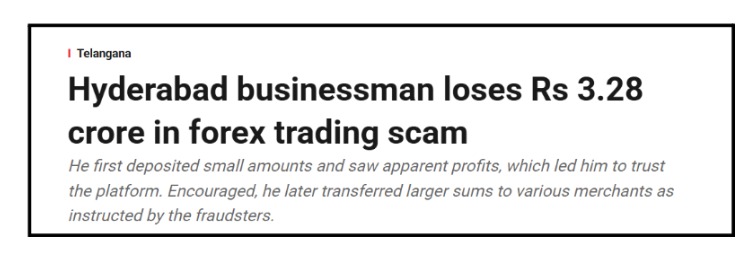
At first, he deposited small amounts and saw apparent profits on the platform. Encouraged, he kept adding bigger sums between January and May. When he tried to withdraw, the platform demanded ₹60 lakh as “tax”.
Even after paying, he got only partial withdrawals. Then came more demands, more excuses, until he realised he had been cheated and approached the Telangana Cyber Security Bureau.
This case shows how scams play a long game. They don’t just attack greed. They slowly build fake trust until you are deeply trapped.
How to Report Forex Trading Complaints in India?
If any of this sounds close to what you experienced, you might be feeling angry, scared, or even embarrassed. Those feelings are normal. But silence only helps the scammers.
Here is what you should do for forex trading scam recovery:
- Visit your local police station or cyber crime cell.
- Collect every detail, such as app name, website, numbers, transaction receipts, and chat screenshots.
- If the platform claimed to be a broker, or used the words “investment” or “trading” in a structured way, file a complaint with SEBI.
- If unauthorised forex platforms or ETPs were involved, the RBI’s FAQs direct victims to file a cyber crime complaint online and with enforcement agencies.
The earlier you act, the better the chance of tracing the money trail.
Need Help?
If you got trapped in a forex trading platform, or you are staring at a screen that won’t let you withdraw, you do not have to deal with this alone.
We will walk you through how to structure your complaint, which authority to approach first, and how to preserve the evidence properly.
Conclusion
So, is forex trading safe?
It can be, but only on recognised Indian exchanges like NSE, BSE, or MSE. Trade only inside the legal fence.
Treat anything outside it as a potential trap.
If you are unsure whether a platform is safe, it is always better to pause, question, and get it checked before your money goes in.