
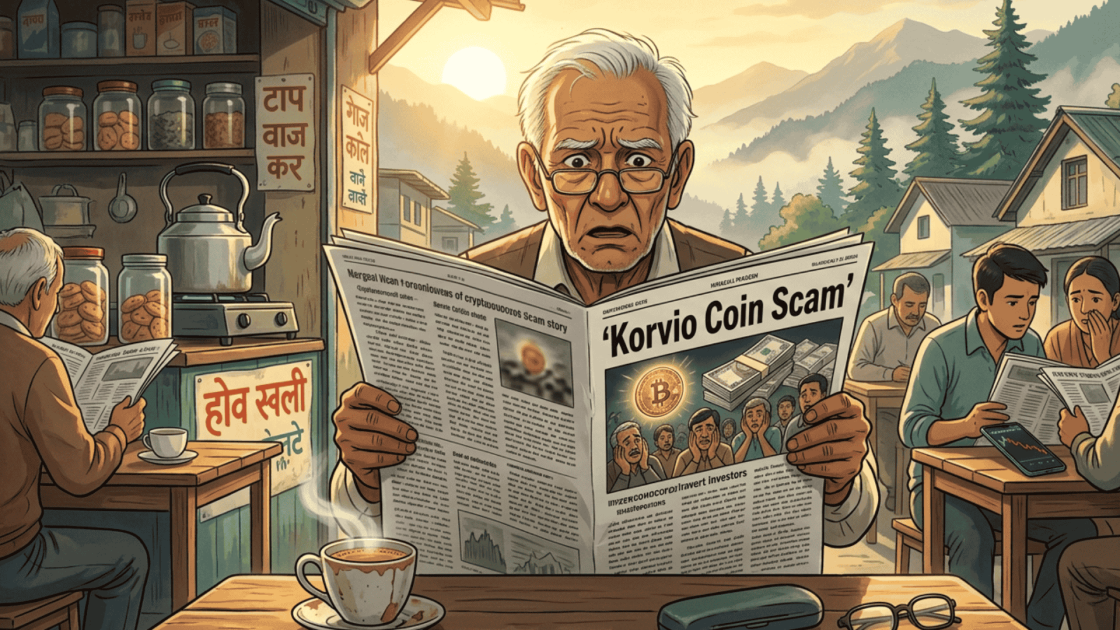
It started with a man who used to sell soap.
Not stocks. Not crypto. Not anything you would associate with a ₹500 crore financial fraud. Subhash Sharma, a graduate from the small town of Sarkaghat in Himachal Pradesh’s Mandi district, spent his early years going door to door, selling consumer goods through multi-level marketing.
Detergents. Supplements. The usual MLM kit.
He learned one skill better than anyone around him: how to make a stranger trust him, and how to make that stranger recruit ten more strangers.
In 2018, he decided to stop selling soap. He had found something far more profitable to sell.
He decided to sell a coin that did not exist.
How Korvio Coin Was Created?
Subhash Sharma did not do it alone. Alongside co-accused Hem Raj, Sukhdev Thakur, Abhishek Sharma, and Radhika Sharma, he launched a cryptocurrency-based MLM scheme.
The product was a “cryptocurrency” they named Korvio Coin, or KRO.
To the average person in a Himachal village in 2018, the word “cryptocurrency” sounded like the future.
Bitcoin was in the news. People were hearing stories of overnight millionaires. Nobody understood how it worked, and that was exactly the point.
The technical muscle came from outside.
A Meerut based engineer, Milan Garg, was brought in to design and market the fake coins and build the websites that would display their prices.
And those prices were not real. They were numbers on a screen, typed in and changed at will by the very people selling the coin.
To make it look serious, the operation was eventually shifted onto foreign servers hosted by DigitalOcean, running through domains like korvio.io and voscrow.com.
Keeping the infrastructure outside India was not an accident. It was insulation. It made the operation harder for Indian authorities to reach and easier to wipe clean later.
The Promise of 10% Every Month: The Classic Ponzi Structure
The offer was simple and devastating: invest in Korvio Coin and earn returns as high as 10 percent every single month.
Read that again.
Ten percent a month.
That is 120 percent a year. No bank, no mutual fund, no legitimate business on earth pays that consistently.
But Sharma was not selling math. He was selling a feeling. He charged an activation fee to switch on each new account, then watched the network do its work.
And here is the cruelest part of the design. The early investors actually got paid. Their 10 percent landed in their accounts like clockwork.
Where did that money come from?
Not from any coin appreciating. It came from the next person who invested. And the next. This is the engine of every Ponzi scheme ever built: new money paying old money, dressed up as profit.
As long as fresh victims kept arriving, the illusion held perfectly.
When the early believers saw real returns, they did something the fraudsters were counting on. They became salesmen themselves.
They roped in family. Friends. Neighbours.
Some individuals reportedly brought in up to 1,000 people each. The fraud no longer needed Sharma to sell it. It sold itself.
When 1,000 Police Officers Became the Sales Force?
Then came the twist that turned a scam into a phenomenon.
Over 1,000 police personnel in Himachal Pradesh put their money into Korvio Coin. And some of them did not stop at investing.
A number of them took voluntary retirement from the force, walked away from their government jobs, and became full-time promoters of the scheme.
Think about what that does to an ordinary person’s judgment. When the constable in your town, the man who is supposed to catch criminals, is telling you this is real, who are you to doubt it?
The presence of police officers gave the fraud a stamp of credibility no advertisement could ever buy. In total, around 5,000 government officials were caught in the web.
Teachers. Babus. Even people who had just received compensation money from the four-lane and national highway land acquisitions handed it straight to Sharma’s network, chasing a quick fortune.
By now the coins had multiplied too. Korvio was joined by DGT Coin, and later by another fake token called Hype.
The playbook repeated each time: pump the price on a fake website, let people buy in at the high, then crash it deliberately. A textbook rug pull, executed again and again.
How COVID Collapsed the Scheme and Left 2.48 Lakh Investors Stranded?
Every Ponzi scheme has one fatal weakness. It must keep growing, or it dies. The moment new money slows, the whole structure collapses inward.
That moment arrived in the form of a pandemic.
When COVID-19 brought economic life to a standstill around 2020, the flow of new investors dried up.
With no fresh money coming in, the returns stopped. Investors who had been getting their monthly payouts suddenly found their accounts frozen and their calls unanswered.
When they pushed for answers, they did not get refunds. They got threats. Report this to the police, they were warned, and you will lose every rupee you put in.
For a while, fear did its job and kept people silent. But fear has a shelf life.
As losses mounted into 2022, victims began to come forward, first in a trickle, then in a flood. The scale that emerged was staggering: more than 2.48 lakh users had been pulled in.
Total transactions had crossed USD 219 million. The estimated loss to ordinary investors stood at around ₹500 crore.
Where Did ₹500 Crore Go? The ED Found Out
Where did all that money go?
According to the Enforcement Directorate (ED), the funds collected through this massive crypto ponzi scheme were primarily routed to two individuals, Vijay Kumar Juneja and Masoom Juneja.
Once the cash reached them, it was allegedly used to buy immovable properties, with one clever trick: the properties were registered at values far lower than what was actually paid.
The gap was settled in cash. This is how black money becomes brick and mortar, with the paper trail deliberately kept thin.
Investigators also found that a portion of the proceeds was converted back into cryptocurrency to scramble the audit trail even further.
The ED found that the two Junejas were nominees in several employee-held accounts, indicating effective control over the channels used to layer and hide the proceeds of crime.
The Arrests, the Seized Assets, and the Man Still Running
The kingpin saw it coming.
As the scheme came apart, Subhash Sharma fled the country, reportedly to Dubai, with his family.
He remains a fugitive to this day. His technical man, Milan Garg, was arrested.
Co accused Sukhdev, Abhishek and Hemraj spent long stretches in judicial custody.
By late 2023, the Special Investigation Team had made 18 to 19 arrests and attached around ₹18 crore in assets.
Then the central agency moved in.
On 15 June 2026, the Enforcement Directorate’s Shimla office conducted search operations against Vijay Kumar Juneja and Masoom Juneja under the Prevention of Money Laundering Act, recovering incriminating documents and digital devices.
Masoom Juneja was arrested under Section 19(1) of the PMLA.
The investigation into the full quantum of laundered money is still ongoing.
What the Korvio Coin Fraud Teaches Every Investor?
Strip away the word “cryptocurrency” and this story is as old as greed itself. A charming salesman.
A promise too good to be true. Early winners who became loud believers. And a structure that was always going to collapse, taking the latecomers down with it.
No regulator approved Korvio Coin. No exchange listed it. No law protected the people who bought it. It was a number on a website controlled by the men selling it.
Knowing how to identify fake cryptocurrency before you invest is not a technical skill. It is a survival skill.
Ask whether the coin trades on any regulated, independently verifiable exchange. Ask whether the returns being promised exist anywhere in the legitimate financial world.
If someone is showing you prices on a private website and promising guaranteed monthly returns, you are almost certainly looking at a fake crypto exchange, not a real market.
If an investment promises you fixed, guaranteed, sky high returns every month, that is not an opportunity.
That is the oldest warning sign in the book. The uniform of the man recommending it does not change the math.
And by the time the music stops, the person who started the dance is usually already in another country.
If you invested in Korvio Coin, DGT Coin, or Hype and lost money, your options depend on what you preserved.
The ED investigation is ongoing. That means the window to add your name to the victim record is still open.
Payment receipts, WhatsApp conversations, bank transfer records, account screenshots, any of these can support a formal complaint.
SEBI, the ED, and cybercrime portals all accept investor complaints in cases like this.
Filing formally does three things: it creates a record of your loss, it adds pressure to the ongoing investigation, and it positions you for any recovery if assets are eventually liquidated.
How to Get Recovery from Korvio Coin?
Recovering funds from an unregulated crypto Ponzi scheme is complex, but it is not entirely impossible if you act while the legal machinery is moving.
Because the Enforcement Directorate (ED) and local cyber units are actively tracing assets and conducting arrests, registering yourself officially as a victim is a critical step.
To build a strong case for recovery, you must systematically organize every piece of evidence you have.
This includes bank transaction slips, crypto wallet IDs, screenshots of your Korvio/Voscrow dashboards, and any WhatsApp or Telegram chats with the promoters.
We specialize in helping victims of unregistered investment schemes navigate this process.
We can help you organize your evidence, map out the money trail, and file your complaints in the correct legal sequence to maximize your chances of recovery.
Reach out to us today. We will review your case details and give you an honest assessment of your situation before you commit to any next steps.
Conclusion
Subhash Sharma sold soap door to door. Then he sold a coin that did not exist, and 2.48 lakh people bought it.
No regulator approved Korvio. No exchange listed it. No law protected the people who trusted it. The price on the screen was a number typed by the man selling it.
The scheme is gone. The investigation continues. The fugitive is still out there.
If you lost money in Korvio Coin, that money has a trail. Evidence preserved today is a claim that can still be made.
Do not sit on it.
Frequently Asked Questions
1. What was Korvio Coin and was it a real cryptocurrency?
No. Korvio Coin, also known as KRO, was a fake cryptocurrency created by Subhash Sharma and associates.
It had no underlying blockchain technology, no real market trading, and no regulatory approval from any authority. The prices displayed on the website were manually set by the operators.
It was a Ponzi scheme dressed as a cryptocurrency investment.
2. How many people lost money in the Korvio Coin scam?
According to investigation records, more than 2.48 lakh users were affected.
Total transactions crossed USD 219 million, and estimated investor losses stand at approximately ₹500 crore.
Over 1,000 police personnel and around 5,000 government officials in Himachal Pradesh were among those who invested.
3. Was Subhash Sharma arrested for the Korvio Coin fraud?
Subhash Sharma, the alleged mastermind, fled India, reportedly to Dubai, and remains a fugitive.
Several co-accused, including Milan Garg, Sukhdev Thakur, Abhishek Sharma, and Hem Raj, were arrested.
On 15 June 2026, the Enforcement Directorate arrested Masoom Juneja under Section 19(1) of the Prevention of Money Laundering Act in connection with the case.
4. I invested in Korvio Coin and lost money. What can I do now?
Preserve all evidence immediately: payment receipts, bank transfer records, WhatsApp conversations, account screenshots, and any promotional material you received. The ED investigation is ongoing.
You can file a complaint with the cybercrime portal at cybercrime.gov.in, the Enforcement Directorate, and your local police.
Formal complaints add your name to the victim record and strengthen the case for asset recovery if the investigation reaches that stage.




 Add us as a preferred source on Google »

