
Most people do not wake up planning to fall for a lottery scam. It usually starts very casually – a message pops up, a call comes in, or a post appears on social media.
Someone tells you that you have won something. Big money. Maybe life-changing money.
And for a split second, you think, “What if?”
That’s exactly where lottery scams in India get you.
Across India, people from all age groups, students, working professionals, and retirees have lost money to fake lottery wins. Some lost a few thousand rupees, others lost their savings.
And almost everyone says the same thing later: “It felt real at the time.”
In this blog, we will break down how lottery scams operate, how to spot them, real cases where people lost money, and what you should do if you encounter one.
What Are Lottery Scams?
Lottery scams are frauds built around one simple promise: big money with very little effort. Scammers use that promise to convince people to send payments, share personal details, or follow instructions that slowly drain their savings.
These scams usually reach people through:
- SMS alerts that look official
- WhatsApp or email messages
- Sponsored posts on social media
- Fake mobile apps claiming to sell or check lottery tickets
Because India has legitimate state lotteries, scammers copy their names, logos, and language. That familiarity lowers suspicion. What starts as excitement slowly turns into pressure, and by the time doubt appears, money has already been sent.
The danger is not only financial. Many victims later realise their identity details were also misused, opening the door to future fraud.
Common Types of Lottery Scams in India
Lottery scams come in various forms, but they all have one goal: to trick you into giving away your money or personal information.
Whether it’s a fake email claiming you’ve won a jackpot, a phone call pressuring you to pay taxes, or a fraudulent cheque that later bounces, scammers use different tactics to appear authentic.
They often create urgency, use official-looking documents, and demand payments. Recognising these red flags can help you avoid falling victim to these frauds.

Let’s now dig deeper to uncover some of the common lottery scams.
1. Fake Lottery Emails & Messages
You get an email or SMS claiming you’ve won a huge prize in an international lottery. These messages often look official, using well-known logos and names.
However, there is an easily identifiable red flag: you need to pay a small fee or tax to claim your winnings.
Other than this, there are other ways by which you can spot lottery-related email frauds in India:
- You never participated in any lottery.
- The sender’s email looks suspicious (e.g., generic Gmail/Yahoo accounts).
- They demand upfront payments before releasing the prize.
2. Fake Phone Calls from “Lottery Officials.”
A caller claims to be from a well-known lottery company and tells you that you’ve won big.
They pressure you to act fast or risk losing the prize. Some even ask for your bank details, claiming they’ll “deposit” the money directly.
Now, your little alertness can protect you from the trap:
- Callers ask for sensitive details like bank information or OTPs.
- They insist on secrecy and rush you to make payments.
- They ask for payments through untraceable methods like gift cards, UPI, or wire transfers.
3. Lottery Cheque Fraud
Scammers send a fake cheque as your “prize money” and ask you to deposit it. But before processing the cheque, they ask you to pay a portion of the money as processing fees.
After making the payment, however, when you deposited the cheque, it bounced, leaving you at a loss.
Now, think twice before you act to protect yourself from getting into the trap:
- The cheque looks suspicious or has errors in printing.
- The sender urges you to deposit it quickly.
4. Scratch Scams
Scammers generally target people by sending emails containing glossy brochures and scratch cards, one of which contains a prize for the winner. To make it look more authentic, they mention the second and third prizes too.
Now, in most cases, the scammer declares you a winner by offering high-value prize money or gifts.
And here is the catch: To claim the prize, you need to deposit some fees or GST.
Instead of following instructions blindly, it is important to:
- Be a little alert and check the source.
- Make sure that you have applied for any such lottery or gift scheme
- Not to give any kind of bank or personal details.
4. Smartphone Gift Scam
Scammers impersonate themselves as bank or other financial institution executives and offer smartphones as a gift in return for maintaining a good credit score.
They then deliver the phone to your address in a branded box with a logo and name that looks reliable and authentic.
You start using the phone without realizing that it contains malware that steals and shares all your personal and sensitive information with the scammer.
By the time you realize the scam, your bank account is nearly emptied.
To avoid such scams:
- It is always good to verify such calls and offers from your bank.
- Avoid receiving unexpected gifts.
- Check and reset the phone before using it.
How to Avoid Lottery Scams?
Most lottery scams give off warning signs if you slow down enough to notice them. Winning a life-changing amount of money out of the blue is an exciting thought, but it is also the most common hook used by scammers.
These frauds work by playing on your emotions to get you to act before you think. If you slow down and look at the details, the red flags are usually right in front of you.
Here is a breakdown of what to watch out for:
1. Advance payments
This is the biggest warning sign of any lottery fraud. A real lottery will never ask you to pay money out of your own pocket to receive a prize.
If they tell you that you need to send money for a processing fee, customs duty, or a transfer tax before you get your winnings, it is a scam.
2. Unexpected contact
You can not win a lottery that you never entered. Scammers will often reach out through email, text, or a social media DM claiming you have won a random global draw or a lucky selection.
If you do not have a record of buying a ticket or entering a specific contest, then the message is fake. Real organizations do not just pick random people from the internet to give millions of dollars to.
3. Unofficial communication
Legitimate organizations use professional channels and verified email addresses. If you get a message from a random person on WhatsApp or an email from a free account like Gmail or Yahoo, you should be very suspicious.
Scammers also tend to use a lot of typos, weird grammar, and generic greetings like “Dear Winner” instead of using your actual name. They also try to create a sense of extreme urgency to stop you from double-checking the facts.
4. Requests for sensitive data
A real prize payout might require your ID for verification, but it will never require your private security codes.
If a representative asks for your banking PIN, an OTP sent to your phone, or your password to “verify your identity,” they are trying to hack your account.
5. Over-the-top rewards
If a prize sounds too good to be true, it almost always is. Scammers promise massive rewards like millions of dollars or luxury cars for zero effort to trigger your excitement and cloud your judgment.
When the prize is huge, and you do not have to do anything to earn it, it is usually just bait.
Real Lottery Scam Cases in India
Even after a lot of awareness, people are getting trapped in lottery frauds, which is revealed by the number of reported cases in India.
These cases will help you understand how do lottery scams work.
Cases Include:
1. Hyderabad Woman Loses ₹42.7 Lakh in KBC Lottery Scam
This is a perfect example of how scammers use the names of famous shows to build trust. A woman was told she won a massive ₹1.3 crore prize from Kaun Banega Crorepati, and to make it look real, the fraudsters sent her fake posters and even counterfeit cheques with celebrity photos. 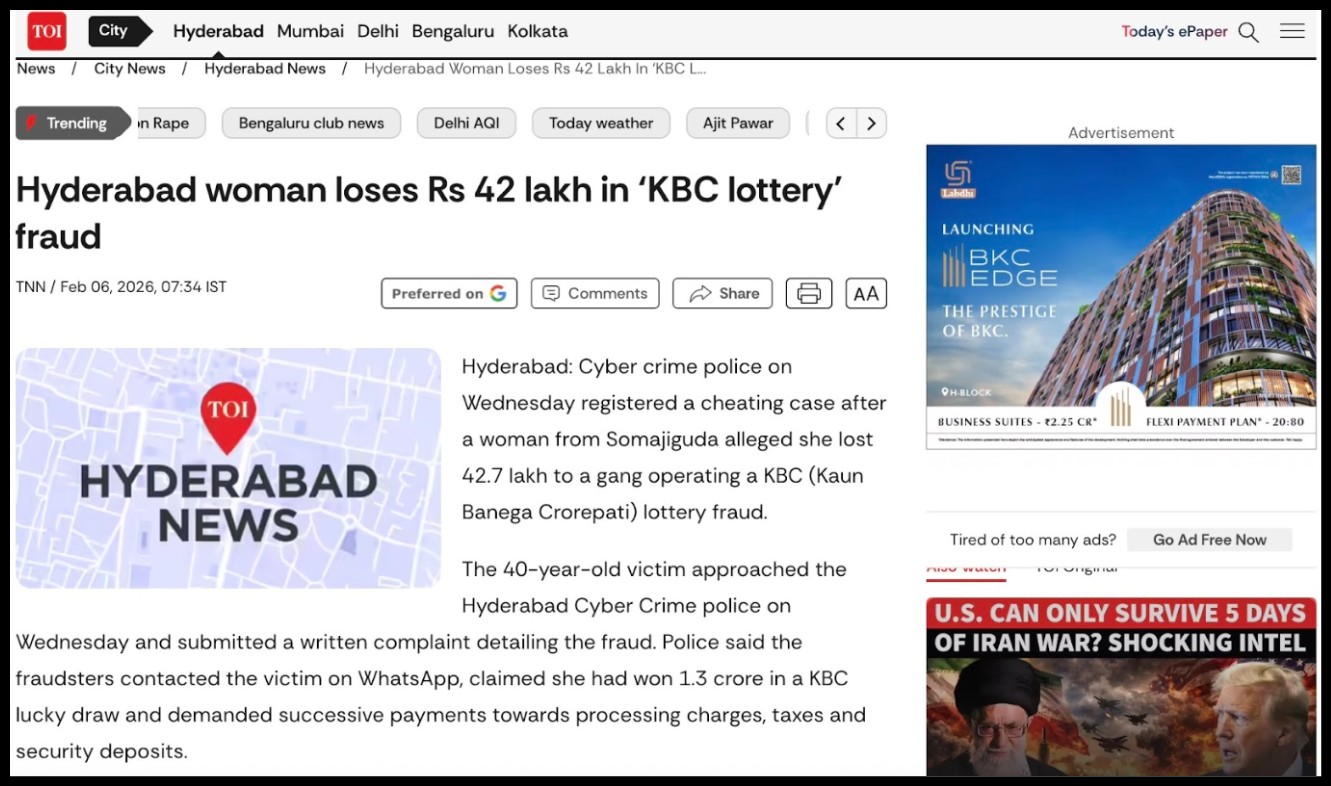
By the time she realized the prize didn’t exist, she had already transferred over ₹42 lakh then immediately approached cyber crime police and submitted a written complaint.
2. Kerala Authorities Find 60 Fake Lottery Apps
In this case, the scale of the fraud was huge. Kerala police discovered about 60 different mobile apps that were pretending to sell official state lottery tickets. These apps looked almost identical to the real government ones, using the same logos and colors to fool people.
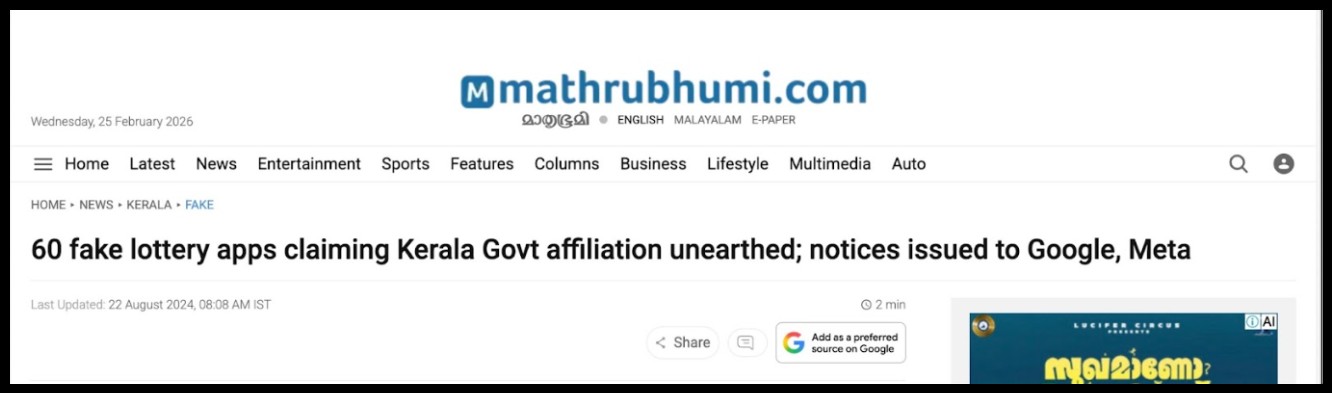 Once a user downloaded an app and “won” a prize, the scammers would immediately start asking for GST and stamp duty payments to release the money.
Because the apps were promoted so heavily on social media, thousands of people were at risk of being tricked into paying for prizes that never existed.
3. Hyderabad Man Scammed of ₹2.1 Lakh in Fake Kerala Draw
A 67-year-old man fell into a trap that started on Instagram, where he was told he had won ₹5 lakh in a lucky draw. He likely recognized the name of the Kerala lottery and assumed the message was legitimate.
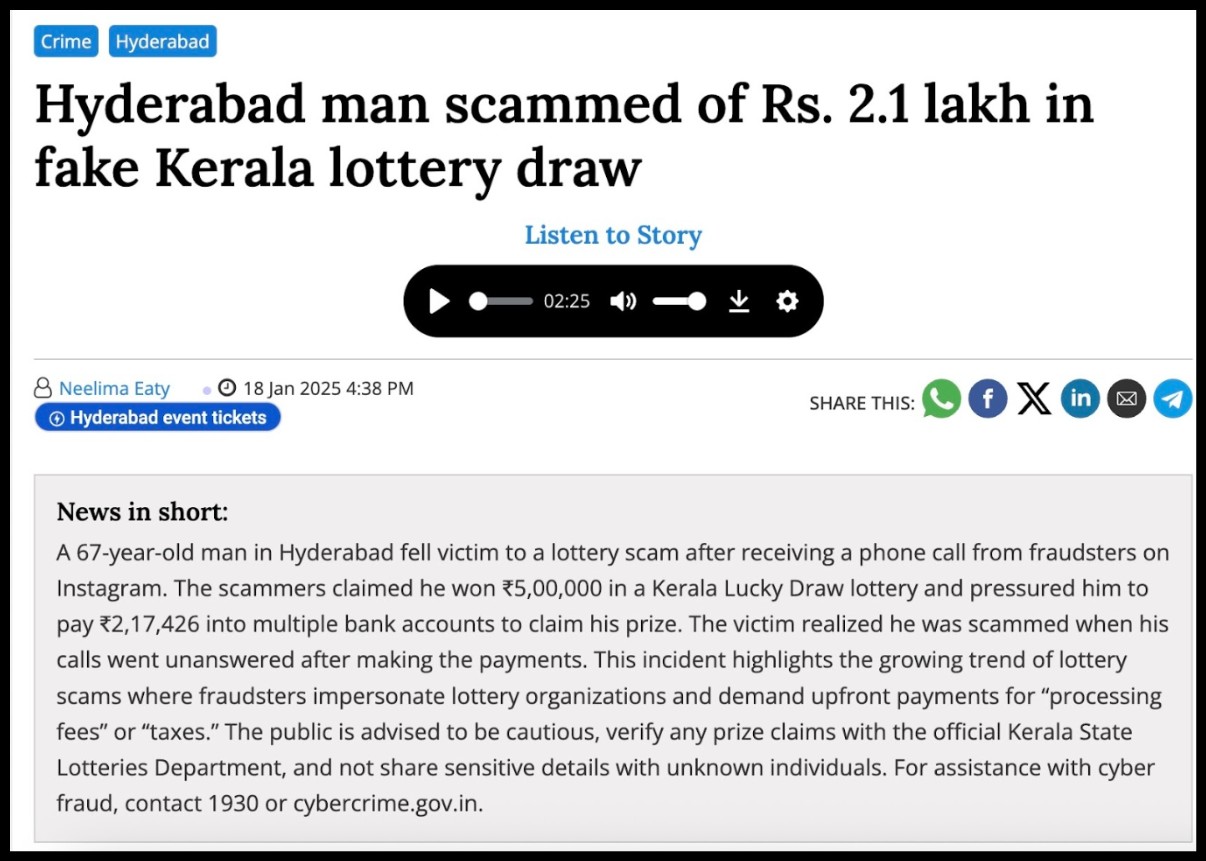 Over just a few days, he made multiple transfers to different bank accounts, believing he was paying necessary fees to get his winnings. The scammers were very organized.
They gave him just enough information to keep him trusting them until they had taken over ₹2 lakh. As soon as the last payment went through, they deleted their accounts and disappeared completely.
4. Delhi Gang Arrested for Running Fake Lottery/Gift Fraud
This case involved a very sophisticated international gang operating right out of Delhi. The police arrested six people, including two foreign nationals, who were running a massive operation to trick people into paying for fake lotteries and expensive gifts.
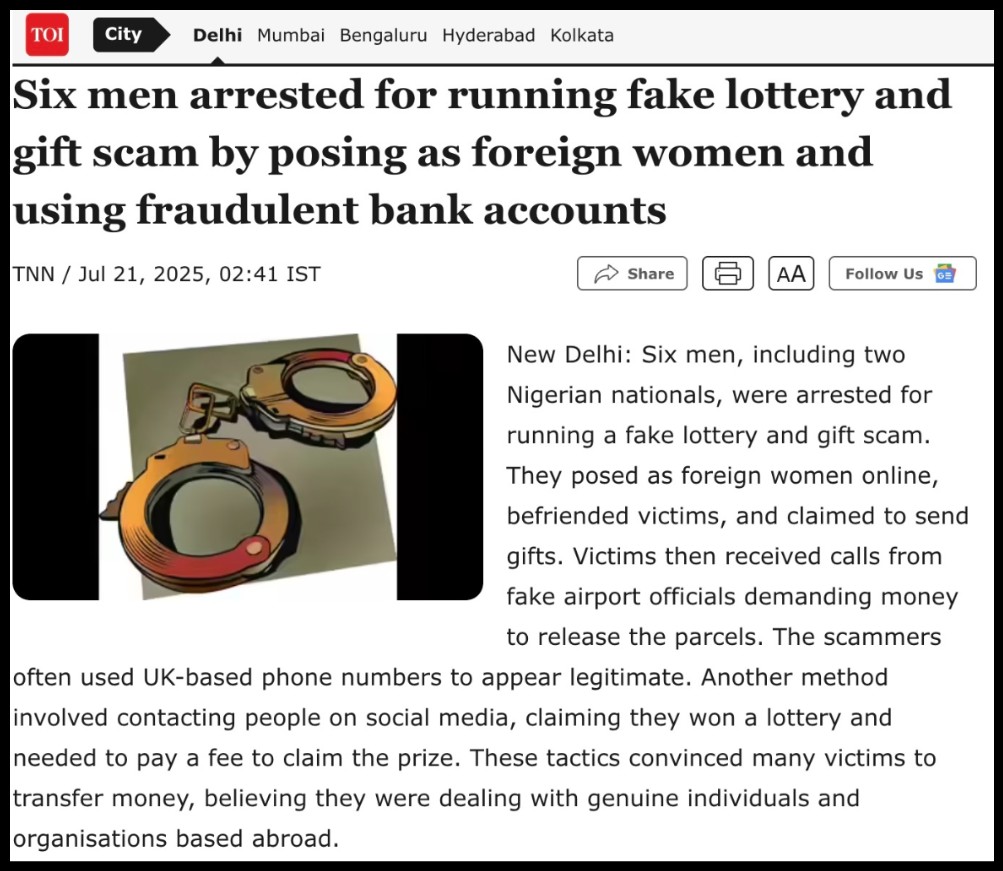 They didn’t just send messages; they used forged documents and fake bank accounts to make it look like they were part of a real delivery or financial service.
They would tell victims that a valuable parcel was stuck at customs and needed a clearance fee to be released. Their arrest showed that these are not just lone scammers, but organized groups that work together to find and exploit people.
Where To Report a Lottery Scam In India?
If you believe you have been targeted by a lottery scam or have already lost money, it is important to act quickly.
Reporting the incident and preserving evidence can increase the chances of tracking the fraud and preventing further losses.
1. Save All Evidence
Keep every piece of communication related to the scam. This includes messages, emails, call logs, screenshots, payment receipts, bank statements, and any documents shared by the scammers.
2. File a Cyber Crime Complaint
You can file a complaint through the official cybercrime reporting platform managed by the Indian Cyber Crime Coordination Centre under the Ministry of Home Affairs.
Visit the portal and submit all relevant details about the scam. You can also call the national cybercrime helpline, which is designed to help victims of financial cyber fraud report incidents quickly.
3. Inform Your Bank Immediately
If you transferred money to the scammers, contact your bank as soon as possible. Banks can sometimes freeze suspicious transactions or flag the receiving account if the report is made quickly.
Early reporting may improve the chances of tracing the funds or preventing additional unauthorized transactions.
4. Approach the Local Police or Cyber Cell
For significant financial losses, you may also consider filing a First Information Report (FIR) at your nearest police station or visiting a specialized cybercrime cell.
Law enforcement agencies can register the complaint and initiate further investigation into the fraudulent activity.
Taking these actions quickly can help authorities respond more effectively and may reduce the chances of further damage.
Need Help?
Discovering that you may have been targeted by a scam can be stressful and overwhelming. Many people feel embarrassed, frustrated, or anxious in such situations, but these reactions are completely normal.
If you are unsure about what to do next, reach out to us.
We can assist you by:
- Explaining What Evidence to Collect: We help you identify the key documents and records that authorities may require, such as communication logs, payment proof, or screenshots.
- Organising Your Complaint: Preparing a clear and structured complaint improves the chances that investigators will understand the situation quickly. We assist in organising information before submitting it through official channels.
- Guiding the Cybercrime Reporting Process: Filing complaints on government portals or approaching law enforcement agencies can sometimes feel confusing. We help explain the steps involved so that you can report the incident properly.
- Helping You Understand the Next Steps: After filing a complaint, victims often wonder what happens next. We help you understand the possible follow-up actions, including communication with banks, police, or cybercrime authorities.
Taking action early often reduces stress and may improve the chances of resolving the issue. If you need assistance understanding your options, register with us.
Conclusion
Lottery scams succeed because they combine two powerful emotions: hope and urgency. When someone receives a message promising a large prize or unexpected winnings, it can feel exciting and tempting to respond quickly.
However, legitimate lotteries do not ask winners to pay advance fees to claim their prize. Requests for payment, personal information, or urgent action are common warning signs of fraud.
Before responding to any message about a lottery win, take a moment to pause and verify the information. Question unexpected prizes, check official sources, and speak with someone you trust before making any financial decision.
By staying cautious, verifying claims, and reporting suspicious messages, individuals can reduce the risk of becoming victims of fraud.
Stay alert. Stay informed. And protect your finances from scams that rely on pressure and deception.