

Quick Summary
SEBI’s final order finds that Madhav Stock Vision Pvt. Ltd., a registered stock broker, ran a front running scheme against the trades of LIC, the country’s largest institutional investor. The method was almost absurdly simple: two dealers sat close enough to overhear LIC’s orders at neighbouring desks, phoned a friendly proprietary desk that traded seconds ahead of LIC, and split the profit through fake salaries. SEBI ordered ₹2,51,15,698 disgorged with 12 percent interest, banned all six parties for a year, and fined each ₹5 lakh. This page shows how the scheme worked, in their own recorded words, and why it matters to you even though you are not LIC.
You have probably never heard of Madhav Stock Vision, and until this order, there was no reason to.
Then SEBI published the recordings, and a scheme built on nothing more than a shared office floor and a pair of good ears came apart in public.
No hacking, no forged documents, no complex derivatives.
Two dealers overheard LIC’s orders being dictated at the next desk, and a broker’s proprietary account traded on what they heard, 1,693 times.
This page walks through the whole operation, the phone call that gives it away, who did what, and what SEBI’s final directions mean.
What is Front Running and How Does It Work?
Start with the thing being abused, because once you see it, the rest is obvious.
When a giant like LIC decides to buy a few lakh shares of a company, that order is big enough to nudge the price up on its own.
The moment those shares start getting bought, the price drifts higher.
So if you knew, seconds before LIC’s order hit the market, that it was coming, you could buy the same share first, wait for LIC’s buying to push the price up, and sell into that rise for a quick, near-certain profit.
You would be running in front of the big order. That is front running, and it is illegal precisely because your profit is stolen from the price the big client should have got.
The information about what LIC is about to buy, before it buys, is what the rules call non-public information.
Getting hold of it and trading on it is fraud under SEBI’s rules.
If you want the fuller mechanics and other examples, our explainer on the Ketan Parekh front running scandal walks through how these schemes are built.
This case is a smaller, quieter, and in some ways more ingenious version of the same idea.
Three Brokers, One Office Floor: Where this Front Running Scheme Began
Most front running needs a leak. Somebody on the inside has to pass the secret out.
Here, there was barely a leak at all.
There was a wall, or rather, the absence of one.
Three of LIC’s empanelled brokers operated their dealing desks from the same office, at Kemp Plaza in Malad West, Mumbai. When LIC wanted to trade, it phoned these desks and dictated its orders.
The dealers placing those orders spoke them aloud, across a shared floor.
Two dealers on that floor, Jyotiswaroop Nandkishore Purohit and Pankit Bhagwati Jhaveri, worked for one of those brokers and handled some of LIC’s own orders themselves.
But because the desks of the other two brokers were right there, they could also hear the LIC orders those desks were handling.
So they listened. And what they heard, they sold on.
How Phone Call Transcripts Exposed Madhav Stock Vision Front Running Scheme?
SEBI’s order reproduces the actual recorded conversations, and one of them is worth walking through because it shows the whole scheme happening in real time.
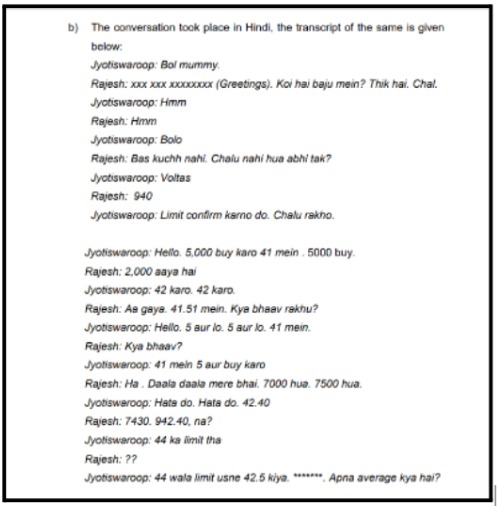
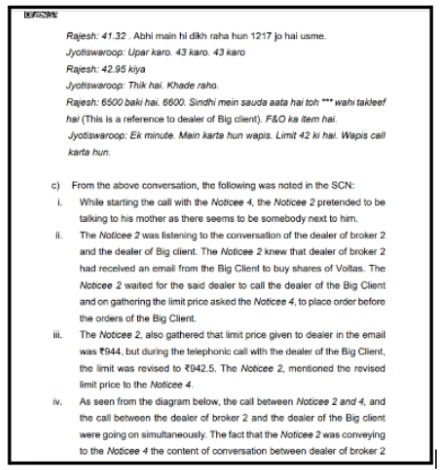
One dealer, Purohit, rings his contact at the proprietary desk, a man named Rajesh Bhagwati Jhaveri. As the call connects, Purohit says, in Hindi, “Bol mummy”, meaning “speak, mother”.
He is pretending to talk to his mother because someone is sitting next to him and he does not want it obvious who he is really calling.
Then, once it is safe, the real conversation starts.
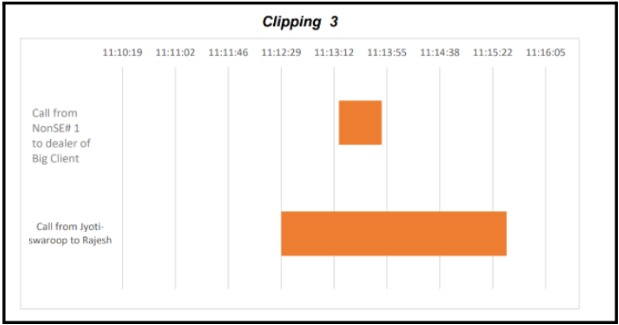
He feeds Rajesh a stock, Voltas, and a price. Over the next couple of minutes, as he overhears the neighbouring desk finalising LIC’s actual order, he updates the instructions live: buy 5,000 at this price, buy 5,000 more, hold, raise your limit.
At one point he catches that LIC’s limit price has been revised from ₹944 to ₹942.5, and passes that correction along too.
While that call is still going, the proprietary desk buys Voltas. Then LIC’s big order goes in and pushes the price. Then the proprietary desk sells into it.
That single sequence, on 15 April 2021, made a profit of about ₹10,894 on one stock in a few minutes.
SEBI documented 1,693 such instances in the equity cash segment across the investigation period.
Who the Six Parties Are, and What Each Did?
SEBI’s order names six noticees, and they split cleanly into three roles.
Understanding the roles makes the scheme easy to follow:
1. The listeners, who carried the information out
Jyotiswaroop Nandkishore Purohit was a dealer at one of LIC’s brokers. Pankit Bhagwati Jhaveri was an employee and dealer at the same broker.
These two overheard LIC’s orders and phoned them through.
For a stretch in 2020 and 2021, Purohit was even handed the login credentials of another broker’s terminal, so he could see LIC order emails directly.
2. The trader, who placed the front-running bets
Rajesh Bhagwati Jhaveri was the dealer at Madhav Stock Vision who took those phone calls and punched the trades into the firm’s proprietary account.
3. The enablers, who owned the desk and shared the spoils
Ajay Sampatraj Jain and Rajkumar Prabhu Damani are the directors of Madhav Stock Vision.
SEBI found they let the firm’s terminals be used for the scheme, and, tellingly, allowed family members and related entities of the others to be shown as employees of the firm so that profits could be paid out to them disguised as salary.
The firm itself, where every trade sat, and every rupee landed.
Madhav Stock Vision Pvt. Ltd. is the registered broker in whose proprietary account every front-running trade sat, and into which every rupee of profit flowed.
How the Money Was Split, in Their Own Words?
The profit sharing is not inferred. It is on tape, and SEBI reproduces it.
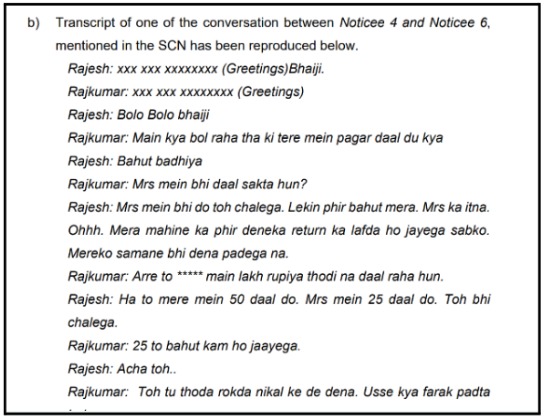
In one recorded call, a director, referred to as Rajkumar, tells Rajesh he is going to put him on the payroll. The conversation is about how much fake salary to route, and to whom.
Should he add Rajesh’s wife too?
They haggle over the figures, fifty thousand here, twenty-five thousand there, and Rajkumar works out that at fifty thousand each it comes to six lakh a year, with barely any tax, and offers to start it from July.
In another, the arrangement is spelled out plainly: Madhav Stock Vision earns brokerage from the trades, and of the front running profit, the two listeners take 75 percent, and the trader takes 25 percent.
Bank records showed the firm paying monthly amounts to the trader and to the family members of the others.
This is the part that turns a trading violation into something closer to an organised operation.
The profits were not just made unlawfully; they were laundered through a payroll.
What Madhav Stock Vision Argued, and What SEBI Did With It?
To its credit, the firm did not brazen it out.
Faced with the recordings, it admitted the cash segment trades could be construed as front running.
But it made several arguments to soften the blow, and how SEBI handled them is instructive.
1. “The company did not know”
Madhav Stock Vision argued that its directors and employees acted on a frolic of their own, a personal escapade the company knew nothing about, so the company itself should not be liable. SEBI rejected this.
A company acts only through its people. When the trades ran through the firm’s own proprietary account, on the firm’s infrastructure, with the profits landing in the firm’s account, the firm cannot then say those were private acts it had no part in.
The beneficiary cannot disown the benefit.
2. “Do not punish the company and the directors both”
The firm said holding both it and its directors liable was double punishment.
SEBI held that the law makes the company liable in addition to the responsible individuals, not instead of them. Both, not either.
3. “The F&O trades were not front running”
This one actually worked, and it is worth noting because it shows the findings were not rubber-stamped.
The firm argued its derivatives trades had no timing correlation with LIC’s orders and were just ordinary intraday trades.
SEBI examined the data, agreed there was no clear pattern, gave the firm the benefit of the doubt, and removed ₹21,67,033 of F&O profit from the disgorgement.
That is why the final figure is ₹2.51 crore rather than the ₹2.72 crore originally alleged.
4. “We cooperated and already deposited the money”
True, and SEBI acknowledged it. The firm had parked the alleged gains in an interest-bearing account with a lien to SEBI even before the show-cause notice.
It counted as a mitigating factor in the penalty, but it did not wipe out the violation or the interest.
Why Institutional Front Running Matters to Every Investor?
Here is the fair question.
No retail investor filed a complaint here. No individual lost a clearly traceable rupee.
So why should you care?
Because you are on the other side of these trades more often than you think.
LIC is not some distant institution. It manages the premiums of crores of ordinary policyholders, and its equity holdings sit inside the index funds and insurance plans that millions of retail investors own.
When someone front runs an LIC order, they are skimming a sliver of value that belonged to the fund, and therefore to the people whose money is in it.
It is invisible, it is tiny per trade, and across 1,693 trades it added up to two and a half crore rupees that came out of the market at everyone else’s expense.
Front running is not a victimless technicality.
It is a tax that insiders quietly levy on the honest majority who trade at the real price. That is exactly why SEBI treats it as fraud rather than a paperwork lapse.
What Did SEBI Order Against Madhav Stock Vision?
After thirty-odd pages of transcripts, trade data, and rejected defences, the order ends the way every investor reading it wants it to: with consequences.
The directions are now in force, and they hit the six parties in three ways: their access to the market, the money they made, and a penalty on top.
Here is each one in plain terms:
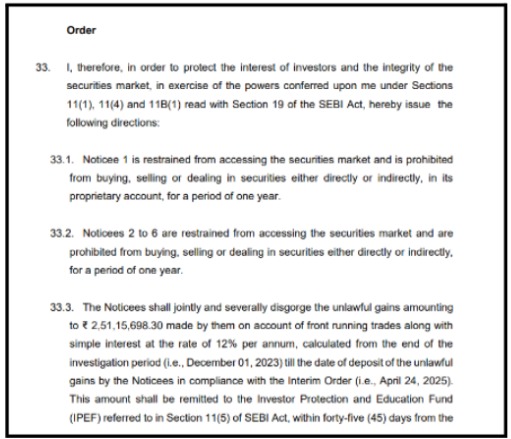
- A one year market ban. Madhav Stock Vision is barred from dealing in securities in its proprietary account for one year. The five individuals are barred from the market entirely for one year.
- The parties must together pay back 2.51 crore rupees in illegal gains, plus 12 percent annual simple interest for the period between 1 December 2023 and 24 April 2025. This money will go to SEBI’s Investor Protection and Education Fund, and the amount they have already deposited will be set off against it.
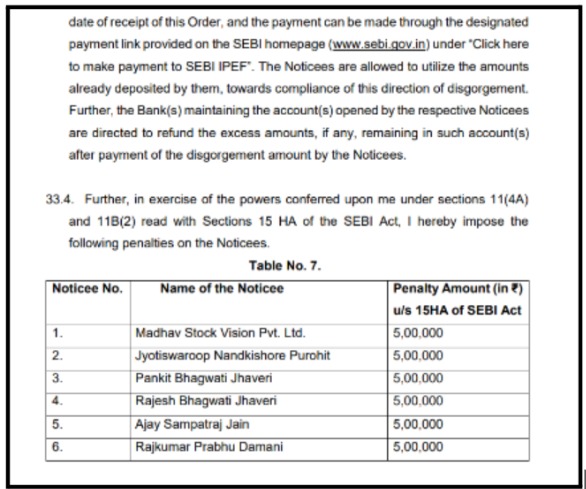
- A penalty of ₹5,00,000 on each of the six, thirty lakh in total, payable within 45 days.
Open derivatives positions may be squared off within three months or at expiry, whichever is earlier.
Key Takeaways for Investors from the SEBI Order
Two details in this case are worth carrying with you.
The first is how little it took. No hacking, no forged documents, no complex derivatives. Just a shared office floor and a pair of good ears. Market abuse does not always look sophisticated.
Sometimes it is a man saying “speak, mother” into a phone so the person beside him does not realise what he is doing.
The second is that SEBI caught it anyway. The scheme relied on private phone calls and cash-like payroll tricks, and it still fell apart under call data records, recorded conversations, bank trails and search operations.
The people involved cooperated in the end because the evidence left them nowhere to go.
For an honest investor, that is quietly reassuring. The market has holes, and people find them. But the trail those people leave is exactly what gets them caught.
Conclusion
SEBI’s final order against Madhav Stock Vision Pvt. Ltd. and five individuals establishes a front running scheme built on overheard orders, executed through a broker’s proprietary account, and paid out through fake salaries.
The firm and all five are banned for a year, ₹2.51 crore has been ordered disgorged with interest, and each carries a ₹5 lakh penalty.
The F&O portion of the allegation was dropped for want of a clear pattern, which is a reminder that these findings are tested rather than assumed.
You will never see a trade like this happen. That is the point of it. But it comes out of the same market your savings sit in, and orders like this one are how it gets policed.
Report. Recover. Stay Fraud Free.
SEBI found that Madhav Stock Vision, a registered stock broker, front ran the trades of Life Insurance Corporation of India. Two dealers at a neighbouring broker overheard LIC's orders, passed them by phone to the firm's proprietary desk, which traded ahead of LIC and shared the profit, across 1,693 documented instances. SEBI ordered the six parties to jointly and severally disgorge ₹2,51,15,698 with 12 percent interest, and imposed a penalty of ₹5,00,000 on each of them, thirty lakh in total. The firm and all five individuals were also banned from the securities market for one year. Front running is trading ahead of a large pending order that you know about but the public does not. Because a big order moves the price, trading in front of it produces a near certain profit taken at the expense of the big client and other honest participants. SEBI treats it as fraud under the PFUTP Regulations. The firm argued its derivatives trades had no timing correlation with LIC's orders and formed no recognisable pattern. SEBI examined the data, agreed, gave the benefit of the doubt, and removed ₹21,67,033 of derivatives profit, reducing the total from the ₹2.72 crore originally alleged to ₹2.51 crore. Large institutions like LIC manage money belonging to crores of policyholders and fund investors. When their orders are front run, a small amount of value is skimmed from the fund, and therefore from the people whose savings sit in it, which is why it is prosecuted as market fraud rather than a technicality.Frequently Asked Questions




 Add us as a preferred source on Google »

