In today’s one-tap world, planning a vacation feels almost effortless. A few clicks and you’re dreaming of turquoise waters in the Maldives or misty mornings in Himachal.
But here’s the twist: this digital ease has also opened the door to a new kind of “travel expert”, one that doesn’t craft memories, but carefully planned illusions.
Whether you are a corporate high-flyer looking for a seamless event or a solo adventurer chasing the sunrise at the Taj Mahal, Magic Trip India has likely appeared on your radar.
Glossy promises, smooth talk, irresistible deals, it all looks magical at first glance.
But what if the magic is just smoke and mirrors?
In this interactive deep dive, we’ll pull back the curtain to examine the services Magic Trip India claims to offer. The tactics that fuel its rise, and the unsettling allegations of financial fraud, are now linked to the brand.
Buckle up, because this journey isn’t about destinations; it’s about uncovering the truth behind the travel dream.
Magic Trip India Review
What began as a modest offshoot of Magic Trip India Travels LLP has since reinvented itself into a New Delhi-based travel agency with a catchy philosophy at its heart:
“The journey is more important than the destination.”
Formally taking shape around 2013, the company’s story is one of rapid transformation.
What started as a small, niche-focused team gradually evolved into a so-called “single-window” travel solution, handling everything from domestic getaways to international luxury holidays under one roof. This company is active on social media and promotes its services.
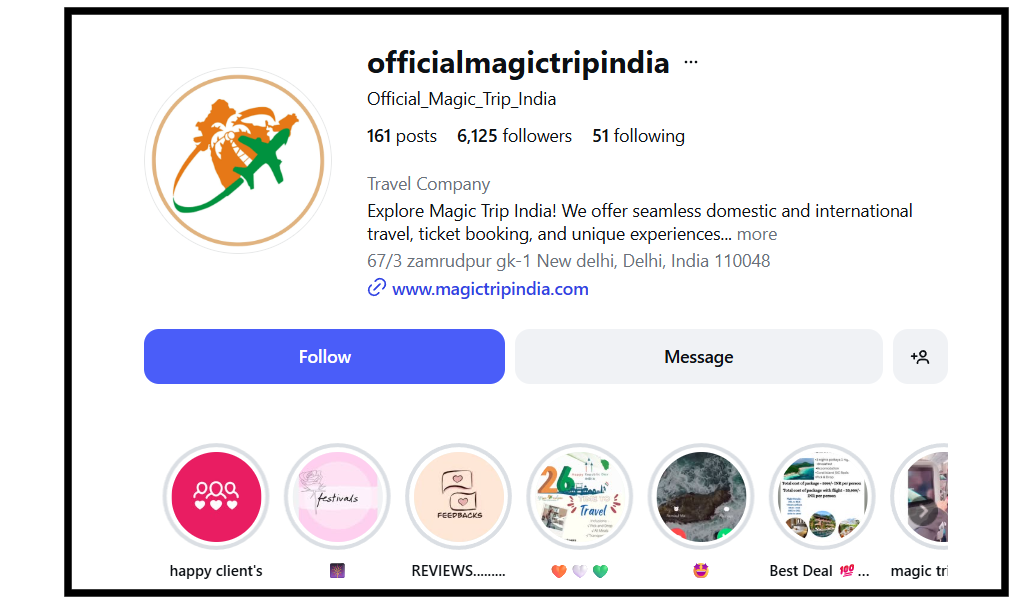
Their business model is firmly rooted in the digital age. Instead of plush offices and walk-in clients, they rely heavily on online platforms and tele-calling, zeroing in on travellers hunting for all-inclusive luxury packages at surprisingly competitive prices.

The pitch is tempting: premium experiences, minimal hassle, and costs that seem almost unbelievable.
And that’s where the strategy truly begins.
At first contact, the agency appears impeccably professional. Queries are answered almost instantly. Itineraries arrive neatly packaged, detailed, and reassuring. Promises of a flawless, worry-free journey flow freely, often accompanied by confident claims that everything will be “taken care of.”
This opening act serves a very specific purpose: building trust.
By projecting efficiency, expertise, and exclusivity, they aim to make travellers feel they’ve found the perfect partner for their dream vacation, before any real doubts have a chance to surface.
Despite its clean initial look, there are still some mazes that can cause trouble. Let’s check those.
Magic Trip India Complaints
If you’re considering booking a holiday with Magic Trip India, you might want to pause and read what many travellers are saying first.
Low ratings on Google and other review platforms reinforce the concerns, with many past customers openly cautioning others to avoid Magic Trip India and look for more reliable travel operators.

A large number of user complaints paint a troubling picture. Customers repeatedly mention poor trip management and broken promises, and itineraries are changed at the last minute.
Additionally, popular sightseeing spots are skipped without explanation, and plans that look great on paper but fall apart on the ground.
Review 1: Scam in disguise
The review presents a customer’s perspective that Magic Trip India is a scam in disguise and not a trustworthy company. The point of view is highly negative, alleging complete mismanagement and fraud.
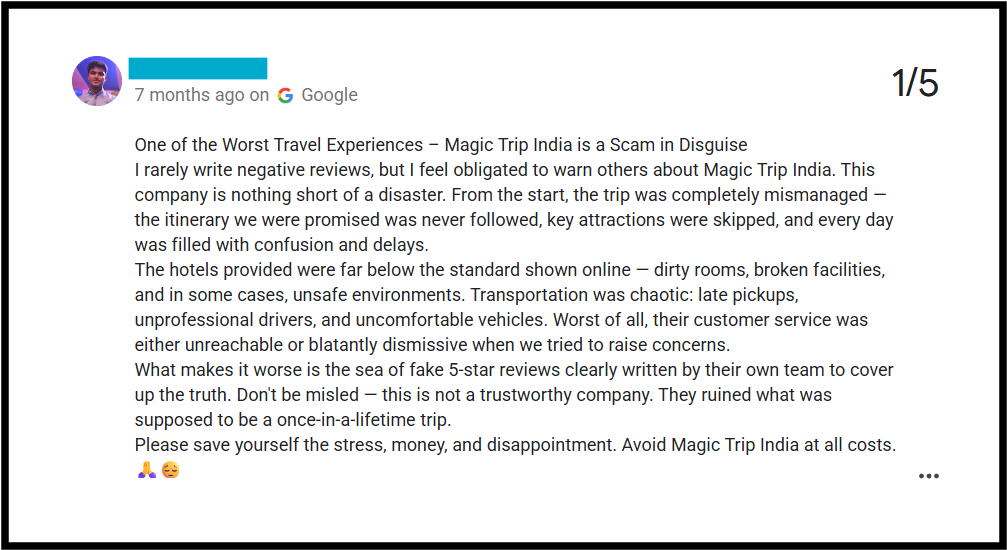
The customer’s perspective is one of extreme frustration, disappointment, and a sense of being cheated. They felt “obligated to warn others” based on their “once-in-a-lifetime trip” being ruined.
This is a first-hand account of perceived systemic failure and deception. The review concludes that potential customers should “Avoid Magic Trip India at all costs” to save themselves from stress, money loss, and disappointment.
Review 2: Not a trustworthy travel company
What seems to frustrate travellers the most is the lack of customer support. Many users claim that once payment is made, responses slow down or stop altogether.
Some reviews go a step further, warning of possible scam-like behaviour, including alleged fake loan offers or complete non-delivery of services after full payment.
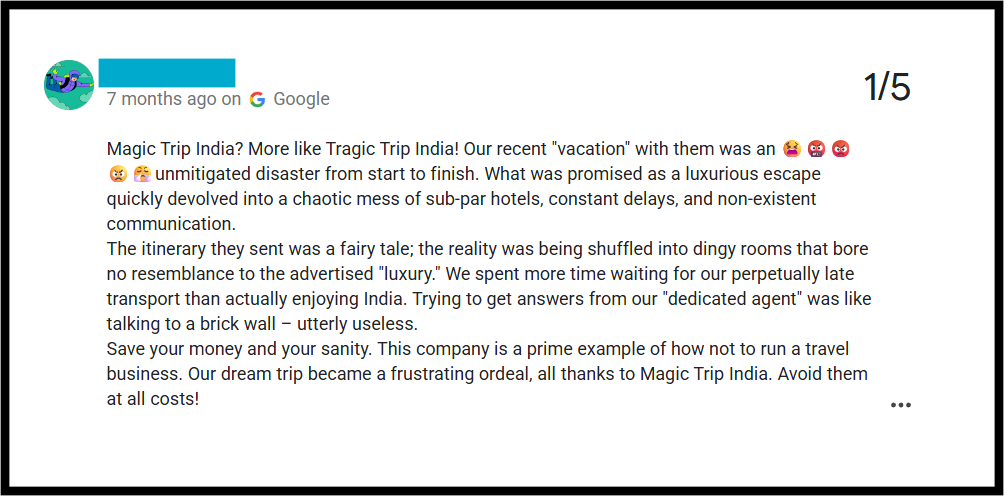
The customer’s perspective is one of extreme dissatisfaction and frustration. They view their “vacation” as an “unmitigated disaster” and feel obligated to warn others to “avoid them at all costs”.
This is a first-hand account of perceived systemic failure. The review concludes that the company is a “prime example of how not to run a travel business” and that the experience transformed a “dream trip” into a “frustrating ordeal”.
Another review by a user also highlights that this company is not reliable.
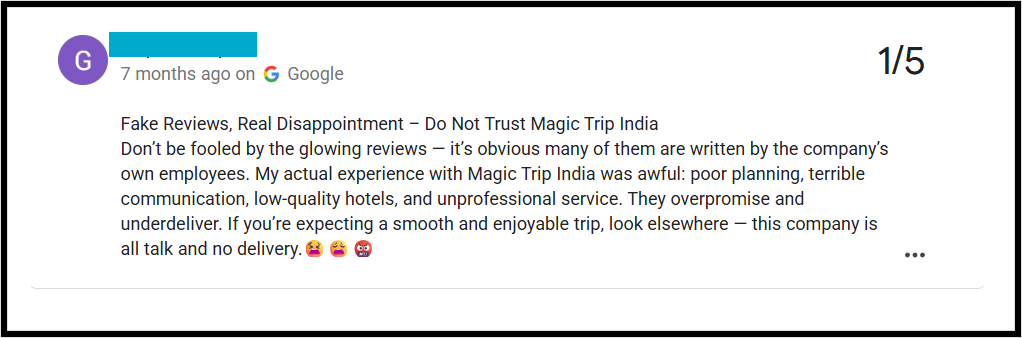
The customer’s perspective is one of disappointment and caution. They view the company as “all talk and no delivery” and feel other travellers should “look elsewhere” to avoid a similar negative experience.
The sentiment in this specific Google review suggests a severely negative customer experience where the quality of the service provided was far below expectations, primarily due to poor execution and communication issues.
This account is consistent with other negative feedback that points to major inconsistencies in service delivery for this company.
Magic Trip India Real User Case Study: The ₹8,35,000 Fraud
To understand the scale of the threat, we must look at a harrowing case from 2024. A traveller (identity withheld for legal reasons) came into contact with Magic Trip India and was systematically defrauded of over ₹8 Lakhs.
The interaction started professionally. The victim, based on the agency’s assurances, booked multiple trips. The first red flag appeared when, despite receiving full payment for a trip, Magic Trip India failed to book the hotel room, leaving the traveller stranded.
Instead of a refund, the agency offered “adjustments” for future bookings, a classic tactic to keep the victim on the hook.
Subsequently, the victim was induced to book a comprehensive land package.
The financial breakdown of the fraud is as follows:
| Payment Stage | Amount | Mode | Status |
| Initial Booking | ₹2,20,000 | Cash | Paid |
| Second Installment | ₹2,00,000 | Direct Payment | Paid |
| “Final” Demand | ₹15,000 | Additional | Paid |
| Cumulative Total | ₹8,35,000 | Multiple | Total Loss |
After the final payment of ₹15,000 was squeezed out of the victim, the accused persons completely cut off communication. No itinerary was issued, no hotel vouchers were provided, and no refund was initiated.
Key Issues and Legal Violations
- Criminal Breach of Trust: Having been entrusted with the money for a specific purpose (travel booking), the agency dishonestly misappropriated those funds for their own use.
- Section 66D of the IT Act: The use of electronic communication (WhatsApp/Mobile) to personate and cheat a person is a punishable cybercrime.
How to Spot Magic Trip Scam?
Travel package scams often look convincing on the surface, especially when they promise luxury trips at unbelievable prices.
However, there are consistent warning signs that can help you identify a fraudulent travel agency before you lose your money.
Below are two major high-risk indicators explained in detail.
1. Pressure for Cash Payments
One of the clearest red flags is when a travel agency insists on cash payments, particularly for large amounts exceeding ₹20,000.
Legitimate travel agencies in India typically prefer:
- Bank transfers (NEFT, RTGS, IMPS)
- Credit or debit card payments
- UPI is linked to a registered business account
These methods create a transaction trail, support GST compliance, and protect both the customer and the agency.
Scam operators, on the other hand:
- Push for cash to avoid traceability
- Claim cash helps them “give discounts” or “block urgent deals”
- Often refuse to issue proper receipts or provide only handwritten slips
If an agency becomes aggressive, creates artificial urgency, or discourages you from using traceable payment methods, treat it as a serious warning sign.
2. Vague or Unverifiable Vouchers
Another common tactic used by fake travel agencies is issuing vague booking confirmations.
A genuine travel booking confirmation will always include:
- A valid PNR (Passenger Name Record) for flights
- A hotel confirmation number generated by the hotel or booking system
- Clear booking details such as dates, guest names, and room categories
These details can be independently verified by:
- Calling the airline directly with the PNR
- Contacting the hotel to confirm the reservation
In scam cases, you may notice:
- Generic-looking PDFs with logos but no real reference numbers
- Statements like “voucher will be activated later.”
- Refusal or excuses when you ask to verify bookings independently
If you cannot verify your booking directly with the airline or hotel, the reservation likely does not exist.
What To do If You Get Scammed?
If you experince same issue and need to get out of it, you can follow these steps:
- File a complaint in Cyber Crime.
- Visit your local police station and file a complaint.
- File a case in the District Consumer Disputes Redressal Commission for “Deficiency of Service” and “Unfair Trade Practices.”
Need help?
Register with us, and we’ll help you turn your problem into a proper, trackable complaint.
Our expert team will help you in properly step by step process to recover your hard-earned money.
Conclusion
The case of Magic Trip India serves as a stark reminder that the travel industry, while full of genuine professionals, is also a playground for predatory scammers.
A loss of ₹8,35,000 is not just a financial setback; it is a traumatic experience that ruins the very idea of travel.
The agency often delivers on the first minor request. They might successfully book a small domestic flight or a short weekend stay.
This “successful” transaction acts as proof of concept, luring the traveller into a false sense of security.