
Quick Summary
SEBI first penalised Mohit Gupta, who ran an unregistered advisory called Safe Trading, back in March 2025 for taking money from investors while promising guaranteed returns. He appealed only the ₹5 lakh fine, arguing SEBI let other similar cases off easier. The tribunal sent that one issue back for a fresh look. On July 31, 2026, SEBI reconsidered and imposed the exact same ₹5 lakh penalty again. The investors’ ₹23.94 lakh refund still hasn’t been paid.
Unregistered advisory services and promises of “guaranteed returns” remain one of the most persistent traps in the Indian stock market.
In a recent order dated July 31, 2026, SEBI reaffirmed its ₹5 lakh fine against Mohit Gupta of Safe Trading after a tribunal-ordered rehearing.
But behind the legal technicalities lies an ongoing struggle: 16 months later, affected investors are still waiting on a ₹23.94 lakh refund.
Here is a breakdown of what happened, why Gupta’s defense fell flat, and where the case stands today.
What Safe Trading Was Actually Doing Without a Licence
Mohit Gupta ran something called Safe Trading and offered investment advice to people for a fee. The catch is he never held a SEBI investment adviser registration to do this legally.
SEBI’s original order, passed in March 2025, found that Gupta had admitted to this himself. He didn’t dispute that he was operating without registration.
What made it worse is how he brought clients in. SEBI held that he collected money from investors by fraudulently assuring them guaranteed returns, something no legitimate advisor, registered or not, is allowed to promise.
That combination, unregistered advice plus fake guarantees, is exactly what SEBI’s investment adviser rules and its fraud regulations exist to catch.
Two Investors Who Paid the Price for Trusting Him
The original March 2025 order lays out exactly how this played out for real people. One investor paid Gupta ₹10,000 for intraday tips, on a promise that investing ₹25,000 to ₹35,000 would earn him ₹22,000. Instead, he lost ₹8,000.
When he asked for his ₹10,000 back, Gupta simply stopped responding and blocked his number.
A second investor paid ₹10,000 for crude oil trading calls through a Telegram group Gupta ran.
He lost money in the very first week, was told to wait for month-end profits, and when markets turned volatile, Gupta stopped sending calls altogether and blocked him too.
How SEBI Traced the Money and What It Found Online
To build its case, SEBI pulled Gupta’s bank statements and found total credits of around ₹1.65 crore in his account. After filtering out unrelated deposits, investigators isolated ₹23,94,574.50 as fees tied specifically to his advisory activity.
SEBI also looked at his online presence. His Telegram channel had been running since September 2019 with over 1,357 subscribers, and openly promised “guaranteed accuracy” on the tips it sold.
A separate Instagram account, run out of Nepal, had crossed 2,288 followers and had changed its username three times.
His own website claimed he had 223 or more satisfied clients and over 13,600 subscribers, numbers SEBI’s order doesn’t appear to have taken at face value.
The One Red Flag You Should Never Ignore
Alongside his tip subscriptions, Gupta also ran an “algo trading” service through the same Telegram channel, charging a ₹1,800 signup fee plus ₹1,000 a month. To use it, investors were asked to hand over their demat account ID and password.
No legitimate advisor, registered or not, ever needs your demat account password. If anyone asks for it, that request alone is reason enough to walk away.
He Never Even Turned Up to Defend Himself
When SEBI first issued a show-cause notice against Gupta in December 2024, he didn’t file a single reply or attend the hearing, even after a personal hearing notice was published in two Hindi newspapers and one English daily.
SEBI went ahead and decided the original case in his absence, relying on a tribunal principle that treats silence on a show-cause notice as an effective admission of the charges.
The Original Punishment: A Refund, a Ban, and Two Fines
Once SEBI made these findings, it didn’t just issue a warning. The March 2025 order directed Gupta to refund ₹23,94,574.50 to the investors he’d taken money from.
On top of the refund, SEBI barred him from accessing the securities market for one year, or until he actually filed proof of repayment, whichever came later.
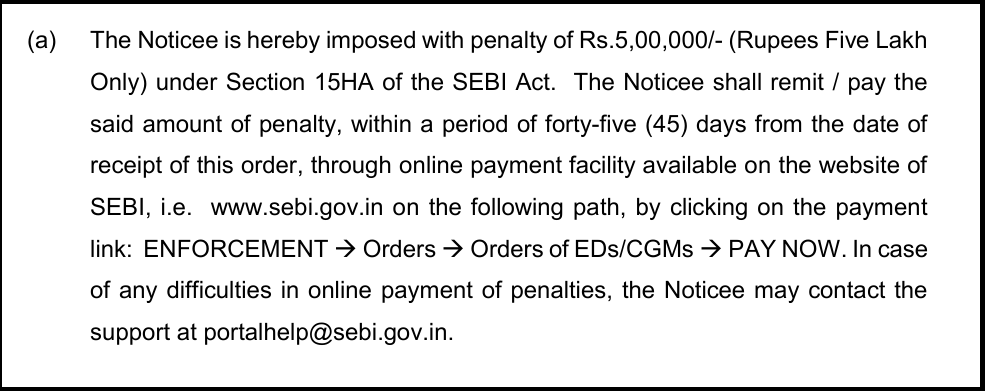
He was also hit with two separate monetary penalties: ₹5 lakh under Section 15HA of the SEBI Act for fraudulent trade practices, and another ₹1 lakh under Section 15EB.
Gupta didn’t challenge most of this. He took the case to the Securities Appellate Tribunal, but only over one specific number.
His Appeal Wasn’t About the Refund, It Was About One Fine
When Gupta went to SAT in 2025, he made it clear he wasn’t fighting the refund order or the ₹1 lakh penalty. He accepted both.
His entire appeal was aimed at the ₹5 lakh penalty under Section 15HA, the one tied to fraudulent and unfair trade practices.
SAT’s order in August 2025 recorded that SEBI’s own lawyer agreed to reconsider just this one penalty. The tribunal sent the matter back to SEBI with instructions to hold a fresh hearing on it.
Everything else in the original order, the refund, the debarment, the ₹1 lakh fine, had already become final and wasn’t up for debate anymore.
The “Everyone Else Got Off Easier” Argument
When SEBI reheard the matter in February 2026, Gupta’s main defence was about fairness, not facts. He didn’t deny what he’d done.
He told SEBI that between February 2024 and January 2025, SEBI had issued more than 55 warning letters to people running similar unregistered advisory services, without slapping them with this particular fine.
He also pointed to more than 20 other unregistered advisory cases where SEBI only ordered a refund or a smaller penalty under different sections, and never invoked Section 15HA at all.
On top of the fairness argument, Gupta added that he was young and lacked formal education at the time, and hadn’t understood the regulations he was breaking.
Why SEBI Didn’t Buy the Comparison
SEBI’s response leaned on a Supreme Court ruling from July 2026 involving Kotak Mahindra Trustee Company, where the court had rejected a similar “others got away with it too” argument.
The principle the court laid down is that you can’t use someone else’s violation to excuse your own. SEBI applied that same logic here.
On the ignorance argument, SEBI was equally blunt: not knowing the law isn’t a valid excuse for breaking it, a position that tribunals have upheld in past cases too.
SEBI did note one thing in Gupta’s favour, weighing it against a separate problem that had shown up in the meantime.
Sixteen Months Later, the Investors Still Haven’t Been Paid
Here’s where the case gets uncomfortable for the people who actually lost money. SEBI’s order records that Gupta still hadn’t complied with the refund direction by the time this final order was passed.
He’d told SAT he wasn’t even challenging the refund, yet he only issued a public notice offering refunds in late November 2025, eight months after the original order.
SEBI had even advised him by email in February 2026 to open an escrow account to hold the refund money. That direction, too, went unfollowed.
SEBI acknowledged this non-compliance could have justified a higher penalty. Instead, taking what it called a holistic view, it decided to keep the fine at the legal minimum.
What Section 15HA Actually Means for You as an Investor
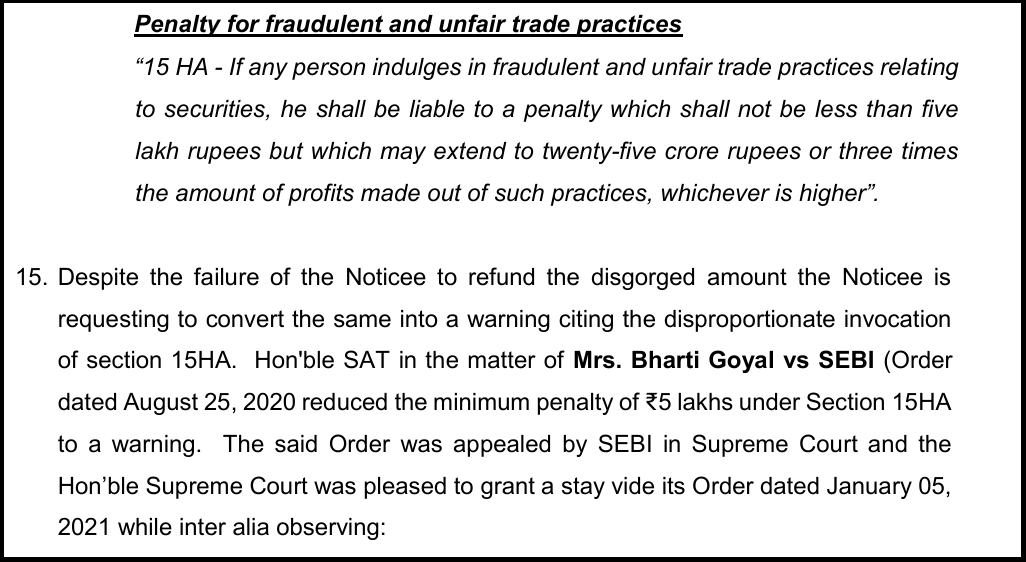
Section 15HA is the provision SEBI uses specifically for fraudulent and unfair trade practices in the securities market. The law sets a floor for how low this penalty can go.
The minimum fine under this section is ₹5 lakh, and it can go as high as ₹25 crore or three times the profits made through the fraud, whichever number is bigger.
That floor exists precisely so that penalties in cases involving guaranteed-return promises and unregistered advice don’t get watered down into a slap on the wrist.
Conclusion
SEBI’s final direction on July 31, 2026, reimposed the ₹5 lakh penalty under Section 15HA, unchanged from the original order. Gupta has 45 days from receiving the order to pay it through SEBI’s online portal.
The refund of ₹23,94,574.50 to affected investors, ordered back in March 2025, still stands as a separate, unresolved obligation.
The original order also makes clear that this refund direction doesn’t stop affected investors from pursuing other legal remedies against Gupta separately, if they choose to.
If you’ve ever been approached by someone offering “guaranteed” daily or monthly returns in exchange for a fee, this case is a reminder of exactly how that pattern usually ends, for the advisor and for the investors who trusted them.
Before you check whether an advisor’s promises sound too good to be true, it helps to know how SEBI defines a guaranteed return violation in the first place.
It’s also worth learning how to verify an advisor’s SEBI registration before you hand over a single rupee.
Report. Recover. Stay Fraud Free.
Frequently Asked Questions
No. SEBI's order confirms he ran Safe Trading and gave investment advice without holding an investment adviser registration, something he admitted himself.
SEBI ordered a refund of ₹23,94,574.50 back in March 2025. As of this final order, that amount still hasn't been paid to investors.
SEBI reimposed a ₹5 lakh penalty under Section 15HA, the same amount as before, along with the earlier ₹1 lakh penalty under Section 15EB that was never in dispute.
Gupta appealed only the ₹5 lakh fine to SAT, arguing it was too harsh compared to other cases. SAT sent just that question back to SEBI for a fresh hearing, and SEBI ended up keeping it the same.
No. SEBI held that one person's violation being treated differently doesn't excuse another person's misconduct, relying on a Supreme Court ruling that rejected the same kind of argument.
The refund order stands and remains enforceable. Investors who paid Safe Trading can also raise the matter with SEBI directly or seek help documenting their claim.
You can look them up on SEBI's official intermediary database using their registration number, and treat any guarantee of fixed or assured returns as an immediate red flag regardless of what they claim.
Gupta's "algo trading" service asked investors to share their demat account ID and password. No genuine advisor or platform ever needs your demat login, and any request for it should end the conversation right there.


 Add us as a preferred source on Google »

