

Quick Summary
This Moneylicious Securities arbitration turned on a fifteen-minute window. At 11:04 AM on 12 July 2024, a trader tried to book his profit. His sell order bounced back rejected. He tried again, and again, with different order types. By 11:19 AM the position had collapsed and a ₹6,00,000 profit was down to ₹33,250. We took the matter to NSE arbitration. In matter NSE-SB-2024-07-620797, the arbitrator held Moneylicious Securities Private Limited liable and awarded ₹4,53,081.60. The whole case sat inside those fifteen minutes, and the broker’s own trade log proved it.
Some trading losses come from a bad call. This one came from a button that would not work.
Bharat Bhaychandbhai Vaghari, a trader from Gujarat, was sitting on a large unrealised profit. His Bank Nifty call option had run in his favour. All he had to do was sell.
He could not. And the record of why he could not is what won him ₹4,53,081.60.
What Happened in Those Fifteen Minutes
The value of this case lives in the timeline. Here it is, as the trade records show it.
1. 11:00 AM: the position was in profit
He held the Bank Nifty 53400 call. Lot size 736, a total of 11,040 quantity. The price had climbed toward his target of ₹94.50. On paper, he was up close to ₹6,00,000.
2. 11:04 AM: the first rejection
He placed a sell order. The system rejected it. He placed another. Rejected again. Market order, limit order, stop loss, each one bounced.
3. 11:04 to 11:19: the price fell while he was locked out
For fifteen minutes, the exit door stayed shut. The option price slid as he kept trying. Every rejected order was a few thousand rupees of profit gone.
11:19 AM: the forced exit
The position finally closed at ₹53.46, far below the ₹94.50 he had aimed for. His ₹6,00,000 profit had shrunk to ₹33,250.
Nothing about the market caused that gap. A system that would not accept his orders did.
The Broker’s Defence, and Why It Failed
Moneylicious had an answer ready. The fault, it said, was not its own. A BSE technical issue that day had affected the whole industry.
It was a reasonable-sounding defence. It also came with nothing to back it.
The broker produced no exchange communication, no incident report, no documentation of any BSE-end failure. The claim rested entirely on the broker’s own word.
The arbitrator did not accept a word without proof. The tribunal held a simple principle: a broker must provide uninterrupted service to execute trade orders in time. When it fails, and cannot show the failure came from elsewhere, the loss is the broker’s to bear.
How We Turned Fifteen Minutes Into a Number
An arbitrator cannot award a feeling of unfairness. It needs a figure, and the figure has to be built from the record.
This is where the work sat. We took the broker’s own trade log and fixed two prices to two timestamps.
- The price he should have got: ₹94.50, the market price at 11:05 AM when his first sell order was rejected.
- The price he was forced to take: ₹53.46, the actual exit at 11:19 AM.
The difference was ₹41.04 per unit. Across his “11,040 quantity,” that came to ₹4,53,081.60.
The strength of this number is that the broker generated every input for it. The order timestamps, the rejection records, the final exit price, all of it came from the broker’s own system. There was nothing for the broker to dispute, because it was disputing its own data.
Moneylicious Securities Arbitration: The Award
| Detail | Value |
|---|---|
| Matter number | NSE-SB-2024-07-620797 |
| Respondent | Moneylicious Securities Private Limited |
| Amount awarded | ₹4,53,081.60 |
| Default interest | 12% per annum if unpaid in one month |
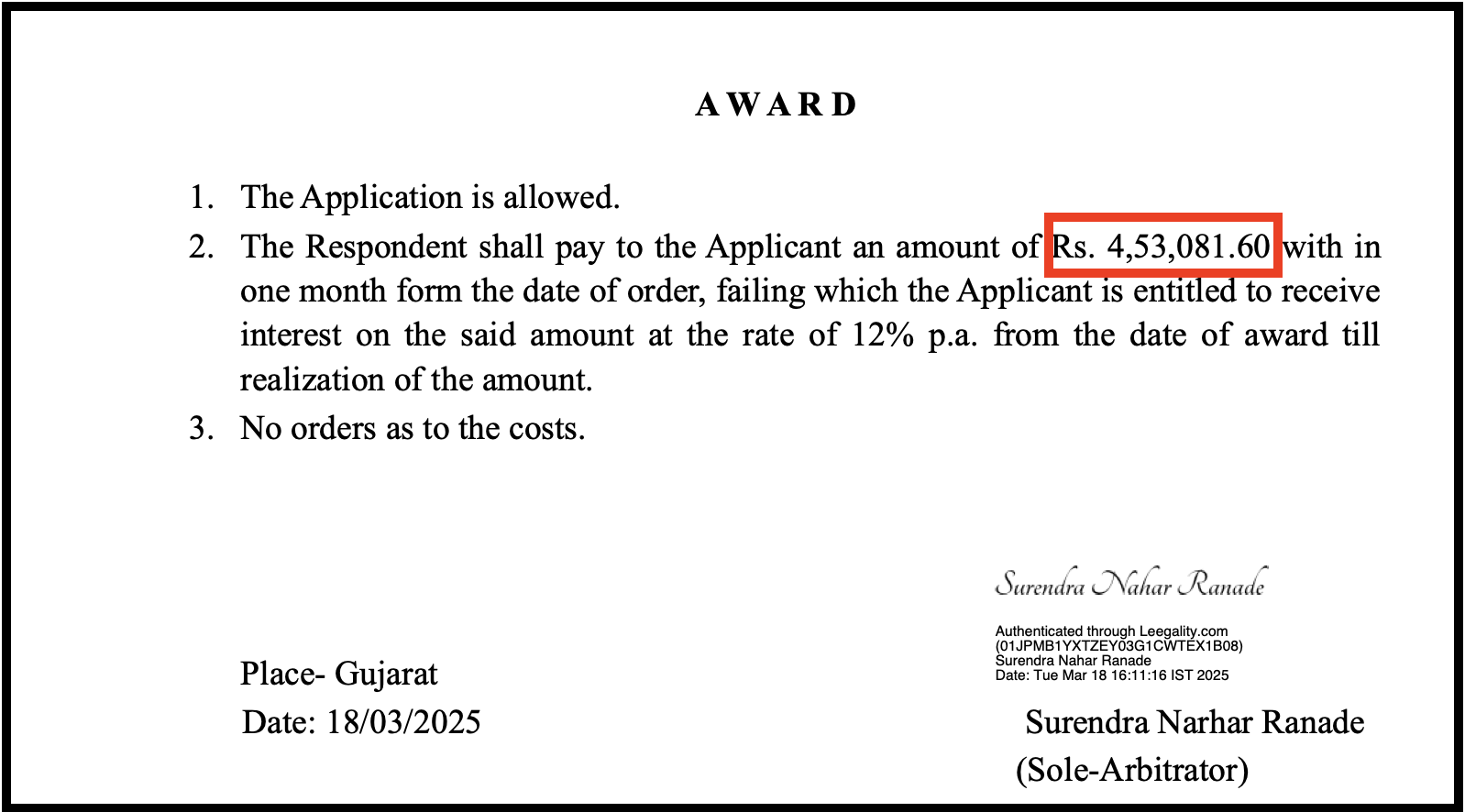
This is a public arbitral record naming the broker.
Did a rejected order or a frozen screen cost you a profit you had already earned?
We work backwards from your order log, fix the price you should have exited at, and turn the gap into a claim the broker cannot argue with.
Register with us for a free consultation.
What This Case Means If a Glitch Cost You Money?
A rejected exit order feels like bad luck in the moment. It is not always luck, and it is not always yours to absorb.
The Moneylicious award establishes a few things you can hold on to:
- A broker’s duty includes executing your exit orders in time
- Blaming the exchange is not enough without proof of the exchange failing
- Your loss is the price you should have received minus the price you got
- The evidence you need is already in the broker’s trade log
The single most important habit is speed of capture. The moment an order is rejected, screenshot it with the timestamp visible. That screenshot, matched to the market price at that second, is the spine of the whole claim.
Conclusion
Bharat did everything right. He had the profit, he tried to book it, and the system stopped him. The market did not take his ₹6 lakh. A failure to execute did.
The arbitrator saw that, rejected a defence that had no proof behind it, and awarded ₹4,53,081.60 built entirely from the broker’s own timestamps.
If a glitch ever locks you out of your own exit, remember that the record of it is sitting in the broker’s system, and that record can be turned into a number.
Report. Recover. Stay Fraud Free.
Frequently Asked Questions
A trader's exit orders on a Bank Nifty option were repeatedly rejected on 12 July 2024. His profit collapsed as a result. The NSE arbitrator held Moneylicious Securities liable and awarded ₹4,53,081.60.
The trader tried to exit at ₹94.50 but the order was rejected. He finally exited at ₹53.46. The difference, multiplied across 11,040 quantity, came to ₹4,53,081.60.
The broker offered no proof that the fault lay with the exchange. The arbitrator held that a broker must execute orders in time, and without evidence, the responsibility stayed with the broker.
Yes, if the rejection caused a loss and stemmed from the broker's service failure. Save your rejected order screenshots with timestamps, as these carried the Moneylicious case.
Your order logs and the timestamps of rejected orders. These come from trade records and do not rely on memory, which is why the tribunal relied on them here.





 Add us as a preferred source on Google »

