
Quick Summary
An NSE arbitration award is the arbitrator’s final, binding decision on your dispute. The losing broker must pay within 15 calendar days of the award, and the exchange watches until the money actually reaches you. A challenge is possible only through court under the Arbitration and Conciliation Act, 1996, and the broker must first deposit 100% of the award amount, from which up to ₹5 lakh can be released to you while the challenge runs. Investors we represented secured awards of ₹28 lakh and ₹15.57 lakh with 15% interest. This page covers the award, the challenge rules, and what to do when payment does not come.
You trusted the market with your money, and unauthorised trades, missing shares, and unexplained losses left you feeling stuck.
If it feels like an uphill battle, you are not alone. Recent NSE complaint data shows a rising number of investors facing the same misconduct.
But here is what most of them never find out: the NSE arbitration award is a legally binding order, not a request the broker can ignore.
This guide shows you what the award is, what happens after you win one, and the real cases where investors got their money back.
What Is an NSE Arbitration Award?
When you lose money in the market, the question that keeps you up is not why it happened. It is whether you can still get it back.
An NSE arbitration award is the final decision an arbitrator passes after reviewing the evidence from both sides, including your transaction records, statements, emails, and messages.
If your claim holds up, the award directs the other party to compensate you. If the evidence falls short, the claim can be partly allowed or rejected.
Either way, the award reaches you in writing with the reasons behind it.
And once passed, it binds both parties.
The road to it runs through the stages of NSE arbitration, where the hearing and evidence decide everything that follows.
How to Check Your NSE Arbitration Award Online?
After months of collecting evidence and attending hearings, opening that decision is the moment everything was for.
Checking it takes four steps: find the portal, search your case, download the order, and read it properly.
Here is each one:
- Go to the arbitration portal where awards and case updates are published.
- Search your case using your arbitration reference number.
- Download the award once it shows as issued.
- Read it slowly. It tells you whether your claim was accepted, partly accepted, or rejected, and why.
Whatever it says, do not stop at the outcome.
If you won, the next section tells you what the broker now owes you and by when. If you lost, the challenge rules below tell you what is still open.
Can an NSE Arbitration Award Be Challenged?
Hearing that your claim was rejected or only partly allowed hurts, especially after months of effort.
But in some situations, it does not have to be the end.
An award can be challenged before a court under Section 34 of the Arbitration and Conciliation Act, 1996, though only on limited legal grounds, not simply because one side disagrees with the outcome.
The grounds courts actually accept fall into three types, and your challenge needs to fit one of them:
- Serious procedural irregularities in how the arbitration ran.
- A violation of the principles of natural justice, such as not getting a fair chance to present your side.
- The arbitrator going beyond their legal authority.
Timing is strict on both sides.
The party challenging must declare its intent within 7 days of the award, and unless a court grants a stay within 3 months, the award must be followed in full.
If no valid challenge comes within the window, the award becomes final, and the clock below starts running.
NSE Arbitration Award Enforcement: What to Do If the Broker Doesn’t Pay?
Winning the award and receiving the money are two different days, and the gap between them is where many investors panic without needing to.
The rules after pursuing an NSE complaint against broker through arbitration in India are stacked in your favour, and they work in this order: a payment deadline, exchange monitoring, and consequences the broker cannot afford.
The broker must pay the awarded amount within 15 calendar days of the award, unless the award itself demands sooner.
The exchange does not pass the award and walk away.
It monitors compliance until the money actually reaches you, and reports any default to SEBI.
If the broker wants to challenge instead of paying, the price of that challenge protects you too.
Before filing any challenge, the broker must deposit 100% of the awarded amount with the exchange.
On your application, up to ₹5 lakh of that deposit can be released to you while the challenge runs.
And a broker who refuses to deposit faces something bigger than your case: the firm can be declared not fit and proper under SEBI’s rules, putting its registration itself on the line.
In plain words: the award in your hand is not a request. It is an instruction the broker’s licence depends on following.
Your own deposited fee returns with a winning award too, and the full refund conditions sit on our page: NSE arbitration fees.
Holding an award the broker keeps ignoring?
We will take up enforcement with the exchange, track the deposit, and push the release you are entitled to while the broker stalls.
How Long Does It Take to Get Your Arbitration Decision?
Winning a dispute brings relief, but waiting for the final order can test anyone’s patience.
While every case moves at its own pace depending on the complexity and arguments presented, the process follows structured timelines set by the exchange.
For smaller claims up to ₹1 lakh, decisions are fast-tracked based solely on documents within 30 days of the arbitrator’s appointment.
Larger matters involve detailed hearings and evidence, with most wrapping up within four to six months of filing.
If you want a step-by-step timeline of how each phase unfolds, read our detailed guide: how long an arbitration decision takes.
How Investors Fought for Their NSE Arbitration Awards?
If you have read this far, you are probably not here for theory.
You want to know if recovery actually happens.
Here are two awards our team fought for and won:
Case 1: The ₹28 Lakh Award
Retirement was supposed to be peaceful. Instead, one investor watched his savings disappear after trusting the wrong person.
By the time he realised, ₹28 lakh was gone, and he saw no way back.
Our investigation found violations that spoke for themselves:
- Trades executed by Motilal Oswal without permission or written order confirmation.
- His registered email changed without his knowledge, cutting off alerts and contract notes.
- OTPs misused to authorise transactions.
- A promised fixed monthly income that never arrived.
- A signed repayment agreement later denied in proceedings.
We built the case from the ground up, escalated through SCORES and SMART ODR, and represented him through the arbitration.
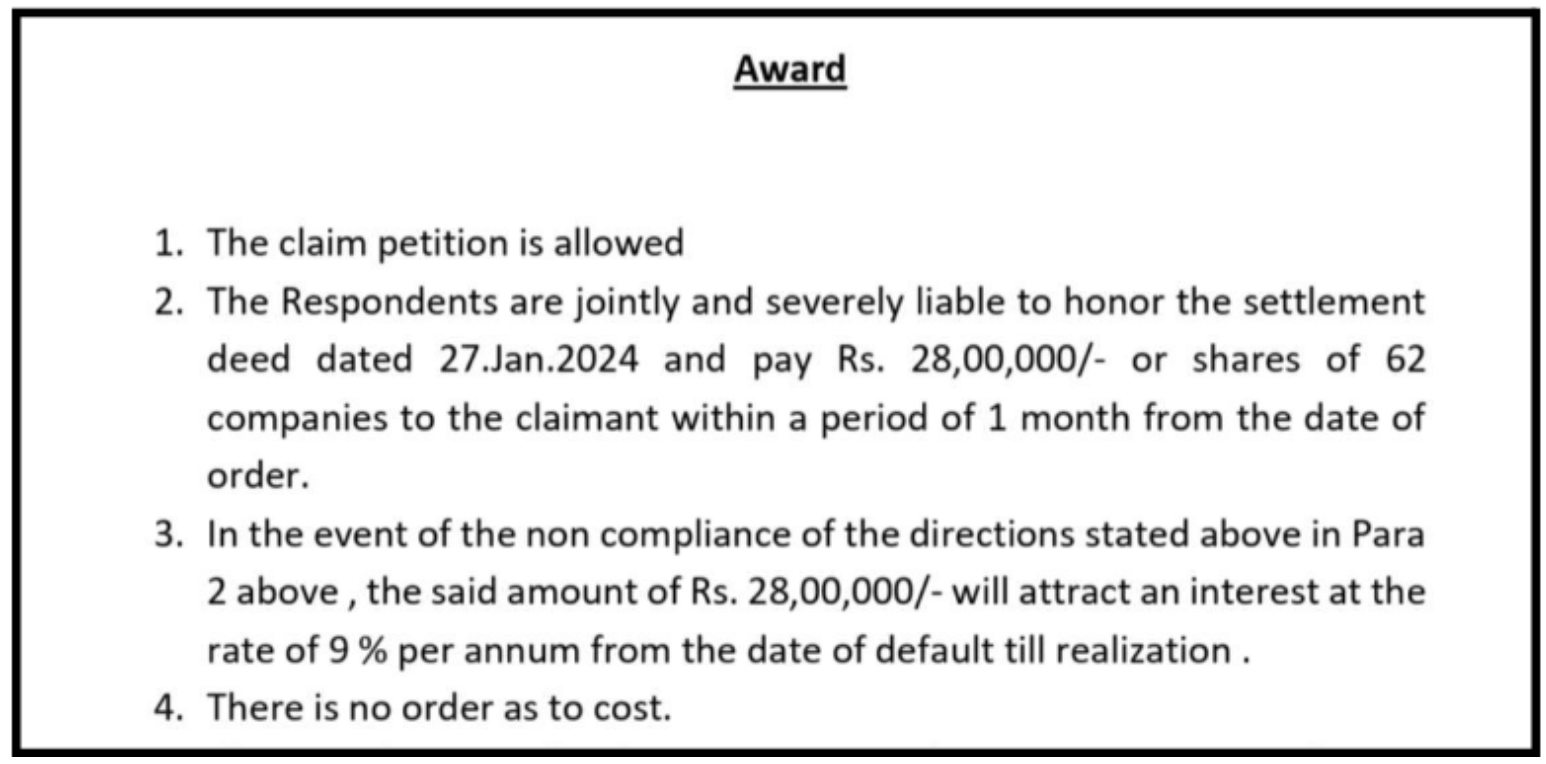
The award held the respondents jointly and severally liable.
He recovered the entire ₹28 lakh.
Case 2: The ₹15.57 Lakh Award With Interest
This investor picked a SEBI-registered advisory firm believing that it would make his money safe. What he got was losses, silence, and a flat refusal to refund.
By the time he reached us, he had tried everything alone.
The violations we established:
- Misleading advice through the engagement.
- Irregular, inconsistent communication.
- Refund refused despite clear deficiency in service.
- Breaches of SEBI’s Code of Conduct for Research Analysts.
We took over the full matter, from documentation to representation.
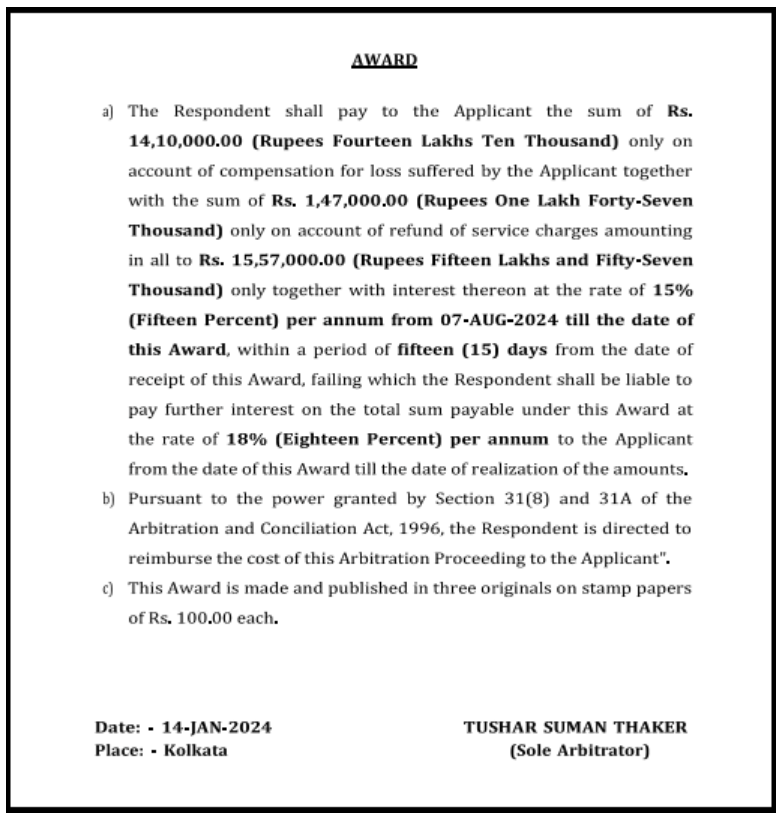
The arbitrator directed the firm to refund ₹15,57,000 with 15% annual interest from 7 August 2024.
Two different investors, two different violations, one common thread: the evidence was organised, the breaches were named, and the awards followed.
How Do You Reach the Award Stage?
The award is the last stop on a defined route, and skipping any earlier stage gets applications rejected.
The path runs from your written complaint to the broker, through SEBI’s complaint system and conciliation, into arbitration only when everything before it fails.
Each completed stage becomes proof that the next one was necessary, which is why the order matters as much as the evidence.
Before any fee or hearing enters the picture, get the stages right.
The complete route with the steps and contacts for each sits in our guide: NSE complaint.
Conclusion
Losing money in the market can make it feel like there is no way back. The two cases above say otherwise.
An NSE arbitration award is more than a legal decision.
It is a binding order with a 15-day payment clock, exchange monitoring behind it, and a deposit rule that protects you even when the broker fights on.
The key is to act early, keep every record, and follow the route in order.
The sooner you start, the sooner the award stops being something you read about and becomes something you hold.
Report. Recover. Stay Fraud Free.
Frequently Asked Questions
Once the award is final and unchallenged within the window, it becomes legally enforceable. The broker must pay within 15 calendar days, and the exchange monitors that payment until it reaches you.
The award stays enforceable within the limitation period under Indian law. If the other side does not pay voluntarily, start the enforcement process early rather than letting time run.
Yes, it binds both parties. The only route past it is a court challenge under Section 34 of the Arbitration and Conciliation Act, and only on limited grounds like procedural irregularity, not simple disagreement.
Read it fully, note what the arbitrator directed and by when, and watch whether the other party complies within the 15 days. If payment does not come, move on enforcement without waiting.
The challenge route costs them. The broker must deposit the full award amount first, and if a court stay does not come within 3 months, full compliance becomes mandatory. Delay tactics cost the broker, not you.
Yes. The exchange monitors compliance until you receive payment, reports defaults to SEBI, and assists with enforcement. You are not left chasing the broker alone after winning.





 Add us as a preferred source on Google »

