

Quick Summary
NSE complaint data is the official record of every complaint filed against registered stock brokers, published by the exchange each year as free downloadable reports. Report 1C lets you compare brokers by client base, complaints, and resolution rates, while Report 1A shows which issues investors report most, such as unauthorised trading at over 33% for one broker. Before trusting any broker with your money, these numbers tell you what advertisements never will.
You trusted your broker with your hard-earned money. Now something feels wrong.
Maybe trades appeared in your account without your approval. Maybe brokerage charges seem much higher than expected. Perhaps your withdrawal request is still pending, or nobody is giving you a clear answer.
At this point, you are probably wondering whether this happened only to you or if other investors have faced similar problems.
That is exactly why many people search for NSE complaint data.
These official reports help you see whether other investors have reported similar issues against a broker.
In this blog, you will learn how to check NSE complaint data, understand what the reports actually mean, and use them to make better decisions with confidence.
NSE Complaint Data Online
NSE complaint data is a publicly available record of all complaints filed against registered stock brokers.
The exchange collects this information from its own complaint and arbitration systems and publishes it in downloadable reports every financial year.
It is not based on opinions or user reviews.
It comes from formal complaints that investors registered through official channels, which alone makes it far more credible than anything you will read on a random forum or review website.
NSE publishes this data because transparency is a core part of how a regulated market is supposed to function.
As an investor, you have every right to know how a broker handles complaints before trusting them with your hard-earned money.
Why Should You Check NSE Complaint Data?
If something has already gone wrong with your trading account, your first instinct is probably to search for reviews online. While reviews can give you some idea about a broker, they do not always tell the complete story.
Some reviews may be genuine, while others can be misleading or biased.
That is why checking NSE complaint data is a better place to start.
Here is why it matters:
- Official source: NSE complaint reports are published by the National Stock Exchange and are based on complaints officially recorded through its grievance mechanism.
- More reliable than online reviews: Unlike random opinions on the internet, official complaint data gives you verified information that is available to every investor.
- Helps identify patterns: One complaint may be an isolated incident, but recurring complaints in the same category over several years deserve attention.
- Shows more than complaint numbers: The reports also include complaint percentage, resolved complaints, pending complaints, and arbitration cases, helping you understand the bigger picture.
- Puts complaints into context: A broker with a large client base may naturally receive more complaints. Looking at the complaint percentage gives you a fairer comparison.
- Reassures investors: If you have faced unauthorised trading, excessive brokerage, delayed withdrawals, or another issue, seeing similar complaints in official records may remind you that you are not necessarily the only investor asking questions.
Taking a few minutes to review NSE complaint data online can give you valuable insights before choosing a broker or deciding your next step after facing a dispute.
How to Check NSE Complaint Data Step by Step?
Finding NSE complaint data is easier than most investors think. The National Stock Exchange makes these reports publicly available, so anyone can access them.
If you want to know whether a broker has received recurring complaints, follow these steps.
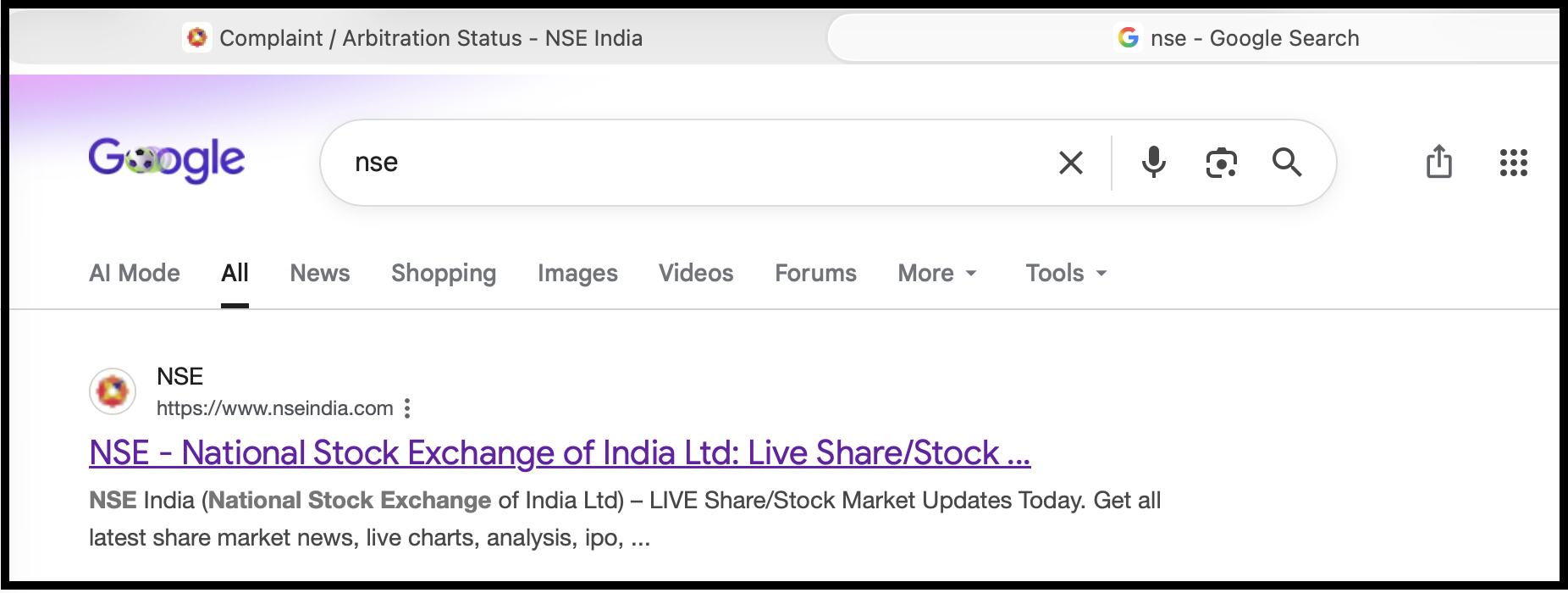
Step 1: Visit the NSE Website
Open the official NSE website in your browser. This is where the exchange publishes complaint and arbitration reports for all registered brokers.
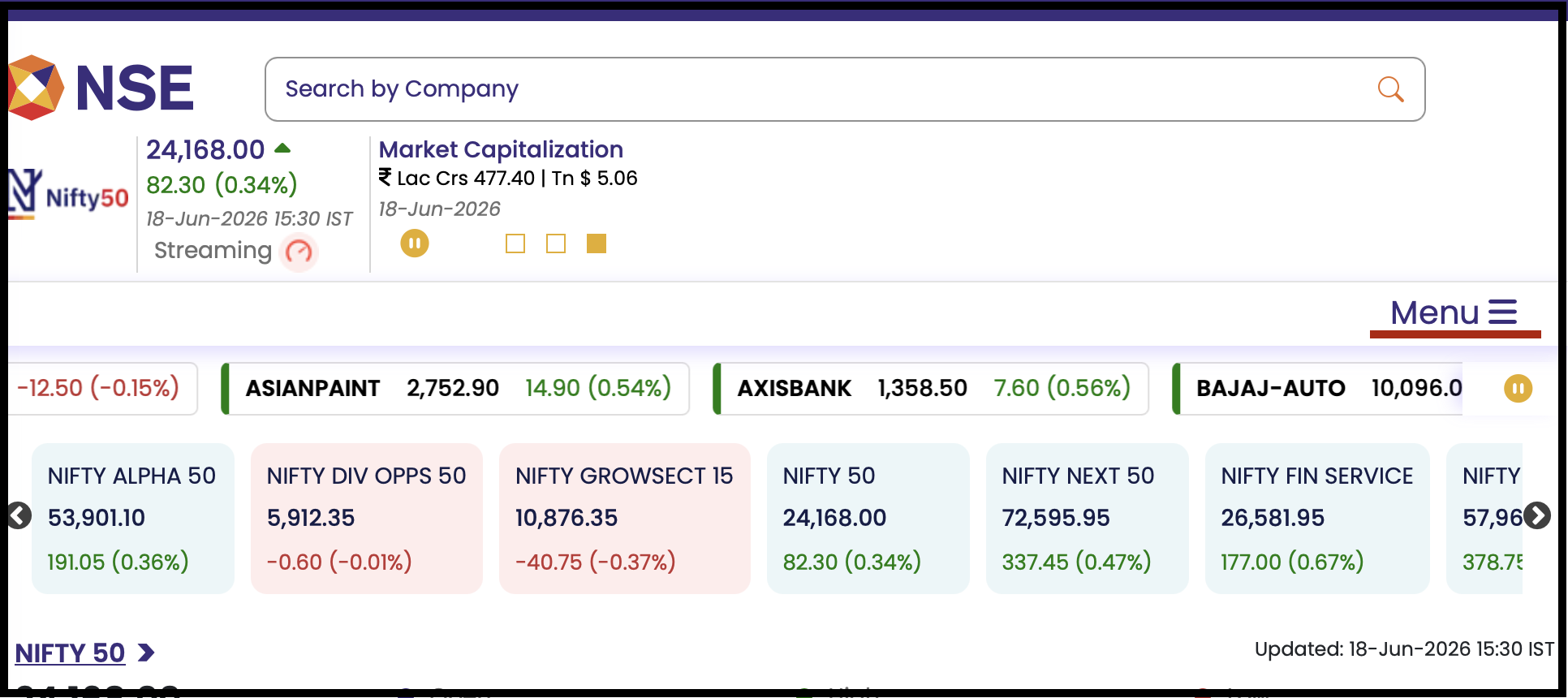
Step 2: Click on the Menu
Once the homepage opens, click on the Menu icon. It contains different sections related to trading, market information, and investor services.
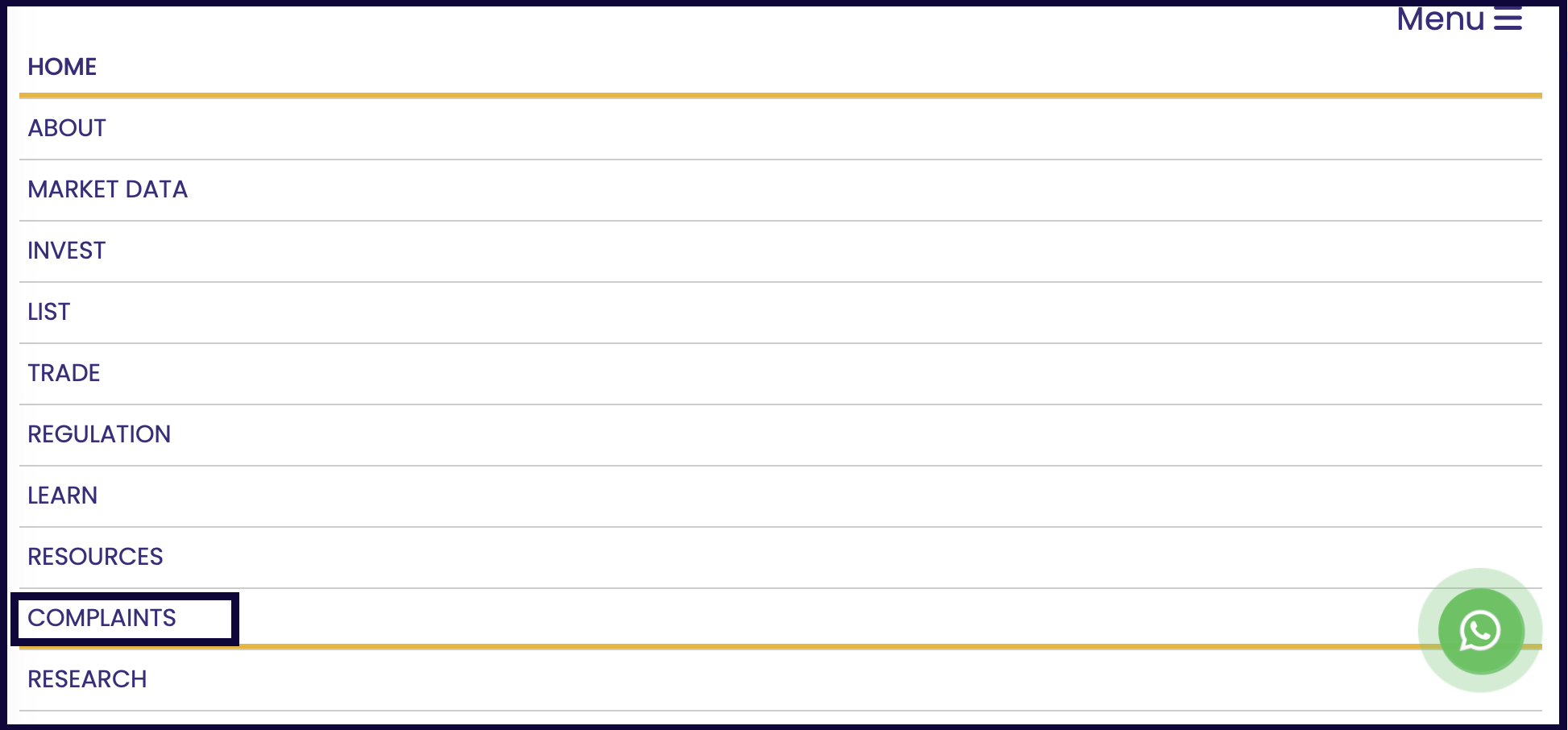
Step 3: Go to the Complaints Section
From the menu, navigate to the Complaints section. This section is dedicated to investor grievances and provides access to complaint-related information published by the exchange.
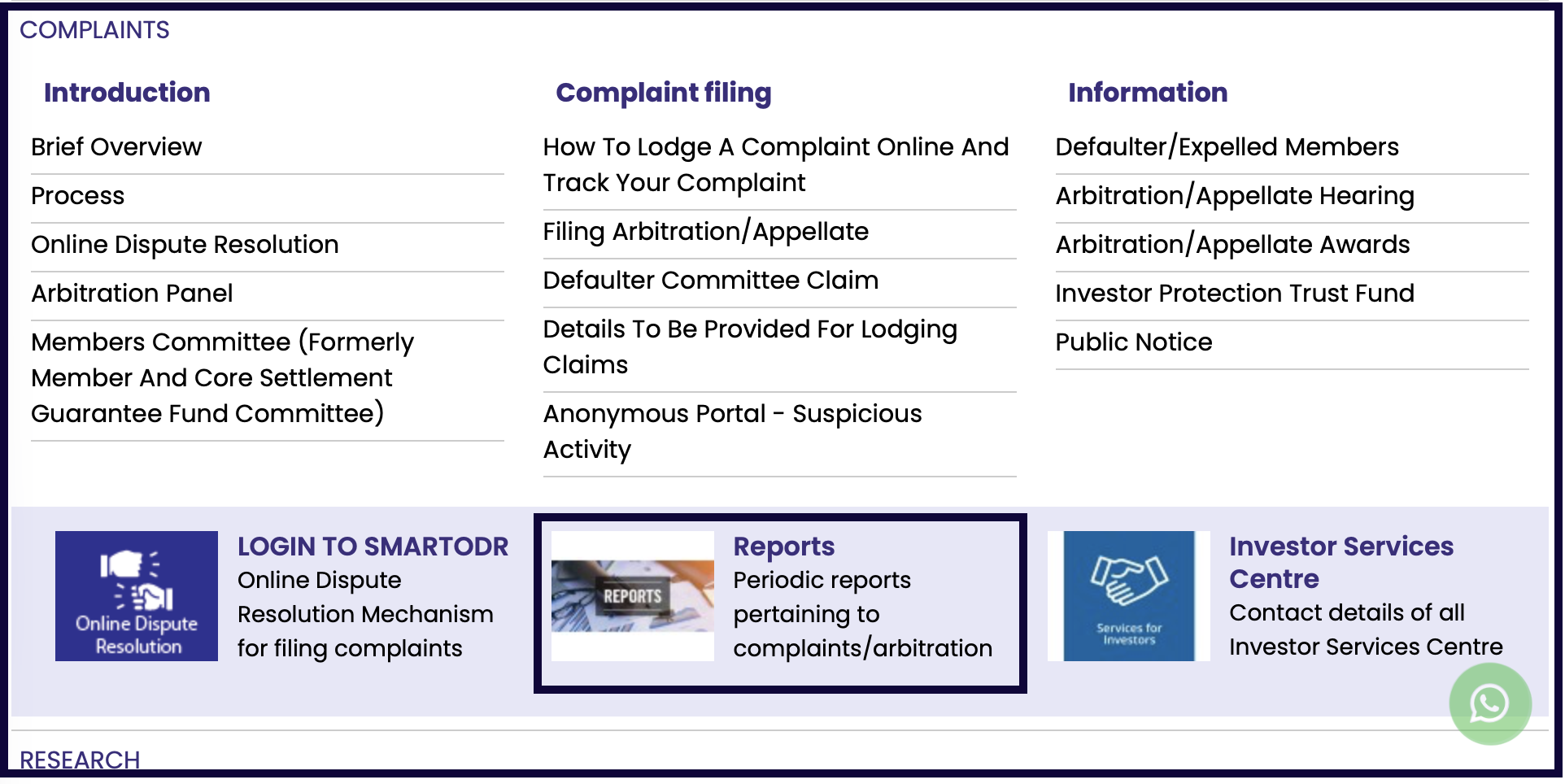
Step 4: Click on Reports
Inside the Complaints section, click on Reports. Here, you will find various reports containing complaint statistics for different financial years.
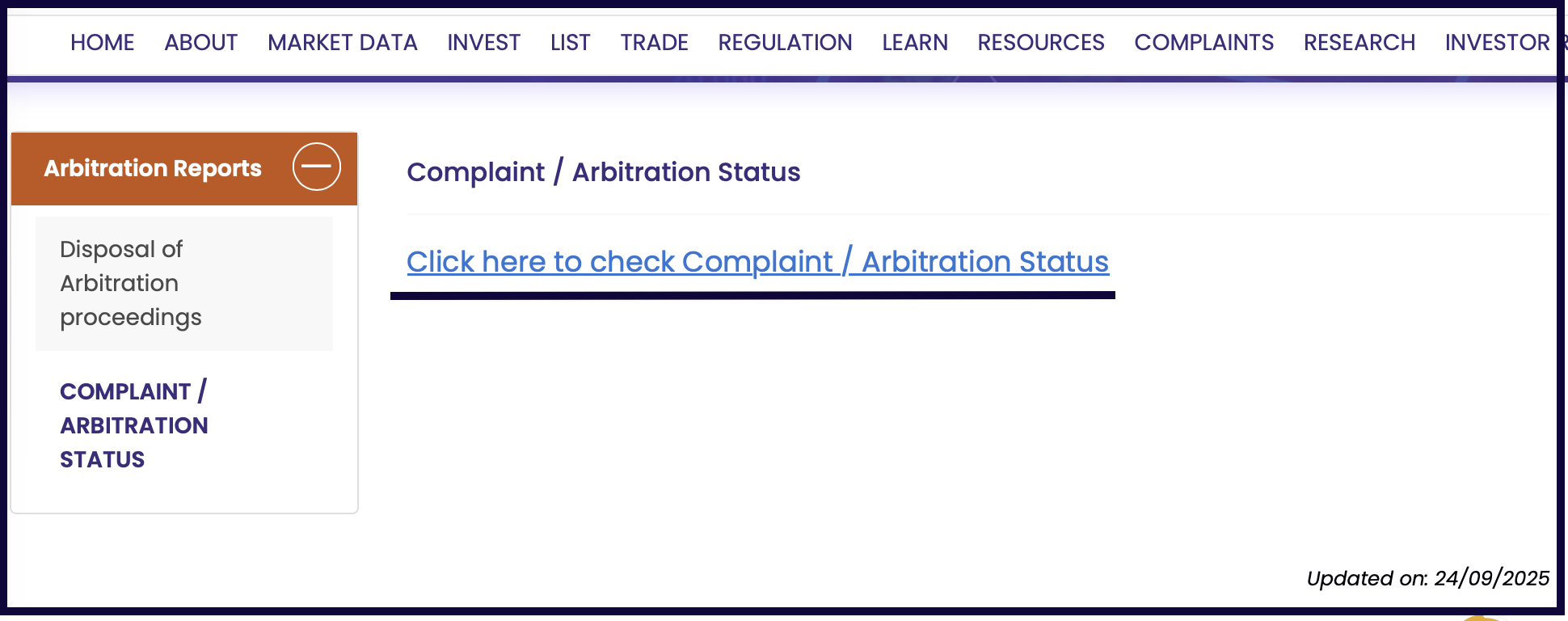
Step 5: Open the Complaints / Arbitration Report
Next, click on Complaints / Arbitration. This page contains downloadable reports that show complaint data, complaint categories, and arbitration statistics for registered brokers.
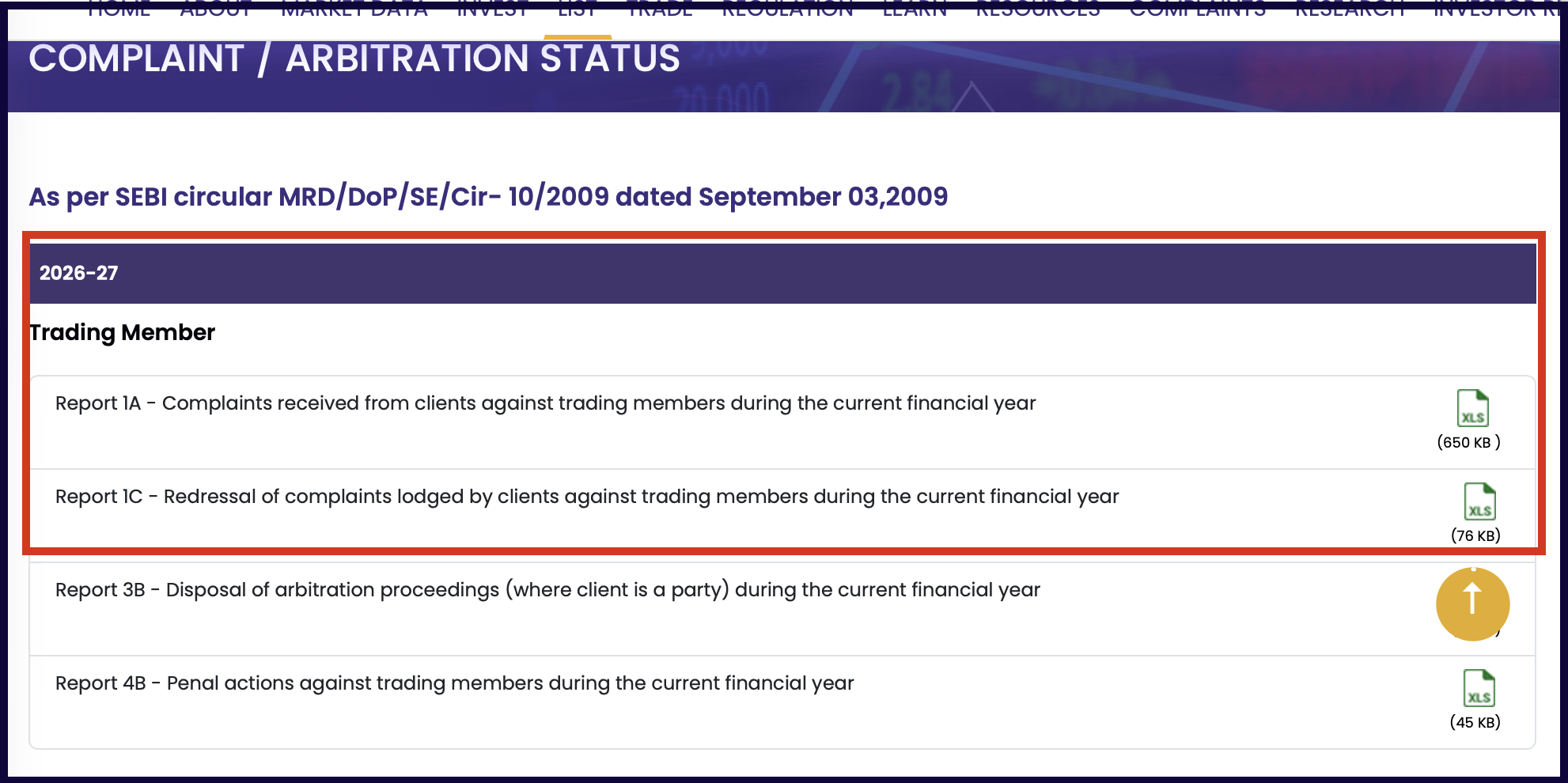
Step 6: Download the Report
Select the report for the current or previous financial year and download the Excel file.
If you want to compare trends over time, downloading reports from multiple years can give you a better understanding of how complaint patterns have changed.
Step 7: Open the Excel File
After opening the workbook, you will notice that it contains several worksheets.
While each sheet serves a different purpose, NSE Report 1A and Report 1C are the most useful if you want to evaluate a broker.
-
NSE Report 1A
This sheet focuses on the types of complaints investors have reported. Instead of showing only the total complaint count, it breaks the data into different categories, making it easier to understand the nature of the issues.
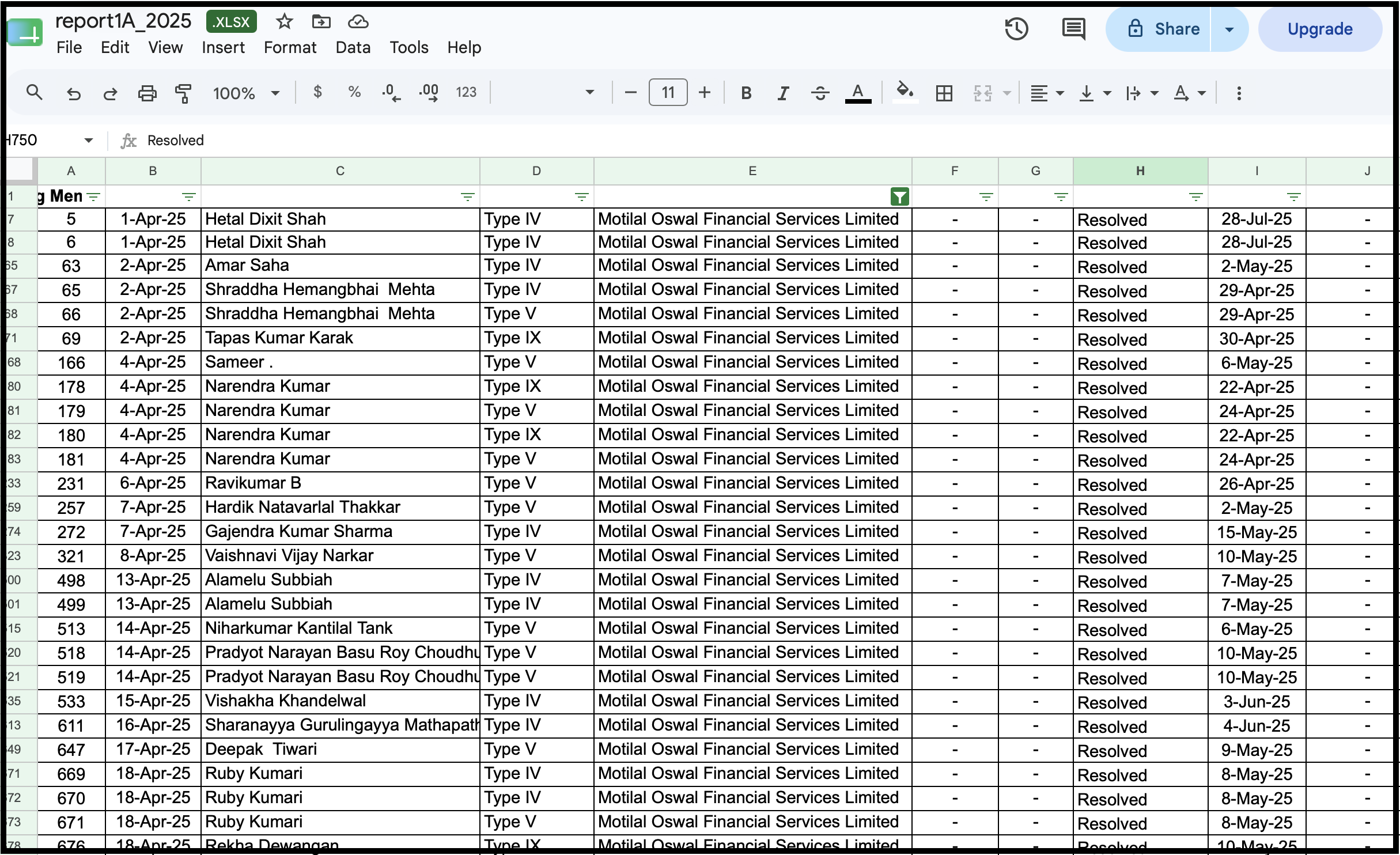
In this sheet, you can find:
- Complaint categories.
- Total complaints received.
- Resolved complaints.
- Pending complaints.
- Complaint type-wise data.
- A summary table at the bottom.
The summary table explains complaint categories from type I to type IX. This makes it easy to check how many complaints fall under specific categories.
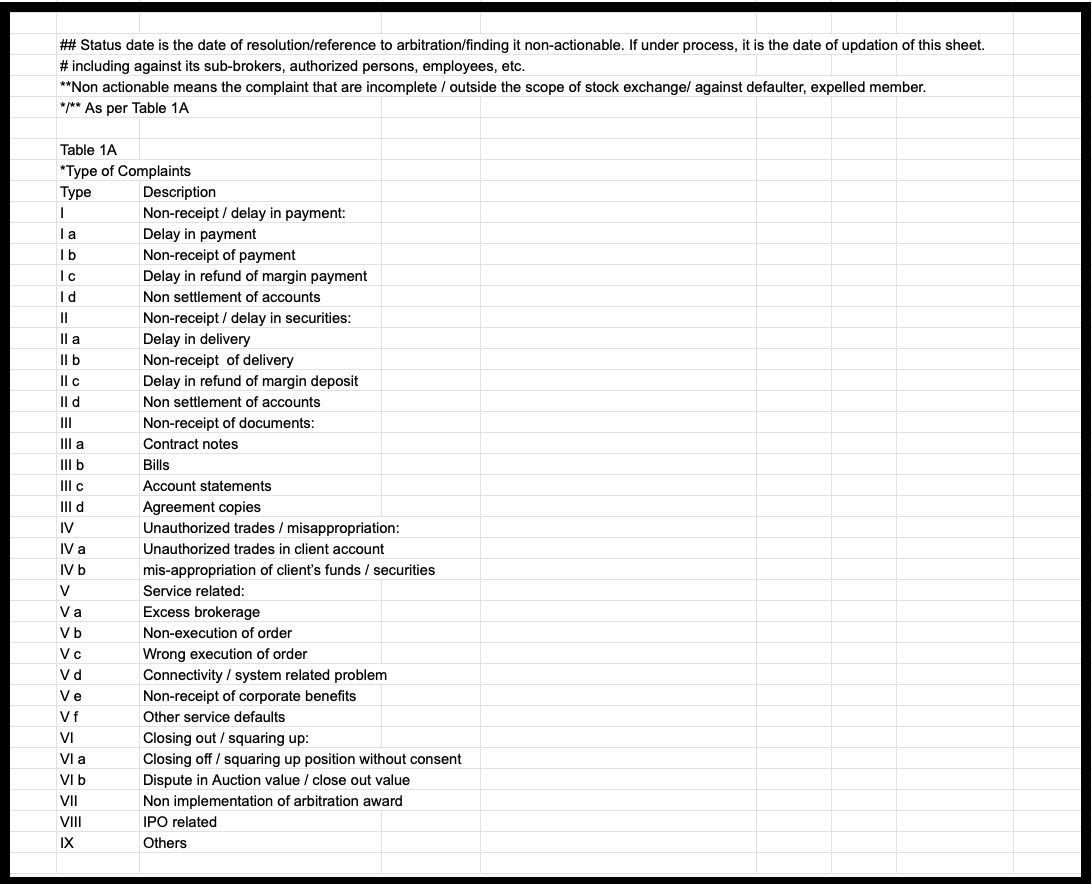
Looking at category-wise data often reveals patterns that total complaint numbers cannot.
-
NSE Report 1C
If your goal is to compare brokers, Report 1C is one of the most valuable sheets in the workbook.
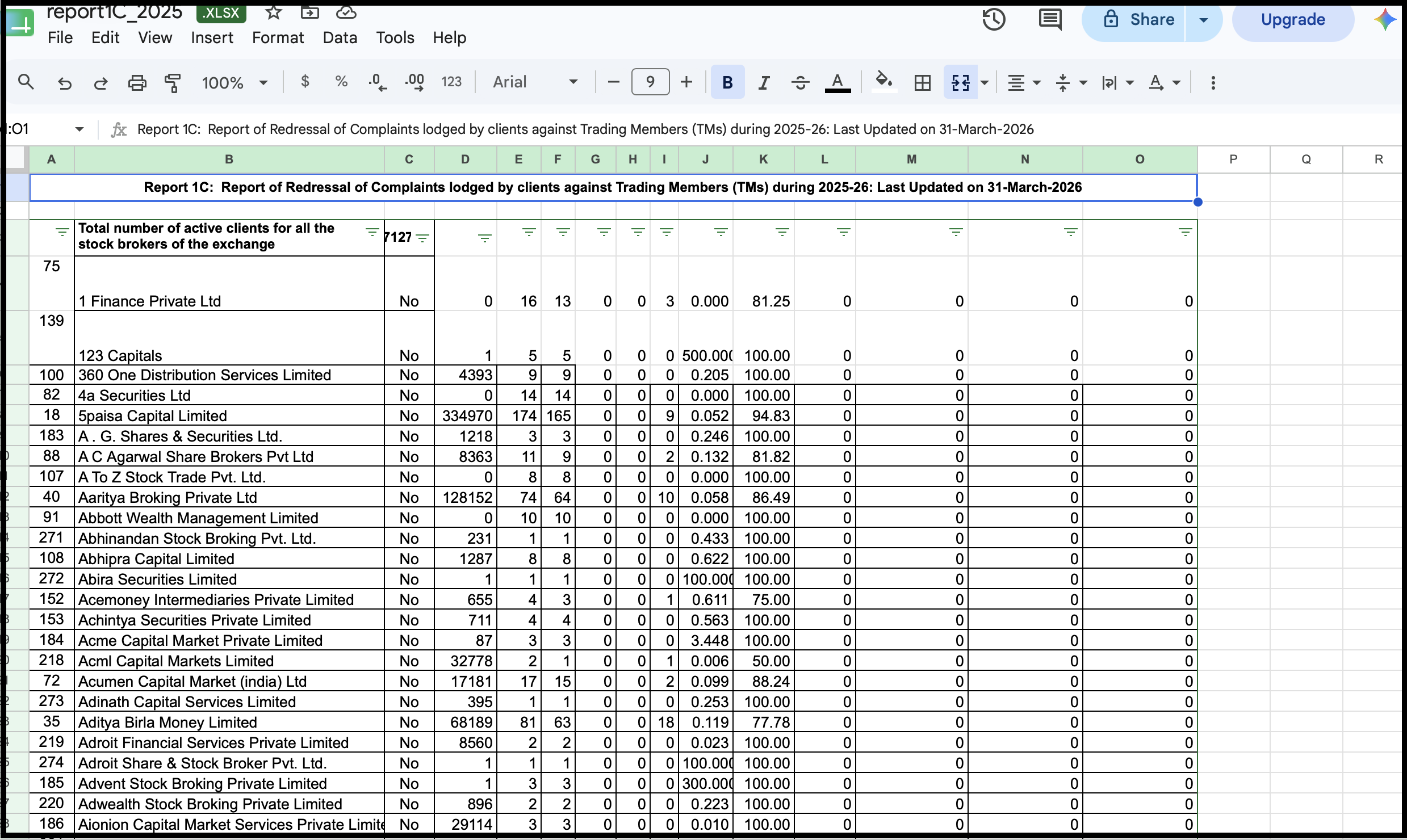
It provides information such as:
- Broker names.
- Total client base.
- Total complaints received.
- Resolved complaints.
- Pending complaints.
- Arbitration cases.
This report helps you compare brokers using official NSE broker complaint data instead of advertisements or online opinions.
By looking at these numbers together, you can understand not only how many complaints were reported but also how effectively they were resolved and whether any disputes progressed to arbitration.
What Does NSE Complaint Data Reveal?
At first glance, you might think NSE complaint data only tells you how many complaints a broker has received. In reality, the reports reveal much more than that.
When you know what to look for, these numbers can help you understand how a broker handles investor grievances and whether certain issues keep appearing over time.
Here are some of the key insights you can find in an NSE complaint report:
- Total client base: A broker with a larger client base is likely to receive more complaints. That is why the client base should always be considered before comparing complaint numbers.
- Complaint percentage: This shows the proportion of complaints compared to the total number of clients. It provides a fairer way to compare brokers of different sizes.
- Resolved complaints: You can see how many complaints have been resolved during the reporting period. A high resolution rate generally indicates that complaints are being addressed through the grievance process.
- Pending complaints: Complaints that remain unresolved may indicate delays in resolving investor issues. Reviewing this number alongside resolved complaints gives you a clearer picture.
- Arbitration cases: Some disputes cannot be resolved through the normal complaint process and move to arbitration. This data helps you understand how many cases reached that stage.
Looking at all these factors together gives you a much better understanding than focusing on a single complaint count.
Instead of relying on advertisements or online opinions, you can evaluate a broker using official NSE complaint statistics and make a more informed decision.
NSE Complaint Data PDF
While the National Stock Exchange hosts its active broker-wise grievance database in interactive Excel formats, the exchange also publishes comprehensive annual market-wide summaries and official regulatory circulars as downloadable PDFs.
These NSE Complaint Data PDF documents are highly valuable for investors who want a static, macro-level snapshot of market compliance trends or need a portable format to read on mobile devices.
They provide official, tamper-proof records often used for legal or arbitration references.
If you are currently preparing to dispute a charge, look for these official PDF disclosures on the exchange portal to see how systemic violations are categorised across the industry before submitting your case.
How to Read NSE Complaint Data Correctly?
Once you download the report, you may feel overwhelmed by the amount of information it contains.
The good news is that you do not need to understand every sheet. A few key numbers can tell you a lot about what other investors have experienced.
Let’s say you are facing a problem with Motilal Oswal and want to know whether other investors have reported similar issues.
Start by opening Report 1C and searching for the broker’s name.
Within seconds, you will see the broker’s client base, total complaints, complaint percentage, resolved complaints, pending complaints, and arbitration cases.
Now, look at the table below:
| Financial Year | Total Clients | Total Complaints | % of Complaints | Resolved | % Resolved | Arbitration |
| 2022–23 | 8,79,629 | 516 | 0.05% | 504 | 99.61% | 19 |
| 2023–24 | 8,79,629 | 498 | 0.05% | 492 | 100% | 9 |
| 2024–25 | 10,14,875 | 1,078 | 0.106% | 1,078 | 100% | 2 |
| 2025–26 | 9,01,619 | 872 | 0.097% | 757 | 86.81% | 0 |
This is where the report starts answering questions that customer support never will.
You can see how many investors raised complaints during each financial year, how many got resolved, and how many were still pending.
If you are waiting for your complaint to move forward, those pending numbers become especially important.
They also help you understand how the broker has handled investor grievances over time and whether you feel confident continuing with them.
Specific NSE Complaint Data
But what if your issue is more specific?
Suppose trades were executed in your account without your permission. Instead of stopping at report 1C, open report 1A and look for Category IV, which covers unauthorised trading.
| Financial Year | Total Complaints | Unauthorised Trading Complaints | Percentage |
| 2022–23 | 516 | 195 | 37.79% |
| 2023–24 | 498 | 174 | 34.94% |
| 2024–25 | 1,079 | 366 | 33.92% |
| 2025–26 | 761 | 286 | 37.58% |
Now the report becomes even more personal.
Instead of looking at overall complaints, you can see exactly how many investors reported the same issue.
If unauthorized trading happened in your account, these numbers can reassure you that others have also raised similar concerns through the official grievance process.
You can use the same approach for excessive brokerage, delayed fund withdrawals, contract note disputes, and other complaint categories to understand whether your issue appears repeatedly in the NSE complaint data.
Found your broker’s name in these numbers and realised your problem is part of a pattern?
We will turn that pattern into your case, matching your complaint to the right category, preparing the documents each stage demands, and carrying it from the first written complaint through to arbitration if it comes to that.
How NSE Complaint Data Helps You Choose the Right Broker?
If you are still evaluating brokers, or thinking about switching after a difficult experience, NSE complaint data gives you a framework for comparison that no advertisement, influencer recommendation, or app rating can replicate.
Here is what to look at when comparing brokers side by side using official NSE data:
1. Complaint percentage over raw complaint count
Always divide total complaints by total clients before comparing two brokers. A larger broker will always have more complaints simply because they serve more people.
2. Resolution rate trends
A consistently high resolution rate suggests the broker has a functioning grievance process. A falling resolution rate year over year is a warning sign worth taking seriously.
3. Pending complaint accumulation
If pending complaints are growing each year rather than clearing, the broker is not keeping pace with investor grievances.
4. Arbitration frequency
When complaints regularly escalate to NSE arbitration, it means investors are not accepting the broker’s informal responses. Tracking how often an official NSE complaint against broker moves to arbitration shows you how frequently disputes fail to resolve amicably.
5. Category-wise complaint patterns
A broker with consistently high unauthorised trading complaints across multiple years is showing a pattern. That pattern deserves your attention before you give them access to your funds.
6. Year-on-year trends
A sudden spike in complaints after years of stability suggests something changed internally. It is worth investigating what happened during that year.
These numbers, taken together, are almost always more useful than anything a broker publishes about themselves.
What to Do If Your Broker’s Name Is in This Data for the Wrong Reasons?
If you are reading this page because something has already gone wrong in your own account, the numbers above are only half the story.
The other half is that a formal, regulated path exists to raise your concern, and it works in stages.
It begins with your own records and a written complaint to the broker, because every forum after that point asks what the broker was given the chance to resolve.
When the broker’s answer disappoints, the dispute moves to the regulator through a SEBI SCORES complaint, where your grievance enters a system SEBI itself monitors.
Beyond that sits conciliation through the SMART ODR platform, which costs you nothing and settles many disputes before anything formal begins.
And for the cases that refuse to settle, NSE arbitration delivers a binding decision, the same stage where the arbitration numbers in Report 1C come from.
If you want the full process of filing a complaint, with the portal steps, contacts, and every stage of tracking your NSE complaint status along the way, check our guide: NSE complaint status.
Conclusion
If something about your trading experience does not feel right, do not ignore it. NSE complaint data can help you understand whether other investors have reported similar concerns through the official grievance process.
While it cannot decide who is right or guarantee an outcome, it can reveal patterns that deserve attention.
If your issue matches those patterns, preserve all your account statements, emails, contract notes, and other evidence. The sooner you begin the complaint process, the easier it becomes to present your case clearly.
Every complaint starts with a single step, and taking that step today is often better than waiting.
You trusted your broker with your money, and if that trust has been broken, you deserve to have your concerns heard.
Report. Recover. Stay Fraud Free.
Frequently Asked Questions
NSE complaint data is available at the official website of the National Stock Exchange. It includes complaint volumes, categories, resolution rates, pending cases, and arbitration numbers that NSE publishes for each financial year in downloadable Excel reports.
Yes, NSE publishes this data on its official website, and any investor can download the Excel reports without creating an account or paying any fee. The data is freely accessible because investor transparency is a regulatory requirement.
NSE typically updates complaint reports on a quarterly or annual basis. Reports for each financial year are made available after the relevant period closes, and historical data for previous years remains accessible on the website.
Report 1A shows category-wise complaint data for the entire exchange, which helps you understand what types of complaints are most commonly filed and how many were resolved or are pending. Report 1C lists individual brokers with their client base, total complaints, resolution rates, pending cases, and arbitration numbers, making it useful for comparing specific brokers directly.
The primary NSE complaint email ID for the Investor Grievance Cell in India is [email protected]. However, depending on your physical location, NSE also provides specific regional email addresses (such as [email protected] for Delhi or [email protected] for Mumbai) to speed up local investor dispute handling.





 Add us as a preferred source on Google »

