

Quick Summary
Chanakya Investment is a Gurgaon-based firm holding both Research Analyst registration INH000023418 and Investment Adviser registration INA000021049. Their own disclosure shows zero complaints for FY 2025-26. But six specific practices on their Telegram, Instagram, and YouTube raise questions about SEBI’s Advertisement Code and conduct requirements. Loss recovery promises, selective profit sharing, disappearing chat screenshots, and VIP group pressure tactics are all visible on their own platforms before you pay a rupee.
Chanakya Investment is a Gurgaon-based research and advisory firm associated with Paresh Gordhandas.
The firm has been active in India’s IPO and grey market analysis space for over a decade through their flagship brand Chanakya Ni Pothi.
The firm holds two active SEBI registrations.
- Research Analyst: INH000023418
- Investment Adviser: INA000021049
Dual registration is significant. It means the firm is authorised both to publish general research recommendations and to provide personalised investment advice tailored to individual client profiles.
These are two different regulatory frameworks with different rules applying to each.
The firm serves 12,000 plus clients across India. Subscription plans run from Rs. 3,000 to Rs. 1,50,000 per year.
They are present across a blog, YouTube channels, and Telegram communities with tens of thousands of followers.
That is the registration and business picture. What their own social media platforms show alongside the registrations is worth examining carefully.
What Chanakya Investment’s Complaint Disclosure Shows?
Chanakya Investment maintains a complaints page on their website, which is itself a positive compared to firms that do not publish this data at all.
Their disclosure shows zero complaints received for FY 2025-26. The firm received its registrations in 2025, so three years of historical data does not yet exist.
The current year data is what is available and it shows zero.
| S. No. | Month | Carried Forward | Received | Resolved | Pending |
|---|---|---|---|---|---|
| 1 | June, 2026 | 0 | 0 | 0 | 0 |
| 2 | May, 2026 | 0 | 0 | 0 | 0 |
| 3 | April, 2026 | 0 | 0 | 0 | 0 |
| 4 | Previous Monthly Complaint for this FY 25-26 | 0 | 0 | 0 | 0 |
| Grand Total | 0 | 0 | 0 | 0 | |
Zero formal complaints from 12,000 plus clients has two possible interpretations. Either investors have had uniformly positive experiences and no one has felt the need to file formally.
Or investors who were dissatisfied resolved matters privately, did not know where to file, or did not know that formal channels existed.
Both interpretations are possible. Neither is verifiable from the disclosure data alone.
What matters is that the mandatory disclosure is present and updated. That compliance is real.
Also Read: Alpha Plus Capital Associates LLP, a firm that shows red flags users should not ignore.
Six Red Flags From Their Own Platforms
Each of the following is sourced from Chanakya Investment’s own Telegram channels, Instagram, and YouTube. We are describing what we observed on their public platforms.
We are not making independent allegations. Everything described here is visible on their own public content.
Red Flag 1: Only Profitable Calls Shared on Instagram
Chanakya Investment’s Instagram regularly features stories and posts highlighting profitable trades and the money clients supposedly earned by following their calls.
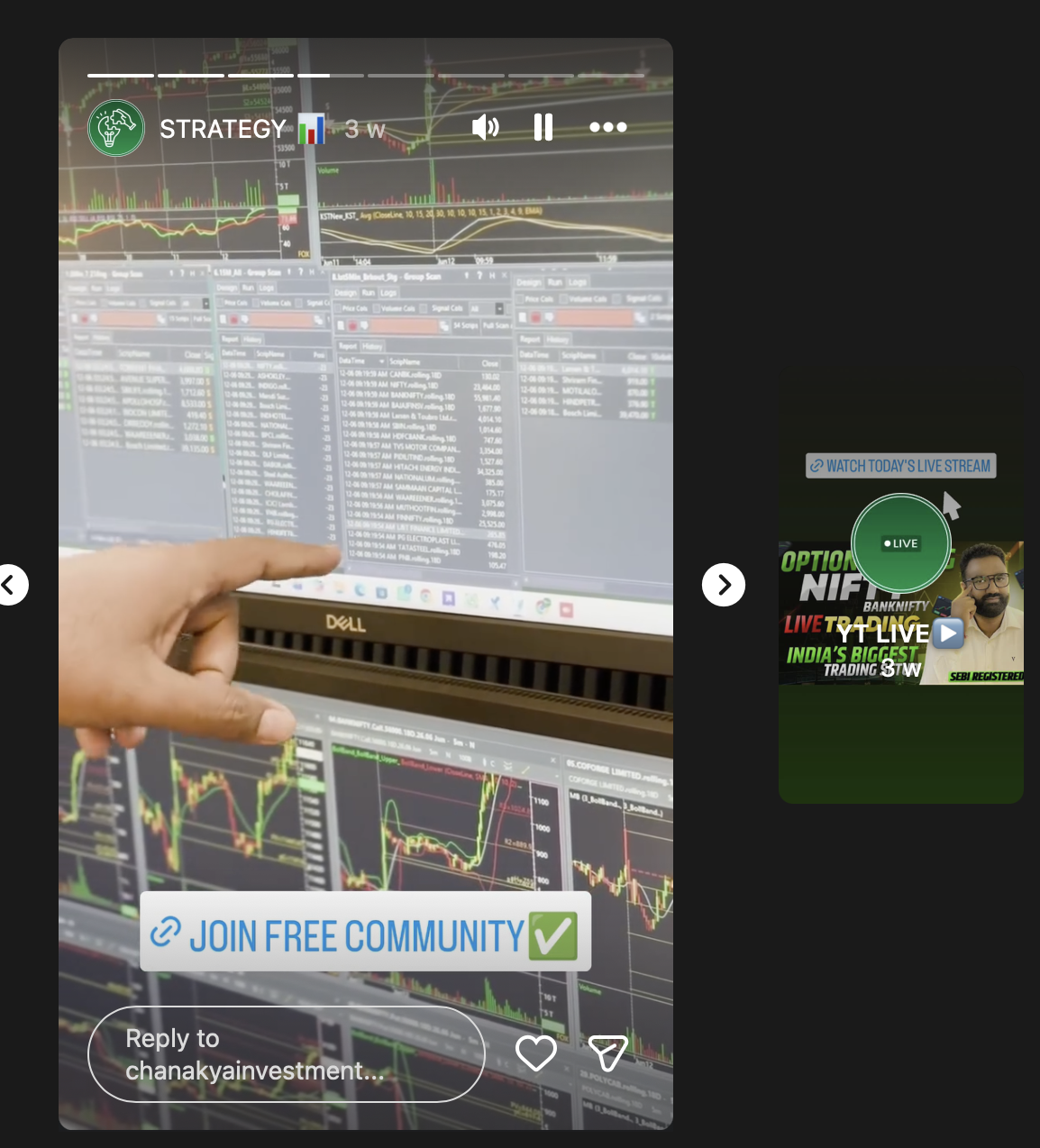
SEBI’s Advertisement Code for Research Analysts requires that marketing material present a fair and complete picture.
Sharing only the profitable calls while the platform carries no mention of calls that did not work creates a misleading impression about the consistency of outcomes.
The stock market produces both profits and losses. Marketing that shows only one side does not reflect the full reality of following any advisory service.
Red Flag 2: Only Positive User Experiences Shared on YouTube
A YouTube Q&A video features clients discussing earnings and profits from following Chanakya Investment’s strategies.
No client discussing a recommendation that did not work or a loss incurred appears in the content.
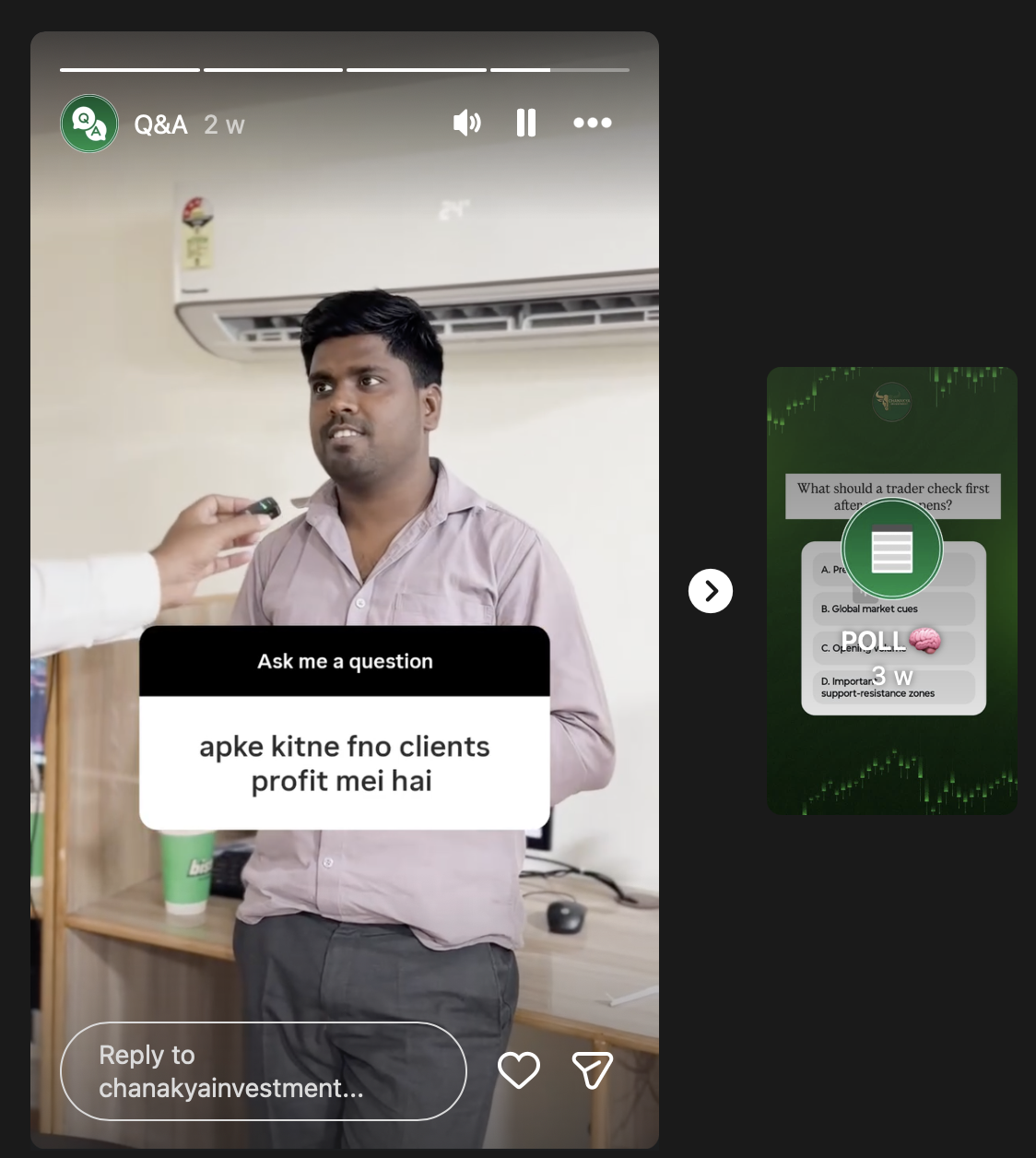
SEBI’s Advertisement Code requires marketing content to not be one-sided or misleading.
A Q&A that presents only the experiences of satisfied clients and omits the experiences of those who incurred losses gives prospective subscribers an incomplete picture before they pay.
Red Flag 3: Loss Recovery Promises on Telegram
This is the most serious finding across the six.
On one of their Telegram channels, Chanakya Investment shares messages suggesting that a single trade can recover previous losses, typically accompanied by an invitation to join the premium group before the opportunity closes.
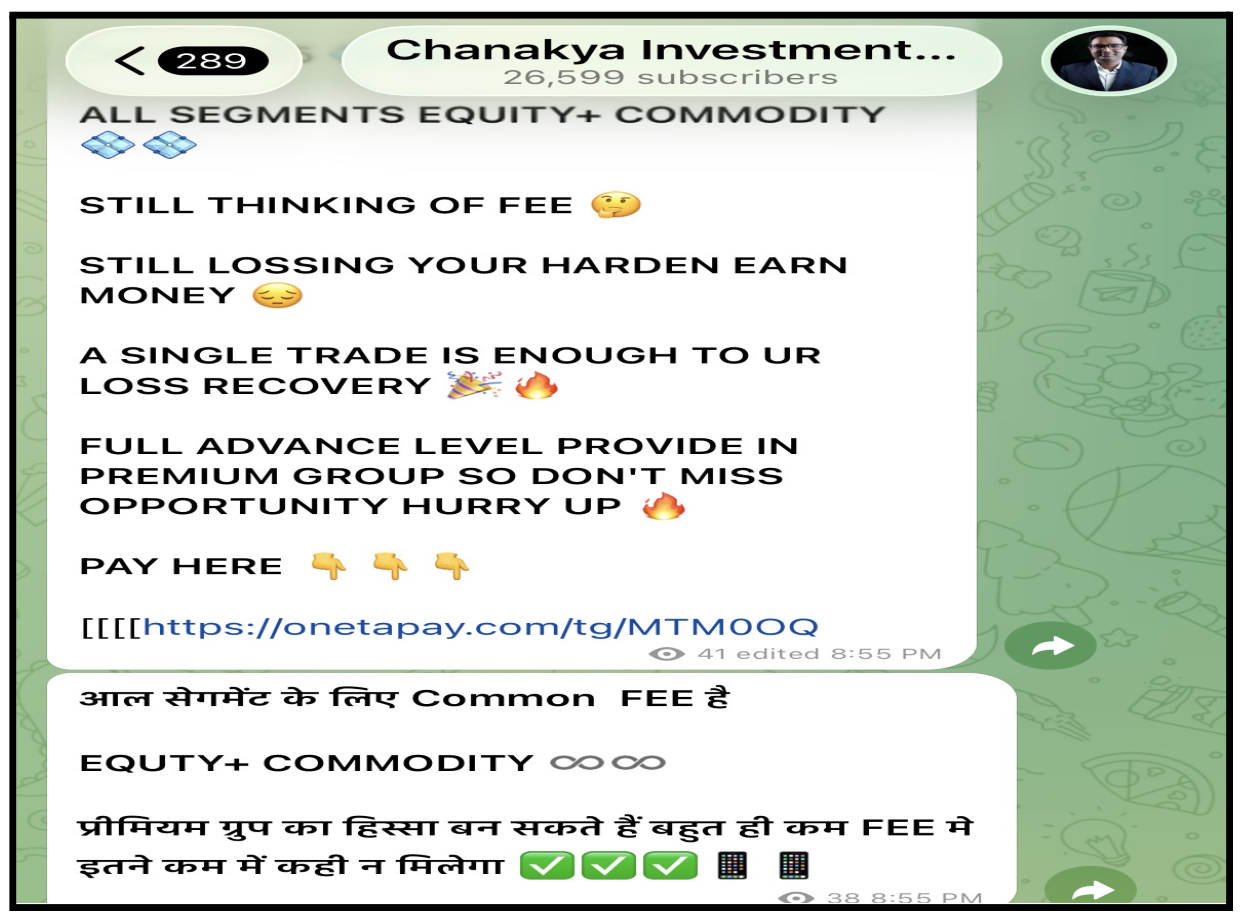
SEBI’s Regulation 15 for Research Analysts explicitly prohibits any registered RA from promising or implying that they can recover investor losses.
This prohibition has no exception. No market professional can guarantee that one trade will reverse a prior loss.
Messages framed in this way violate the regulation regardless of whether the premium group is eventually profitable.
Red Flag 4: Selective Profit Updates on Telegram
The Telegram channel regularly shares profit announcements such as “20 Lots equals Rs. 45,000 plus profit,” “55 Point Jackpot Rally,” and similar messages.
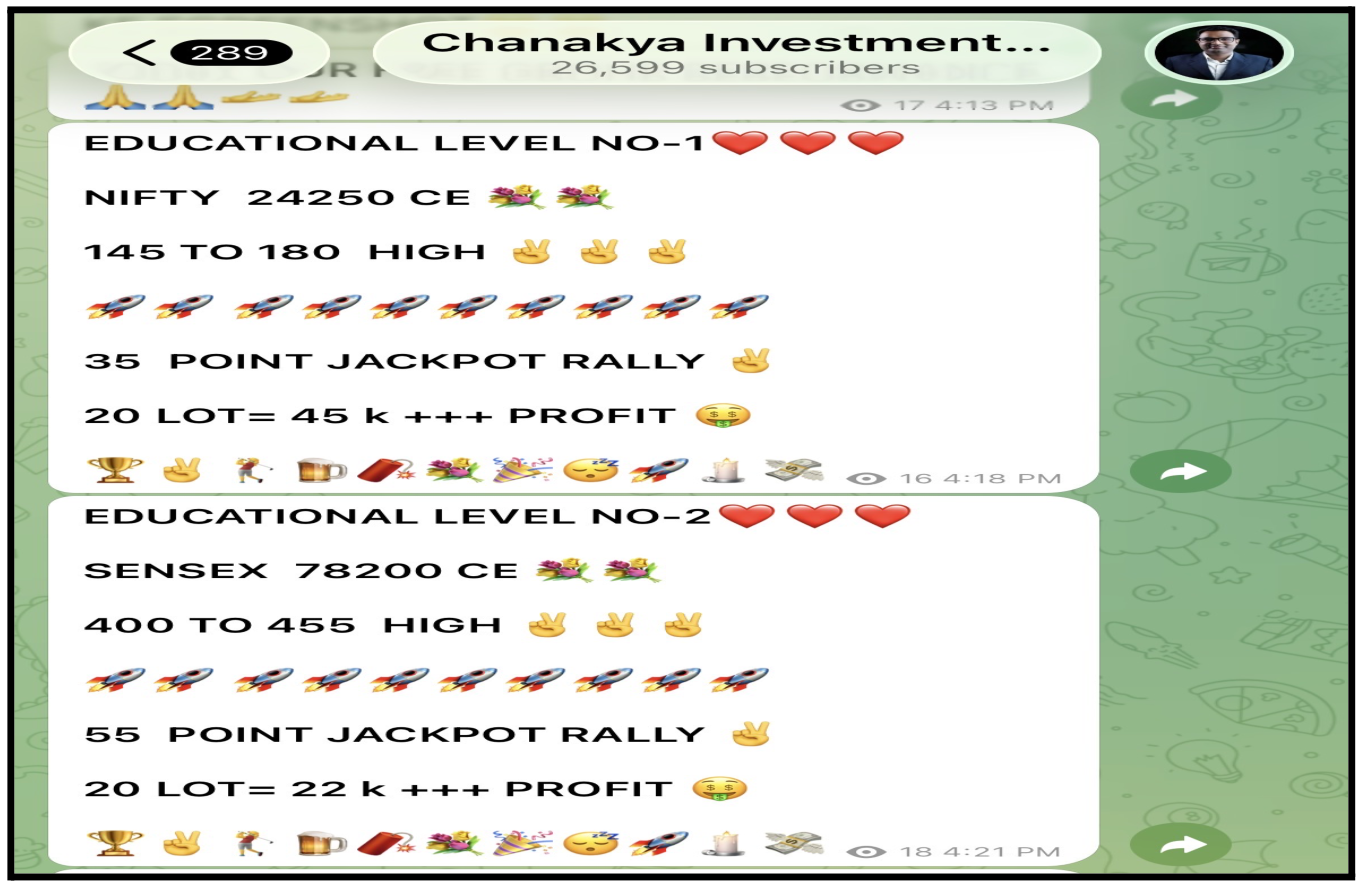
The consistent pattern of sharing only profit outcomes creates the impression that consistent profits are close to guaranteed when following the service.
Losses from trades in the same period do not appear.
SEBI’s Advertisement Code specifically targets this pattern of selective disclosure because it is one of the most common ways prospective investors are misled into subscribing.
Red Flag 5: VIP Group Pressure Using Urgency Language
The free Telegram channels carry recurring messages using phrases like “Jackpot Day,” “Recovery Before 10 AM,” and “Open Challenge,” typically followed by an invitation to join the VIP group to receive calls with correct targets and stop losses.
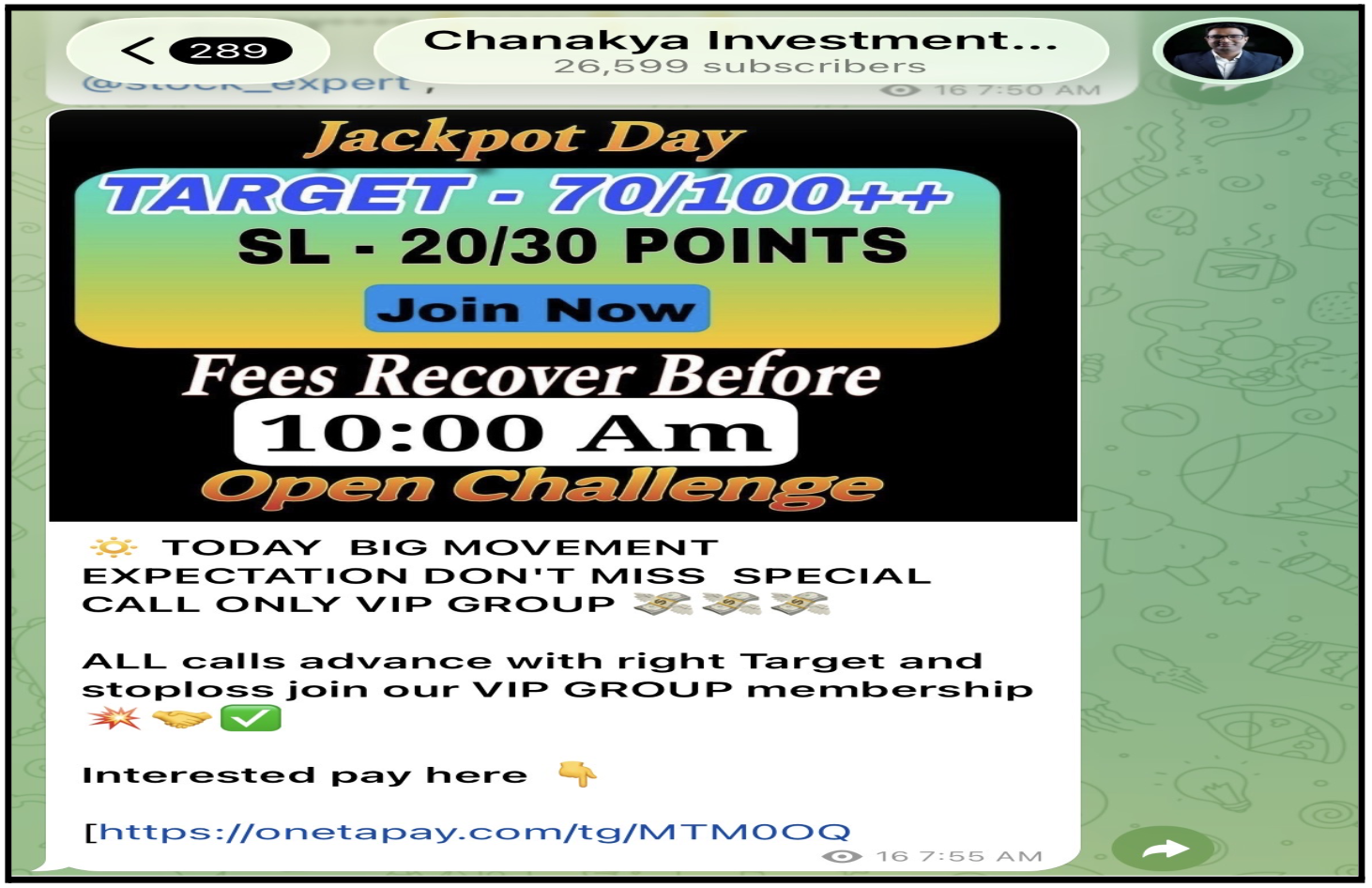
This pattern creates artificial urgency and activates the fear of missing out.
SEBI’s guidelines specifically flag urgency-based selling tactics as inconsistent with fair and transparent marketing for registered entities.
An investor who subscribes because they fear missing a “Jackpot Day” is not making a considered investment decision.
Red Flag 6: Unverifiable Chat Screenshots That Sisappear
Chanakya Investment shares screenshots of user chats praising the service, claiming significant profits, and describing loss recovery.
When attempts are made to capture these screenshots independently, they reportedly appear blank or disappear.
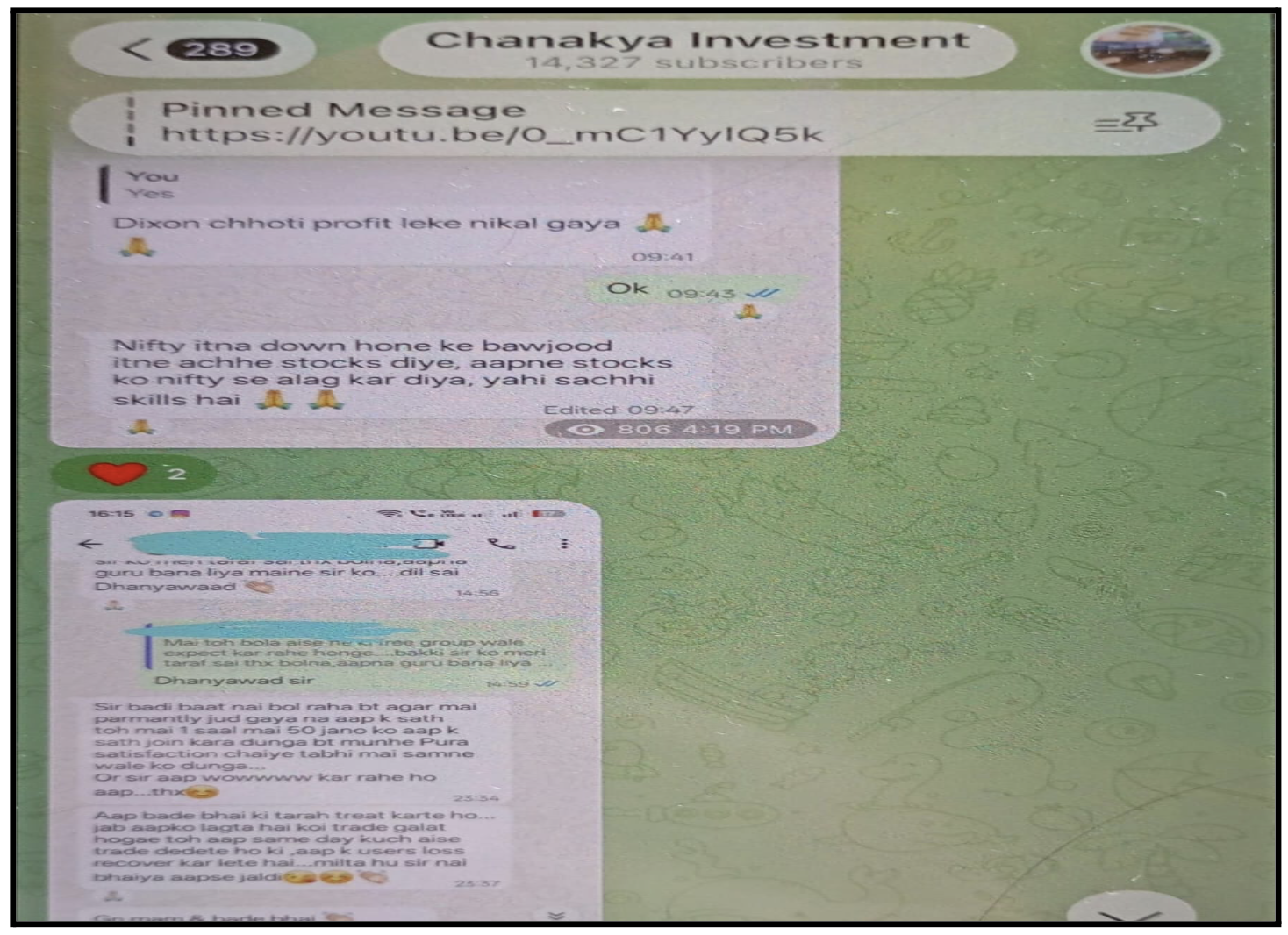
Whether these chats are genuine cannot be verified by an ordinary investor.
That is precisely the problem. SEBI’s disclosure requirements exist because investors need to be able to independently verify claims made by registered entities.
Content that appears and disappears is not independently verifiable.
Also Read: AlphaGrep Advisors Private Limited, holding a second SEBI registration its own website never mentions.
What Chanakya Investment’S Dual Registration Means for Your Complaint?
Because Chanakya Investment holds both an INH and an INA registration, the correct SEBI SCORES category depends entirely on which service you used.
- If your complaint is about research recommendations, stock tips, or the subscription-based calls service, file under Research Analyst using INH000023418.
- If your complaint is about personalised portfolio advice built around your specific financial goals and risk profile, file under Investment Adviser using INA000021049.
Filing under the wrong category routes the complaint to the wrong desk and can delay resolution by weeks.
For the complete SEBI SCORES guide including what each status means and what happens at each stage, the SCORES guide covers the full process. Read the SEBI SCORES complaint.
If you have already subscribed and your experience involved any of the six patterns described above, the formal complaint path is available.
Our team files your SEBI SCORES complaint, prepares the documentation, and represents you through SMART ODR and arbitration.
Conclusion
Chanakya Investment holds genuine dual SEBI registration and maintains a complaints disclosure showing zero formal grievances for FY 2025-26. Those are real positives.
Six specific practices on their own Telegram, Instagram, and YouTube channels raise questions that sit directly against SEBI’s Advertisement Code and Regulation 15.
Loss recovery promises on Telegram. Selective profit sharing. Urgency-based VIP group invitations. Unverifiable disappearing chat screenshots.
None of these require going outside the firm’s own platforms to observe.
Registration confirms authorisation. It does not confirm that marketing practices stay within what the regulations governing those registrations require.
The six findings above are all visible before any subscription is paid. They deserve to factor into your decision.
Frequently Asked Questions
Yes. The firm holds Research Analyst registration INH000023418 and Investment Adviser registration INA000021049. Both are verifiable on sebi.gov.in under their respective intermediary categories.
It means no formal complaints were filed through the official grievance mechanism for FY 2025-26 from their 12,000 plus client base. It does not confirm that every client had a positive experience. Complaints not formally filed through SEBI channels do not appear in the disclosure.
No. SEBI's Regulation 15 explicitly prohibits any registered Research Analyst from promising or implying they can recover investor losses. Any Telegram message or communication suggesting a single trade can recover previous losses is outside what the RA registration permits.
Select Research Analyst and enter INH000023418 for complaints about research calls or subscription-based tips. Select Investment Adviser and enter INA000021049 for complaints about personalised advice tailored to your financial profile. Using the wrong category routes the complaint incorrectly and delays resolution.
SEBI's Advertisement Code requires that promotional content be fair, balanced, and not misleading. Sharing only profitable trades while omitting losing trades creates a misleading impression about the consistency of outcomes. This is a specific concern the Advertisement Code addresses for registered Research Analysts.





 Add us as a preferred source on Google »

