

Quick Summary
NSE arbitration fees follow a slab system under SEBI’s dispute resolution framework, starting at ₹5,400 for claims up to ₹1 lakh and ₹9,000 up to ₹10 lakh, rising to ₹1,35,000 for claims near ₹1 crore, with GST and stamp duty extra. Timing decides your real cost: file within a month of conciliation failing and you pay the base fee, but delay doubles the fee, and late fees stay non refundable. The winner’s deposit comes back after the award. One investor we represented recovered ₹1,20,061 plus his full arbitration fee.
If you are weighing up a broker dispute on the National Stock Exchange, the NSE arbitration fees start at just ₹5,400, but that number tells only half the story.
The other half is what most investors learn too late: the same claim can cost double depending on when you file it.
And there is a rule at the end of the process that changes the maths entirely for anyone with a genuine case.
This page gives you the exact slab for every claim amount, the timing rules that inflate the bill, and the refund rule that can bring your cost down to zero.
NSE Arbitration Fees in 2026: Full Slab by Claim Amount
The fee depends on one thing: the value of your claim.
Two charges apply together: the arbitrator’s fee and the platform’s fee, but you do not need to work them out separately.
The table below shows them combined into the one amount you actually pay when you start the arbitration.
The slabs run from small retail claims under ₹1 lakh right up to claims above ₹1 crore, and the fee jumps at each level.
Finding your row is simple: take your total claim, including any interest or compensation you are adding on top of the loss, and see which slab it lands in.
Here is the complete structure:
| Claim Amount | Fee You Pay |
|---|---|
| Up to ₹1 lakh | ₹5,400 + GST |
| Above ₹1 lakh to ₹10 lakh | ₹9,000 + GST |
| Above ₹10 lakh to ₹20 lakh | ₹13,500 + GST |
| Above ₹20 lakh to ₹30 lakh | ₹18,000 + GST |
| Above ₹30 lakh to ₹50 lakh | ₹67,500 + GST |
| Above ₹50 lakh to ₹1 crore | ₹1,35,000 + GST |
| Above ₹1 crore | 1% of the claim or ₹1,20,000, whichever is higher, plus ₹35,000 |
Stamp duty applies on actuals, and for claims above ₹30 lakh, the matter goes before a tribunal of three arbitrators instead of a sole arbitrator.
One more thing worth knowing before the fee ever becomes relevant: the conciliation stage that comes before arbitration costs you nothing, because the market participant bears that cost.
The fee only enters the picture when conciliation fails, and you choose to push the dispute to a binding decision through NSE arbitration.
Whether the free conciliation stage or the paid arbitration stage serves your case better is exactly the tradeoff mapped on our guide on SMART ODR vs NSE arbitration.
What Happens If You File Late?
This is where two investors with identical claims end up paying completely different amounts.
The timing rules work in three layers, from the base fee to the penalties, and the clock starts when your conciliation fails:
File within one month of the conciliation failing, and you pay the base fee from the table above.
Wait beyond one month, and the fee doubles, and late fees are non-refundable regardless of the outcome.
A separate rule punishes the other side’s delays: If the broker’s side starts arbitration more than six months late, they pay an extra 50% for every month after that.
There is also a ₹1,000 late fee at the very start if you initiate the conciliation itself more than six months after the dispute arose.
What Delay Actually Costs: Two Examples
The rules above can feel abstract until you put real numbers on them.
So here are two claims, one small and one mid-sized, each calculated twice: once filed on time, once filed late.
Same dispute, same evidence, two very different bills.
- Imagine your claim is ₹8 lakh: File within a month of conciliation failing, and you pay ₹9,000 plus GST, refundable if you win. Wait three months, and the same claim costs ₹18,000, and late-paid fees do not come back even when the award goes your way.
- Now suppose your claim is ₹15 lakh: On time, the fee is ₹13,500 plus GST. Delayed, it becomes ₹27,000 for the identical dispute.
The claim has not changed. The evidence has not changed.
Only your timing has, and it cost you the price of the case.
Just realised your delay has already crossed the one month window?
Our team will check which fee slab you are actually in today, files before the next month adds more, and builds the claim so the fee comes back with your award.
Essential NSE Arbitration Fee Rules to Avoid Extra Costs
Knowing the slab is half the story.
The other half is the small print that quietly changes what you actually pay, and most investors meet these rules only after the fee is already gone.
The five rules below cover who you can file against, what sits on top of the slab, what the fee does not cover, how your claim amount is counted, and what happens on the other side of the table.
Not all five will apply to you, so read each one against your own situation and note the ones that do:
- Arbitration is not limited to stockbrokers: claims against depository participants, authorised persons, research analysts, and other registered intermediaries follow the same fee structure.
- The slabs are exclusive of GST, and stamp duty applies on actual outgoings.
- These fees cover the first arbitration only: challenging an award involves a separate process with its own costs.
- Your fee is calculated on the total claim: adding interest or compensation to your loss figure can push you into the next slab.
- The respondent pays too: the party you filed against deposits the same fee, and if they fail to pay within the window, you can deposit on their behalf and recover it through the proceedings.
Before locking your claim amount, it helps to know how long the process runs, because the timeline shapes whether interest claims are worth adding.
Check our guide: how long does arbitration decision take.
Can You Get a Refund of Your NSE Arbitration Fees?
Nobody likes paying to fight for their own money, so here is the rule that matters most.
If the award is passed in your favour, the fee you deposited comes back to you.
A few conditions shape that refund:
- You get the fee back only if you win: lose the case, and the fee stays gone.
- Late fees never come back: whatever extra you paid for filing late is gone for good, win or lose.
- You can pull out early and lose almost nothing: back out before an arbitrator is appointed, and the fee returns minus ₹100 at most. Once the arbitrator is in place, there is no pulling out.
What the winning award itself obligates the broker to do, including the 15-day payment deadline and the deposit rule that protects you during any challenge, is covered in full on our page: NSE arbitration award.
Real Case Study: The Investor Who Got His Fee Back With His Money
Arbind Kumar, a retail investor from Bihar, paid a ₹40,000 service fee to Capital Craft Research after its representative promised returns of ₹10,000 a day.
The profits never came.
He lost ₹1,09,625.
His case ran on WhatsApp chats, payment receipts, trade statements, and emails, all showing guaranteed returns had been promised, something no registered research analyst is permitted to do.
The Arbitral Tribunal awarded him ₹1,20,061, payable within two weeks, and directed something many investors never hear about.
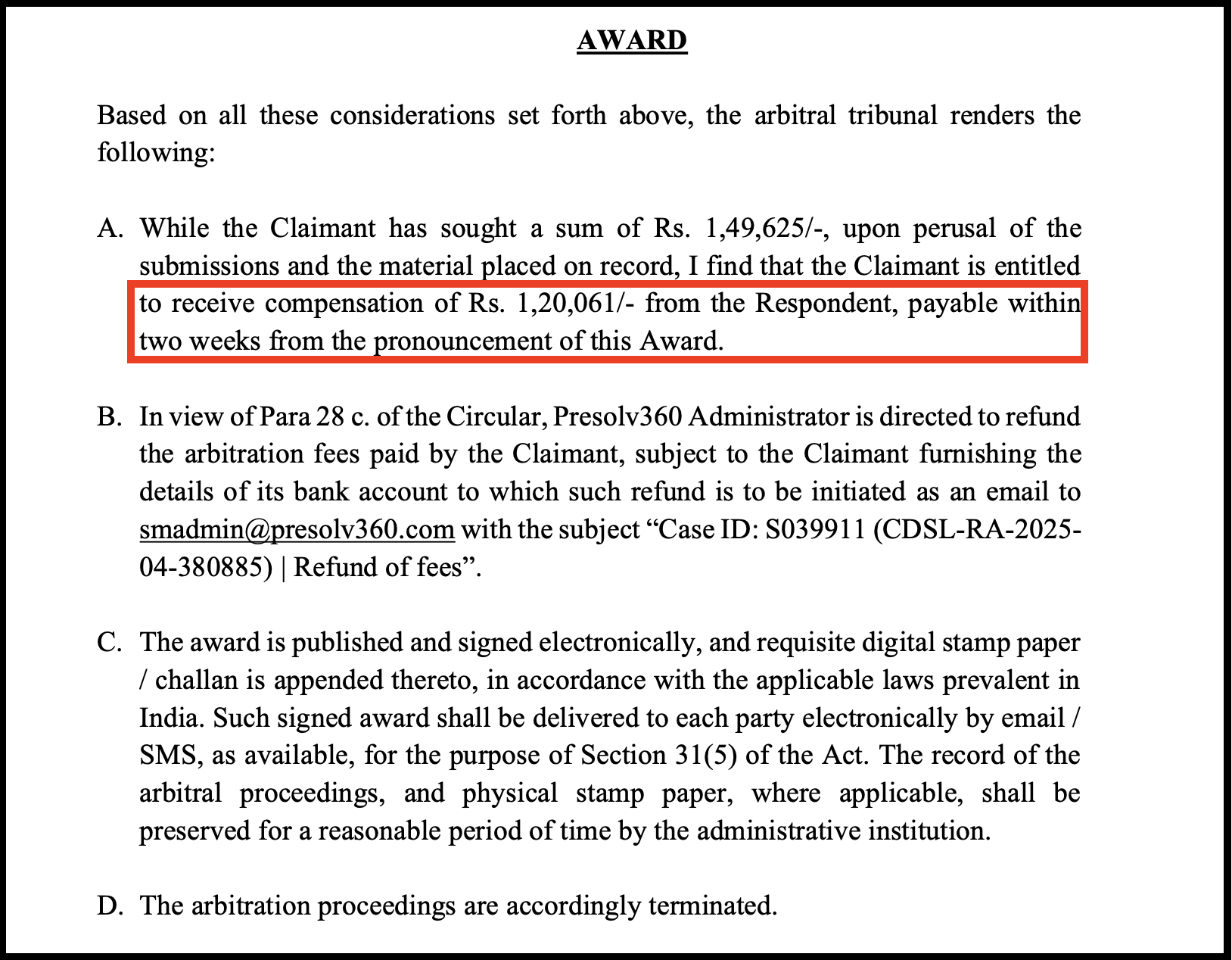
His arbitration fee was refunded in full.
A genuine claim, filed on time and won, ends with the fee back in your pocket.
When Does the Fee Actually Become Payable?
You cannot pay the arbitration fee on day one, because arbitration is the last stage of a longer route.
The dispute travels from your written complaint to the entity, through SEBI’s complaint system, and into conciliation, and the fee applies only when conciliation ends without a settlement, and you choose arbitration.
Before any fee enters the picture, you need the stages done right, and our guide on how to file complaint in NSE covers each one, from the first email to the portal steps.
That guide covers the NSE route, which is where most broker disputes land.
But some investors are still a step earlier than that, deciding which exchange route even applies to their case, especially when the broker trades on both NSE and BSE.
If that is you, the broader picture sits on our page on arbitration in share market, covering how the process runs across both exchanges.
Conclusion
NSE arbitration fees are transparent, slab-based, and refundable when you win, which means the real cost of a strong case filed on time is close to nothing.
What costs real money is waiting.
Delay after conciliation fails doubles the bill, and the late portion never comes back.
If your broker has stopped responding or keeps promising a resolution that never arrives, the fee table above is not a reason to wait. It is the reason to move.
Report. Recover. Stay Fraud Free.
Yes. When the final award is passed in your favour, the base fee you deposited is refunded as part of the outcome. Only late fees paid due to delayed filing stay non refundable, which is one more reason timing matters. Conciliation costs you nothing as an investor, since the market participant bears that stage's cost. The arbitration fee only arises after conciliation fails, so a settlement before arbitration means you never paid an arbitration fee at all. No. You can represent yourself at every stage. That said, the respondent usually appears through professionals, so experienced help in organising evidence and structuring the claim measurably improves outcomes, especially at the hearing stage. Trade records, account statements, payment receipts, every communication with the respondent including WhatsApp and email, and a Statement of Claim describing the dispute, the violations, and the relief sought. Complete documents also protect you from delays that trigger late fees. No. The slab depends only on your claim amount, not on who the respondent is. A ₹5 lakh claim against a research analyst costs the same ₹9,000 plus GST as one against a stockbroker.Frequently Asked Questions





 Add us as a preferred source on Google »

