
Quick Summary
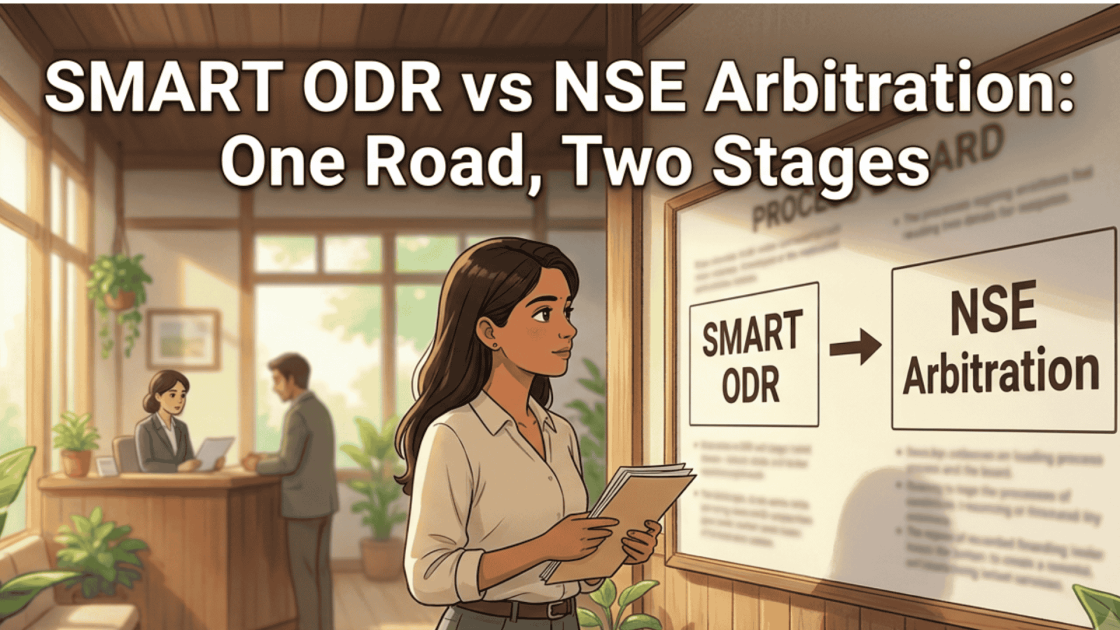
SMART ODR and NSE arbitration are not alternatives. They are sequential stages in the same escalation path, with SMART ODR first and exchange arbitration following only if conciliation fails. You cannot skip SMART ODR to reach arbitration, and SMART ODR cannot produce an arbitration award on its own. A conciliation settlement is a binding contract, while an arbitration award carries the force of a court decree, which is the real difference when an intermediary refuses to pay. This page explains what each stage produces, where one ends and the other begins, and which outcome is stronger for your case.
The comparison between SMART ODR and NSE arbitration comes up constantly, usually from investors who have exhausted SEBI SCORES and want to know which path is stronger.
Here is the honest answer: the question itself is slightly wrong.
The two are not competing options.
They are steps in the same path, with SMART ODR first and NSE or BSE arbitration after, only when conciliation produces no settlement.
You cannot skip one to reach the other, and neither replaces the other’s job.
This page shows you exactly where each begins, what each produces, and which outcome carries more force.
What Does a SMART ODR Conciliation Actually Produce?
Start with the stage you will meet first.
SMART ODR is SEBI’s structured dispute resolution platform, and it works in two rounds.
Pre-conciliation comes first, an online structured negotiation between you and the intermediary, and an agreement here gets documented and binds both sides.
Formal conciliation follows if that fails, with an independent conciliator facilitating the dialogue, and a settlement reached here binds both parties the same way.
Only when both rounds end without agreement does the case move to arbitration, and at that point SMART ODR’s role ends.
One thing about that settlement deserves plain words.
It is binding, and the intermediary must pay within the period it specifies, but a settlement is only as strong as the intermediary’s willingness to honour it.
A cooperative firm makes SMART ODR the fastest resolution there is. An uncooperative one is why the next stage exists.
How the conciliator gets assigned, how the sessions run, and what the intermediary must do at each point is covered in our guide: how SMART ODR conciliation works.
What Does NSE or BSE Arbitration Produce?
Picture the moment this stage begins.
Your conciliation sessions ended without a settlement, the intermediary walked away unmoved, and for a second it feels like the whole process failed you.
It did not. It just handed your case to the stage with the teeth.
Everything changes with one swap of chairs.
An arbitrator, not a conciliator, now reviews the evidence, and the difference is everything: the conciliator helped both sides agree, while the arbitrator decides for them.
That decision is the award, and it is the reason this stage exists.
An award from NSE arbitration or BSE’s equivalent is legally binding under the Arbitration and Conciliation Act, 1996, enforceable like a court decree, which means non-payment lets you approach a court for enforcement without filing a fresh lawsuit, and the court can direct recovery from the intermediary’s assets.
That is the legal weight difference in one line: a settlement is a contract, while an award is a deemed decree, and courts move faster on decrees.
The stage is not free, but it is fair.
Fees follow a slab starting at ₹5,400 for the smallest claims and ₹9,000 up to ₹10 lakh, refunded when the award goes in your favour, with the full slab and late fee rules on our page: NSE arbitration fees.
Why Can You Not Skip SMART ODR?
Every few weeks, an investor asks us to go straight to arbitration, and the answer is always the same.
The exchange will not accept an arbitration application that has not gone through the SMART ODR process.
Not a technicality, a structural requirement.
SEBI built the framework this way deliberately, so that as many disputes as possible resolve at the faster, free conciliation stage before reaching the formal machinery.
The practical meaning for you: SMART ODR is not optional on the road to an award.
It is the road.
What Is the Complete Escalation Path for SMART ODR and NSE Arbitration?
Here is the whole ladder in one view, so the two stages stop floating and start connecting.
Five stages carry your dispute from the first complaint to the binding decision, and each one’s completion opens the next:
- Stage 1: The intermediary’s grievance cell. A formal written complaint, with 21 days for a response.
- Stage 2: SEBI SCORES. The regulator forwards the complaint, the intermediary responds within 21 days, and review follows if the response disappoints.
Whether this stage or the exchange comes first depends on who you are complaining about, a sequencing question settled on our guide on SEBI SCORES vs exchange complaint. - Stage 3: SMART ODR pre-conciliation. The structured online negotiation, reached through the platform, with our guide on the SMART ODR login, covering the registration and access.
- Stage 4: SMART ODR formal conciliation. The independent conciliator’s round.
- Stage 5: Exchange arbitration. The arbitrator reviews the evidence and issues the binding award, challengeable afterwards only before a court on narrow legal grounds.
Every stage must genuinely conclude before the next opens.
There is no lateral entry anywhere on this ladder.
Case stuck at conciliation with an intermediary who attends every session and agrees to nothing?
We will recognise the stalling pattern early, close the conciliation stage cleanly instead of letting it drag, and carry the case into arbitration with the record already built to win there.
Which Stage Produces the Better Outcome?
By now you know the two stages are one road.
But that does not stop the question you really came with, because what you actually want to know is where your case ends up better off.
Fair question, and the honest answer depends on what “better” means to you. Faster money, stronger legal force, or a bigger recovery are three different prizes, and the two stages do not win the same ones.
So here are the three honest answers, one for each prize:
- For speed, conciliation wins: A case settling at pre-conciliation can close in 4 to 8 weeks, while arbitration rarely concludes inside 3 months.
- For enforceability, arbitration wins: Default on a settlement, and you hold a contract dispute. Default on an award, and you hold a decree enforcement proceeding, which courts process faster.
- For the amount recovered, neither stage decides it: The evidence does. A well-documented case settles for more at conciliation than a poorly documented one wins at arbitration, which is why the file you build at stage one decides everything after.
SMART ODR vs NSE Arbitration: Key Differences
You have read a lot of detail by now, and when someone at home asks you tonight what the actual difference is, you will want it in one glance, not five sections.
That is what this table is for.
Eight rows put the two stages side by side, from who sits in the deciding chair to what happens when the other side refuses to pay.
Run your eye down the middle column first, then the right, and one pattern will jump out at you: the first stage trades legal weight for speed, and the second trades speed for force:
| Factor | SMART ODR Conciliation | Exchange Arbitration |
|---|---|---|
| Place in the sequence | Comes first, after SCORES | Opens only after conciliation fails |
| Who decides | A conciliator, who helps both sides agree | An arbitrator, who decides for them |
| What you walk away with | A settlement agreement | A binding award |
| Its legal weight | A binding contract | Treated like a civil court decree |
| If the intermediary defaults | Contract enforcement through court | Decree enforcement, which moves faster |
| How long it takes | Usually 4 to 12 weeks | Usually 3 to 6 months |
| What it costs you | Nothing | A slab fee from ₹5,400, refunded when you win |
| Can you start here directly | No, SCORES comes first | No, conciliation comes first |
What happens in the room when conciliation gives way to arbitration, and how the settlement and award stages connect in practice, sits in our guide: SMART ODR settlement arbitration.
Conclusion
SMART ODR and NSE arbitration were never rivals.
One opens the road, and the other ends it, and the strongest position is a case so well documented that conciliation settles it fairly before arbitration is ever needed.
For speed, settle. For force, arbitrate. For either, the evidence you organised on day one decides the outcome.
And every dispute resolved on this road, at whichever stage, adds one more record to the system that builds a scam free India.
Report. Recover. Stay Fraud Free.
No. Exchange arbitration requires prior completion of the SMART ODR process, and NSE and BSE will not accept applications that skipped conciliation. The sequence is structural, so plan your timeline around both stages from the start. Both bind, but in different legal categories. A settlement is a binding contract, while an award is treated like a civil court decree, and if the intermediary defaults, enforcing a decree moves faster through court than enforcing a contract. Conciliation typically runs 4 to 12 weeks when it produces a settlement, while arbitration takes 3 to 6 months from filing to award. A case that needs both stages usually spans 6 to 12 months from SCORES to the final award. The settlement is a binding contract, so non compliance becomes a breach addressable through civil court, and it can also be reported to SEBI as evidence of non cooperation, which affects the intermediary's regulatory standing. The award can be enforced like a court decree without a fresh lawsuit, with the court directing recovery from the intermediary's assets, and non compliance also carries regulatory consequences for the member's standing with the exchange.Frequently Asked Questions





 Add us as a preferred source on Google »

