
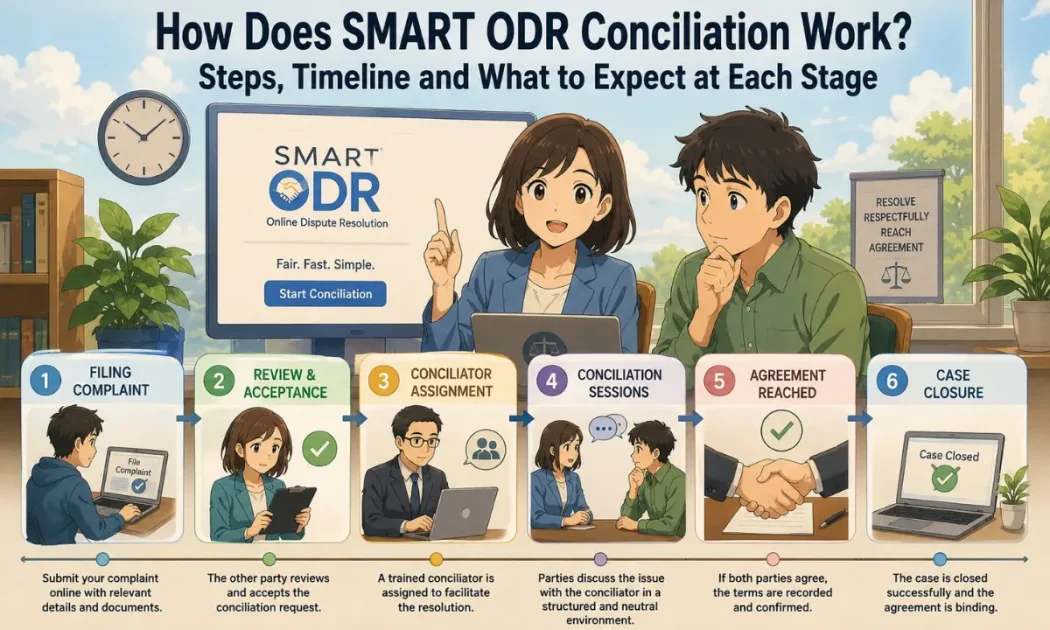
Quick Summary
The SMART ODR platform helps investors resolve disputes with market intermediaries through three structured online stages. It begins with direct negotiations during preconciliation, moves to guided discussions with an independent mediator, and can go to binding arbitration if needed. You can easily track your case progress and view official deadlines directly through your portal. This guide will help you navigate each step of the process.
Once your dispute reaches SMART ODR, most investors are not sure what happens next. You filed. You got confirmation.
Now what?
The conciliation process on SMART ODR has specific stages, defined timelines, and clear obligations for both the investor and the intermediary.
Understanding what happens at each stage helps you participate actively rather than wait passively, which is one of the most important factors in whether the process produces a result.
But what is SMART ODR?
Essentially, it is a centralized online dispute resolution platform launched by SEBI to streamline and digitize the grievance redressal process between investors and market intermediaries.
This page covers the full conciliation process from the moment your case appears on SMART ODR through to the point where it either settles or moves to arbitration.
What Happens Immediately After You File on SMART ODR?
After you submit your dispute on the SMART ODR portal at smartodr.in, two things happen in sequence.
First, the platform generates a case reference number for your SMART ODR dispute. This is separate from your SCORES complaint reference number, though both numbers are linked in the system.
Save the SMART ODR case reference number as you will need it for every subsequent interaction with the platform.
Second, a notice goes out to the intermediary you have filed against. This is called the Notice to the Opposite Party.
The intermediary receives a formal communication through the SMART ODR system informing them that a dispute has been filed against them and directing them to respond within a defined period.
The intermediary cannot claim ignorance of the dispute after this notice is sent.
The notice to the opposite party is a formal regulatory communication, not a courtesy email. A SEBI-registered intermediary that does not respond to it within the required window faces regulatory consequences.
This is what gives SMART ODR its weight compared to simply emailing the firm again yourself.
How Is the SMART ODR Conciliator Assigned?
Once the dispute is accepted and the notice goes to the intermediary, an independent conciliator is assigned to your case from SEBI’s empanelled list.
The conciliator is not a SEBI employee.
They are an independent professional, typically a retired judge, a chartered accountant, a lawyer, or a securities market expert, who have been empanelled by SEBI or the relevant exchange to serve in this role.
They have no financial relationship with either party and are required to declare any conflict of interest before accepting an assignment
The assignment typically happens within a few days of the dispute being accepted on the platform.
You will receive a notification through the SMART ODR portal when a conciliator has been assigned to your case.
The conciliator’s name and designation will be visible on your case dashboard.
If you have a genuine, documentable conflict of interest with the assigned conciliator, you can object the platform. This is rare in practice, but the mechanism exists.
The Three Stages of SMART ODR Conciliation
The SMART ODR conciliation process operates in three sequential stages.
Each stage has its own format, timeline, and outcome possibility.
Stage 1: Pre-Conciliation
Pre-conciliation is an online structured negotiation between the investor and the intermediary facilitated by the platform itself, before the formal conciliator becomes actively involved.
In this stage, both parties are asked to submit their positions through the SMART ODR portal. You describe your grievance, the outcome you are seeking, and the evidence supporting your position.
The intermediary submits their response and position.
The platform then presents both positions to each party and gives both an opportunity to negotiate a settlement directly.
Many disputes are resolved at this stage without needing formal conciliation at all, particularly when the facts are clear and the intermediary recognises the regulatory exposure of their conduct.
If a settlement is reached at the pre-conciliation stage, the terms are recorded in the SMART ODR system and the case is closed. The settlement is binding on both parties.
If pre-conciliation does not produce a settlement, the case moves automatically to the formal conciliation stage.
Stage 2: Formal Conciliation
In formal conciliation, the assigned conciliator takes an active role.
They review all submissions from both parties, examine the evidence uploaded to the platform, and facilitate a structured dialogue aimed at helping both sides reach an agreed resolution.
The conciliator may request additional documents from either party. They may ask clarifying questions. They may propose settlement terms and ask each party whether those terms are acceptable.
They are not judges and do not issue orders at this stage. Their role is to facilitate agreement, not impose a decision.
Both parties are expected to respond to the conciliator’s communications within the defined response windows.
Missing a response window without explanation can be noted in the case record and may affect how the conciliator views each party’s engagement with the process.
Sessions happen online through the SMART ODR portal. No physical attendance is required. Video sessions may be arranged for complex cases if both parties and the conciliator agree.
If formal conciliation produces a settlement, the conciliator records the settlement agreement in the system.
This agreement is binding on both parties. The intermediary is required to comply with its terms within the period specified in the agreement.
If formal conciliation does not produce a settlement, the case moves to arbitration.
Stage 3: Movement to Arbitration
If conciliation at both stages is unsuccessful, the matter proceeds to formal arbitration. At this point, an arbitrator is appointed. Unlike the conciliator, the arbitrator makes decisions, not recommendations.
The arbitrator reviews all evidence submitted by both parties and issues a binding award.
For the full guide on what happens when SMART ODR conciliation fails and how the arbitration process works, including the award and enforcement, the outcome guide covers each stage.
You can check our guide: SMART ODR settlement and arbitration.
What is the Intermediary Required to Do?
The SMART ODR process places specific obligations on the registered intermediary.
Understanding these obligations helps you know when the intermediary is complying and when they are not.
After receiving the Notice to the Opposite Party, the intermediary must acknowledge receipt and submit their response within the defined window.
The standard response period is typically 15 to 21 days, depending on the dispute category and platform guidelines.
The intermediary’s response must address the substance of the complaint. A generic reply that does not engage with the specific grievance is treated differently from a substantive response by the conciliator.
During formal conciliation, the intermediary must participate in sessions through their designated representative.
A SEBI-registered entity that refuses to participate in SMART ODR proceedings faces regulatory consequences beyond the individual dispute because non-participation in a SEBI-mandated dispute resolution process is itself a compliance failure.
If the intermediary accepts a settlement, they are required to implement its terms within the period specified.
Failure to implement a settlement agreement produces a formal record of non-compliance that SEBI can act on independently of the investor’s original complaint.
How to Track Your SMART ODR Case Status?
Every stage of your SMART ODR case is visible on your dashboard at smartodr.in.
When you log in with your registered PAN and mobile number.
The dashboard shows the current stage of your case, the date of the last update, any submissions from the intermediary, communications from the conciliator, and the next action required from you.
The most important active step in tracking is responding to conciliator communications within the required window.
If the conciliator sends a question, requests a document, or proposes a settlement term, your response within the specified period keeps the case moving.
Missing a response window without explanation can slow the process significantly.
Check your SMART ODR dashboard at least twice a week during active proceedings. Email notifications from the platform may go to your spam folder.
Do not rely on email alone for tracking. Log in directly to see the full case status.
If your case shows no update for an unusually long period, more than 2 to 3 weeks without any communication from the platform or the conciliator, contact the SMART ODR helpdesk through the contact details on smartodr.in.
Provide your case reference number and ask for a status update.
In case you find that your case remains completely stalled, your SMART ODR complaint rejected, or is closed without a clear explanation, you may need to evaluate the specific reasons behind the roadblock to determine your next course of action.
SMART ODR Dispute Timeline: What to Expect
Timeline expectations are important because the process has defined windows at each stage, but actual elapsed time varies by case complexity and how quickly both parties respond.
To help you plan, here is the typical breakdown of how each stage unfolds:
- Notice to Opposite Party: Sent within a few days of dispute acceptance. Intermediaries typically have 15 to 21 days to respond.
- Pre-Conciliation: After the intermediary responds, the pre-conciliation exchange typically runs for 2 to 4 weeks. If a settlement is reached here, the case closes within days of agreement.
- Conciliator Assignment: Happens within days of the dispute being accepted, often before the pre-conciliation exchange concludes.
- Formal Conciliation: If pre-conciliation does not settle the matter, formal conciliation adds another 4 to 8 weeks on average. Complex cases with multiple evidence submissions can take longer.
- Movement to Arbitration: If conciliation fails, the transfer to arbitration is typically processed within 1 to 2 weeks of the formal conciliation closure.
- Arbitration: The most variable stage. Simple, well-documented cases can conclude in 2 to 3 months. Complex cases can take longer.
The total elapsed time from SMART ODR filing to a binding arbitration award typically falls between 3 and 9 months.
Cases that settle at pre-conciliation or formal conciliation resolve significantly faster.
The single biggest factor determining the timeline is documentation quality at the start.
Cases with complete, well-organised evidence from the first submission move through every stage faster than cases that generate repeated information requests.
For the complete guide on eligibility, which disputes qualify, and which documents to prepare before filing on SMART ODR, see the eligibility guide for the full pre-filing picture. Read the complete SMART ODR eligibility guide before you start.
Want professional legal experts to run your SMART ODR case?
We can help you put together your evidence, keep track of all those platform deadlines, and step in to represent you at every stage so you don’t have to stress about it.
Register with us today for a free initial consultation and let our team take care of the heavy lifting.
Conclusion
The SMART ODR conciliation process has three sequential stages. Pre-conciliation is a structured online negotiation before the conciliator becomes active.
Formal conciliation brings in an independent conciliator to facilitate settlement. If both stages fail, the matter moves to arbitration for a binding decision.
The conciliator is assigned from SEBI’s empanelled list within days of the dispute being accepted. The intermediary receives a formal Notice to the Opposite Party and is required to respond and participate.
Non-participation has regulatory consequences beyond the individual case.
Tracking your case status actively through the SMART ODR dashboard and responding to conciliator communications within required windows are the two most important things you can do to keep the process moving efficiently.
Frequently Asked Questions
2. An independent conciliator from SEBI's empanelled list is assigned to your SMART ODR case within a few days of the dispute being accepted. The conciliator is not a SEBI employee. They are independent professionals such as a retired judge, chartered accountant, or securities market expert. Their name and designation appear on your SMART ODR case dashboard once assigned.
The Notice to the Opposite Party is a formal communication sent by the SMART ODR platform to the registered intermediary after a dispute is filed. It informs the intermediary that a dispute has been filed against them and directs them to respond within a defined period. It is a formal regulatory communication and non-response to it has regulatory consequences for the intermediary.
Pre-conciliation typically runs for 2 to 4 weeks. Formal conciliation adds another 4 to 8 weeks if pre-conciliation does not settle the matter. Cases that settle at pre-conciliation resolve significantly faster. The total timeline from SMART ODR filing to a binding arbitration award if conciliation fails typically falls between 3 and 9 months.
If the intermediary fails to respond to the Notice to the Opposite Party within the required window, the conciliator can note this non-participation in the case record. A registered intermediary that refuses to engage with SMART ODR proceedings faces regulatory consequences from SEBI beyond the individual dispute, because non-participation in a mandated dispute resolution process is a compliance failure.
Yes. Log in to smartodr.in with your registered PAN and mobile number. Your case dashboard shows the current stage, the date of the last update, intermediary submissions, conciliator communications, and the next action required from you. Check the dashboard directly at least twice a week rather than relying on email notifications alone as these may go to spam.
If both pre-conciliation and formal conciliation fail to produce an agreed settlement, the matter automatically moves to formal arbitration. An arbitrator reviews all submitted evidence and issues a binding award. Unlike the conciliator, the arbitrator makes a decision rather than facilitating agreement. The intermediary is legally required to comply with the arbitration award.





 Add us as a preferred source on Google »

