
Quick Summary
SMART ODR eligibility has two conditions and both must be met. The entity must be SEBI-registered, and a prior SCORES complaint on the same dispute must already exist. There is no minimum dispute amount and no geographic restriction within India. Your SCORES reference number is the identifier that carries your case across, so save it the day you receive it. The platform is free through pre-conciliation and conciliation, and no lawyer is required at those stages. Documents from your SCORES filing carry forward, which means preparation done at the SCORES stage decides how quickly your SMART ODR case moves.
Before you start the SMART ODR process, three questions need clear answers.
Does your situation qualify for SMART ODR? Do you have what you need to file? And do you need to have gone through SEBI SCORES first?
Getting these right before you start saves significant time and prevents the most common filing mistakes.
This page covers all three questions in full, along with the specific dispute categories SMART ODR handles, the documents you need to prepare, what the process costs, and whether you need a lawyer at any stage.
Who Is Eligible to File on SMART ODR?
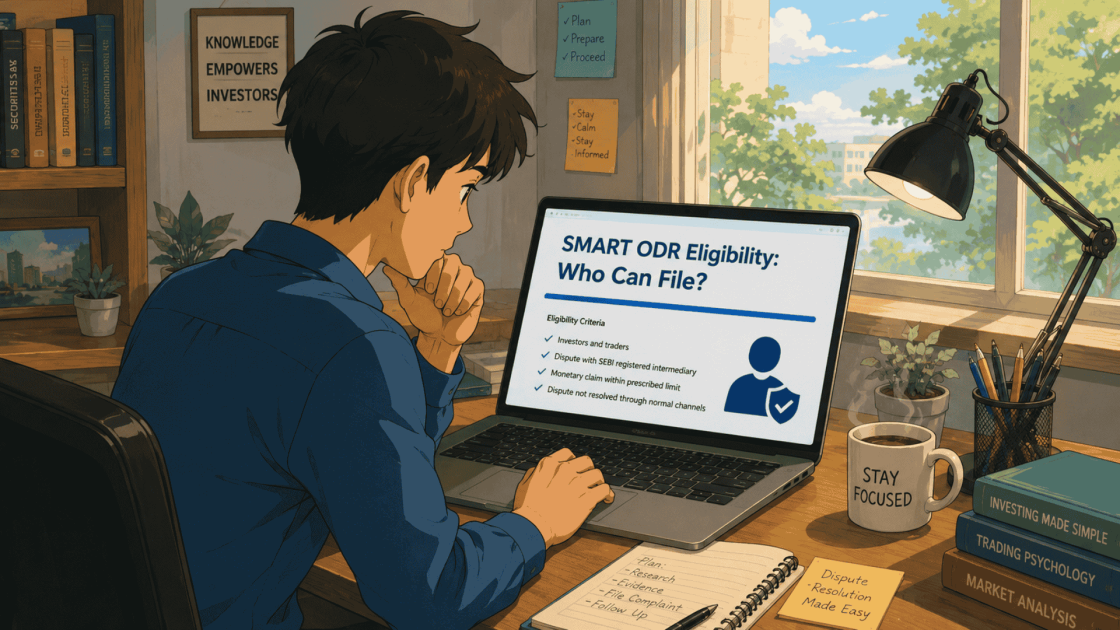
Any investor who has a grievance against a SEBI-registered intermediary and has already filed a complaint on SEBI SCORES can use SMART ODR India.
The eligibility requirement has two parts, and both must be satisfied.
1. The Entity Must Be SEBI Registered
The first part is that the entity you are complaining against must be registered with SEBI.
SMART ODR covers disputes with stockbrokers, research analysts, investment advisers, depository participants, mutual funds, portfolio managers, and listed companies for certain investor grievance types.
If the entity is unregistered, SMART ODR is not the right channel regardless of the amount involved.
2. A Prior SCORES Complaint Must Exist
The second part is that a prior SEBI SCORES complaint must exist for the same dispute.
SMART ODR does not accept fresh disputes that have not first gone through the SCORES process.
The SCORES complaint creates the regulatory record and the case reference that SMART ODR uses as its foundation.
NRI investors with Indian securities accounts can use SMART ODR under the same eligibility terms as resident Indian investors.
There is no geographic restriction within India and no minimum dispute amount.
Can I File on SMART ODR Without a SCORES Complaint?
No.
This is the most important eligibility rule and the one that catches the most investors off guard.
SMART ODR was specifically designed as the next step after SCORES, not as an independent complaint channel.
The SCORES complaint creates the regulatory record that the SMART ODR conciliator reviews.
Without it, the platform has no prior documented record of the dispute, and the intermediary has had no formal obligation to respond.
If you file on SCORES and the intermediary does not respond within 21 days, or if their response does not actually address your concern and you mark it as unsatisfactory, that is when SMART ODR becomes accessible.
In SCORES 2.0, which launched in 2023, the transfer from SCORES to SMART ODR happens within the system itself.
You do not need to start a fresh process on a separate platform.
The SCORES reference number follows the complaint into SMART ODR, and the case history transfers automatically.
If you have not filed on SCORES yet, our step-by-step guide on how to file complaint on SCORES covers the full process, including how to select the correct intermediary category and what documents to upload.
Do I Need My SCORES Complaint Number for SMART ODR?
Yes.
Your SCORES complaint reference number is the primary identifier that connects your SCORES case to SMART ODR.
When your complaint transfers from SCORES to SMART ODR through the integrated SCORES 2.0 system, this number travels with it.
If you are accessing SMART ODR directly at smartodr.in rather than through the SCORES escalation path, you will need to enter your SCORES complaint reference number to link your prior filing to the new SMART ODR case.
Save your SCORES reference number from the moment you receive it after filing.
If you have lost it, log in to your SCORES account and retrieve it from your complaint history before attempting to access SMART ODR.
What Disputes Can Be Filed on SMART ODR?
SMART ODR handles the same range of disputes that SCORES covers, which means any grievance against a SEBI-registered intermediary that has already been through the SCORES process without satisfactory resolution.
The specific dispute types that appear most commonly in SMART ODR proceedings fall into four categories.
1. Fee Recovery Disputes
These involve a registered intermediary charging fees above what was agreed, above the SEBI annual cap, or collecting fees without a proper written agreement before services began.
Examples include research analysts charging above the Rs. 1,51,000 annual cap, investment advisers collecting fees in personal bank accounts, and advisory firms charging upgrade fees after initial losses without a new written agreement.
2. Guaranteed Return Promise Disputes
These involve a representative of a registered entity making explicit or implied return promises that violate SEBI Regulation 16(b).
The complaint basis is the promise itself, documented through a WhatsApp message, call recording, or email, combined with the financial outcome after the investor relied on it.
3. Unauthorised Transaction Disputes
These involve trades executed in a client’s account without the client’s instruction or consent.
The contract note for the unauthorised trade, the client’s own transaction instruction record, and any communication where the client disputed the trade with the broker are the core evidence for this dispute type.
4. Service Delivery Disputes
These involve a registered entity providing services that materially differ from what was contracted before payment.
A research analyst delivering vague WhatsApp alerts instead of formal research reports, an investment adviser providing generic advice without any suitability assessment, or an IA charging for a service that was never actually delivered are examples of this category.
SMART ODR Complaint After SCORES Rejection vs After Unsatisfactory Response
A SCORES complaint can end in two ways that look similar on your dashboard but mean opposite things for what happens next.
In one, the firm answered you, and the answer was useless. In the other, SEBI never processed the complaint at all.
The first keeps SMART ODR open to you. The second closes it until you fix what went wrong and file again.
Check which one your case record shows before you go any further, because the wrong assumption here costs weeks.
1. After an Unsatisfactory SCORES Response
The intermediary responded to your SCORES complaint, but the response did not address the actual issue. You marked it as unsatisfactory.
In SCORES 2.0, this moves the complaint to Level 2 Review and then to SMART ODR.
The transfer is handled within the SCORES system. You do not need to do anything separately on SMART ODR until the case appears on your SMART ODR dashboard.
Once it does appear, how SMART ODR conciliation works becomes the next thing worth reading, because the conciliator assignment and the response windows start immediately.
2. After a SCORES Rejection
If your SCORES complaint was rejected because of an eligibility or procedural issue, SMART ODR does not automatically become available.
SMART ODR requires a valid, processed SCORES complaint as its foundation. A rejected SCORES complaint is not the same as an unresolved one.
You need to address the reason for rejection, refile on SCORES correctly, and then escalate to SMART ODR from there.
The most common situation where investors confuse these two is when their SCORES complaint was closed by the intermediary with a generic response, and they did not mark it as unsatisfactory in time.
In that situation, contact SEBI’s investor helpline at 1800 22 7575 with your SCORES reference number and request that the complaint be reopened or moved to the next level before attempting SMART ODR access.
For the full guide on SCORES rejection reasons and how to address each one, our dedicated rejection guide covers every category.
Read why SEBI SCORES complaints get rejected and what to do about it.
What Documents Do You Need for SMART ODR?
The SMART ODR process builds on the evidence you submitted during SCORES.
You do not need to collect new documents from scratch.
However, you will need to organise your existing evidence clearly and add any new developments that occurred after your SCORES filing.
1. Documents That Carry Forward From SCORES
Your SCORES complaint reference number and the complete complaint description you submitted. The intermediary’s SCORES response.
Your subscription agreement or account opening form. Payment receipts covering all amounts paid to the entity.
Trading account statements or ledgers covering the disputed period.
2. Documents to Add Specifically for SMART ODR
Any new communications with the intermediary that occurred after your SCORES filing.
Evidence of any additional financial harm that occurred during the SCORES process.
A clear timeline document showing the sequence of events from first contact with the entity through the SCORES filing and its outcome.
3. Documents for Specific Dispute Types
For guaranteed return complaint cases, the specific WhatsApp message, email, or call recording where the promise was made must be clearly identified and ready to be presented to the conciliator.
For fee recovery disputes, a complete calculation showing total fees paid against the SEBI annual cap of Rs. 1,51,000 is important.
If you are combining fees from multiple RA or IA subscriptions, the calculation across all of them strengthens the case.
For unauthorised transaction cases, the contract notes for the disputed trades and your own instruction record showing what you actually authorised need to be organised chronologically and clearly labelled.
The SMART ODR platform accepts PDF files for multi-page documents and JPG or PNG image files for screenshots.
File size limits apply per upload. Convert large files to compressed PDF before uploading to avoid errors during submission.
Not sure your evidence is strong enough to hold up in conciliation?
We audit what you have, fill the gaps, and build the submission the conciliator actually reads.
Is SMART ODR Free for Investors?
Yes.
SMART ODR is free for investors at the pre-conciliation and conciliation stages. These are the two stages where most disputes are resolved.
If the matter proceeds to formal arbitration because conciliation was unsuccessful, a fee structure applies.
For claims below Rs. 10 lakh, there is no investor filing fee for exchange arbitration proceedings.
For claims between Rs. 10 lakh and Rs. 25 lakh, a nominal investor fee applies.
For claims above Rs. 25 lakh, the fee increases on a slab basis.
The practical outcome is that investors with claims below Rs. 10 lakh, which covers the large majority of retail advisory disputes, can go through the entire process from SCORES through SMART ODR through arbitration without paying any platform fee.
There is no fee for registering on the SMART ODR portal.
There is no fee for accessing the dashboard, uploading documents, or participating in the conciliation sessions.
Do You Need a Lawyer for SMART ODR?
No.
SMART ODR is designed to be accessible to individual investors without professional legal representation.
At the pre-conciliation stage, you participate directly through the online platform.
You submit your position, respond to the intermediary’s submissions, and communicate with the conciliator through the portal.
At the conciliation stage, an independent conciliator facilitates the process.
You present your case, the intermediary presents theirs, and the conciliator works toward a settlement.
No formal court procedure is involved, and no legal qualification is required on the investor’s side.
At the arbitration stage, which is the most formal part of the process, legal representation becomes practically helpful even though it is not mandatory.
Presenting evidence in a structured format, responding to the intermediary’s defence, and cross-examining witnesses if required are tasks that benefit from expert support.
Navigating this stage successfully leads to the final decision.
To understand what this outcome looks like, what a binding award means, and how it is enforced, is covered in our guide to SMART ODR settlement and arbitration.
Legal Representation vs Specialist Complaint Support
The difference between the two is worth understanding.
A lawyer provides legal advice and representation in the formal legal sense.
A specialist complaint support team organises evidence, drafts submissions, prepares the investor for the process, and manages the case at each stage.
The second is often more practical and accessible for retail investors dealing with advisory disputes.
Conclusion
SMART ODR eligibility requires two things. The entity must be SEBI-registered. A prior SCORES complaint on the same dispute must exist and must have produced either no response or an unsatisfactory response.
Without both, SMART ODR cannot be accessed for that dispute.
The platform is free through the conciliation stage and requires no lawyer. The SCORES reference number is your primary identifier and must be available when you access SMART ODR.
Documents from your SCORES filing carry forward into SMART ODR and form the foundation of your case there.
Understanding the eligibility rules before you start prevents the most common filing mistakes and ensures your case reaches the right stage without unnecessary delays.
Frequently Asked Questions
No. SMART ODR requires a prior SEBI SCORES complaint as the basis for every dispute. The SCORES complaint creates the regulatory record that the SMART ODR conciliator reviews. If you have not filed on SCORES yet, complete that step first. Only after the SCORES process has been exhausted without satisfactory resolution does SMART ODR become accessible.
SMART ODR handles any grievance against a SEBI-registered intermediary that has gone through SCORES without resolution. The four most common dispute types are fee recovery disputes where fees exceeded the SEBI cap or were collected improperly, guaranteed return promise disputes where SEBI Regulation 16(b) was violated, unauthorised transaction disputes where trades were executed without client consent, and service delivery disputes where the service provided differed materially from what was contracted.
Yes. Pre-conciliation and conciliation on SMART ODR are completely free for investors. If the dispute proceeds to formal arbitration, investors with claims below Rs. 10 lakh pay no filing fee. Nominal fees apply for larger claims. There is no registration fee for the SMART ODR portal itself.
Yes. Your SCORES complaint reference number is the primary identifier that connects your SCORES case to SMART ODR. When the complaint transfers through the SCORES 2.0 integrated system, this number follows automatically. If you are accessing SMART ODR directly, you will need to enter the SCORES reference number to link your prior filing.
SMART ODR builds on your SCORES evidence. Carry forward your SCORES complaint reference, the intermediary's SCORES response, your subscription agreement or account opening form, payment receipts, and trading records. Add any new communications with the intermediary since SCORES, a clear event timeline, and the specific evidence for your dispute type such as the WhatsApp guarantee message for a return promise case or the contract notes for an unauthorised trade case.
No. SMART ODR is accessible to individual investors without legal representation at the pre-conciliation and conciliation stages. For the formal arbitration stage, legal representation is optional but practically helpful. Specialist complaint support, which handles evidence organisation, submission drafting, and case representation without requiring a formal legal engagement, is a practical alternative for retail investors.
SCORES is where you file first. It is a complaint and monitoring platform that obligates the intermediary to respond within 21 days. SMART ODR is where disputes go after SCORES for binding resolution through conciliation or arbitration. They are sequential stages in the same escalation chain, not competing platforms. SCORES 2.0 integrates the two so the transfer between them happens within the same system.





 Add us as a preferred source on Google »

