
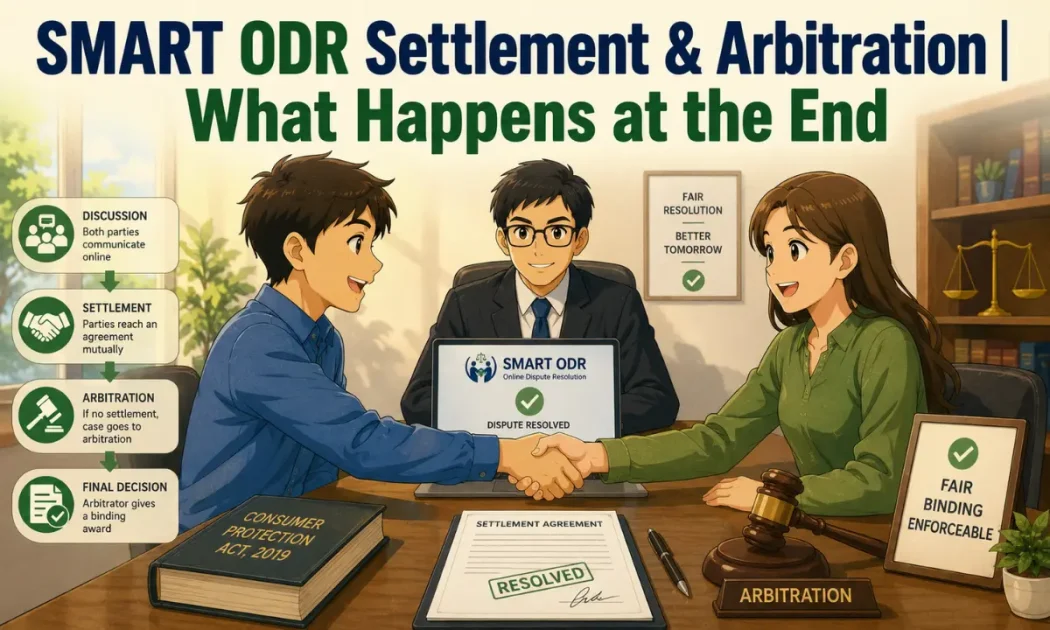
Once the SMART ODR conciliation process runs its course, one of three things happens. The parties reach a settlement agreement. The matter moves to formal arbitration.
Or the case closes without resolution because one or both parties did not engage with the process.
Understanding what each of these outcomes means, what your rights are at each point, and what happens after a binding award is issued is what this page covers.
If you are mid-process and wondering whether the process actually produces enforceable results, the short answer is yes: when it reaches arbitration, the award is legally binding, and the intermediary is required to comply.
What Is a SMART ODR Settlement Agreement?
A SMART ODR settlement agreement is a written record of the terms both parties agreed to during conciliation.
It can be reached at either the pre-conciliation stage or the formal conciliation stage.
The settlement agreement is not a suggestion. It is a binding document.
Once both parties have accepted the settlement terms and the conciliator has recorded them in the SMART ODR system, both parties are legally obligated to honour those terms.
For investors, a settlement agreement typically covers one or more of the following outcomes.
A refund of fees paid to the intermediary, either in full or in part. A payment to compensate for documented losses caused by the intermediary’s conduct.
A combination of a fee refund and loss compensation. In some cases, a commitment by the intermediary to change specific practices, though monetary recovery is the primary goal for most investors.
The terms of the settlement specify the amount to be paid and the timeline within which the intermediary must pay.
Standard settlement agreements in SMART ODR proceedings include a payment deadline, typically between 15 and 30 days from the date the agreement is recorded.
Once a settlement is reached, the case is formally closed on SMART ODR and the status on your dashboard changes to Dispute Resolved or Case Closed.
If you want to understand the steps that lead up to this point, you can read our detailed guide on how SMART ODR conciliation works from filing to the final agreement.
What Does Case Closed Mean on SMART ODR?
Once a dispute reaches its conclusion, your dashboard status will update.
However, seeing “Case Closed” on the SMART ODR portal doesn’t always mean the same thing.
Depending on how your case reached its end, “Case Closed” can mean one of three different things.
Understanding which of these scenarios applies to you is crucial, as the next steps and actions available to you will differ completely:
- Case Closed after settlement: The parties reached a settlement agreement, and the intermediary has complied with its terms. This is the ideal outcome.
Your case is fully resolved. No further action is required unless the intermediary defaults on the payment after the status updates. - Case Closed after arbitration award compliance: An arbitration award was issued, and the intermediary complied with it within the required period.
The case is formally closed with a binding resolution in your favour. - Case Closed without resolution: The case was closed for procedural reasons such as the investor not responding within required windows, the dispute being found ineligible after review, or both parties failing to engage with the conciliation process. This is not a resolution.
If this happens, you may need to review the correct SMART ODR dispute filing steps to see if you can refile the claim properly, or contact the SMART ODR helpdesk with your case reference number to understand your options..
If your case shows Case Closed and you received the settlement payment or the arbitration award amount, the matter is resolved.
If your case shows Case Closed and you have not received any payment, do not assume it is over.
Check the detailed case record in your dashboard to understand which closure reason applies.
What If SMART ODR Mediation Fails?
If both the pre-conciliation and formal conciliation stages do not produce an agreed settlement, the dispute does not simply end there.
The SMART ODR process provides a clear path forward through formal arbitration.
When conciliation is declared unsuccessful, the conciliator formally records this outcome in the case file.
The case is then flagged for arbitration proceedings. An arbitrator is appointed from SEBI’s empanelled list or from the relevant exchange’s arbitrator panel, depending on the nature of the dispute.
The transition from conciliation to arbitration typically takes 1 to 2 weeks after the conciliation closure is recorded.
At this stage, the investor must confirm that they wish to proceed to arbitration.
This confirmation is made through the SMART ODR portal or through the relevant exchange’s arbitration portal, depending on where the proceedings are directed.
Do not miss this confirmation step.
Before advancing to this formal stage, it is highly recommended to review your SMART ODR eligibility to ensure your dispute satisfies all procedural requirements and that you have the correct documents ready to file a formal claim.
Failure to confirm your intent to proceed can result in the dispute being treated as withdrawn
How Does SMART ODR Arbitration Work?
Formal arbitration is a structured legal proceeding with defined procedural rules. It is more formal than conciliation but less complex than a full court case.
After an arbitrator is appointed, both parties receive a formal notice to submit their Statement of Claim and Statement of Defence, respectively.
The investor submits the Statement of Claim describing the dispute, the relief sought, and the evidence supporting the claim.
The intermediary submits the Statement of Defence responding to the claim.
Both submissions are made through the platform or through the exchange arbitration portal.
Deadlines for submission are strict. Missing a submission deadline without an approved extension can significantly affect how the case proceeds.
After both submissions are received, the arbitrator may call for an oral hearing if the case complexity warrants it, or may proceed on documentary evidence alone for simpler cases.
Oral hearings in SMART ODR-linked arbitration typically happen through video conference rather than in person.
The arbitrator reviews all evidence, considers the arguments from both sides, and issues a binding award.
What Is a SMART ODR Binding Award?
A binding arbitration award in a SMART ODR-linked proceeding is a formal legal decision that the losing party is required to comply with.
It is not a recommendation. It is not a suggestion. It is enforceable in the same way a court decree is enforceable.
The award specifies the amount the intermediary must pay the investor, the timeline within which payment must be made, and any other terms the arbitrator considers appropriate given the facts of the case.
For claims below Rs. 10 lakh, the investor pays no filing fee for the arbitration.
The intermediary bears the arbitration fee.
This means investors with smaller claims face no financial barrier to pursuing a binding outcome through arbitration even when conciliation fails.
The award is issued in writing and communicated to both parties through the exchange arbitration portal.
The investor receives a copy of the award document which serves as the primary enforcement instrument if the intermediary does not comply voluntarily.
What Happens If the Intermediary Does Not Comply With the Award?
This is the question investors ask most frequently after a binding award is issued. The intermediary is required to comply within the period specified in the award.
If they do not, specific enforcement mechanisms are available.
The award can be enforced as a decree of a civil court under the Arbitration and Conciliation Act, 1996.
This means you can approach a civil court with the award document and request enforcement without filing a fresh lawsuit. The court can direct recovery of the award amount from the intermediary’s assets.
SEBI also monitors compliance with arbitration awards by registered intermediaries.
A registered entity that consistently fails to comply with arbitration awards faces regulatory consequences, including potential suspension or cancellation of registration.
The threat of regulatory action is often sufficient to produce compliance without the investor needing to approach a civil court.
If the intermediary has not paid within the specified period after an award is issued, write formally to the relevant exchange’s arbitration department with your award document and the evidence that the deadline has passed without payment.
The exchange escalates the matter through its own compliance monitoring process.
A Real Recovery Through SMART ODR
An investor who approached this team after losing Rs. 84,000 in fees to the Dealwisepro company recovered Rs. 59,000 through the escalation process that included SMART ODR.
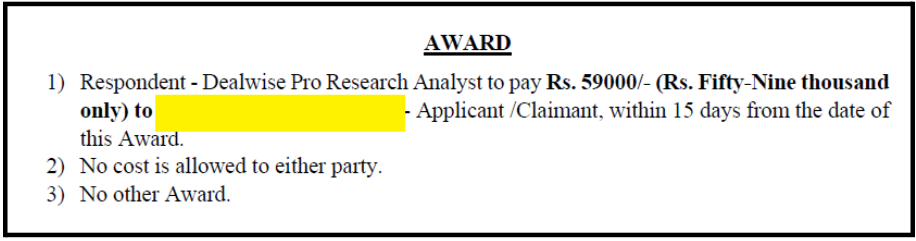
The firm had made loss-recovery and high-profit assurances while continuing to pressure the investor to add capital after trading losses appeared.
The key to that outcome was the evidence package submitted at the start of the process.
The WhatsApp messages showing the recovery promises, the payment receipts, and the trading statement showing the losses that existed at the time the promises were made formed a clear factual record for the conciliator.
The proceedings also placed on record concerns about guaranteed return promises and the firm’s failure to properly disclose its fee structure.
The award directed a partial refund that the investor received within the compliance period.
Cases where the evidence is organised from the start move through the SMART ODR process significantly faster and produce better outcomes than cases where evidence is gathered piecemeal as the process runs.
What Does Dispute Resolved on SMART ODR Actually Mean?
When your SMART ODR dashboard shows Dispute Resolved, it means one of two things.
Either a settlement agreement was reached, and both parties accepted its terms, or an arbitration award was issued, and the intermediary complied within the required period.
In either case, the formal dispute resolution process is complete. The case record remains in the SMART ODR system and can be referenced if any further compliance issues arise.
If the status shows Dispute Resolved but you have not received the payment agreed in the settlement or awarded in the arbitration, the status may reflect the formal closure of the case proceedings rather than a confirmed payment receipt.
Verify directly with your bank that the payment arrived.
If it has not, contact the SMART ODR helpdesk or the exchange arbitration department with your case reference and award document immediately.
If your case is currently stalled or has been dismissed, read our guide on what to do when a SMART ODR complaint rejected or stuck to find your next steps.
Stuck with an unresolved case or unpaid award?
You don’t have to navigate the enforcement process alone.
Reach out to us for a free consultation today and let our team help you secure your recovery.
Conclusion
SMART ODR produces three possible outcomes. A settlement agreement at pre-conciliation or formal conciliation that is binding on both parties.
A binding arbitration award if conciliation fails. Or a procedural case closure if neither party engages adequately with the process.
A binding award issued through SMART ODR arbitration is legally enforceable as a civil court decree under the Arbitration and Conciliation Act, 1996.
The intermediary is required to comply within the period specified. Non-compliance has regulatory consequences for their SEBI registration beyond the individual case.
The Case Closed status means different things depending on how the case reached closure. Always check the detailed case record to understand which closure reason applies before assuming the matter is fully resolved.
Frequently Asked Questions
A SMART ODR settlement agreement is a binding written record of the terms both parties agreed to during conciliation. It can be reached at pre-conciliation or formal conciliation. Once both parties accept the terms and the conciliator records them in the system, both are legally obligated to comply. The intermediary must pay the agreed amount within the timeline specified in the agreement.
If both pre-conciliation and formal conciliation fail to produce an agreed settlement, the dispute moves to formal arbitration. An arbitrator is appointed and both parties submit a Statement of Claim and Statement of Defence. The arbitrator reviews all evidence and issues a binding award. The investor must confirm their intent to proceed to arbitration through the portal to avoid the case being treated as withdrawn.
Yes. A SMART ODR-linked arbitration award is a legally binding decision enforceable as a civil court decree under the Arbitration and Conciliation Act, 1996. The intermediary is required to comply within the period specified in the award. If they do not, the award can be enforced through a civil court and SEBI can take regulatory action against the intermediary for non-compliance.
Case Closed on SMART ODR can mean the case was resolved through a settlement agreement, resolved through an arbitration award that the intermediary complied with, or closed for procedural reasons without a substantive resolution. Check the detailed case record to understand which reason applies. If the case closed without a payment you were entitled to, contact the SMART ODR helpdesk immediately with your case reference number.
If the intermediary does not comply with an arbitration award within the specified period, write formally to the relevant exchange's arbitration department with your award document and evidence that the deadline passed without payment. The exchange escalates the matter through its compliance monitoring process. Additionally, the award can be enforced as a civil court decree under the Arbitration and Conciliation Act, 1996 without filing a fresh lawsuit.
Dispute Resolved means the formal SMART ODR process has concluded with either a settlement agreement or an arbitration award and the intermediary has complied with the terms. Verify with your bank that the payment was actually received. If the status shows Dispute Resolved but no payment has arrived, contact the SMART ODR helpdesk or exchange arbitration department with your case reference and award document immediately.





 Add us as a preferred source on Google »

