

Quick Summary
Initial Claim: ₹75,000 in fees plus ₹1,00,000 in trading losses Core Violation: A firm registered as a Research Analyst used a token registration fee to secure entry, forced the client to liquidate his existing portfolio, gave execution level lot size instructions, and threatened to cut off service unless further payments were made. Forum Used: Direct negotiation with the firm, following a formal legal notice. Recovery Secured: ₹50,000 total settlement, with ₹35,000 received and a further ₹15,000 installment pending. Naveen Chhabra (name changed) is from Indore, Madhya Pradesh. He paid fifteen hundred rupees to get started. By the time he understood what had actually happened, the number had grown fifty times over.
Naveen was contacted repeatedly by representatives of a firm registered with SEBI as a Research Analyst, who eventually pressured him into attending a demo session.
There, he was shown screenshots of other clients’ alleged profits and promised a specific daily profit figure of ten thousand rupees.
Convinced by the demo, he paid a registration fee of just ₹1,550.
A fee this small rarely triggers hesitation, and that is precisely what made it an effective entry point into a relationship that would escalate far beyond it.
Dismissed and Liquidated: How a ₹2,00,000 Portfolio Was Forced Out?
Once registered, Naveen was asked to share details of his existing stock portfolio, worth roughly ₹2,00,000. The representatives criticised his holdings directly, describing them as worthless, and pushed him to sell everything he already owned.
No suitability assessment or understanding of his actual risk profile preceded this instruction. An existing, independently built portfolio was dismantled entirely on the strength of a single dismissive conversation.
Anyone pushed to liquidate an existing portfolio on an advisor’s say-so can complaint against SEBI registered research analyst, since forcing liquidation without any documented risk assessment sits well outside what advisory guidance is meant to look like.
Execution Instructions Disguised As Research
The advice that followed went beyond general recommendations. Naveen was specifically instructed to take positions in five lots of contracts, despite repeatedly explaining that his financial capacity could not support that scale.
Directing exact lot sizes and quantities is execution level guidance, a function closer to portfolio management than research-based advisory.
This exposed Naveen to disproportionate risk relative to what he had ever agreed to take on.
Coercive Demands: How ₹73,000 Was Extorted Across Installments?
Over roughly ten days, a team identifying itself as the firm’s finance department called repeatedly, pressuring Naveen into further payments.
He ended up paying a total of ₹73,000 across multiple installments, with no consolidated invoice, service agreement, or written acknowledgment ever provided for any of it.
Even after paying a substantial portion of this amount, the calls continued, now carrying an explicit threat that his service would simply stop unless he paid still more.
How Advisory Directives Caused a ₹1 Lakh Account Drawdown?
Between the start of July and the end of that month, following the trades and lot sizes he had been instructed to take, Naveen’s losses reached ₹1,00,000.
No stop loss levels accompanied these recommendations, and positions were held for extended periods against his own stated preference.
When Direct Communication and Written Complaints Fail?
Naveen raised his concerns repeatedly through email and phone calls, describing the losses, the missing invoices, and the harassment for further payment.
Every one of these complaints was met with silence.
Reconstructing the Case: Connecting the Entry Fee to Final Coercion
The contrast between the tiny initial fee and the eventual total became a useful anchor for showing exactly how the relationship had been designed to grow.
Step One: We Reconstructed The Full Fee Escalation Timeline
Every payment, from the initial ₹1,550 through to the final installment of the ₹73,000 total, was placed on a single timeline, showing the scale of escalation clearly.
Step Two: We Documented The Forced Portfolio Liquidation Separately
The instruction to sell an existing ₹2,00,000 portfolio, with no risk assessment behind it, was recorded as its own distinct violation, separate from the subsequent trading losses.
Step Three: We Flagged The Lot Size Instructions As Execution Level Guidance
Specific quantity instructions given despite Naveen’s repeated objections about his financial capacity were documented as conduct closer to portfolio management than licensed research advisory.
Step Four: We Compiled The Service Termination Threats As Coercion
The explicit threat to stop service unless further payment was made was recorded directly from the communications where it occurred, establishing coercion independent of the underlying fee dispute.
Step Five: We Sent A Legal Notice Covering The Complete Pattern
Our notice combined the fee escalation, the forced liquidation, the execution level instructions, and the coercive threats into one complete demand, each tied to its specific regulatory basis.
Step Six: We Pushed Through Direct Negotiation With The Firm
With the full pattern documented from the initial small fee through to the final threats, our team engaged the firm directly to move the matter toward resolution.
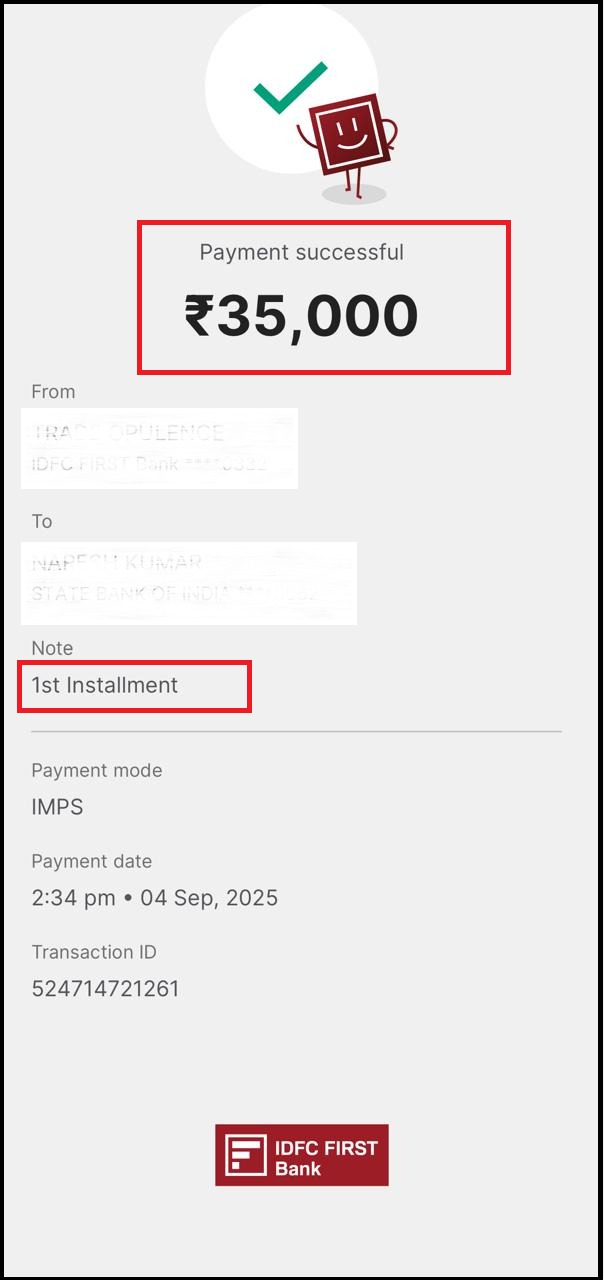
Through this direct negotiation, a total settlement of ₹50,000 was agreed. The first installment of ₹35,000 has already been received, with a further ₹15,000 installment still pending.
Started With A Small Fee That Grew Into Something Much Bigger? Our Team Can Help
Naveen’s case worked because we traced every payment from that first fifteen hundred rupees onward, showing exactly how the relationship escalated. If your fee history looks similar, list every payment out with its date today.
Register with us and we will take it from there.
Conclusion
A token entry fee that feels too small to worry about is often exactly the point; it lowers the barrier to a relationship that can escalate far beyond what anyone would have agreed to upfront.
Naveen’s case shows why tracing the complete fee history, from that first small payment through every subsequent installment, gives a clear picture of intentional escalation rather than a single unfortunate decision.
Forcing the liquidation of an existing, independently built portfolio deserves particular attention in a case like this, since it represents a loss of capital that had nothing to do with any advice given afterward.
Report. Recover. Stay Fraud Free.
Frequently Asked Questions
A low entry fee reduces hesitation and gets a client committed to the relationship, making it easier to escalate toward much larger payments afterward.
No. Any recommendation to liquidate existing holdings should be based on a documented suitability and risk assessment, not a dismissive, unsupported judgment.
Research advice offers general recommendations. Instructing specific lot sizes or quantities moves into execution level guidance, which falls outside what a Research Analyst is licensed to provide.
Yes. Conditioning continued service on additional, undocumented payments is a coercive practice that can be raised as its own violation.
Yes, once formally agreed. Tracking each installment against the agreed schedule ensures the case moves toward genuine, complete closure.





 Add us as a preferred source on Google »

