
Quick Summary
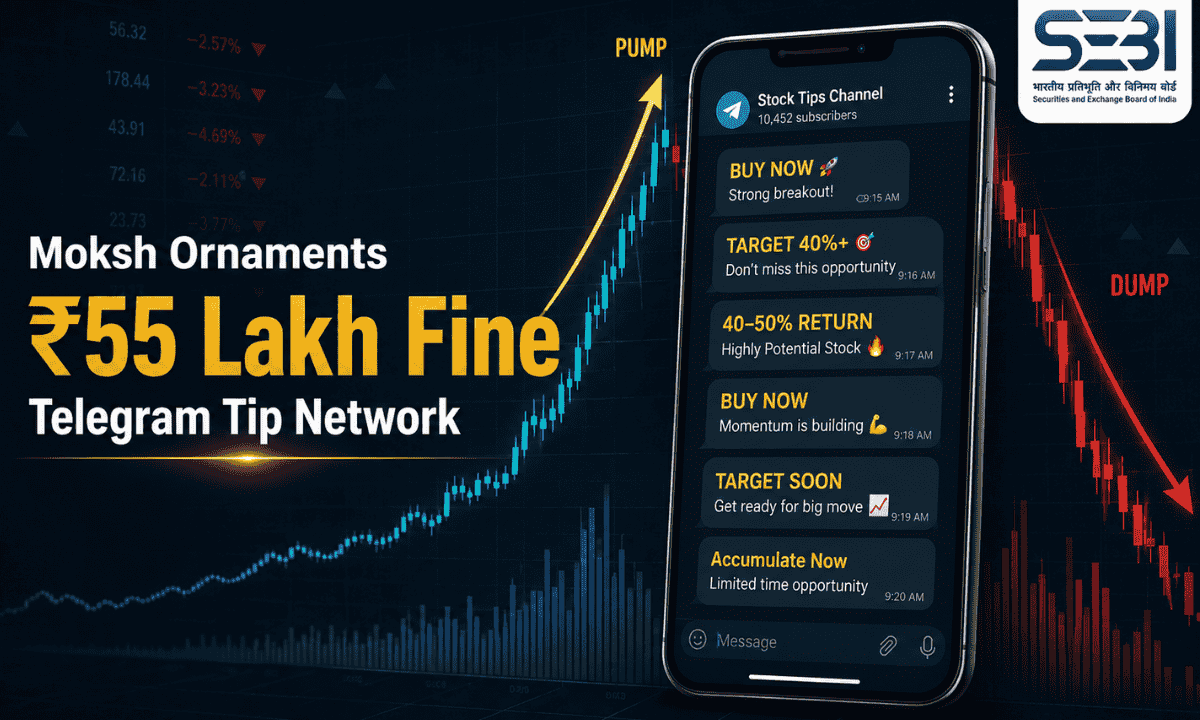
SEBI penalized four Telegram tipsters a total of fifty five lakh rupees for driving a paid pump and dump scheme in Moksh Ornaments Limited. Operators received daily cash to broadcast fake buy tips promising forty to fifty percent returns in a week. Trading volumes surged five times before the stock crashed fifty one percent within nineteen sessions. Meanwhile nine key orchestrators escaped fines due to insufficient date specific trade evidence. Retail investors must avoid unverified social media recommendations and check SEBI registrations before trading.
If you’re active in small-cap trading WhatsApp groups or Telegram channels, this one’s for you.
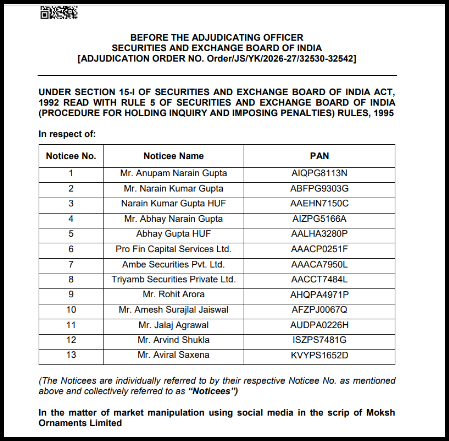
On July 30, 2026, SEBI’s Adjudicating Officer passed an order in the matter of market manipulation in the scrip of Moksh Ornaments Limited (MOL), an NSE-listed company.
The order revealed that a group of promoters and associates ran a classic pump and dump operation, utilizing a network of Telegram tipsters paid in cash to blast out misleading buy recommendations promising 40% to 50% returns in just five to seven days.
The stock jumped over 9% on recommendation days, and trading volumes spiked more than five times before the price crashed over 50% within nineteen sessions.
SEBI penalized the four individuals behind the Telegram tip network a combined Rs 55 lakh.
However, nine key orchestrators avoided penalties because the evidence did not specifically quantify their gains on the exact recommendation dates.
What Actually Happened in the Moksh Ornaments Case?
Moksh Ornaments Limited is a company listed on the National Stock Exchange.
SEBI’s investigation began after it seized the digital device of a middleman during a search-and-seizure operation into stock tips being circulated on Telegram.
Going through that device, investigators found WhatsApp conversations that traced a chain of people forwarding “buy recommendations” for the MOL scrip, complete with entry price, stop loss, target price, and a promised return.
SEBI then widened the probe and looked at trading data for the period between May 31, 2021 and March 31, 2022, which it called the Investigation Period.
How Telegram Tipsters Ran the Moksh Ornaments Pump Scheme?
According to the order, one individual passed buy recommendations for MOL to a middleman, who in turn forwarded them to two Telegram channel operators for posting.
Call records showed dozens, and in one case over a hundred, phone calls between these parties on the exact days the tips were posted, January 31 and February 1, 2022.
The channel operators admitted, in statements recorded on oath, that they were paid daily cash amounts of Rs. 20,000 to Rs. 25,000 to push these recommendations to subscriber bases running into lakhs across multiple channels with generic, trust-building names like “Intraday Trading Tips” and “Sure Means Sure.”
None of them were doing independent research; they were relaying scripted messages and were told to delete them from the channels by the end of each trading day.
How the Stock Price Reacted After the “Buy” Calls?
The price-volume data in the order tells the real story.
On the two recommendation dates, MOL’s closing price rose roughly 9% compared to the previous session, while the number of trades jumped more than fivefold and total volume rose nearly 375%.
The number of public shareholders in the company nearly doubled within three trading days of the tips going out, and by the end of the following quarter it had grown more than fivefold compared to the prior quarter.
That’s the “pump.”
The “dump” followed almost immediately: from February 2, 2022 onward, the price fell steadily and closed over 51% lower within nineteen trading sessions.
In other words, everyone who bought on the promise of a 40-50% return in a week was sitting on a loss of over half their capital within a month.
SEBI Penalties in Moksh Ornaments Case: Who Was Fined and Who Escaped?
This is where the order gets genuinely interesting for anyone trying to understand how SEBI enforcement actually works in practice, rather than how it’s assumed to work.
SEBI held that the tipster network, the middleman and the two Telegram channel operators, along with the person who originally fed them the recommendations, violated the fraudulent and unfair trade practice provisions of securities law, specifically sections 12A(a), (b), (c) of the SEBI Act and multiple sub-clauses of regulation 3 and regulation 4 of the SEBI (Prohibition of Fraudulent and Unfair Trade Practices relating to Securities Market) Regulations, 2003, commonly called the PFUTP Regulations.
One of them also failed to respond to SEBI’s summons altogether, adding a separate violation under section 11C(5) of the SEBI Act.
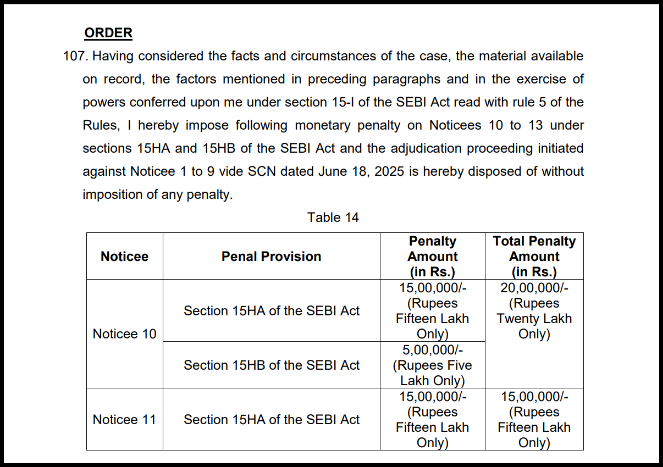
The final penalty came to Rs. 20 lakh, Rs. 15 lakh, Rs. 10 lakh, and Rs. 10 lakh respectively, totalling Rs. 55 lakh across the four of them.
Why the “Main Perpetrators” Walked Away Without a Fine?
Here’s the twist. The order describes nine other Noticees, including the company’s promoter group, as the ones who actually accumulated and offloaded shares in a “Manipulative Pump and Dump scheme,” generating what SEBI calls unlawful gains.
Yet the Adjudicating Officer disposed of the case against all nine of them without imposing any penalty. Why?
Because, going through the arguments recorded in the order, the show-cause notice and investigation report didn’t specifically break down what shares these nine Noticees bought or sold on the actual recommendation dates, as opposed to across the broader multi-month “patches” of trading activity being examined.
Without that date-specific link between the misleading tips and their trades, the case against them couldn’t be sustained on the evidentiary standard required.
As SEBI itself put it while explaining the seriousness of manipulation generally, “market abuse impairs economic growth and erodes investors’ confidence”, but proving who specifically profited from a particular round of manipulation is a different, harder evidentiary bar to clear than proving manipulation happened at all.
The Bigger Lesson: How Pump-and-Dump Schemes Actually Work on Social Media?
Strip away the legal language and this case is a textbook pump-and-dump, run through channels that feel informal and low-stakes to the average retail trader: a Telegram group, a WhatsApp forward, a “tip” that a friend shared in a trading community.
The mechanics are almost always the same. Someone holding a large position in a thinly-traded small-cap stock arranges for coordinated buy recommendations to go out through multiple channels simultaneously.
The recommendations always include specific, official-sounding details: entry price, stop loss, target price, expected timeframe, which makes them feel researched even when they’re copy-pasted scripts.
The promised returns are aggressive and time-boxed, in this case 40-50% in five to seven days, which is designed to trigger fear of missing out rather than careful due diligence.
Genuine retail buying interest then pushes up the price and volume exactly as intended, at which point the people who accumulated the stock beforehand sell into that demand.
Once the selling pressure kicks in, the price falls just as fast as it rose, leaving the people who bought on the tip holding shares worth a fraction of what they paid.
Key Red Flags: How to Spot Social Media Stock Scams?
Analyzing recent SEBI enforcement orders reveals a clear pattern in how social media stock manipulation operates.
If you want to spot these warning signs early, learn how to identify pump and dump stocks before trading.
These schemes rely on a predictable playbook designed to lure retail traders before the stock collapses.
Here are the key warning signs every investor should look out for:
- Promised high returns in a short window: Legitimate research analysts never guarantee exact profit percentages within a few days. Recommendations promising 40% to 50% returns in a week are almost always traps.
- Sudden spikes in volume and trades: A dramatic surge in daily trading activity in an obscure or rarely discussed stock is often artificial, driven by coordinated buying rather than genuine market interest.
- Rapid jumps in retail shareholders: A sharp, sudden increase in the number of public shareholders over just a few trading sessions indicates that a stock is being heavily dumped onto retail buyers.
- Pushing tips across generic social channels: If the same recommendation appears simultaneously across multiple Telegram channels or WhatsApp groups with generic names, and without certification from a SEBI-registered analyst, avoid acting on it.
What This SEBI Order Means for Retail Traders?
The practical takeaway isn’t just “don’t trust Telegram tips,” even though that’s obviously part of it.
It’s that regulatory action, even when it comes, often lands on the visible layer of a scheme, the tipsters and channel operators, while the harder-to-prove layer of coordinated trading can escape penalty simply because the paper trail doesn’t tie specific trades to specific dates cleanly enough.
That should change how you think about risk.
You cannot assume that because a stock is heavily discussed or “everyone is buying it,” there’s institutional-grade due diligence behind the move.
You also can’t assume that just because no one has been penalized for a stock’s price action, the move was organic.
The absence of enforcement is not the same as the absence of manipulation; it can simply mean the evidence didn’t meet the bar SEBI needs for that specific violation.
How to Protect Yourself from Telegram and WhatsApp Stock Tips?
Protecting your capital starts with treating unsolicited stock tips like any other unsolicited offer from a stranger: verify the source before you ever trust the stock.
Here are the most effective habits to protect yourself from social media trading traps:
- Verify SEBI registration first: Always check whether the individual or channel sharing recommendations is a SEBI-registered research analyst or investment adviser. Only registered entities are legally allowed to provide investment advice.
- Cross-check fundamentals: Ignore the target prices quoted in Telegram forwards. Perform independent research by reviewing the company financial reports, public shareholding patterns, and recent exchange disclosures on official exchange websites.
- Be cautious with low liquidity stocks: Exercise extreme caution with small cap and micro cap companies that suddenly experience massive volume surges alongside social media hype, as these stocks are easier to corner and manipulate.
- Recognize aggressive marketing vs research: Any recommendation promising guaranteed, high returns within a tight timeframe is marketing rather than financial advice. In pump schemes, these tips are simply paid promotions designed to create an exit for early holders.
Conclusion
The Moksh Ornaments order highlights a critical reality in modern stock trading: while regulators can track down and fine social media channels, retail investors rarely recover money lost to coordinated manipulation.
Protecting your capital requires looking beyond quick return promises and hyped social chatter.
Before acting on any trading tip, always verify whether the source is a SEBI-registered professional and conduct your own fundamental checks.
In today’s market, staying disciplined and skeptical is your strongest defense against organized pump and dump schemes.
Frequently Asked Questions
It's a SEBI adjudication order dated July 30, 2026 dealing with alleged market manipulation in the scrip of Moksh Ornaments Limited, where misleading buy recommendations were circulated through Telegram channels in early 2022, coinciding with unusual price and volume movement in the stock.
No. SEBI penalized four Noticees who ran or fed the Telegram tip network, with penalties totalling Rs. 55 lakh. The adjudication proceedings against nine other Noticees, described in the order as the scheme's alleged orchestrators and traders, were closed without any penalty due to insufficient evidence linking their specific trades to the recommendation dates.
It's a form of market manipulation where a stock's price and trading volume are artificially inflated through misleading promotion, often via social media, so that early holders can sell into the resulting demand before the price collapses back down.
The SEBI (Prohibition of Fraudulent and Unfair Trade Practices relating to Securities Market) Regulations, 2003 are the rules that prohibit fraudulent, deceptive, or manipulative practices in dealing with securities. They were central to the violations found in this case.
Verify whether the person sharing the tip is a SEBI-registered research analyst or investment adviser, avoid acting on recommendations that promise specific high returns in a short timeframe, check exchange disclosures and shareholding data independently, and be extra cautious with small-cap stocks showing sudden volume spikes alongside heavy social media promotion.
Sharing general market commentary isn't automatically illegal, but offering specific investment advice for consideration without SEBI registration, or knowingly circulating misleading recommendations to manipulate a stock's price, can attract action under the SEBI Act and PFUTP Regulations, as seen in this order.




 Add us as a preferred source on Google »

