

Quick Summary
This Supreme Investrade complaint was a contest between two documents. The firm held a signed consent form and a page of disclaimers. The investor held a voice recording of a promise the firm was never allowed to make. The recording won. In matter NSDL-RA-2025-01-199165, the arbitrator ordered Abhishek Kumar Singh, Proprietor of Supreme Investrade and Research Services, to refund ₹1,97,000. The tribunal added that SEBI had already penalised the firm ₹5,00,000 for the same kind of conduct.
Every firm that mis-sells keeps a disclaimer. A signed form saying the client understood the risks, agreed to the terms, and would not hold anyone responsible.
Firms treat these forms as armour. Shikha Sharma’s case showed how little they protect when the firm’s own words are on record saying the opposite.
She paid Supreme Investrade ₹1,97,000 as a novice investor and specifically asked to be risk-profiled, but the firm never conducted one. After her capital was wiped out, she relied on a recording that preserved what had happened.
The Firm’s Side of the Table
Supreme Investrade came to arbitration well-armed, at least on paper.
The firm relied on a signed consent form and disclaimers stating that trading carries risk and past performance does not guarantee future returns.
It argued that Shikha had understood the risks and agreed to the terms before taking the service.
This is the standard defence, and against most complaints it does real work. A signed form is hard to argue away when the other side only has a memory of what was said.
Shikha did not only have a memory.
Her Side of the Table
During the hearing, she played a call.
On it, an employee of the firm told her she need not pay any fee until he had booked her a profit of ₹1,00,000. A fee contingent on making her money. A promise of profit, in the firm’s own voice.
The same recording caught the firm telling her when to buy and when to sell, specific instructions on specific trades.
The firm did not challenge the recording. It could not. Two prohibited acts sat in that one call, spoken by the firm’s own employee.
A research analyst may publish research. It may not guarantee a profit, and it may not direct a client’s individual trades. The recording had both.
Why the Recording Outweighed the Signature?
Here is the point that matters for anyone in Shikha’s position.
A disclaimer describes what was supposedly agreed. A recording captures what was actually said. When the two conflict, the tribunal follows what happened, not what a form claims was understood.
The arbitrator, Sanjay Arora, held that boilerplate disclaimers do not absolve a firm when the service itself breaches SEBI rules. A signature at the bottom of a page cannot license conduct the regulations forbid.
There was a second detail we placed on record. The firm’s own website listed its highest annual package at ₹1,78,180. Shikha had been charged ₹1,97,000 in under three months. The tribunal called the fee structure non-transparent and reverse-engineered.
And there was the firm’s history. SEBI had already fined it ₹5,00,000 for similar violations. That prior order did not decide the case, but it confirmed the pattern the recording revealed.
Supreme Investrade Complaint: The Award
| Detail | Value |
|---|---|
| Matter number | NSDL-RA-2025-01-199165 |
| Respondent | Abhishek Kumar Singh, Proprietor, Supreme Investrade |
| Amount awarded | ₹1,97,000 refund |
| Default interest | 9% per annum from the 31st day |
| Loss compensation | Dismissed |
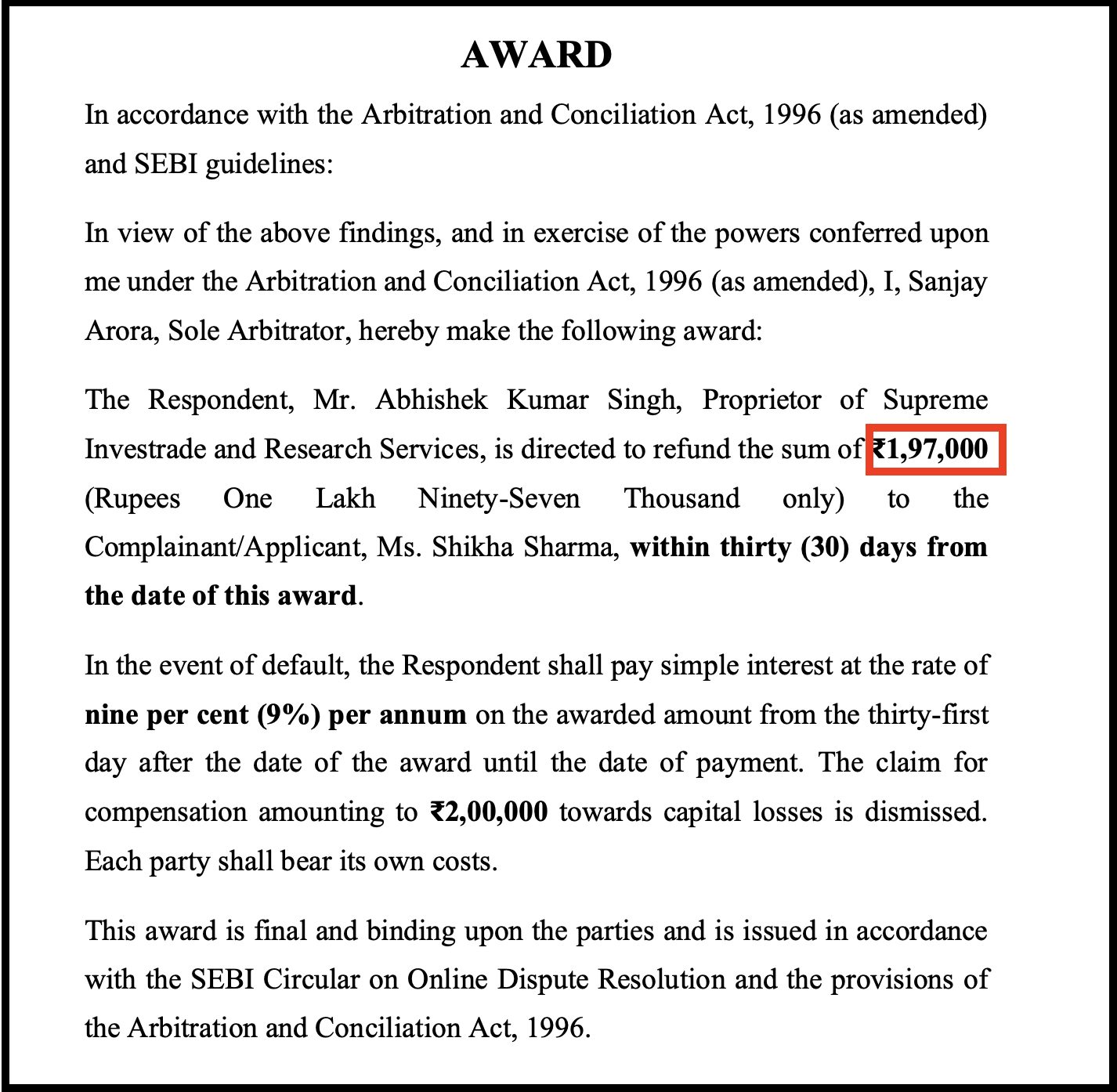
One honest note on this award. The tribunal refunded the full fee but dismissed the separate claim for trading loss. Because Shikha still clicked the buttons herself, the loss could not be pinned wholly on the firm.
The fee, paid under a misrepresented promise, came back in full. The trading loss did not. That line between the two is worth understanding before you file.
Do you have a recording of a firm promising you profit, sitting against a form you signed?
The recording is usually the stronger document. We know which evidence outranks which, and we build the case on the one that wins.
Register with us for a free consultation.
What to Save Before You Ever Complain?
Shikha won because of one thing she kept. The lesson is to keep it before you know you will need it.
If a firm is advising you now, preserve the following while you still can:
- Every call recording, especially any mention of profit, guaranteed returns, or fee waivers
- Screenshots of any package or pricing on the firm’s website
- Every invoice and payment record, to compare against their advertised rates
- Any message telling you specifically when to buy or sell
The recording is the one people forget to keep and later wish they had. A signed disclaimer will be waiting on the firm’s side. Your recording is what answers it.
Conclusion
Supreme Investrade did what mis-selling firms do. It got a signature, then made a promise it was never allowed to make.
The signature was meant to be the end of any complaint. The recording made it the beginning of one. Faced with the firm’s own voice guaranteeing profit and directing trades, the disclaimer counted for nothing, and the tribunal refunded ₹1,97,000.
If a firm ever asks you to sign and then promises you profit in the same breath, both of those moments matter. Keep the second one.
Report. Recover. Stay Fraud Free.
Frequently Asked Questions
A voice recording. It caught the firm promising a profit and directing specific trades, two things a research analyst cannot do. The firm did not challenge the recording, and it outweighed the disclaimer the firm relied on.
No. A disclaimer describes what was supposedly agreed, but it cannot license conduct that breaches SEBI rules. Where a recording shows what was actually said, the tribunal follows the recording.
Because Shikha executed the trades herself, the loss could not be placed wholly on the firm. The fee refund was granted because the fee was paid under a misrepresented promise, but the loss was treated differently.
No, but it helped. SEBI had already fined the firm ₹5,00,000 for similar conduct. That did not settle Shikha's case, but it confirmed the pattern her recording exposed.
Call recordings. A signed disclaimer will already be on the firm's side of the table. A recording of what the firm actually promised is what answers it, and it is the item people most often fail to save.





 Add us as a preferred source on Google »

