
Quick Summary
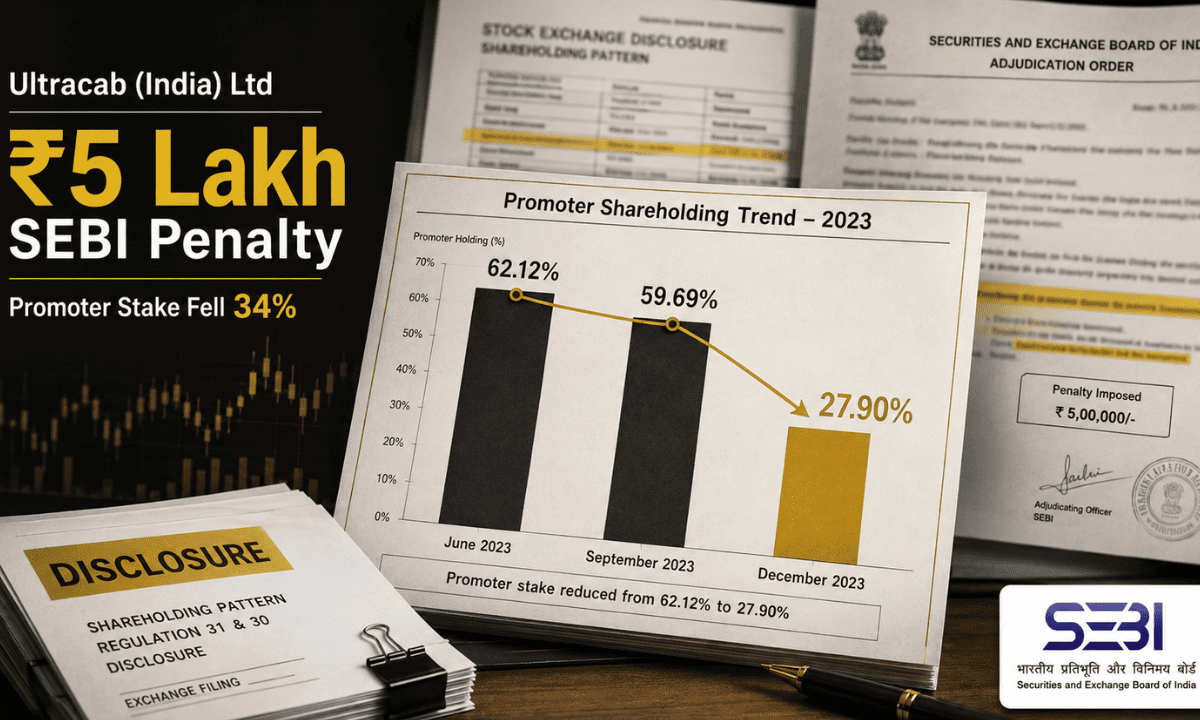
SEBI has fined 16 promoters and promoter-group entities of Ultracab (India) Ltd a combined ₹5 lakh for failing to disclose a major shift in their shareholding. Between September and December 2023, the promoter group’s stake dropped from roughly 60% to under 28%, while public shareholders jumped from under 15,000 to nearly 43,000. Four other individuals named in the same order were cleared after showing they weren’t actually part of the promoter group. The order is dated August 7, 2026.
If you’ve ever looked at a stock and wondered why the promoter’s shareholding suddenly dropped, this case is a useful example of what SEBI expects to see disclosed, and what happens when it isn’t.
This one involves 20 people connected to Ultracab (India) Ltd, most of them from two extended families, the Vaghasiyas and the Shingalas.
Ultracab Shareholding Pattern: How the Promoter Stake Dropped by 30%?
SEBI’s examination looked at the promoter group’s holding in Ultracab across three quarters.
In June 2023, the promoter and promoter group together held 62.12% of the company. By September 2023, that had slipped slightly to 59.69%. By December 2023, it had fallen to 27.90%.
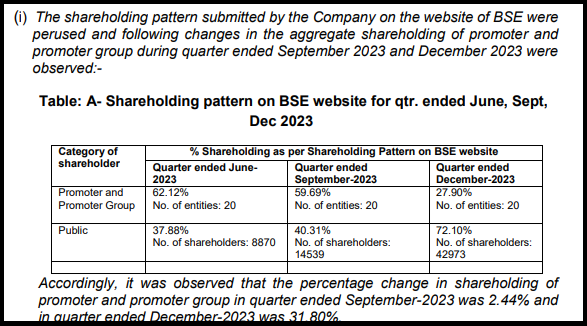
On the other side of that shift, public shareholders went from 8,870 in June 2023 to 14,539 in September, then to 42,973 by December.
That’s roughly a fivefold jump in the number of public shareholders in six months.
SEBI’s own calculation puts the aggregate change in promoter shareholding at 2.44% for the September quarter and 31.80% for the December quarter.
Under the SAST Regulations, any change of more than 2% in a quarter is supposed to trigger a manual disclosure to the stock exchange within two working days.
That disclosure never showed up on the exchange’s records for 12 separate instances across these two quarters.
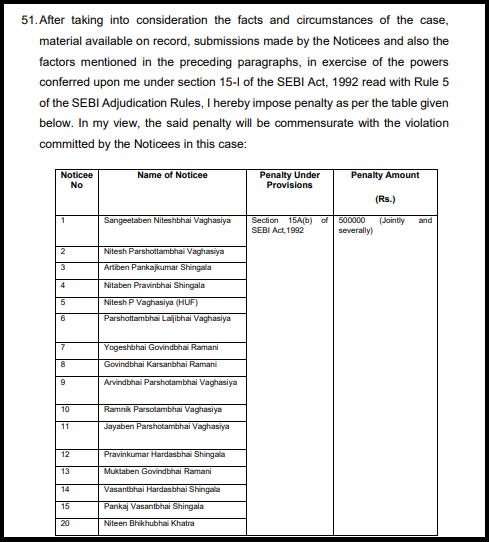
Who Did SEBI Penalise? Full List of 20 Ultracab Promoter Group Noticees
SEBI’s order named 20 individuals and entities connected to Ultracab as Noticees, treated collectively as the promoter group and persons acting in concert, a legal term for people who coordinate on decisions affecting a company’s shares.
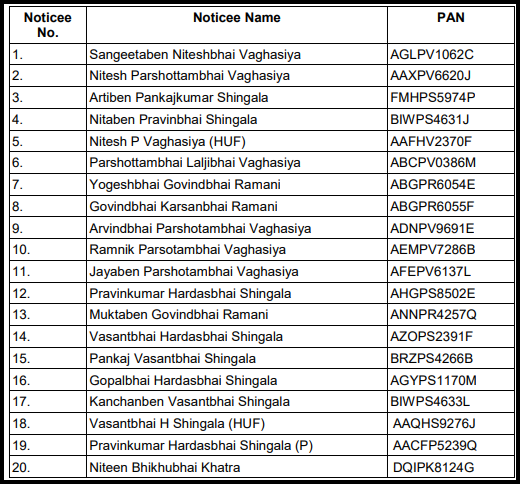
Most of these names belong to the Vaghasiya and Shingala families, along with a few members of the Ramani family and one individual, Niteen Bhikhubhai Khatra, listed separately.
Why Ultracab Promoters Blamed System-Driven Disclosure Rules for the Delays?
The defence from most Noticees wasn’t that the shareholding change didn’t happen. Nobody disputed that. The argument was about why the required disclosure never got filed.
Their case was that SEBI’s own 2022 circular on automated, system-driven disclosures had led them to believe the depository was responsible for filing these updates automatically, and that they didn’t need to do it manually themselves.
SEBI didn’t accept that.
The adjudicating officer pointed to the basic legal principle that ignorance of the law isn’t a valid excuse, and noted that the automation circular didn’t remove the manual disclosure requirement for transactions involving persons acting in concert.
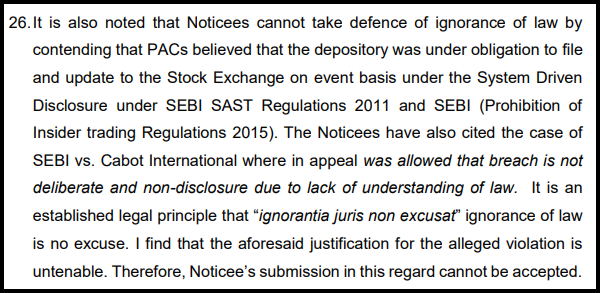
The Noticees also argued this was a purely technical lapse since the same information was already public through the company’s regular quarterly shareholding filings, and that nobody gained unfairly or caused investor losses.
SEBI’s response leaned on a 2006 Supreme Court ruling that a penalty applies as soon as a statutory violation is established, regardless of intent or actual harm.
Not All 20 Were Fined: How 4 Promoters Proved Their Innocence to SEBI?
Not everyone named in the order ended up penalised.
This is the part of the case that actually shows SEBI checking its own facts rather than treating all 20 Noticees the same way.
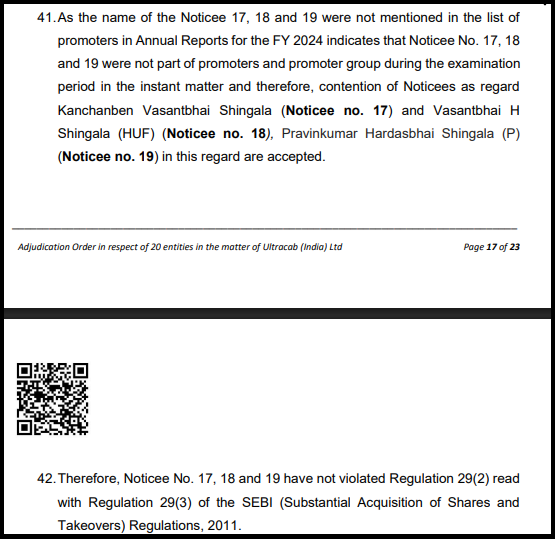
Three people, Kanchanben Vasantbhai Shingala, Vasantbhai H Shingala (HUF), and a partnership firm under Pravinkumar Hardasbhai Shingala’s name, argued they weren’t part of the promoter group at all during this period.
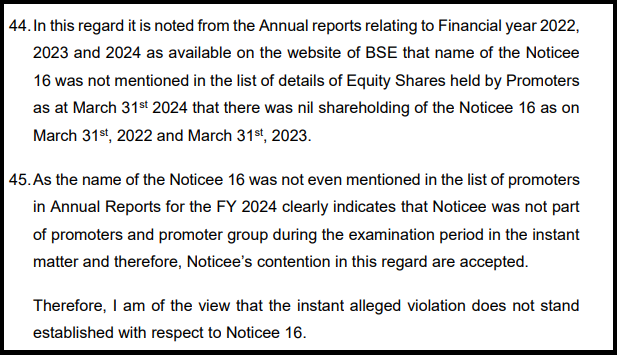
SEBI checked Ultracab’s annual reports and found their names genuinely weren’t listed as promoters, and that their shareholding stood at zero going back to 2022.
A fourth person, Gopalbhai Hardasbhai Shingala, had a cleaner paper trail.
He’d transferred his entire 72,000-share holding to a relative back in January 2021, nearly two years before the period SEBI was examining even began.
For the remaining 16, including three people who argued they personally hadn’t sold any shares but were still found liable simply for being part of the promoter group that collectively crossed the disclosure threshold, SEBI held the violation established.
What Fine Did SEBI Impose on Ultracab Promoters?
SEBI imposed a combined penalty of ₹5,00,000 on the 16 Noticees found liable, to be paid jointly and severally, meaning SEBI can recover the full amount from any one of them rather than dividing it into 16 separate fines.
The order gives them 45 days to pay through SEBI’s website.
If they don’t, SEBI can pursue recovery through attachment and sale of their property.
Should Ultracab Shareholders Be Concerned About the SEBI Penalty?
This case is a reminder that a company’s shareholding pattern can shift dramatically behind the scenes before you see it reflected anywhere official.
A near five-fold jump in public shareholders alongside a collapsing promoter stake is exactly the kind of change that’s supposed to be flagged to the exchange within two working days, not just picked up later in a quarterly filing.
If you’re tracking Ultracab or any other listed company, it’s worth checking the exchange’s disclosure filings directly rather than relying only on quarterly shareholding patterns, since those can lag well behind the actual transactions.
If you believe a company or its promoters haven’t disclosed a material change on time, you can raise it through the SEBI SCORES portal, the same system used for investor grievances against any SEBI-regulated entity or listed company.
Conclusion
The core facts here are straightforward: a promoter group’s stake fell from over 60% to under 28% in six months, and the required disclosures for that shift never reached the exchange.
SEBI treated this as a disclosure lapse, not fraud, and its own review of the evidence cleared four Noticees who genuinely weren’t part of the promoter group.
The ₹5 lakh penalty reflects that distinction, a real violation, established without needing to allege anything beyond what the order itself states.
Report. Recover. Stay Fraud Free.
No. SEBI's order is a disclosure-violation finding under the SAST Regulations, not a fraud finding. The order never uses that word for this conduct. From 62.12% in June 2023 to 27.90% by December 2023, a drop of roughly 30 percentage points over two quarters. Four of them proved to SEBI's satisfaction that they weren't actually part of the promoter group during the relevant period, either due to zero shareholding or an earlier share transfer. A combined ₹5,00,000 on the 16 Noticees found liable, payable jointly and severally rather than as 16 separate fines. They said they believed SEBI's automated system-driven disclosure process would handle the filing for them. SEBI rejected this as a valid defence. This order doesn't address stock price impact directly, but a large, undisclosed shift in promoter holding is generally considered material information that investors are entitled to see on time. You can review the shareholding pattern and disclosure filings directly on the stock exchange's website, rather than relying solely on news coverage or the company's own statements.Frequently Asked Questions



 Add us as a preferred source on Google »

