

Have you ever received a call promising guaranteed stock profits? Or joined a Telegram group offering “90% accurate” trading tips? If yes, you have encountered the reality of unregistered advisory firms india.
Thousands of traders face these schemes every day. These operators sound convincing. They show profit screenshots, share aggressive targets, and push paid subscriptions quickly.
However, most of them lack legal authority to provide investment advice.
As a result, many traders lose money before understanding what actually happened. Some firms stop responding once losses occur. Others demand additional payments to “recover” earlier losses.
Moreover, this problem continues to grow across India’s trading ecosystem. Many investors realise the risks only after paying hefty fees.
In this blog, we explain how these firms operate, what SEBI regulations say, real penalty cases, and how affected traders can file complaints properly.
How SEBI Regulates Investment Advisory Firms in India?
Before we get into the cases, let us understand something important and often overlooked.
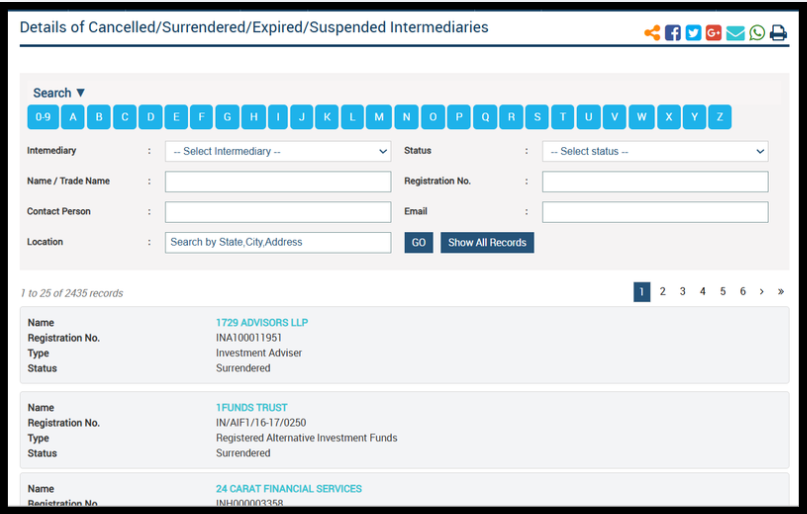
SEBI maintains a public database where you can verify whether any investment adviser is legally registered. But there is another list that most traders never check.
SEBI also maintains a separate list of cancelled, surrendered, expired, and suspended intermediaries, available at SEBI’s website.
Under the SEBI (Investment Advisers) Regulations, 2013, any person or firm offering investment advice for a fee must hold a valid and active SEBI registration certificate. This is not optional. It is the law.
A registered investment adviser must meet minimum qualification standards, maintain a prescribed net worth, conduct proper risk profiling of clients, disclose all conflicts of interest, and keep thorough client records.
These obligations exist for one reason: to protect the investor from unqualified, unaccountable advice.
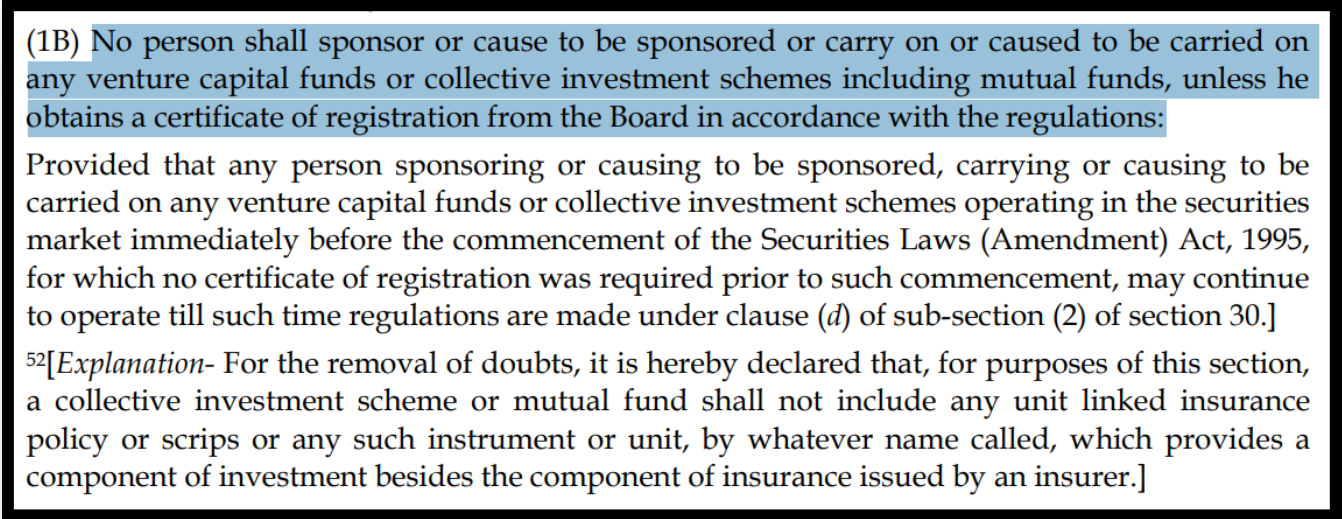
Section 12(1) of the SEBI Act, 1992 is crystal clear on this. Operating as an investment adviser without SEBI registration is a punishable offence.
SEBI can issue refund orders, impose heavy monetary penalties, and ban firms and individuals from the securities market entirely.
How Unregistered Advisory Firms Target Traders?
Before we get to the SEBI orders, let us pause for a moment. Because most traders do not get defrauded overnight. It happens step by step, and there are always warning signs before the money is gone.
These firms follow a pattern. Once you know it, you will spot it instantly.
- Firms often attract traders with “sure-shot” calls and guaranteed profits: SEBI-registered entities cannot promise fixed returns. Therefore, such claims are a major warning sign.
- Many firms offer free trial calls that initially generate profits: As a result, traders quickly develop trust in the service. Later, the firm pushes expensive subscription plans.
- Some companies use urgency tactics to force quick decisions: For example, they claim “limited seats” or “offer ends tonight.” In contrast, genuine advisers allow investors enough time to evaluate properly.
- Fake SEBI registration certificates; SEBI itself has warned that fraudulent entities use forged or fabricated SEBI certificates to appear legitimate.
- Payments to personal or unknown accounts: If a firm asks you to transfer money to a personal bank account, a payment link on an unofficial app, or a UPI handle that does not match the firm’s name, stop.
- Professional-looking websites with no traceable details: A good-looking website means nothing. Many unregistered firms invest in sleek designs, fake testimonials, and fabricated performance records.
- Social media and messaging app operations: Telegram groups, WhatsApp broadcasts, Instagram reels with profit screenshots, these are the preferred playgrounds of unregistered advisers.
Recognising these signs early is the single most effective form of protection. Because once the money has been paid, the journey to get it back is long and uncertain.
With that in mind, let us now look at what SEBI has done when investors did not spot these signs in time.
SEBI Actions Against Unregistered Advisory Firms India
SEBI has been actively cracking down on unregistered investment advisory activity across India.
Many of these cases involve unregistered advisory firms in India operating through websites, Telegram groups, and paid trading subscriptions.
Below are three real orders, each one a story of how traders got misled, how SEBI investigated, and what followed.
Case 1: Lifeinspire Knowledge Solutions Private Limited SEBI Order
This case started with a suspicious credit in a bank account.
During SEBI’s investigation into another unregistered advisory entity, Option Research Consultancy, the regulator noticed unusual credits flowing into the HDFC Bank account of Lifeinspire Knowledge Solutions Private Limited (LKSPL).
That finding opened an entirely new investigation.
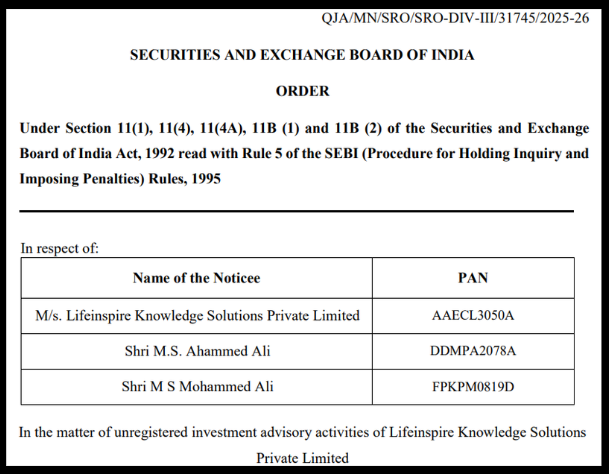
LKSPL ran its advisory business through the website www.bankniftyoption.in. The website made bold claims.
It promised accurate predictions on Bank Nifty options and positioned itself as a professional advisory service.
Here is what SEBI found on digging deeper:
Key Violations Found By SEBI
- Operated as an investment adviser without holding any SEBI registration.
- Collected advisory fees from investors between September 2020 and 2024.
- Used a website with false and misleading claims to attract clients.
- Additionally, SEBI held directors Ahammed Ali and Mohammed Ali personally liable under Section 27 of the SEBI Act.
- Further, Ahammed Ali had earlier faced penalties for similar unregistered advisory operations through Option Research Consultancy. This indicated a repeated compliance pattern.
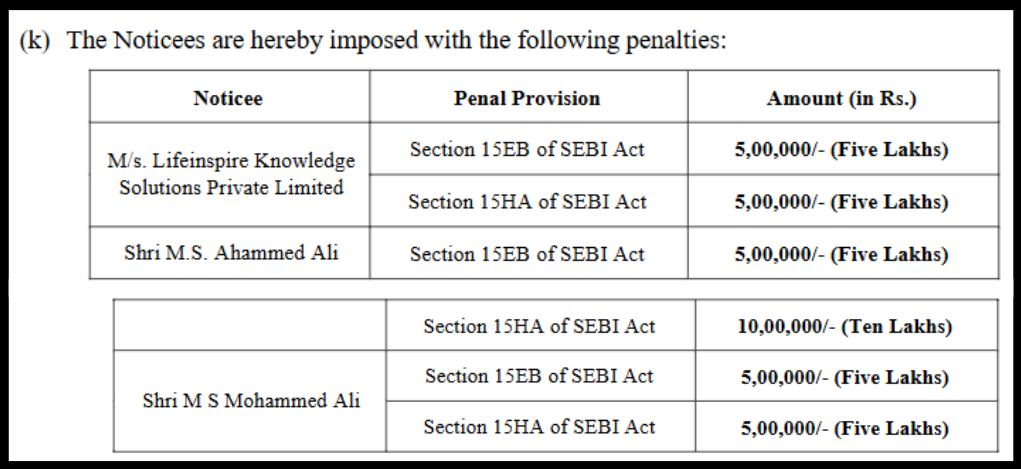
- Moreover, SEBI found violations of Section 12(1), Section 15EB, Section 15HA, and multiple PFUTP Regulation provisions.
SEBI Penalty on Lifeinspire Knowledge Solutions Private Limited
Case 2: M/s NIFM Equity and Commodity Research SEBI Order
The next story involves a firm that presented itself as a credible, professional research outfit. The name sounded familiar. The website looked legitimate.
But behind it all, there was no SEBI registration.
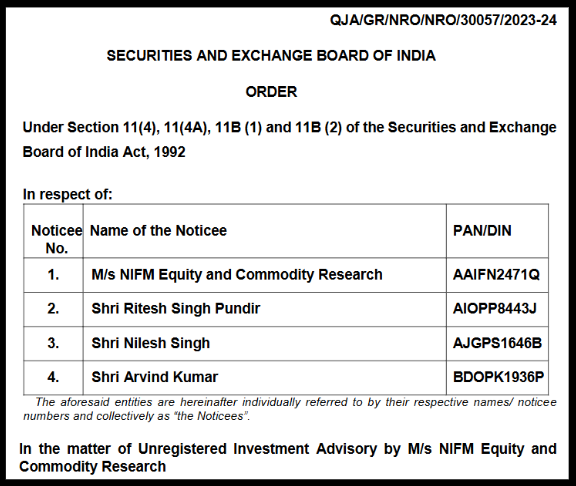
M/s NIFM Equity and Commodity Research and its three partners, Ritesh Singh Pundir, Nilesh Singh, and Arvind Kumar, were running a full-scale advisory operation.
Their website offered stock tips, commodity tips, and futures and options tips. Subscription packages ranged from ₹2,500 to ₹60,000.
Payments were accepted directly into specified bank accounts with ICICI Bank and HDFC Bank.
SEBI’s investigation found all of this clearly recorded in bank statements and KYC records.
Key Violations Found By SEBI
- Provided investment advisory services without SEBI registration, violating Regulation 3(1) of the IA Regulations, 2013.
- Offered multiple advisory packages for a fee through a public website.
- Collected payments through two separate bank accounts to receive client money.
- None of the four noticees held SEBI registration in any capacity.
- The firm’s website, though later taken down, had been actively soliciting investor subscriptions.
SEBI Penalty on M/s NIFM Equity and Commodity Research
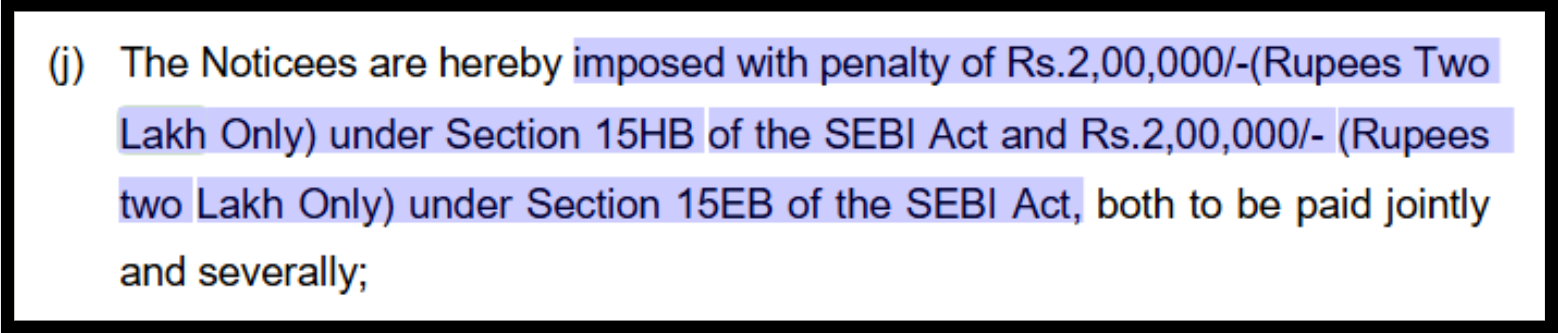
SEBI ordered all four noticees to jointly refund ₹25.20 lakh, the total amount collected as advisory fees. A monetary penalty of ₹4 lakh was imposed.
All four were barred from the securities market for two years.
A website and a professional-sounding name are not enough. SEBI checks the database, and the absence of registration tells the whole story.
Case 3: M/s Real Capital Services SEBI Order
This case is slightly different, and more personal in nature.
Diptiben Maheshbhai Thakrar ran her advisory business under the trade name Real Capital Services, operating through the website realcapitalservices.in.
Alongside her, Kiritbhai Chavda, proprietor of Shreesons Enterprise, was also providing unregistered advisory services.
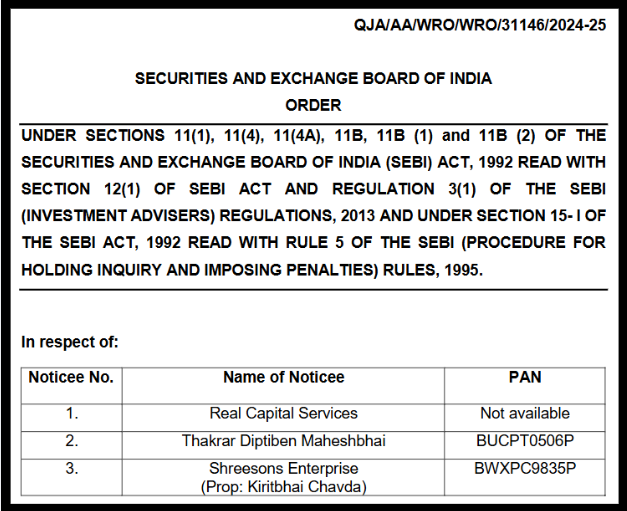
SEBI’s investigation was triggered by a complaint alleging that Real Capital Services was offering investment advice to investors without the mandatory SEBI registration.
What made this order especially significant was SEBI’s detailed tracing of the money trail. SEBI identified the exact bank transactions linked to the advisory activities.
Accordingly, investigators found that Thakrar received ₹56.36 lakh through his Axis Bank account. Similarly, Chavda received ₹48.22 lakh in advisory-related payments through another Axis Bank account.
Key Violations Found By SEBI
- Offering investment advisory services without SEBI registration.
- Collected fees from investors through a named business with a public-facing website.
- No independent corporate identity behind the trade name, making the proprietor directly liable.
- Violated Regulation 3(1) of SEBI (Investment Advisers) Regulations, 2013.
- The advisory was marketed through a professional-looking website with no legal backing.
SEBI Penalty on M/s Real Capital Services
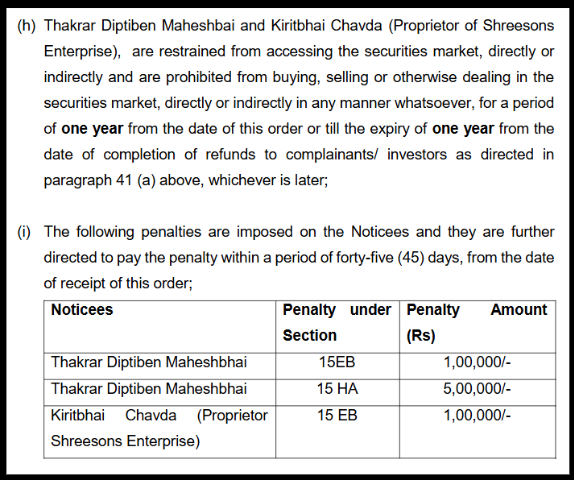
SEBI banned both from the securities market for one year. Thakrar was fined ₹6 lakh and Chavda was fined ₹1 lakh. Both were ordered to jointly refund a total of ₹1.04 crore, the entire amount collected from clients.
The message here is simple: if the money came in through unregistered advisory activity, SEBI will trace it, and it will come back out as a refund order.
How To File a Complaint Against an Unregistered Advisory Firm?
So, you have paid fees to a firm that had no SEBI registration. Or you have been misled by guaranteed-return promises. What do you do now?
Victims of unregistered advisory firms India often realise the problem only after repeated losses or when the firm stops responding entirely.
Here is a clear, step-by-step process:
Step 1: Save All Your Evidence Right Now
Do not wait. Evidence disappears fast, websites go offline, numbers get blocked, WhatsApp groups get deleted.
Save screenshots of all communication, payment receipts and bank statements, promotional messages or claims of guaranteed returns, and any advisory calls or tips received.
Organise everything with clear dates and amounts.
Step 2: Verify Their Registration Status
Before you file, confirm that the firm is indeed unregistered. Visit the SEBI intermediary search database at SEBI’s website and search by firm name or individual name.
If no registration appears, that is your proof. Take a screenshot of the search result and keep it.
Step 3: File Your Complaint with SEBI
If the entity is unregistered, you generally cannot rely only on the SCORES platform. In such cases, the better approach is to directly email SEBI with a detailed complaint and all supporting evidence.
Your complaint should clearly mention:
- The name of the person or entity.
- How they approached you.
- What promises or claims were made.
- Payment details.
- The losses or issues faced.
Attach screenshots, payment proofs, chats, emails, call recordings, and any other relevant documents.
Step 4: File a Complaint with Cyber Crime
If you suspect that you have been deceived, charged for services that were never provided, or induced to make payments through misleading representations, you may file a complaint with the cyber crime.
Online financial fraud and digital investment-related misconduct can be reported through this channel for further investigation.
Step 5: Seek Legal Advice
If the amount involved is substantial, consider consulting a lawyer experienced in securities and financial disputes.
A legal professional can assess your situation, explain the remedies available, and guide you on the most appropriate course of action for recovering your losses.
Need Help?
If you are unsure where to start, or if you feel overwhelmed by the process, you do not have to navigate this alone.
Our expert team can guide you through evidence collection, complaint drafting, SEBI follow-ups, and every step in between.
Register with us and our team will get in touch with you.
Conclusion
Unregistered advisory firms in India are not a small problem. They are a widespread, organised pattern of fraud, dressed up in professional websites, credible-sounding names, and bold return promises.
SEBI is watching. The cases above prove that clearly. But by the time SEBI acts, the money is often already gone.
So the best protection is always verification first. Before you pay any advisory firm, search their name on SEBI’s database. If no registration appears, walk away.
Ultimately, staying protected from unregistered advisory firms India begins with one simple step: verifying SEBI registration before paying for any advisory service.
And if you have already paid and suffered losses, do not stay silent. File your complaint, preserve your evidence, and stay in the process.
The investors who act are the ones who at least stay eligible for whatever SEBI recovers. The ones who do nothing guarantee nothing.





 Add us as a preferred source on Google »

