
Quick Summary
Filing a complaint in SEBI SCORES means registering with your PAN, picking the correct entity category, and submitting your evidence, after which the entity gets 21 days to respond and you get two review windows if that response falls short. This guide covers who can use SCORES, what documents to prepare, the full step by step filing process, why complaints get rejected, and how to escalate to SMART ODR or arbitration if SCORES alone does not resolve things. It also covers what a complaint against each type of registered entity, from a stock broker to a credit rating agency, usually involves. For cases that need more than a straightforward filing, it explains when to bring in someone like Aseem Juneja, who has recovered money for investors through this exact process.

More than 5,000 Complaints Reported in SCORES per month in 2025-26
However, with the right procedure, it can be recovered.
Do You Have a Concern About Your Stock Broker?
Get expert assistance in filing a formal SEBI SCORES complaint.
SEBI SCORES Complaint: How to File and Track a Complaint Online (2026 Guide)

File a complaint on SEBI SCORES in a few minutes using your PAN; the company has 21 calendar days to respond. If their response misses the mark, you can request up to two reviews, or move over to SMART ODR.
Doing it yourself is completely free, and this guide walks you through every step. If you want professional handling from start to finish, we’ve also included details on when outside help makes sense.
SEBI SCORES Complaint at a Glance: Cost, Deadlines and Helpline
| Question | Answer |
|---|---|
| Where do I file? | scores.sebi.gov.in or the SEBI SCORES mobile app |
| What does it cost? | Nothing |
| What do I need to register? | PAN (or PEKRN), name, address, email, mobile number, date of birth |
| How long does the entity have to reply? | 21 calendar days |
| How long do I have to ask for a review? | 15 days for the first level, then 15 days for the second level |
| Is there a filing deadline? | One year from the date the problem arose |
| SEBI helpline | 1800 266 7575 or 1800 22 7575, 9 am to 6 pm |
| Technical help with the portal | [email protected] |
| Can SCORES order a refund? | No |
SEBI has also reported that it disposed of 5,037 complaints against 5,035 received in June 2026 (PTI). That means the system is clearing more than it takes in.
What Is the SEBI Complaints Redress System (SCORES)?
SCORES stands for SEBI Complaints Redress System. It is the online portal where you raise a grievance about the securities market against a listed company, a SEBI registered intermediary or a market infrastructure institution such as a stock exchange or a depository.
SEBI calls SCORES a facilitation platform, and the wording matters. SCORES sends your complaint to the entity, sends the entity reminders and moves the complaint up a review ladder if the reply is late or unsatisfactory. It does not hold a hearing, decide who is right or order a refund.
The current version is SCORES 2.0, which replaced the old scores.gov.in site in 2024. The old site stopped taking new complaints from 28 March 2024, and complaints filed there earlier can only be checked on the old site. Every new complaint goes through scores.sebi.gov.in or the SEBI SCORES mobile app, and both connect to the same system.
SCORES 2.0 vs the Old SCORES: What Changed
You may have found a guide or a screenshot that shows a different SCORES website from the one you see today. That’s because SEBI moved the portal, and plenty of older pages never caught up.
The old site, scores.gov.in, stopped taking new complaints on 28 March 2024. It’s still online for one reason, which is to let people check complaints they filed before that date. So if a page asks you to file something new there, you’re in the wrong place.
Everything new goes through scores.sebi.gov.in or the SEBI SCORES app. When you register, it pulls your details from your KYC Registration Agency, or you can fill in the registration form instead.
The biggest change is the wait. The company or broker now has 21 calendar days to reply, and some older pages still say 30. SEBI’s own investor education site is one of them, so don’t be thrown if you see the longer number.
You also don’t have to keep chasing them. The system sends reminders on its own. And once your complaint is closed, you get 15 days to give feedback on how it was handled.
Who can file a SEBI SCORES Complaint?
Any retail trader or investor with a grievance about the Indian securities market can file, alongside NRIs, OCIs, and other eligible market participants, as long as it is a matter SCORES handles (see the sections on accepted and rejected complaints below).
SCORES needs six details before it lets you lodge anything: name, address, email address, PAN, mobile number and date of birth.
While resident retail investors follow the standard registration flow, non-resident participants face slightly different verification requirements, though the portal remains fully accessible to them.
SCORES Complaint for NRIs and OCIs
NRIs and OCIs can register through the KYC Registration Agency route or the registration form. They do not have to enter or verify an Indian mobile number. The email address is still verified by OTP.
Registering With PEKRN Instead of PAN
Residents of Sikkim, small mutual fund SIP investors putting in up to Rs 50,000 a year, and certain government or court-appointed officials can use their PAN Exempt KYC Reference Number (PEKRN) in place of a PAN.
Documents Required to File a Complaint in SEBI SCORES
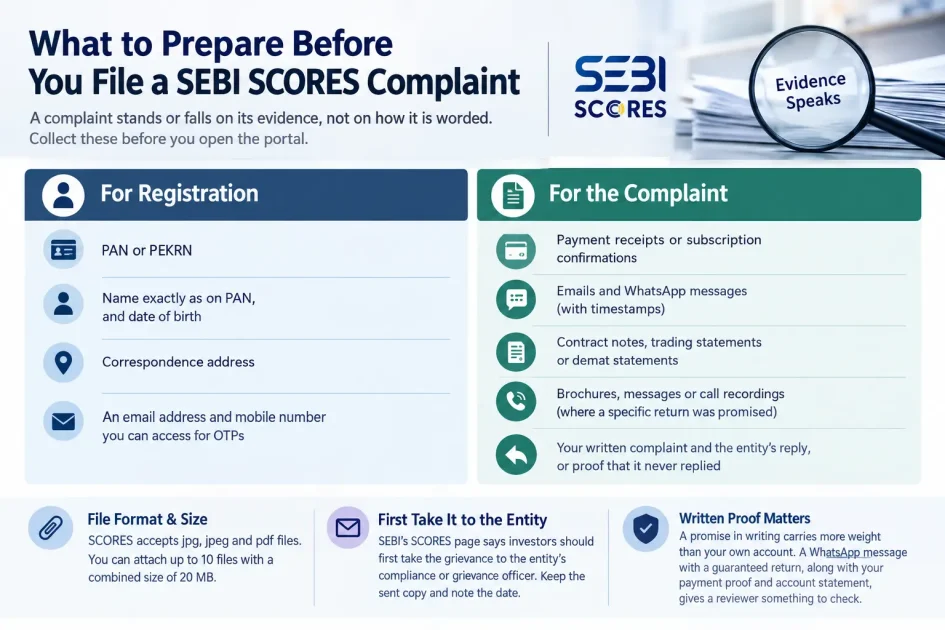
A complaint stands or falls on its evidence, not on how it is worded. Collect these before you open the portal.
| For registration | For the complaint |
|---|---|
| PAN or PEKRN | Payment receipts or subscription confirmations |
| Name exactly as on PAN, and date of birth | Emails and WhatsApp messages saved as screenshots with timestamps visible |
| Correspondence address | Contract notes, trading statements or demat statements for the period in dispute |
| An email address and mobile number you can access for OTPs | Brochures, messages or call recordings where a specific return was promised |
| Your written complaint to the entity and its reply, or proof that it never replied |
SCORES accepts jpg, jpeg and pdf files. You can attach up to 10 files with a combined size of 20 MB, so compress large statements before uploading.
SEBI’s SCORES page says investors should first take the grievance to the entity’s designated compliance or grievance officer. Write to that person by email, keep the sent copy and note the date. That dated record helps if the matter later reaches a review, SMART ODR or arbitration.
A promise that exists in writing carries more weight than your own account of what happened. A WhatsApp message quoting a guaranteed return, together with your payment proof and account statement, gives a reviewer something to check instead of a story to weigh.
SEBI SCORES Registration: PAN Route and Manual Route
Fast Route: Validate Your PAN
Go to scores.sebi.gov.in and select investor registration. Enter your PAN and date of birth, then click Validate PAN. SCORES pulls the mobile number registered with the KYC Registration Agency (KRA), shows it to you in masked form and sends an OTP to it. Confirm the OTP and registration is done in about a minute.
Manual Route: Enter Details Yourself
Use this if the mobile number held by the KRA is old or you do not want the auto fetch. Fill in your name, PAN, date of birth, email address and a mobile number you can access, exactly as they appear on your ID. Confirm the OTPs sent to your email and phone. Both routes end at the same login.
Submitting the form creates your login ID and password. You will use them for this complaint and any later one.
SEBI SCORES Login: Sign In, Reset Password and Fix OTP Problems
Go to scores.sebi.gov.in, choose sign in and enter the login ID and password you received at registration. Check the address bar before you type anything. The real portal always ends in sebi.gov.in, and lookalike sites exist.
Forgot Your SCORES Password or Login ID
Use the password reset option on the sign in screen. If it does not work, email [email protected] with your PAN and registered email address, or call the technical support numbers listed in the helpline section below.
SCORES OTP Not Arriving: Why It Happens and What to Do
The OTP goes to the mobile number held by the KRA, or to the number you typed during manual registration. If your KYC mobile number is out of date, the OTP goes to a number you no longer use. In that case register through the manual route with a number you can access. Also check your spam folder for the email OTP, and wait a couple of minutes before asking for a new one.
Name or date of birth not matching
SCORES checks your details against your PAN. If registration fails, compare the name and date of birth you entered with your PAN card, letter by letter.
Fake SCORES Websites: How to Check You Are on the Real Portal
Lookalike pages copy the SCORES design to collect your PAN and OTP. You can spot most of them in about ten seconds. Look at the address bar first. The real portal is scores.sebi.gov.in, and the address always ends in sebi.gov.in.
Then think about money. SCORES is free, so a page asking for a fee to register or lodge a complaint isn’t the real one. Watch out for the old site too. scores.gov.in no longer takes new complaints, so a page there asking you to file one is out of date.
Got the link in an SMS or a social media message? Don’t tap it. Type scores.sebi.gov.in into your browser yourself.
How to File a Complaint on SEBI SCORES Online
SEBI SCORES 2.0 filing process
How to file a SEBI SCORES 2.0 complaint in six steps
SCORES 2.0 is SEBI’s current complaint portal. It replaced the old scores.gov.in site, which stopped taking new complaints on 28 March 2024. Pick the wrong category in Step 3 and the complaint gets misrouted, so follow the steps in order.
Free
No fee to register or file
21 days
Time the entity has to send its Action Taken Report
15 + 15 days
Two review windows if the reply falls short
1 year
Filing limit from the date the problem arose
-
1Register on SEBI SCORESGo to scores.sebi.gov.in and select investor registration. The faster route: enter your PAN and date of birth and click Validate PAN. SCORES fetches the mobile number held by your KYC Registration Agency (KRA), shows it masked and sends an OTP to it. If that number is old, use the manual route and enter your name, PAN, date of birth, email and a mobile number you can access.NRIs and OCIs do not need an Indian mobile number. PAN exempt investors can use their PEKRN.
-
2Verify the OTP and get your SCORES loginConfirm the OTP sent to your email and phone. This creates your SCORES login ID and password, which you will reuse for every later complaint. Check that the address bar ends in sebi.gov.in before you enter your PAN.
-
3Sign in and select the correct categoryChoose Lodge a complaint and match the category to the entity: Stock Broker, Investment Adviser, Research Analyst, Mutual Fund, Listed Company, and so on. A wrong category sends the complaint to the wrong department and costs you time.
-
4Enter the entity’s name and SEBI registration numberCheck the registration number on SEBI’s intermediary search first (sebi.gov.in, then Intermediaries, then Registered Intermediaries). A wrong number can stop the complaint from reaching the right entity.
-
5Describe the problem and attach your evidenceState what happened, on which dates, how much money is involved and what you want the entity to do. Keep to facts in the order they happened. Attach payment proof, statements, screenshots and any message or brochure that quotes a promised return.
-
6Submit and save your complaint registration numberSCORES gives you a registration number on submission. Save it. You will use it to check status, to ask for a review and to quote on every follow up call.
What happens after you submit
SCORES 2.0 timeline-
Day 0
SCORES forwards your complaint to the entity automatically and sends it reminders.
-
Within 21 days
The entity sends its Action Taken Report (ATR) to you through the portal.
-
Next 15 days
Not satisfied? Ask for a first level review of the ATR.
-
Next 15 days
Still not satisfied? Ask for a second level review. After that, SMART ODR is the next route.
Documents required for a SEBI SCORES 2.0 complaint
Before you fileFor registration
- PAN (or PEKRN if you are exempt from PAN)
- Full name and date of birth, exactly as on your PAN
- Correspondence address
- A mobile number you can access for the OTP
- An email address you check, for the OTP and updates
For every complaint
- Payment receipts or subscription confirmations
- Emails and WhatsApp messages, saved as screenshots with timestamps visible
- Contract notes, trading statements or demat statements for the period in dispute
- Brochures, messages or call recordings where a specific return was promised
- Your written complaint to the entity’s compliance officer, and its reply (or proof that it never replied)
Unauthorised trade or wrong contract note
Contract notes, ledger and trade statements for the dates in question, a screenshot of the order history, and your email to the broker’s compliance officer.
Guaranteed return promise
The message, brochure or call recording with the promise, proof of every payment, the entity’s SEBI registration number from SEBI’s search, and your account or advisory statements.
Research analyst or investment adviser
Fee invoices and payment proof, any agreement or terms you accepted, the reports or calls you received, and a record of what was promised against what was delivered.
Listed company, dividend or share transfer
Your holding statement or folio details, bank statement showing the dividend did not arrive, and the transfer or transmission application with its acknowledgement.
Mutual fund
Folio statement, transaction acknowledgement or payment proof, and your earlier correspondence with the fund house or its registrar.
NRI or OCI investor
Your KRA registered details and an email address for the OTP. An Indian mobile number is not required.
Upload rules: SCORES accepts jpg, jpeg and pdf files, up to 10 files with a combined size of 20 MB. Compress large statements before uploading. Complaints that are anonymous, incomplete or sent without supporting documents are not treated as complaints on SCORES.
Step 1: Sign in and choose Lodge a complaint
Sign in and open the option to lodge a complaint.
Step 2: Select the correct category
The category decides where the complaint is routed. A complaint against a research analyst filed under Stock Broker gets misrouted and loses time. Match the category to the entity: Stock Broker for your broker, Investment Adviser for a registered adviser, Research Analyst for an analyst, Mutual Fund for a fund house, Listed Company for a company, and so on down the list on the portal.
Step 3: Enter the entity’s name and registration number
Check the entity’s SEBI registration number on SEBI’s own intermediary search before you submit. On sebi.gov.in, open Intermediaries, then Registered Intermediaries, choose the category and search by name. A wrong registration number can stop the complaint from reaching the right entity.
Step 4: Write the complaint
State what happened, when, how much money is involved and what you want the entity to do. Use plain facts in the order they happened. Leave out opinions about the entity’s character.
Step 5: Attach your evidence
Upload payment proof, statements, screenshots and any message or brochure that quotes a promised return.
Step 6: Submit and save your complaint registration number
SCORES gives you a complaint registration number on submission. Save it. You will use it to track the complaint and to quote on every follow up.
SEBI SCORES Complaint Example
This is an example only. Change the facts to match your own case.
“On 12 August 2026, three trades in my account were placed without my instruction, causing a loss of Rs 48,200. I did not give any order by phone, app or message that day. I wrote to the broker’s compliance officer on 14 August 2026 and have received no reply. I ask for the loss to be reversed and for an explanation of how the orders were placed. Contract notes, my statement and the email I sent are attached.”
It names the dates, the amount, the step already taken with the entity and the outcome wanted. A reviewer can check each of those against the attachments.
SEBI SCORES App for Android and iOS: What You Can Do on It
The SEBI SCORES app is available for Android and iOS. It uses the same registration and the same system as the website. In the app you can sign up, lodge a complaint, follow its progress and use the two review levels. If the website is slow or the OTP gives you trouble, trying the app is a reasonable second attempt.
What Happens After You File: 21 Days, Two Reviews, Closure
| When | What happens |
|---|---|
| Day of filing | SCORES sends the complaint to the entity automatically |
| Within 21 calendar days | The entity sends its ATR to you |
| Within 15 days of the ATR | You can ask for a first level review if you are not satisfied |
| Within 15 days of the first review outcome | You can ask for a second level review |
| At any point | You can move the dispute to SMART ODR or another civil remedy |
If you move to SMART ODR or go to court while the complaint is open on SCORES, the SCORES complaint is treated as disposed and you cannot pursue it there again.
SEBI SCORES Complaint Status: How to Check It and What Each Stage Means
Sign in to the portal with your registered credentials and open the complaint using your complaint registration number. The dashboard shows where the complaint stands and how many days are left at that stage. The app shows the same information
Labels on screen can differ slightly, but the stages run in this order.
| Stage | Meaning |
|---|---|
| Lodged | Your complaint is registered |
| Sent to the entity | The entity has received it and its 21 day clock is running |
| ATR received | The entity has replied and you can accept it or ask for a review |
| First level review | The first review of the reply is under way |
| Second level review | SEBI is examining the matter |
| Closed | The complaint is disposed of |
Once a complaint is closed you can give feedback on how it was handled. SEBI asks for that within 15 days of closure.
Not Happy With the SCORES Reply? Using the Two Review Levels
An unsatisfactory ATR is common. Do not let the 15 day window pass.
- Read the ATR against your complaint and note which point it ignores or answers wrongly.
- Ask for the first level review within 15 days of the ATR. Say specifically what is wrong with the reply, and attach any new evidence.
- If the first review does not help, ask for the second level review within 15 days of its outcome.
- If both reviews fail, consider SMART ODR, which is covered below.
If both windows pass without any action from you, the complaint is treated as closed. Repeating the same words in each round does little. Each request should point to something the previous reply missed.
SEBI SCORES Helpline Number, Email ID and Technical Support
| Need | Contact |
|---|---|
| Guidance on lodging a complaint or knowing its status | Toll free helpline 1800 266 7575 or 1800 22 7575 |
| Helpline hours and languages | 9 am to 6 pm on all days except declared holidays, in English, Hindi, Marathi, Gujarati, Tamil, Bengali, Telugu and Kannada |
| Technical trouble such as login failure or a missing OTP | Email [email protected] or call 022 2644 9377, 022 4045 9377 or 022 2075 2247, 9 am to 6 pm |
| Help in person to start an ODR dispute | The Investor Service Centres of NSE and BSE, listed at investor.sebi.gov.in |
The helpline answers questions about how to file, whether a company is listed, where to take grievances SEBI does not handle and how to find a company’s registrar. It does not give legal opinions or investment advice. It also cannot file the complaint for you.
Can you complain to SEBI by email?
No. SCORES states that grievances sent to SEBI’s email addresses will not be attended to, and that complaints must be lodged through the portal. The scoreshelp address is only for technical problems with the portal, such as a login that fails or an OTP that never arrives. It does not accept complaints either.
SCORES Complaint by Entity: Broker, Adviser, Analyst, Mutual Fund and More
SCORES covers securities market issues under the SEBI Act, the Securities Contracts (Regulation) Act, the Depositories Act and the rules under them, plus the parts of the Companies Act that SEBI administers. What a complaint contains depends on who it is against.
| Entity | Typical complaint | Detailed guide |
|---|---|---|
| Stock broker | Unauthorised trades, wrong contract notes, delayed payout of funds or securities, undisclosed charges | Complaint against a stock broker |
| Investment adviser | Fee overcharging, unsuitable advice, fees split to get around SEBI’s annual cap | Complaint against an RIA |
| Research analyst | Guaranteed return promises, tips sold without registration, advice that differs from what was paid for | Complaint against a research analyst |
| Portfolio manager | Unauthorised changes to strategy, disputed performance reports | Complaint against a portfolio manager |
| Mutual fund | Wrong NAV applied, delayed redemption, folio errors | Complaints against SEBI intermediaries |
| Listed company | Declared dividend not paid, stalled share transfer, missing rights or bonus benefit | Covered below |
| Depository participant | Wrongful debit from a demat account, delay in updating holdings | Complaints against SEBI intermediaries |
| Registrar and share transfer agent | Lost certificates, delayed transmission to a legal heir, KYC mismatches | Complaints against SEBI intermediaries |
| Merchant banker | IPO allotment errors, delayed refund of application money | Complaints against SEBI intermediaries |
| Credit rating agency | A rating issued without proper disclosure or with an undisclosed conflict of interest | Complaints against SEBI intermediaries |
A listed company complaint is almost always about a dividend that was declared but not paid, a share transfer or transmission that has stalled, or a corporate action benefit that never reached your account. Choose the listed company category and name the exact payment or action that is missing.
Complaints SCORES Does Not Accept and Where They Go Instead
SEBI’s FAQ lists matters it will not treat as complaints on SCORES. The main ones:
- Complaints that are anonymous, incomplete, unspecific or sent without supporting documents.
- Suggestions, requests for guidance or explanation, and matters unrelated to securities market investments.
- Disputes arising from a private agreement with a company or intermediary.
- Matters involving fake or forged documents.
- Complaints about unregistered or unregulated activity.
- Matters pending in a court or tribunal, or already before an Online Dispute Resolution mechanism.
- Matters that belong to another regulator, such as the RBI, IRDAI, PFRDA, the Competition Commission or the Ministry of Corporate Affairs.
- Information about violations such as price manipulation, insider trading or tips. SEBI treats this as market intelligence, and it goes to the Market Intelligence portal at miportal.sebi.gov.in.
SCORES also refuses complaints against unlisted and delisted companies, companies on the Dissemination Board of a stock exchange, companies in liquidation or insolvency resolution under the IBC, and companies struck off the Register of Companies.
Claims for shares, unpaid dividends and similar amounts that have already moved to the Investor Education and Protection Fund after seven years go to the IEPF Authority at iepf.gov.in. Complaints about a frozen or unfrozen PAN after an enforcement action go to secure.sebi.gov.in.
Why a SCORES Complaint Gets Rejected or Closed
Most rejected or delayed complaints trace back to a short list of avoidable mistakes.
- The wrong category was chosen, so the complaint went to the wrong department.
- The registration number of the entity was wrong or missing.
- The complaint was filed more than one year after the problem arose.
- The entity falls outside SCORES, such as a delisted company, an unregistered adviser, or a matter already before a court.
- The description was vague and no documents were attached, which makes a thin ATR easy to write and hard to challenge.
SCORES Complaint Time Limit: The One-Year Rule
SEBI requires a complaint to be lodged within one year of the date the cause of action arose, and it may reject complaints filed after that. The one year limit is separate from the review windows. If you are already close to the limit, file first and collect any remaining documents afterwards.
Complaint Against a Stock Broker to SEBI: SCORES and Exchange Routes
For a broker complaint, write to the broker’s compliance or grievance officer first, using the email address on your contract note or the broker’s website. If the reply does not fix the problem, file on SCORES using the steps above and choose Stock Broker as the category. SCORES handles unauthorised trades, wrong contract notes, delayed payout of funds or securities, and excessive or undisclosed charges.
You can also take the complaint to the exchange where the broker is a member. NSE uses its NICE Plus portal, and BSE has an e Complaint facility in its investor section.
Name the problem precisely in your description. Churning means the broker traded your account more often than your strategy needed, generating brokerage for the firm. Undisclosed charges are fees that do not match what you were told when you opened the account. An unauthorised trade is a position taken without your instruction. A delayed payout is money or securities not released within SEBI’s timeline. A specific violation backed by your statements is easier for a reviewer to check than a general grievance.
Our full guide covers this in detail: how to file a complaint against a stock broker.
SEBI Complaint Against Fraudsters and Unregistered Advisers: What Still Works
SCORES tracks a registered entity’s reply, so it works cleanly only when the party holds a SEBI registration number. A Telegram tip group, or someone who sold advice without registering, will not appear in the SCORES list of entities at all.
SCORES alone is not the answer in that case. These steps help:
- If the person claimed a SEBI registration number, even a fake one, file on SCORES anyway under the category they claimed, such as Investment Adviser or Research Analyst. It puts the impersonation on record.
- Report the fraud at cybercrime.gov.in or your nearest police station. Once money has moved through a bank account or UPI ID, the matter belongs with law enforcement.
- If a transaction is still pending, tell your bank or UPI app immediately so they can try to stop or reverse it.
- If the fraud centred on a specific stock or tip, informing NSE or BSE can help flag the entity.
Checking a person’s registration number on SEBI’s intermediary search before you pay them takes a couple of minutes.
If SCORES does not solve it: SMART ODR and arbitration
If the review process leaves you without a resolution, two further routes remain. Both use the evidence you already gathered.
SMART ODR conciliation
SMART ODR is SEBI’s Online Dispute Resolution platform, at smartodr.in. You can reach it after SCORES or file there directly. The first stage, before a conciliator gets involved, is free for you and for the entity. If it does not settle things, a conciliator works with both sides toward an agreement. The conciliation fee is charged to the market participant and not to the investor. Our guide to the portal is here: SMART ODR complaint portal.
Exchange arbitration at NSE or BSE
If conciliation fails, either side can request arbitration. An independent arbitrator reviews the evidence and passes a binding award, which the registered entity is required to follow.
For claims up to Rs 10 lakh, the exchange bears the arbitration cost on the investor’s side. A claim of up to Rs 25 lakh is heard by a sole arbitrator. A claim above Rs 25 lakh goes to a panel of three. A party unhappy with the award can appeal to an appellate panel of arbitrators within one month. After that, either side can ask a court to set the award aside under Section 34 of the Arbitration and Conciliation Act, 1996, within 120 days, but courts step in only on narrow grounds such as fraud or bias.
Exchange specific guides: NSE complaint and BSE complaint portal.
Recorded Outcomes From SCORES and Arbitration Cases
These outcomes come from cases our team handled. Recovery is often partial. In the December 2025 Angel One case, the claim was Rs 19,82,893 and the award was Rs 2,00,000.
| Case | Against | Date of arbitration | Claim | Recovered |
|---|---|---|---|---|
| Guaranteed returns | Angel One | 6 December 2025 | Rs 19,82,893 | Rs 2,00,000 |
| Unauthorised trades, Rs 10.39 lakh loss | Zerodha Commodities Private Limited | 3 April 2025 | Rs 10,39,000 | Rs 10,39,000 |
| Fee splitting and erratic trading calls | Stocksence Research Private Limited | Resolved after SCORES and arbitration | Rs 6,38,000 in losses | Rs 4,31,500 |
| Hidden fees and unauthorised trades | Motilal Oswal | 23 October 2025 | Rs 7,00,000 | Rs 7,00,000 |
| Refund ordered | Angel One | 11 May 2026 | Rs 18,00,000 | Rs 10,80,000 |
The Stocksence case shows why records matter at every stage. The firm had charged an investor Rs 3,00,000 by splitting the payment into advisory and mentorship fees, a structure used to get around SEBI’s Rs 1,51,000 annual fee cap for registered advisers. Erratic trading calls added a further Rs 3,38,000 in losses. His first claim was rejected at conciliation. A SCORES complaint was then filed to put the violation on record, and the case went on to arbitration, where the arbitrator ruled in his favour once the fee structure was laid out clearly. He recovered Rs 4,31,500.
More outcomes are on the arbitration results.
When it makes sense to get help with a SCORES complaint
Many straightforward grievances, such as a delayed dividend or a rejected transfer, get resolved without outside help. Cases tend to stall when the dispute involves a disguised fee structure, an unauthorised trading pattern that has to be rebuilt from statements, or a guaranteed return promise that has to be tied to the rule it breaks.
Aseem Juneja was Vice President at Angel One from 2014 to 2016 and holds an MBA from CEIBS. Since July 2024 he has represented investors at SCORES, in SMART ODR conciliation and in NSE and BSE arbitration. By our own count, his team has worked on more than 10,000 scam and grievance cases, handled more than 300 arbitrations and recovered over Rs 11 crore for investors. His background is on the about us page.
What we do in a paid engagement: file the complaint on your behalf, write the description, attach the evidence, follow every review level and carry the case into SMART ODR or arbitration if needed. This is paid work, and you do not need it to use SCORES. A priority callback within one business hour costs a Rs 99 token, and the actual case fee is quoted after we have discussed your case.
Get assistance to register complaint in SCORES portal.
Frequently Asked Questions
Yes, if they concern genuinely separate issues or separate entities. Splitting one dispute into several complaints against the same entity for the same cause of action is not advisable, since it fragments your evidence and can work against you at the review or arbitration stage.
Yes. There is no fee to register on SCORES or to file a complaint. Pre-conciliation on SMART ODR is also free for the investor, and conciliation fees, where they apply, are charged to the market participant, not to you.
Yes. SCORES is designed for direct filing by the investor, and no legal representation is required at this stage. What matters is a clear, factual description of the issue, the correct intermediary category, and complete supporting documents.
SCORES itself does not order refunds; it requires the entity to respond and resolve the matter, and SEBI monitors that response. Actual monetary recovery typically happens through SMART ODR conciliation or through a binding arbitration award at NSE or BSE, both of which build on the record you establish at the SCORES stage.
No, SEBI itself does not issue refunds. It oversees the resolution process and can act against an entity for non-compliance, but the money changes hands through the entity's own action taken report, a conciliation settlement, or an arbitration award.
The entity has 21 calendar days to respond. A first-level review, if needed, adds roughly 15 more days, and a second-level review another 15. Taken together with escalation to SMART
Yes. There is no 30-day filing deadline. The actual limit is one year from the date the cause of action arose. What is worth doing within days, not 30 days, is writing to the entity's grievance officer, since a documented first attempt strengthens the case you eventually build on SCORES.
Yes, within limits. If you are dissatisfied with the entity's ATR, you can request a first-level review within 15 days, and a second-level review within a further 15 days of the first review's outcome. Once both review windows lapse without action from you, the complaint is treated as closed.
Yes. SCORES is SEBI's own official portal, not a third-party tool, and the PAN, contact details, and evidence you submit stay inside SEBI's system for the purpose of resolving your grievance. The one real risk is entering your details on a lookalike site instead of the genuine scores.sebi.gov.in address, so check the URL before you register.

