Have you ever heard someone whisper, “Bhai, original market se zyada leveraget yahan milta hai”? Or someone promising “no tax, no SEBI issues, instant trading”?
That world is Dabba Trading. And the more you read real cases, the clearer it becomes: this is not a shortcut. It’s a trap.
Before you lose money, trust, or peace of mind, let’s understand why investors must stay far away from it.
Let’s find out: why should investors avoid dabba trading through this blog?
How Dabba Trading Works?
Imagine seeing prices move and profits flash on your screen, thinking you’re buying shares in Reliance or Tata.
It looks real, but your trades never actually leave a private “box” controlled by an operator.
Nothing reaches the NSE or BSE. You aren’t investing; you’re just betting against a middleman who wins when you lose.
Guru Trade 7 is a prime example of this digital dabba system.
It looks like a high-tech platform, but it’s essentially a private wager. When you “buy,” the app doesn’t go to the market for you. Because they aren’t SEBI-registered, your money stays in their “box.”
If you win too much, they can simply trigger a “technical error” to block your withdrawal—there’s no regulator to stop them.
The trap is the 500x leverage. They tell you ₹200 can control ₹1,00,000 worth of stock. It sounds like a shortcut, but the math is brutal: a tiny 0.2% move in the wrong direction wipes you out instantly.
It’s high-risk gambling dressed as investing, and the “house” always has the edge. If it feels too easy or too fast, it’s a box you should never open.
Why Dabba Trading is Risky?
Dabba trading looks like normal stock trading from the outside. But none of it touches NSE or BSE.
Everything happens inside a private network, controlled by an operator sitting in a room, often with a laptop, a terminal, and a long list of victims.
Dabba operators run parallel markets. They mimic real prices, but the outcome is fixed because they control the books. It’s a bet, not a trade.
And the worst part? You have no legal protection because dabba trading lives in the shadows.
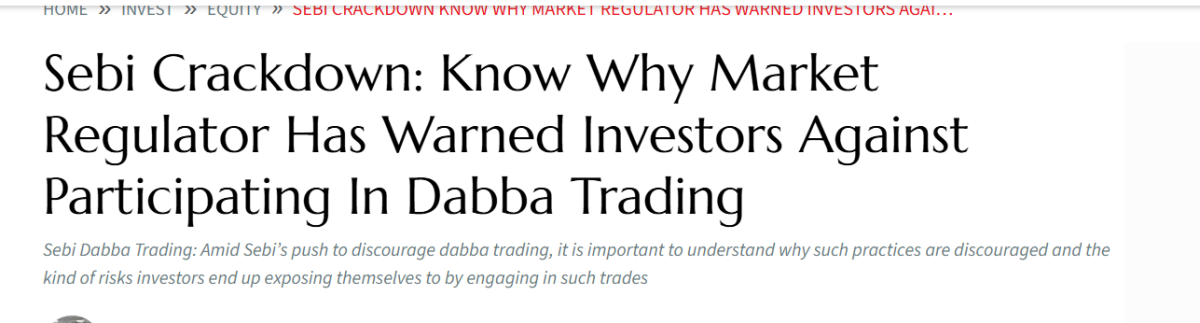
- SEBI publicly stated that dabba trading is illegal, carries high financial risk, and has no investor protection at all. Even ads promoting dabba trading were flagged as “dangerous”.
- NSE issued its own warning, saying unregistered groups operating dabba rings pose a severe fraud risk and often target “close friends and traders who trust each other”.

Dabba Trading Scams
Let’s talk about what’s happening across India because the complaints are becoming louder and scarier.
Scams are spreading through:
- Telegram/WhatsApp groups
- Fake trading apps
- Private UPI networks
- Personal references
- “Guaranteed profit” schemes
People are losing savings, salaries, and years of financial stability. Below are real cases that show how deep this runs.
Case 1: Mumbai Flat Busted: 3 Arrested
Police busted a full-fledged dabba trading setup operating from a Mumbai flat.
Inside, they found multiple computer terminals, fake trading software, cash records, and logs of hundreds of victims
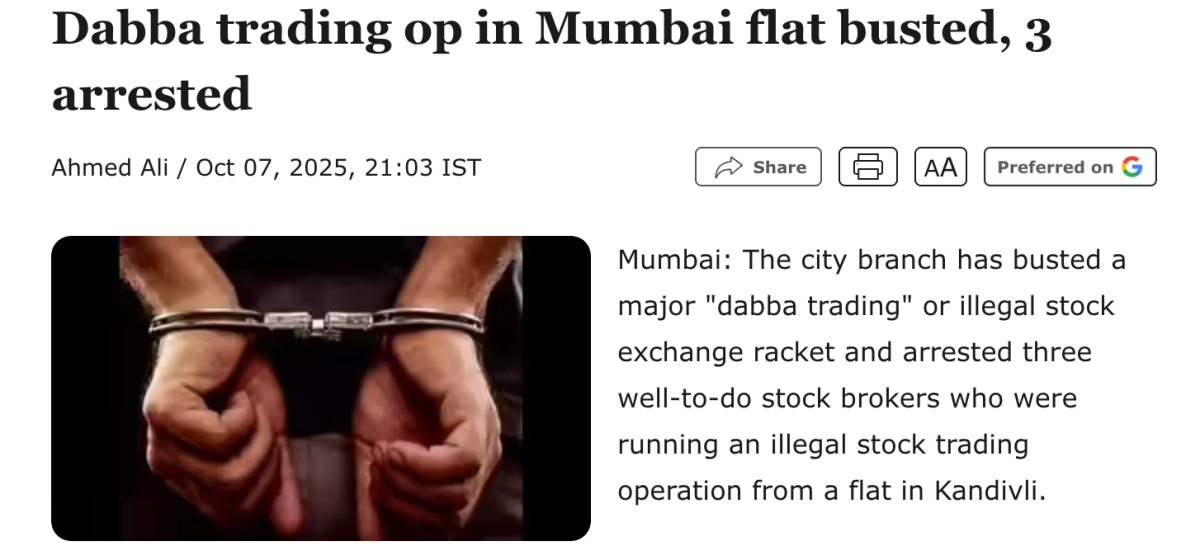
Operators were running “private trades” and collecting money from unsuspecting retail traders who believed they were investing in the real market.
The lack of regulation means you are at the mercy of the operator. When the police knock, or the operator vanishes, your capital is gone. Always stick to SEBI-registered brokers to ensure your hard-earned money stays safe.
Case 2: Noida Man Loses ₹64 Lakh in Illegal Stock Scheme
A man from Noida was lured into what appeared to be a professional trading service. They promised daily profits, fast payouts, and expert-run trades.
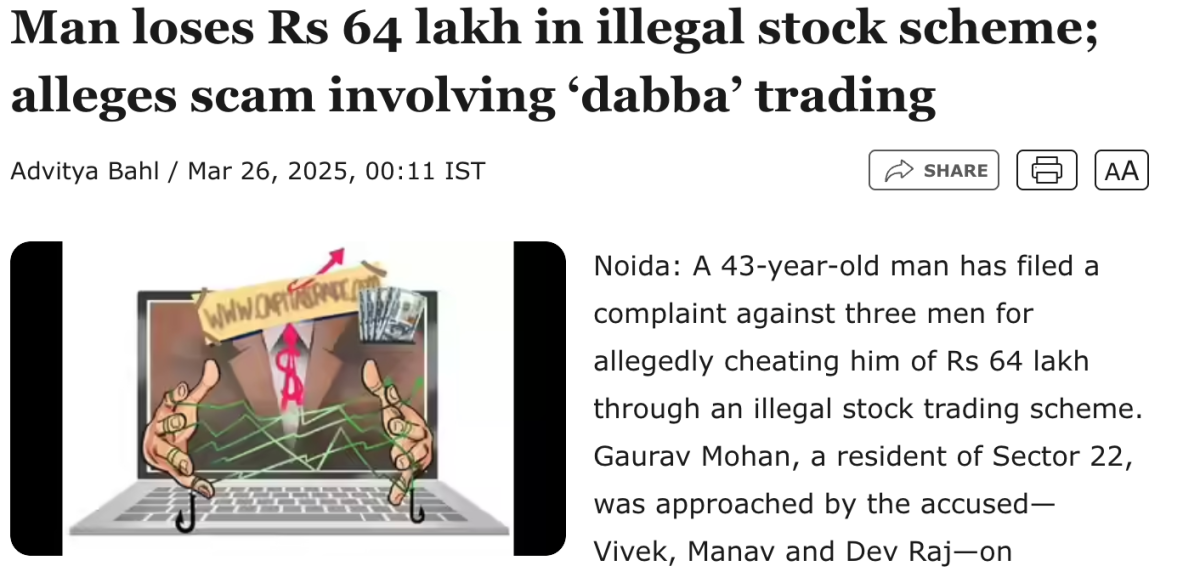
He deposited money in multiple transactions. When he asked for withdrawal, they stopped responding. His total loss: ₹64 lakh.
In this case, the police confirmed the accused had no licenses. Moreover, they were operating entirely outside the law. This indicates a total lack of safety for your money.
The Noida dabba trading scam is a tragic example of financial fraud. It shows that even “verified-looking” apps can be total fakes. The biggest lesson here is to always check SEBI registrations.
How to Report Dabba Trading?
If you have lost money or suspect that you were involved in a dabba trading setup, it’s important not to stay silent.
Prompt reporting increases the chances of action and helps prevent others from being affected.
Here are the steps you can take:
- File a complaint in cyber crime:
- File a complaint on the National Cyber Crime Reporting Portal.
- Select “Financial Fraud” and upload all supporting evidence, including screenshots, chat records, UPI or bank transaction proofs, app details, and website links.
- After submission, note down the complaint number for follow-up.
- Approach the Nearest Cyber Police Station:
- Visit your nearest cyber police station and file an FIR.
- FIRs help authorities trace operators, shell accounts, payment routes, and digital infrastructure used in dabba trading operations.
- File a Complaint with SEBI:
- If the platform or individual claimed to provide trading access, investment advice, or brokerage-like services, file a complaint on SEBI’s SCORES portal.
- This helps SEBI take regulatory action against unregistered and illegal market participants.
- Report to the MCX (Multi-Commodity Exchange):
- If the activity involves commodities trading or MCX-linked contracts, submit a complaint through the MCX Investor Grievance / Reporting Portal.
- MCX collects information on illegal and off-market trading activities and forwards credible cases to regulators and enforcement agencies.
Need Help?
If you’re confused, overwhelmed, or scared after losing money, you’re not alone. But dabba operators thrive on that silence.
Register with us, and we can help you:
- Draft the complaint properly
- Organise your evidence
- Understand which authority to report to
- Track your case step-by-step
Support matters. And you don’t have to fight this alone.
Conclusion
Dabba trading is illegal, unregulated, and dangerous. If someone offers you a “better version” of the stock market, walk away.
If an app promises zero tax, zero SEBI issues, instant returns, run.
Real trading happens on NSE, BSE, through SEBI-registered brokers. Everything else is a gamble where the house always wins, and you always lose.