

Quick Summary
Farida Mansuri (name changed), a first time options trader from Belagavi, lost about ₹25 lakh after a research analyst firm collected fees before consent, directed her trades over WhatsApp, and kept promising recovery. Her claim of ₹26,60,000, covering fees and trading loss, went through conciliation and then arbitration on the SMART ODR portal. The Tribunal ordered a full fee refund of ₹1,51,000 and half the net trading loss, totalling ₹14,64,371 with interest, about 55 percent of the claim.
What if the firm that promised to win your money back was the one that cost you ₹25 lakh?
Farida Mansuri (name changed) is from Belagavi, Karnataka. She had never traded options.
Within months, her account had lost a sum she could not explain to her family.
That is what happened to one family, and an arbitration award against a research analyst for options trading losses brought a large part of it back.
Here is how it unfolded.
How a Recovery Promise Led to ₹25 Lakh in Options Losses?
A relationship manager from a research analyst firm called Farida.
He said the firm could generate profits and recover any losses she had suffered.
On that promise, she paid ₹50,000 as a first service fee.
More fee demands followed, and her payments reached about ₹1,60,000.
Small First Profit Used to Build Client Trust
The first trade the firm gave her made a small profit. It did its job.
She believed the firm knew what it was doing.
The next trades lost heavily.
Each time, she was told the loss would be recovered if she added capital and raised her quantity, sometimes up to a thousand units.
Options Trading Advice Without Risk Profiling or Disclosures
Farida had told the firm plainly that she knew nothing about options. She was advised to trade them anyway.
No risk profiling was done. No risk disclosure was given.
No stop loss came with the calls, and she was told to hold even as the account sank.
Anyone in this position can start a complaint against research analyst with the chat record as evidence.
Profit Screenshots Shared Without SEBI Verification
To win her trust, the firm shared screenshots of large profits said to belong to other clients.
These were sent before she paid anything.
SEBI’s advertisement code bars references to past performance unless an approved agency verifies them.
None of these screenshots carried any warning or verification.
WhatsApp-Only Advice and Missing Client Record Keeping
All trades, advice, and fee instructions ran on WhatsApp alone.
No email trail and no recorded advisory file existed.
Records of client interactions must be kept for five years, and a dispute extends that period. A
firm running only on chat threads leaves its client holding the only copy.
₹25 Lakh Net Loss, Margin Force Closures, and Pledged Gold
Farida’s net losses came to about ₹25,00,000, set off against her own gains.
Her account was force closed by her broker for want of margin on three separate days.
By then she had also pledged gold to raise money for the account.
Directions to add and enlarge positions kept arriving through all of it.
Personal Trade Directions: Where Research Analysts Cross SEBI Rules?
The firm’s messages asked how much fund she had.
Then they named a contract, a lot size, an entry, and an exit to fit that amount.
That is advice for one client’s own portfolio.
Research analysts may publish research. They may not run a client’s trades.
Building the Arbitration Claim Through SMART ODR
Conciliation did not settle the matter, so the dispute moved to arbitration. We represented the family through every stage, from the claim to the hearing.
Step 1: Proving the Research Analyst Fee Was Collected Before Consent
The first payments were dated against the date the terms were first sent.
The terms were emailed after the money had moved, and nobody ever signed them.
Step 2: Proving the Calls Were Personal Investment Advice
We set the dated WhatsApp messages in front of the Tribunal, showing quantities, averaging, and instructions to hold, all tied to her own funds.
Step 3: Placing Assured Recovery Promises on Record
Messages promising that her loss would be covered in days were quoted in full.
They sat against the firm’s own written rule that no returns can be assured.
Step 4: Demanding Research Reports and Interaction Records
We asked for research reports, dispatch records, and records of interaction.
The firm produced none at any stage, and the Tribunal drew an adverse inference.
Step 5: Holding the Firm Liable for Its Employee’s Promises
The relationship manager collected the fees and made the promises in the course of the firm’s business.
We argued the firm was bound by what he said.
Step 6: Defending Commodity Derivative Losses Before the Tribunal
Part of her loss was in gold and silver.
The firm argued commodities were outside the forum, and we showed that commodity derivatives are securities.
How the Arbitration Tribunal Reasoned?
The Tribunal rejected the firm’s objection on commodities.
Every commodity position in her broker’s statement was an exchange traded futures or options contract.
It held that consent came late, since the terms were sent after the fee was taken.
It held that a contract can exist by conduct, but that does not cure a breach of the consent rule.
The Tribunal Ordered a Full ₹1,51,000 Fee Refund
The firm had collected the entire yearly fee ceiling within four days, against an invoice running fifteen months.
The Tribunal found the advance fee exceeded what the firm’s own terms allowed.
The line saying payments were non refundable was held void.
The Tribunal ordered back the whole fee of ₹1,51,000, not just a share for the unexpired period.
Why the Tribunal Awarded Half the Trading Loss?
The firm argued it earned no brokerage, so it should not answer for losses. The Tribunal rejected this.
It said a wrongdoer’s gain is not a test for liability.
But it also found that Farida placed every trade herself and kept adding funds, so it split the loss equally.
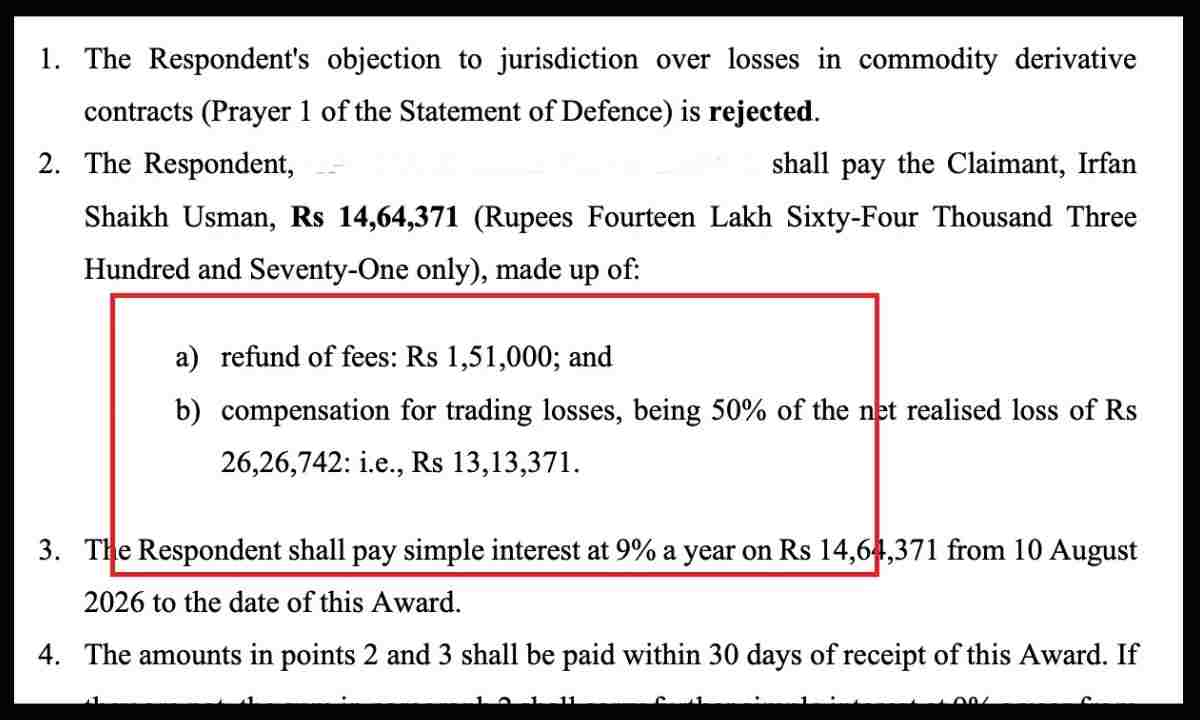
She was awarded half of the net loss of ₹26,26,742, which is ₹13,13,371.
Final Arbitration Award of ₹14,64,371 With Interest
The award came to ₹14,64,371, made of the ₹1,51,000 fee refund and ₹13,13,371 as half the net loss. Interest at 9 percent a year runs from the date of the claim.
Of her ₹26,60,000 claim, the award covers about 55 percent. The Tribunal also directed a copy of the award to the market regulators.
Facing a Loss Of Lakhs After A Research Analyst’s Promises? Our Team Can Help
The fee, the promises, and the missing research reports can all be argued.
If you have the chats and statements, Register with us and we will tell you which forum fits your case.
Conclusion
This case shows what arbitration can do when the facts are laid out in order.
The fee came back in full, because the firm had taken it before consent and charged for fifteen months in four days.
A large part of the loss came back too, because the firm directed the trades and promised recovery.
It also shows why an award is not a full refund.
The Tribunal weighed her own part, since she placed every trade and kept adding funds.
Hence half the loss was awarded, not all of it.
Honest expectations help families plan, and we share them from the start.
Arbitration also takes patience.
Payment is due within a set period after the award, and our team keeps tracking it.
If a notice to your own firm stalls, the Smart ODR complaint portal is where conciliation begins, and arbitration can follow.
Report. Recover. Stay Fraud Free.
Yes. If fees were collected before consent on the terms, an arbitrator can order the whole fee back. Commodity derivatives are securities under the law. Futures and options on exchange traded commodities can be claimed in the same forum. The Tribunal found the firm’s directions caused the loss. But the client placed every trade, so responsibility was split equally. No. A wrongdoer’s gain is not a test for liability. The Tribunal held that the absence of brokerage does not excuse the breach. The award sets a payment window after receipt, with interest if the firm delays. Keep records of every payment received.Frequently Asked Questions





 Add us as a preferred source on Google »