

Quick Summary
Md Tousif Uddin, an investor from Birbhum, West Bengal, won ₹15,57,000 in NSE arbitration against Aurostar Investment Advisory Private Limited. The tribunal found the firm gave options-trading advice without valid risk profiling, ignored the investor’s stated risk limits, and pushed a 40% profit-sharing arrangement paid in cash or through third-party accounts to bypass its SEBI fee cap of ₹1,47,500. The award covers the investor’s ₹14,10,000 trading loss plus a full refund of his subscription fee, with 15% interest (18% if payment is delayed).
An Aurostar Investment Advisory complaint ended in a decisive arbitration win for the investor, with the tribunal exposing not just reckless advice but a profit-sharing scheme that had no basis in SEBI regulations. The award was signed on 14 January 2025.
The complainant was Md Tousif Uddin, an investor from Bolpur, Birbhum, West Bengal. He took advisory services from Aurostar Investment Advisory Private Limited, based in Allahabad. What started as a low-risk monthly package escalated, through a mix of assured returns, cash demands, and a proposed 40% profit-sharing arrangement, into a single BANKNIFTY options trade that wiped out most of his capital.
He ended up holding 6,120 quantities of a BANKNIFTY Call Option that expired worthless, a loss of ₹14,10,000 on that trade alone. He took the matter through NSE arbitration, restricting his claim to the single trade plus his subscription fee.
Here is what the tribunal decided and what you can learn from it.
Aurostar Investment Advisory Complaint: What the Arbitrator Found
The arbitrator, Shri Tushar Suman Thaker, went through the call recordings, WhatsApp exchanges, and the disputed Risk Profiling document on record. The findings were direct.
1. No Valid Risk Profiling Existed
The Respondent’s own representative admitted at the hearing that they may not have conducted risk profiling. The Respondent later produced an unsigned, uncountersigned document with no proof they had ever sent it to the investor. The tribunal held that advice given without valid risk profiling under the SEBI (Investment Advisers) Regulations, 2013 was neither valid nor sustainable.
2. The Trade Contradicted The Investor’s Own Risk Profile
Even taking Aurostar’s disputed risk profile at face value, it capped the investor’s proposed investment at ₹1–3 lakh with a 1–3 year horizon. Advising him into a 6,120-quantity weekly-expiry options position was, in the tribunal’s words, reckless and dangerous, with no rational basis.
3. A Profit-Sharing Scheme Was Proposed Outside Any Agreement
Voice recordings captured an executive first asking for a flat ₹5,00,000 cash payment to chase ₹25,00,000 in profit, then pivoting to a 50% profit-share offer, negotiated down to 40%. No such profit-sharing structure existed in the investor’s actual agreement with Aurostar.
4. Payments Were Routed to Avoid The Fee Cap
The signed agreement capped annual charges at ₹1,47,500. The investor had already paid that in full. To collect more without appearing to breach the fee cap, the executive suggested cash payments or transfers from a third party’s account, such as the investor’s wife, manager, or “anyone else.” A new contract was issued in that person’s name while the investor’s own email address and phone number remained on the account.
3. Assured Returns and Manipulation Claims Being Made
Executives told the investor that recommending the same trade to other clients would push up the contract’s market price. They also assured him they would recover his losses if he kept paying. Both assurances amounted to prohibited inducements under SEBI’s Master Circular.
Why the Profit-Sharing Demand Mattered So Much in This Complaint
The 40% profit-sharing offer did more than add a claim; it exposed the whole pattern.
A SEBI-registered investment adviser has one legitimate fee structure: whatever is documented in the client agreement, subject to the regulatory ceiling. The moment an executive asks you to pay a profit share in cash or into someone else’s bank account, the arrangement falls outside SEBI’s rules, regardless of the returns promised.
That is precisely what made this case hard to defend. The Respondent’s own agreement set an annual fee cap of ₹1,47,500. The investor paid it in full. The Respondent demanded every rupee after that point outside the contract, whether as a profit share, a “special offer,” or a recovery fee.
The recordings proved those demands.
The tribunal ordered the fee refunded on this basis, and then added compensation for the loss caused by advice that had no valid risk profiling behind it.
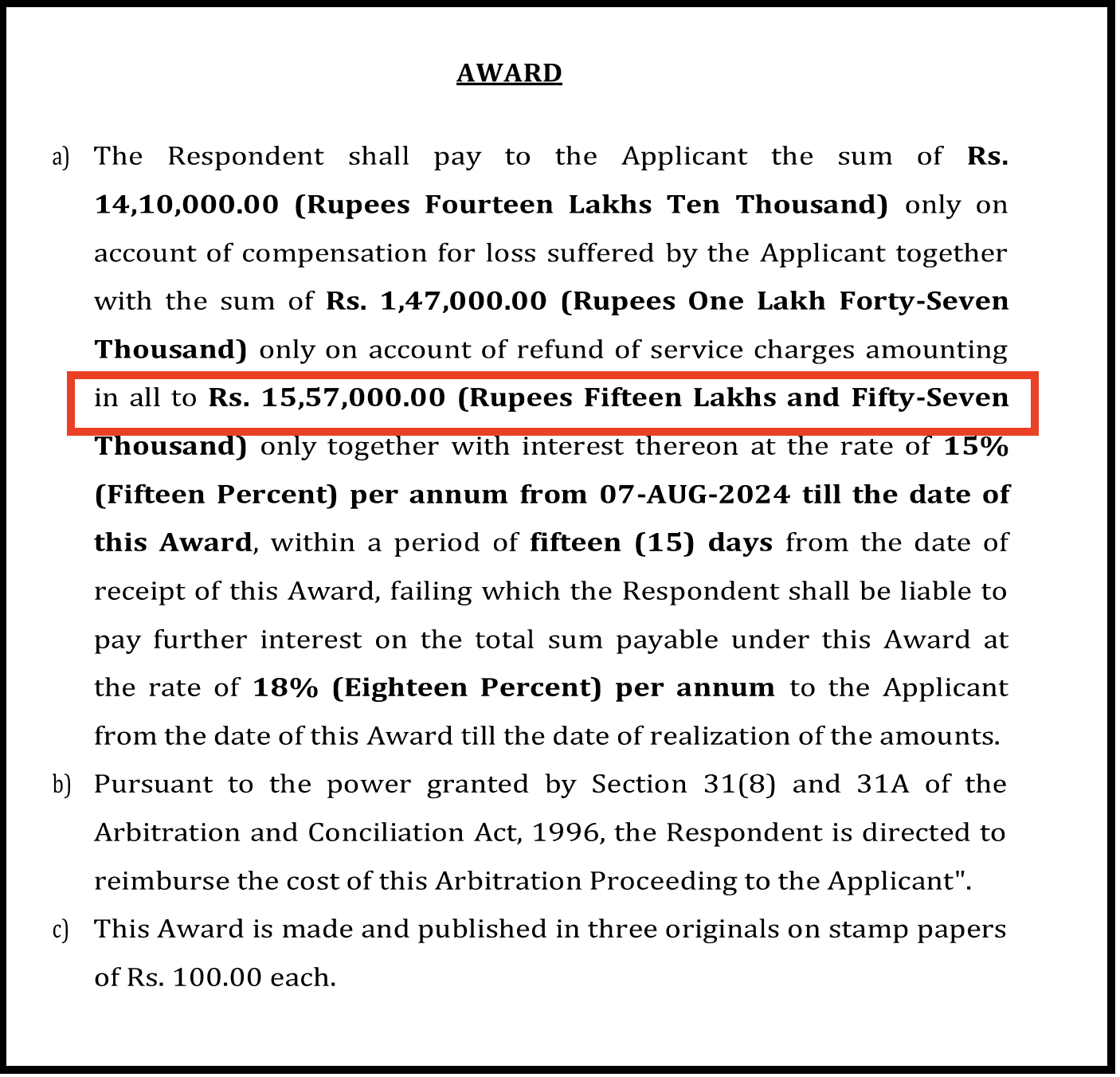
Aurostar Investment Advisory Complaint: The Award in Full
The tribunal passed a clear award in the investor’s favour.
| Detail | Value |
|---|---|
| Matter number | NSE-IA-2024-09-537449 |
| Respondent | Aurostar Investment Advisory Private Limited |
| Compensation for trade loss | ₹14,10,000 |
| Refund of service charges | ₹1,47,000 |
| Total awarded | ₹15,57,000 |
| Interest (till date of award) | 15% per annum from 07-Aug-2024 |
| Default interest (if unpaid within 15 days) | 18% per annum |
| Arbitration cost | Reimbursable to the complainant |
The award is a public arbitral record. The entity is named in it, and the finding is on record.
What a Research Analyst or Investment Adviser Cannot Do Under SEBI Rules
This case turned on conduct SEBI rules clearly prohibit. Knowing these limits helps you recognise a breach.
An investment adviser or research analyst cannot:
- Propose a profit-sharing arrangement instead of a documented, capped advisory fee
- Ask for payment in cash, or from an account that isn’t the client’s own
- Skip risk profiling, or advise trades that ignore the client’s stated risk profile
- Assure or guarantee profits, or promise that losses will be “recovered”
- Claim that pooling client trades will move market prices in the client’s favour
- Issue a fresh contract in a third party’s name to route around fee limits
The Aurostar matter shows each of these becoming part of a single, connected pattern, and each one independently strengthened the complaint.
Pushed into a profit-sharing scheme or asked to pay from someone else’s account?
We check the payment trail against your actual agreement, match the advice given to your documented risk profile, and build the complaint on what SEBI rules actually allow.
Register with us for a free consultation.
How to Act on an Advisory Complaint Like This
If your situation resembles the Aurostar matter, a clear path exists. These steps mirror how this case moved.
Step 1: Line up every payment against your agreement
Total what you’ve paid and compare it to the fee structure in your signed agreement. Any profit-share, cash payment, or third-party transfer outside that agreement is a strong point on its own.
Step 2: Save your voice recordings and chats
This award turned heavily on recorded calls and WhatsApp messages. Keep every call recording, chat, and offer you received, especially anything proposing cash or a profit-share.
Step 3: Ask for your risk profiling document
If you were never shown a signed risk profile, or the trades you were pushed into don’t match the risk appetite you stated, that mismatch is central to a complaint.
Step 4: File through the proper route
A SEBI SCORES complaint starts the registered route. SMART ODR then takes it to conciliation and, if unresolved, then arbitration is the final step.
The full arbitration path is covered in our guide on the arbitration in stock market process.
Conclusion
The Aurostar Investment Advisory matter shows how far a “recovery” pitch can drift from anything SEBI permits. From a documented advisory fee to cash demands, third-party accounts, and an off-the-books 40% profit share.
The arbitrator found that the adviser gave advice without valid risk profiling, ignored the investor’s stated risk limits, and accompanied the advice with inducements and payment demands that breached the SEBI (Investment Advisers) Regulations, 2013.
The result: The arbitrator awarded ₹15,57,000 to the investor, with interest.
The evidence that won it was ordinary: a fee record checked against a signed agreement and recordings of what was actually asked for.
If someone asked you to share profits, pay in cash, or route money through someone else’s account, that same evidence may already be sitting on your phone.
Report. Recover. Stay Fraud Free.
Frequently Asked Questions
An investor named Md Tousif Uddin trusted Aurostar with his trading decisions. Instead of steady advice, he got pushed into a massive BANKNIFTY options bet. Along the way, advisors demanded cash payments, asked him to route money through his wife's account, and offered him a 40% profit-sharing deal that wasn't in his contract anywhere. He took the whole mess to NSE arbitration, and the tribunal agreed the advice broke SEBI rules from start to finish.
He walked away with ₹15,57,000 total. That's his full trading loss of ₹14,10,000 plus a complete refund of the ₹1,47,000 he'd paid in advisory fees. On top of that, interest keeps adding up at 15% a year from August 2024, and it climbs to 18% if Aurostar drags its feet on paying.
Because it gave the tribunal something concrete to point to. His agreement capped Aurostar's fee at ₹1,47,500 a year, and he'd already paid that in full. So every rupee they asked for afterward, whether framed as a profit-share or a recovery fee, had zero legal basis. You don't need to guess at intentions when the number itself proves the breach.
Absolutely, and this case is proof it works. SEBI requires advisors to match their advice to your actual risk profile, not what's convenient for them. If you told them you wanted low-risk investments and they still put you into volatile options trades, that mismatch alone can carry a complaint. Start with SEBI SCORES, then it moves to SMART ODR for conciliation and arbitration.
Nothing fancy, honestly. He kept his call recordings, his WhatsApp messages, and a clear record of every payment he'd made. That let him show exactly when advisors promised guaranteed returns, asked for cash, and pushed him past his own stated risk limits. Ordinary evidence, saved consistently, is often all it takes.





 Add us as a preferred source on Google »

