Choosing a broker like Axis Securities usually feels like a straightforward decision, especially when the brand already carries a sense of trust and familiarity for most investors.
What often gets overlooked at this stage is how the platform performs when something goes wrong, whether it is a delay in funds, a trading issue, or a complaint that takes time to resolve.
This is where looking at actual complaint data becomes useful, because it gives a clearer picture of investor experience beyond just features and promises.
In this blog, we will look at Axis Securities complaints in detail, including exchange complaint data, the most common types of issues reported by users, and what these patterns mean for investors.
Axis Securities Complaints Overview
Axis Securities is a full-service broker, and because it’s backed by a bank, most investors go in with a certain level of trust.
You expect things to work smoothly, not just in terms of trading, but also when it comes to support, charges, and handling your money.
But when you start looking at complaint data over a few years, you realise that the issues investors face are not always random.
They show up across common areas like trading experience, fund movement, and overall service quality.
That doesn’t mean something is fundamentally wrong with the broker, but it does tell you one important thing; understanding these patterns matters, especially if you want to avoid getting stuck in the same situations later.
Exchange Complaint Data
Looking at complaint data over multiple financial years gives a clearer picture of how investors actually experience a broker beyond just features and branding.
Instead of focusing on isolated cases, this data helps identify whether complaints remain stable, increase over time, or follow a consistent pattern.
Here is how Axis Securities has performed in terms of complaints, resolution, and arbitration over the years:
| Financial Year | Total Clients | No. of Complaints | % of Complaints | Resolved Complaints | % Resolved | Arbitration |
|---|---|---|---|---|---|---|
| 2022–23 | 1,061,214 | 384 | 0.036% | 372 | 96.87% | 5 |
| 2023–24 | 1,061,214 | 401 | 0.038% | 392 | 97.75% | 3 |
| 2024–25 | 1,188,507 | 612 | 0.051% | 612 | 100% | 1 |
| 2025–26 | 1,102,884 | 533 | 0.048% | 489 | 91.74% | 0 |
When you go through this data, a few things become clear.
Complaints increased over time and peaked in 2024-25, which shows that more investors raised issues as overall activity grew.
The complaint percentage also moved up, so the increase does not come only from a higher number of clients.
Resolution remained strong for most years and even reached 100% in 2024-25, but the drop in 2025-26 shows that maintaining the same consistency becomes more difficult as scale increases.
Arbitration cases stayed low throughout, which usually means most issues got resolved before escalation, but it also highlights why investors should act early instead of waiting.
Overall, the data shows a clear pattern, complaints grow with scale, and service consistency becomes more important as more users come in.
Types of Complaints Against Axis Securities
Looking at the number of complaints alone gives you a broad idea, but breaking them into categories helps you understand where investors actually face problems in day-to-day usage.
The data below shows the different types of complaints reported against Axis Securities over the years:
| Complaint Type | Description | 2022–23 | 2023–24 | 2024–25 | 2025–26 |
|---|---|---|---|---|---|
| Type I | Non-receipt of funds / securities | 22 | 19 | 28 | 24 |
| Type III | Charges / brokerage related complaints | 6 | 9 | 21 | 14 |
| Type IV | Trading related complaints | 142 | 151 | 278 | 231 |
| Type V | Funds / payout related complaints | 88 | 102 | 221 | 189 |
| Type VIII | Technical / platform issues | 5 | 7 | 26 | 18 |
| Type IX | Others / miscellaneous | 121 | 113 | 218 | 175 |
When you read this closely, a pattern becomes obvious.
Trading-related complaints form the largest share every year, and in some cases, this category may also include serious concerns such as Axis Securities unauthorised trading, where investors question trades executed in their accounts.
Funds and payout issues also appear consistently in high numbers. Since this involves actual money movement, even small delays or confusion create immediate concern for investors.
Charges-related complaints are lower in comparison, but they still show up every year, which tells you that cost clarity remains an area where investors feel uncertain, especially in cases related to Axis Securities excess charges, where users often struggle to understand how fees are applied.
Technical issues appear in smaller numbers, but the increase over time shows that platform performance cannot be ignored, especially during active market hours.
So instead of random problems, the complaints stay concentrated around a few key areas; trading experience, fund handling, and service clarity.
And once you understand this, you know exactly where you need to stay alert as an investor.
Axis Securities Reviews
Looking at complaint data shows one side of the picture, but user reviews reveal how these issues affect investors in real situations.
Many of these reviews do not highlight one major problem, but they consistently point towards gaps in platform experience, execution, and communication.
1. Platform Experience & Feature Gaps
Some users raise concerns about the overall app experience, especially around missing features and confusion between multiple applications.
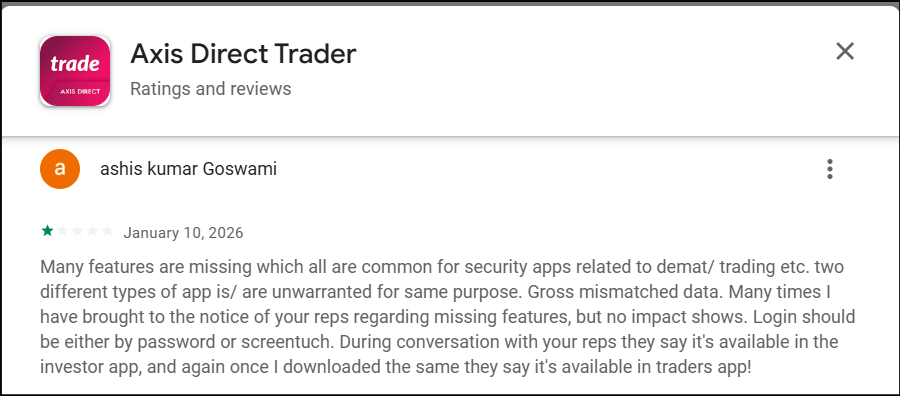
In this review, the user highlights missing features, inconsistent data, and confusion between different apps.
The issue goes beyond features and directly affects usability and clarity.
When a platform forces users to switch between apps or provides inconsistent information, it creates confusion and reduces overall efficiency.
2. Transaction Handling & Charges
Users also raise concerns about how the platform handles transactions, especially when buying and selling happen on the same day.
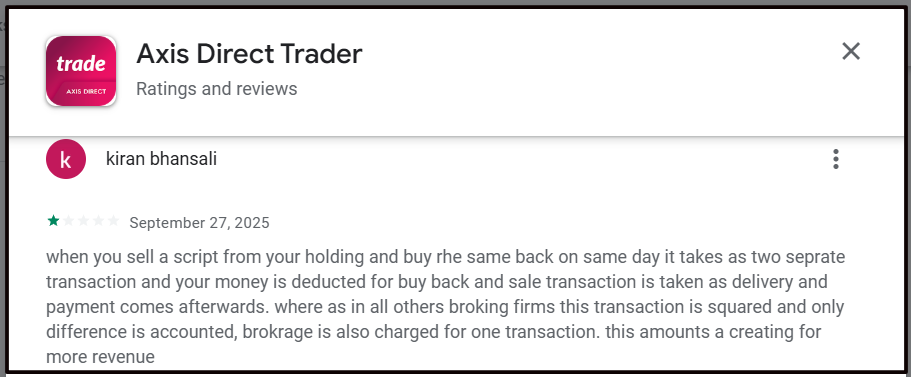
In this case, the user explains that the platform treats same-day buy and sell transactions as separate entries, which leads to additional charges and delayed settlement.
This approach creates confusion, especially when investors compare it with other brokers that adjust such transactions more efficiently.
Even if the system follows internal rules, the lack of clarity affects user trust.
3. Real-Time Data & IPO Experience
Some users point out issues related to IPO allotments and real-time price updates.
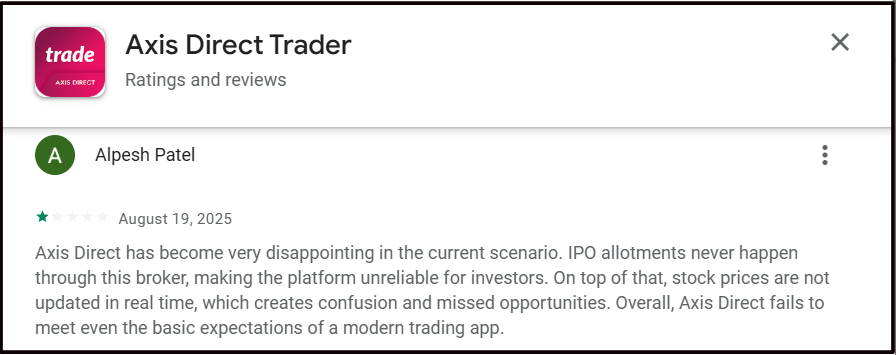
In this review, the user expresses dissatisfaction with IPO allotments and highlights delays in stock price updates.
Investors rely on real-time data to make decisions.
When the platform does not update prices accurately or creates uncertainty around IPO participation, it directly impacts trust and usability.
These reviews highlight recurring concerns around platform experience, transaction clarity, and data reliability.
For investors, this shows why it is important to evaluate how a broker performs in everyday usage instead of relying only on features or brand value.
When To Take Action Against Brokers?
Most investors don’t take action at the right time.
They notice an issue, follow up once or twice, and then wait, assuming the broker will eventually fix it. In many cases, that delay makes the situation harder to resolve.
You should take action the moment you notice clear warning signs like:
- Your funds do not get credited within the expected timeline after selling shares or placing a withdrawal request, especially when the delay goes beyond standard settlement periods.
- You see repeated or unexplained charges in your account, and the broker does not provide a clear explanation even after you raise the concern.
- Your trades face execution issues, such as delays, incorrect orders, difficulty in placing or modifying trades, or situations that resemble unauthorised trading, which directly affect your positions or profits.
- Support does not respond properly, gives generic replies, or keeps delaying resolution despite multiple follow-ups from your side.
- Your contract notes, ledger, or account statements do not match your actual transactions, which can indicate deeper issues if left unchecked.
Each of these situations signals that you should not keep waiting or assuming things will get resolved automatically.
Acting early helps you stay in control, keeps your documentation strong, and improves your chances of resolving the issue before it escalates further.
How to File a Complaint Against a Stockbroker?
When you face an issue with Axis Securities or any broker, following a clear step-by-step process makes a big difference.
It helps you stay organised and increases the chances of getting your issue resolved without unnecessary delays.
Step 1: Collect Proof
Take screenshots, save transaction details, record all calls from the broker, save contract notes.
Keeping a comprehensive record of all communications and transactions ensures that you have sufficient proof to support your case if required.
Doing so makes your complaints verifiable. It also helps authorities or support teams review your issue more efficiently and take appropriate action based on clear evidence.
Step 2: Contact the Broker’s Support
Start by raising the complaint through the broker’s official support channels like their app, website, or email.
Clearly explain the issue, mention timelines, and attach supporting documents such as screenshots, contract notes, or account statements so there is no confusion from the beginning.
Step 3: Lodge a Complaint in SCORES
In the case that the broker is unable to solve your issue, file a complaint in SEBI under the SCORES platform. This platform formalises your grievance and ensures that it is officially recorded.
SCORES makes complaints official, and your broker will have to reply on the record.
This not only creates accountability but also provides a clear paper trail, helping regulators monitor the resolution process and take
Step 4: Arbitration in the Stock Exchange
If the issue involves financial loss and still does not get resolved, you can proceed with arbitration. This is a formal dispute resolution process and usually acts as the final step.
Following these steps in order keeps your complaint strong and improves your chances of getting a proper resolution.
Need Help?
Dealing with a complaint against a broker is not always straightforward, especially when you are not sure what exactly went wrong or how to present it properly.
Many investors reach a point where they know something is off, but they struggle to structure their complaint or escalate it in the right way, which slows down the entire process.
We work with investors to review their account activity, identify gaps or discrepancies, and build a complaint that clearly explains the issue with proper supporting documents.
We also guide you through each step of escalation so your case does not get ignored or delayed unnecessarily.
If your complaint is stuck or you are not getting a proper response, register with us today to take your case forward in a structured and effective way.
Conclusion
Axis Securities, like any large broker, handles a wide base of investors, and complaint data shows that issues do come up across areas like trading experience, fund movement, and overall service.
The data does not point to any single major concern, but it clearly shows that these issues are not isolated and tend to follow certain patterns over time.
For investors, the takeaway is simple; stay aware of how your account operates, keep track of transactions, and don’t ignore early signs of a problem.
Taking timely action and following the right process can make a significant difference in how quickly and effectively your issue gets resolved.