
You paid for what they called education. You sat through the sessions, followed the calls, and trusted the process. Then the losses started piling up, and the doubt crept in.
You began asking yourself whether what they were doing was even legal. The question that keeps coming back is simple and painful: can trading academies give stock tips legally?
You deserve a straight answer, not more confusion. What happened to you may not have been an accident, and it may not have been your fault.
In this blog, you will learn exactly what the law says, see real SEBI cases against trading educators, understand the risks you faced, and find out what you can do right now.
Can Trading Academies Give Stock Tips Legally or Not?
The short answer is no, not without proper SEBI registration.
A trading academy can teach you how markets work, how to read charts, how to manage risk, and how to think like a trader.
That is education, and there is nothing wrong with it. But the problem arises when they start saying things like:
- Buy this stock as it is expected to move sharply.
- This is a high conviction trade. Do not miss this opportunity.
- Enter around this price and book profits near this target.
- Set a stop-loss at this level and hold your position.
- Members of our premium group received this recommendation first.
- Follow this trade exactly as shared.
- We will send daily stock calls directly to your WhatsApp.
At that point, the conversation is no longer just about learning how markets work. It starts looking much closer to a recommendation about what action you should take with your money.
Under the SEBI (Investment Advisers) Regulations, 2013, anyone offering personalised investment advice for a fee must be registered with SEBI as an Investment Adviser.
So, no registration means no legal right to give you stock tips. It does not matter whether they call it a course, a mentorship, a premium channel, or a live session.
The nature of what is being delivered is what matters, not what it is labelled.
If your trading academy was sending you specific calls and charging you for it, the question you need to ask is simple:
Were they registered? If not, they were operating illegally, and you have every right to question what happened to your money.
Real Cases Where SEBI Took Action Against Trading Educators
If you are wondering whether regulators actually take action when trading academies start giving stock recommendations, the answer is yes.
These cases show that stock tips given in the name of education can attract serious regulatory scrutiny.
Stock recommendations were not the only issue involved, but they formed an important part of the concerns identified by SEBI.
If you have ever received stock calls through a course, webinar, Telegram channel, or WhatsApp group, these cases may feel surprisingly familiar.
Case 1: When “Education” Was Just a Cover for Paid Stock Calls
Think about how most people join a trading academy.
You pay because you want to learn. You expect lessons, strategies, and market knowledge.
Instead, imagine receiving stock calls on Telegram along with promises such as “100% profit guaranteed, otherwise full refund” and “0% risk.”
This is exactly how Yash Trading Academy operated and collected money from investors in violation of SEBI regulations.
According to SEBI, Yash Garg was running multiple Telegram channels through Yash Trading Academy where stock recommendations were allegedly being shared despite not being registered with SEBI.
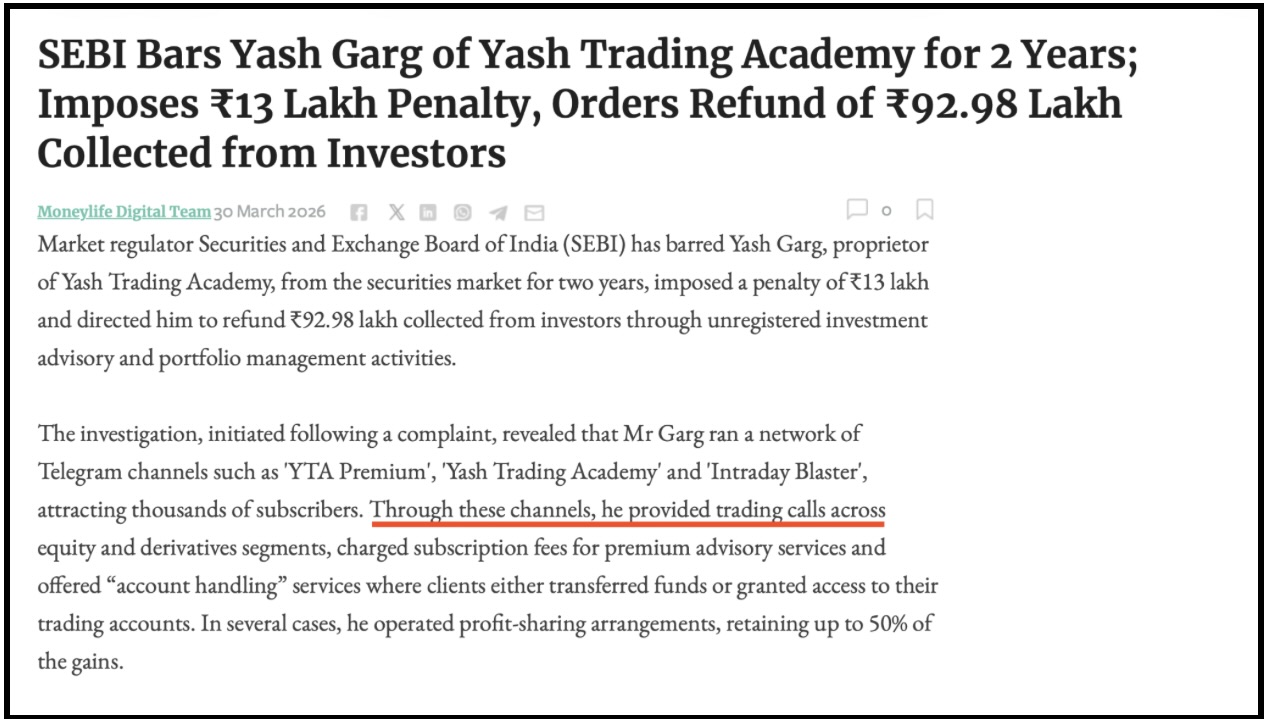
Yash Garg was offering paid trading calls, specific buy/sell recommendations on stocks and derivatives, to subscribers across his Telegram channels. He even charged the customers for these stock tips.
Apart from this, there were various violations being done such as profit sharing, account handling, fake registration claim, portfolio management, etc.
SEBI found that nearly ₹93 lakh had been collected from investors.
In March 2026, SEBI imposed a ₹16 lakh penalty, ordered a refund of ₹92,98,405, and barred him from the securities market for at least two years.
The biggest red flag here was not just the promise of profits but the fact that a trading academy had moved beyond teaching and started telling people what stocks to buy.
Case 2: ₹601 Crore Built on Live Stock Calls Disguised as Lessons
Now imagine joining a trading programme that promises to help you become a better trader.
During the course, you begin seeing messages such as “Buy PFC near 160, SL clear, can make new highs” and “ITC, fill it, shut it, forget it.”
At that point, are you really being taught how to analyse a stock or are you simply following somebody else’s recommendation?
That question became important in SEBI’s case involving Avadhut Sathe. The regulator found that more than 3.37 lakh participants had enrolled in programmes that generated over ₹601 crore.
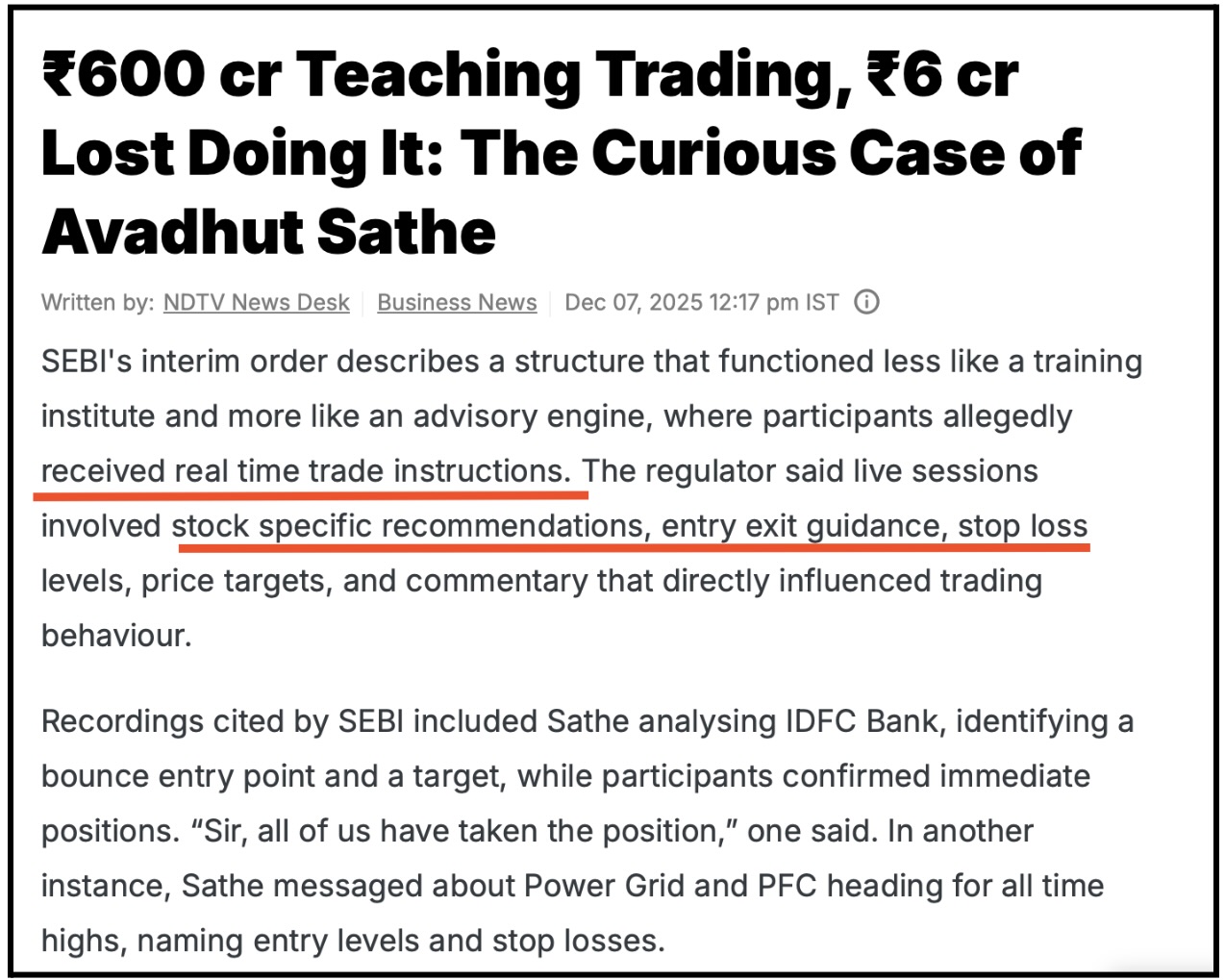
According to SEBI, stock specific recommendations, entry prices, and trading guidance were regularly shared with participants despite the absence of SEBI registration.
The regulator eventually froze accounts, halted operations, and moved to impound ₹546 crore linked to alleged unregistered advisory activities.
For you, the lesson is straightforward: When a trading academy starts giving stock calls instead of teaching independent analysis, that is not something you should ignore.
It is one of the clearest warning signs that the line between education and advice may have already been crossed.
Risks of Following Unverified Stock Tips
When someone is confidently telling you the next call will recover everything, it is genuinely hard to walk away.
These platforms are built to keep you hooked. But the damage they cause goes much deeper than a single bad trade.
- Financial losses pile up faster when you are acting on someone else’s call without understanding the reasoning behind it.
- Misleading claims about success rates and guaranteed returns push you to take on risks your portfolio was never built to handle.
- Zero accountability means that when things go wrong, there is no SEBI oversight, no legal obligation, and no one to answer for what happened.
- Emotional decision-making takes over when you are chasing recovery on a tip that already cost you money.
- Dependency replaces learning, and over time you end up knowing less about trading than when you first started.
- Recovering losses becomes difficult when fees were collected in personal accounts, and documentation is either missing or scattered.
Understanding these risks is not about making you feel worse. It is about helping you recognise the pattern so you can break out of it and take back control.
What to Check Before You Take a Stock Tip?
Before you act on the next call from any trading platform, stop for a moment. Most investors who got hurt were not careless.
They were simply never told what questions to ask.
These three questions can save you from repeating a very costly mistake.
- Is this person or entity registered with SEBI as an Investment Adviser or Research Analyst?
- Are they making any promises about fixed returns, guaranteed profits, or a specific success rate?
- If this advice causes me a loss, is there any legal mechanism through which I can hold them accountable?
Every legitimate advisory service in India should be able to answer the first question with a verifiable SEBI registration number.
If they cannot, the second and third questions do not even need to be asked.
Protect your money before you place the trade, not after.
How to File a Complaint Against a Misleading Trading Academy?
If you believe a trading academy gave you stock advice without SEBI registration and caused you financial harm, your complaint can make a real difference.
Not just for you, but for every other investor who went through the same thing and never spoke up.
Here is exactly how to report:
Step 1: Collect Evidence
Save every screenshot, payment receipt, Telegram or WhatsApp message, and course material that contains stock recommendations. Arrange everything in order so your complaint tells a clear story.
Step 2: Draft a Proper Complaint
Write a factual account of what happened. Include the academy’s name, the fees you paid, the type of advice you received, specific dates, and the losses you suffered. Keep the tone factual and avoid emotional language.
Step 3: Submit a Complaint on SEBI SCORES Portal
Since most misleading trading academies operate without a valid SEBI registration, you cannot file a standard complaint against them on the SCORES portal. Instead, you must report them directly to the regulator via email.
Compile your drafted complaint along with all your gathered evidence, and email it directly to SEBI.
Be sure to upload everything clearly, organised, well-documented email complaints carry significantly more weight and help regulators take swift enforcement action.
Need Help?
If a trading academy has given stock recommendations disguised as education and you suffered losses because of those recommendations, do not stay silent.
Register with us and explore the legal options available to protect your rights. Tell us what happened and we will help you in the process of recovery.
Contact now & we’ll get back to you within 24 hours.
Learning Should Empower You, Not Make You Dependent on Tips
The difference between genuine education and disguised advisory is not always easy to spot at the moment. But looking back, the pattern is usually clear.
Real education teaches you how markets work and builds your own ability to analyse, decide, and act.
What gets sold as education but actually delivers daily tips, entry prices, and profit guarantees is something else entirely, and it is something the law treats very seriously.
Your experience matters, and your complaint has the potential to protect others who are still inside the same system you just walked out of.
You do not need to feel embarrassed for having trusted what looked like a credible platform. You need to feel informed enough to act.
The market can still work for you, but only when you are equipped with real knowledge, not someone else’s calls.
That is the kind of learning worth investing in.
Frequently Asked Questions
1. Can a trading academy legally give stock tips?
No. Unless the academy holds the required SEBI registration, it cannot legally provide stock specific investment recommendations for a fee.
2. How do I know if a trading academy crossed the line from education to advice?
If they told you what stock to buy, when to enter, where to exit, or what profit to expect, they may have gone beyond education and into advisory activity.
3. What should I do if I lose money after following a trading academy’s stock tips?
Save all messages, payment records, and recommendations you received, then consider filing a complaint with SEBI or seeking legal guidance on your options.