
Quick Summary
SEBI’s final order dated August 28, 2026 found Debock Industries Limited and its Managing Director Mukesh Manveer Singh ran a scheme of fake preferential shares, inflated sales and purchases, and forged bank statements between FY22 and FY24.
Debock and Mukesh Manveer Singh are barred from the securities market for 7 years. Three aides face 2 to 5 year bans. Together, the order directs over ₹137 crore in disgorgement, penalty and refunded rights issue money.
A final order finds Debock Industries inflated its books with fake sales, fake preferential shares and forged bank statements to climb onto NSE’s main board, then diverted ₹49 crore of rights issue money. Twenty nine people and entities were investigated. Eleven were held responsible.
How this case started
Debock Industries Limited began life as Debock Sales and Marketing Limited, listed on the NSE Emerge platform for small companies in 2018.
SEBI’s final order says that under Managing Director Mukesh Manveer Singh, the company used a series of fictitious transactions to inflate its size on paper, until it qualified to migrate from the Emerge platform to NSE’s main board.
Once on the main board, the same pattern allegedly continued through further preferential share issues, a bonus issue and a rights issue, before SEBI stepped in.
An interim order dated August 23, 2024 first froze the market access of Debock, Mukesh Manveer Singh, promoter Sunil Kalot and Priyanka Sharma. SEBI confirmed those directions on December 11, 2024, then investigated further before issuing a show cause notice on September 15, 2025.
This final order, signed by SEBI Whole Time Member Amarjeet Singh on August 28, 2026, closes that investigation.
A fictitious share issue used to reach the main board
SEBI’s order says Debock met the eligibility criteria for migrating to NSE’s main board through a preferential issue of warrants that was fictitious in nature, meaning the money supposedly paid for those warrants never genuinely came in.
The order describes circuitous transactions where the same funds moved between the company, Sunil Kalot and Mukesh Manveer Singh in a loop, creating the appearance that preferential allottees had paid for their shares when they effectively had not.
One example the order gives: a day before money was due from allottees, ₹30 lakh moved from an individual to Debock, then from Debock to Sunil Kalot, then to Mukesh Manveer Singh, who used it to pay for the very same warrants. The same ₹30 lakh was recycled repeatedly to show a total of ₹3.28 crore in application money that never actually existed.
Sales and purchases inflated through circular transactions
The order finds that Debock inflated its sales by around 72% in FY22 and around 77% in FY23. Purchases were inflated by around 94% in both years.
This was done through circuitous transactions, where goods and money were shown moving between related and connected entities without any real underlying business, puffing up the company’s revenue and asset base on its financial statements.
These inflated numbers fed into free reserves that Debock later used to justify a bonus share issue, and they also fed into a further preferential issue of warrants in November 2023 that was converted to equity in February 2024, an issue that drew qualifications from the company’s own auditor.
Forged bank statements shown to SEBI
To back up its fictitious transactions, the order finds that Debock submitted bank statements to SEBI that did not match the company’s actual banking records.
SEBI’s order treats this as a deliberate attempt to conceal the fictitious preferential issues and the inflated sales and purchases from the regulator during its examination.
₹49.50 crore rights issue, and where the money went
In June 2023, after migrating to the main board, Debock raised ₹49.50 crore through a rights issue open to its shareholders.
The order finds that ₹49 crore of this was moved out almost immediately, first to Impex Agrotech Limited, a company where Mukesh Manveer Singh and Jyoti Choudhary are majority shareholders and which the order calls a related party of Debock.
From Impex, ₹25.07 crore was passed on to Naturo IndiaBull Limited, whose Managing Director was Gaurav Jain. From Naturo, the money was further routed to entities including Bright Trading, Arvika Shipping and Arrowship Services, some of them overseas, and booked in Naturo’s own records as advances even though these firms did no real business with it.
The order notes that around ₹14 crore of the diverted rights issue money was still lying in Impex’s account at the time the interim order was passed, and has directed Debock to recover the rest.
📸 Screenshot to use:
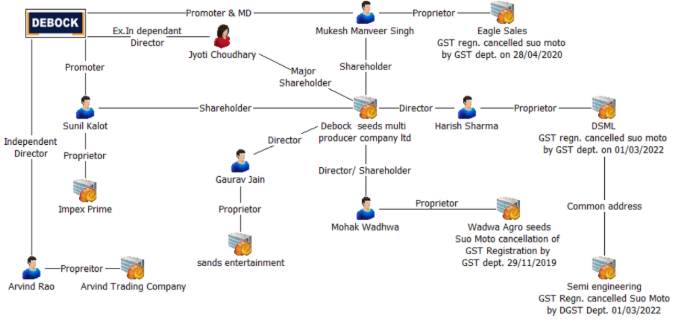
The flow chart in the order tracing the ₹49 crore rights issue diversion from Debock through Impex Agrotech to Naturo IndiaBull and onward entities (around the Role of Impex Agrotech Limited section).
The people SEBI says ran the scheme
SEBI’s order describes Mukesh Manveer Singh, the Managing Director, as the person at the helm of the entire scheme, from the fictitious preferential issue that enabled the main board migration to the diversion of the rights issue money.
Sunil Kalot, described in the order as a promoter of Debock, is found to have aided the fictitious preferential allotments. Shares issued without real consideration were transferred to him off market, and he sold them along with his own existing holding for an unlawful profit of ₹37.66 crore.
Priyanka Sharma is found to have acted as a conduit for the diversion of rights issue proceeds.
The order also examines a separate transaction where Mukesh Manveer Singh gifted shares worth ₹17.39 crore to Gaurav Jain without any payment or, as the order puts it, without natural love and affection that would explain a genuine gift. Gaurav Jain then sold these shares, and the order was unable to establish who the real beneficiary of that money was, so it holds the two of them jointly and severally liable for the ₹17.39 crore in proceeds.
What the CFO and CEO were held responsible for
Nishu Goyal was Debock’s Chief Financial Officer through FY22, FY23 and FY24. Vandana Patidar was Chief Executive Officer during FY22 before resigning in October 2022.
Listing rules require the CEO and CFO to certify to the board that a company’s financial statements are accurate and not misleading. The order finds that both signed such certifications during years in which the fictitious preferential issues, inflated sales and purchases, and the bonus issue were taking place, and holds them responsible on that basis.
The order does note this as a mitigating factor while deciding their penalty: unlike Mukesh Manveer Singh, Sunil Kalot or Gaurav Jain, neither Goyal nor Patidar is found to have personally pocketed any money from the scheme beyond their salary.
The three companies used to move the money
Impex Agrotech Limited, formerly Impex Agrotech Private Limited, is found to have acted as the vehicle through which Debock’s inflated sales and purchases were routed, and as the first stop for the diverted rights issue money. The order notes Impex filed no reply to the show cause notice.
Naturo IndiaBull Limited received ₹25.07 crore of that diverted money from Impex and passed it on further, including to entities with no real business relationship with it. Naturo also did not respond to the notice.
Avance Ventures Private Limited was a preferential allottee in the second round of share issues. The order finds it paid only ₹68 lakh of the funds it claimed to have transferred to Debock, with the rest actually funded by Debock itself in a circular arrangement, and holds that this ₹68 lakh in genuine payment was enough to establish that Avance participated in and benefited from the fraudulent allotment.
The 18 noticees SEBI let off
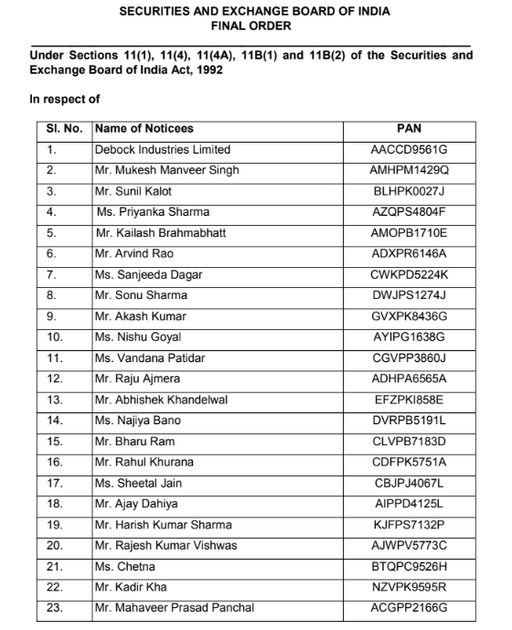
Not everyone named in the show cause notice was held liable. Five people connected to Debock’s board and management were investigated and cleared: independent directors Kailash Brahmabhatt, Arvind Rao and Sanjeeda Dagar, non executive director Sonu Sharma, and former executive director Akash Kumar.
Thirteen individuals who had subscribed to the company’s first round of preferential shares were also investigated and cleared: Raju Ajmera, Abhishek Khandelwal, Najiya Bano, Bharu Ram, Rahul Khurana, Sheetal Jain, Ajay Dahiya, Harish Kumar Sharma, Rajesh Kumar Vishwas, Chetna, Kadir Kha, Mahaveer Prasad Panchal and B Pavan Kumar Sharma.
SEBI’s order says the material on record did not show that these 18 people knew about the fraudulent design or consciously helped carry it out, even where their bank accounts or share allotments were used in the scheme. Proceedings against all of them were closed without any direction or penalty.
Is Debock Industries a SEBI registered intermediary?
No. Debock Industries is a listed company whose shares trade on NSE, not a SEBI registered intermediary such as a broker, research analyst or portfolio manager.
A company does not need a SEBI intermediary registration to list its shares. This order was passed under SEBI’s powers to protect investors and the securities market, using the PFUTP Regulations and the LODR Regulations that apply to any listed company, not under the rules that govern registered intermediaries.
What the final order actually directs
SEBI’s order under Sections 11(1), 11(4) and 11B(1) of the SEBI Act lays out a detailed set of directions.
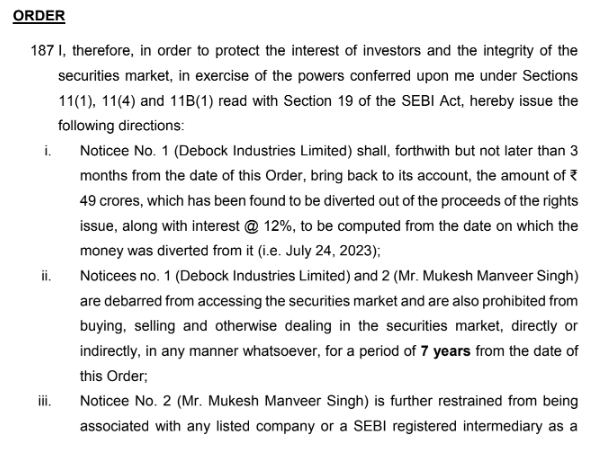
Debock Industries must bring back the ₹49 crore diverted from its rights issue, with 12% interest calculated from July 24, 2023, within 3 months of this order.
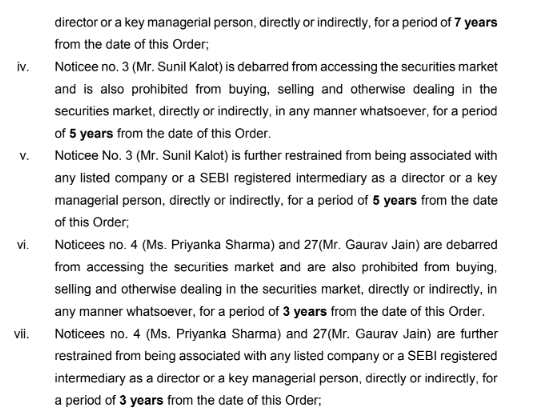
Debock Industries and Mukesh Manveer Singh are barred from accessing the securities market and from buying, selling or dealing in securities for 7 years. Mukesh Manveer Singh is also barred from holding a director or key managerial position at any listed company or SEBI registered intermediary for the same 7 years.
Sunil Kalot faces a 5 year market ban and a 5 year bar on holding a director or key managerial role. Priyanka Sharma faces a 3 year market ban and a 3 year bar on such roles.
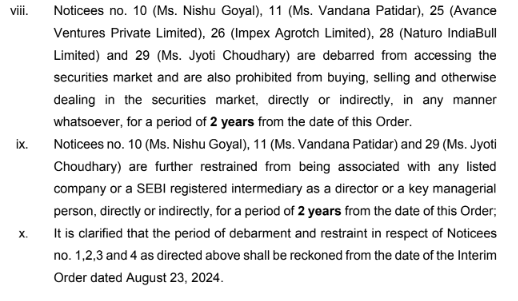
Nishu Goyal, Vandana Patidar, Avance Ventures Private Limited, Impex Agrotech Limited, Naturo IndiaBull Limited and Jyoti Choudhary are barred from the securities market for 2 years. Goyal, Patidar and Choudhary also face a 2 year bar on director or key managerial roles.
For Debock, Mukesh Manveer Singh, Sunil Kalot and Priyanka Sharma, who were also covered by the August 2024 interim order, the order clarifies their ban is counted from that interim order date rather than from this final order. That means Debock and Mukesh Manveer Singh’s 7 year ban runs until August 23, 2031, and Sunil Kalot’s 5 year ban runs until August 23, 2029.
Gaurav Jain was not a party to the 2024 interim order, so his 3 year ban runs from this final order instead, until August 28, 2029.
📸 Screenshot to use:
The ORDER section listing the debarment directions i to x (Page 117-118 of the order, right after the ‘Conclusion’ heading).
Where the money is supposed to go
Sunil Kalot, Mukesh Manveer Singh and Gaurav Jain together have to disgorge ₹59.30 crore in unlawful gains, with 12% interest from the date each block of shares was sold, within 45 days. Sunil Kalot’s share is ₹37.66 crore. Mukesh Manveer Singh owes ₹4.24 crore individually, plus ₹17.39 crore jointly with Gaurav Jain from the share gift proceeds.
This money goes to SEBI’s Investor Protection and Education Fund, not directly back to individual Debock shareholders.
Separately, SEBI has imposed monetary penalties on the 11 noticees found liable, adding up to ₹29.57 crore. Mukesh Manveer Singh’s penalty alone is ₹20.10 crore, the largest single amount. Debock Industries as a company has been fined ₹1.10 crore. The rest ranges from ₹5 lakh to ₹5 crore depending on each noticee’s role.
Add the ₹49 crore rights issue money to be returned, the ₹59.30 crore disgorgement, and the ₹29.57 crore in penalties, and the combined financial value of this order crosses ₹137 crore, before the 12% interest that keeps adding up until every rupee is actually paid.
📸 Screenshot to use:
Table 44 listing the monetary penalty for each noticee (Page 119 of the order, just after the disgorgement direction).
What this means if you hold or were considering Debock shares
If you bought Debock Industries shares based on its reported sales growth, its main board listing, or its bonus and rights issues, this order confirms that a meaningful part of the company’s financial picture during FY22 to FY24 was built on fictitious transactions.
The order itself does not create a compensation mechanism for shareholders who bought at inflated prices. The disgorged amount goes to SEBI’s investor protection fund, not to individual claim payouts.
Investors who believe they suffered a specific, quantifiable loss because of Debock’s disclosures can pursue their own remedies, including through the exchange’s investor grievance mechanisms.
If you ever need to complain about a SEBI registered entity
Debock Industries and the individuals named in this order were not registered intermediaries, so a direct SEBI intermediary complaint route does not apply to this specific case. But if you ever face an issue with a broker, adviser or portfolio manager, these are the official channels.
Start with SEBI’s own SCORES portal to file a formal complaint against any SEBI registered entity: SCORES SEBI complaint portal
If your grievance is against a stockbroker specifically, here is how to raise it correctly: file a complaint against a stock broker
For issues with a research analyst who gave you paid recommendations, there is a separate process: complaint against a SEBI registered research analyst
Problems with a registered investment adviser follow their own track, explained here: file complaint against an RIA
If a portfolio manager mismanaged your funds, this guide walks through the steps: how to file a complaint against portfolio managers
General complaints against any SEBI registered intermediary can also go through this route: complaint against SEBI intermediaries
For exchange level issues, NSE has its own investor grievance process: file a complaint in NSE
BSE runs a similar portal for disputes on its platform: BSE complaint portal
If your complaint doesn’t get resolved directly, SEBI’s online dispute resolution mechanism is the next step: Smart ODR complaint portal
Report. Recover. Stay Fraud Free.
Have questions about a SEBI order affecting you or your investments?
Talk to us. Register with us
Frequently Asked Questions
SEBI's final order dated August 28, 2026 found that Debock Industries used a fictitious preferential share issue to migrate to NSE's main board, inflated its sales and purchases through circular transactions, submitted forged bank statements, and diverted ₹49 crore from a rights issue.
Debock Industries and Managing Director Mukesh Manveer Singh are barred from the securities market for 7 years, counted from the August 23, 2024 interim order, meaning the ban runs until August 23, 2031.
The order directs Debock to return ₹49 crore of diverted rights issue money with interest, orders ₹59.30 crore in disgorgement from three individuals, and imposes ₹29.57 crore in penalties, a combined value of over ₹137 crore before interest.
No. Only 11 of the 29 noticees were found liable and face directions or penalties. The other 18, including five former directors and 13 preferential share allottees, were investigated and cleared.
No. It is a listed company, not a SEBI registered broker, adviser or portfolio manager. This order was passed under the PFUTP and LODR Regulations that apply to listed companies.
The disgorged amount goes into SEBI's Investor Protection and Education Fund, not as direct compensation to individual shareholders. The order itself does not set up a payout mechanism for investors who bought shares at inflated prices.
He is the Managing Director of Debock Industries, whom SEBI's order identifies as having masterminded the fictitious share issues, inflated financials and diversion of rights issue proceeds, aided by Sunil Kalot, Priyanka Sharma and Gaurav Jain.





 Add us as a preferred source on Google »

