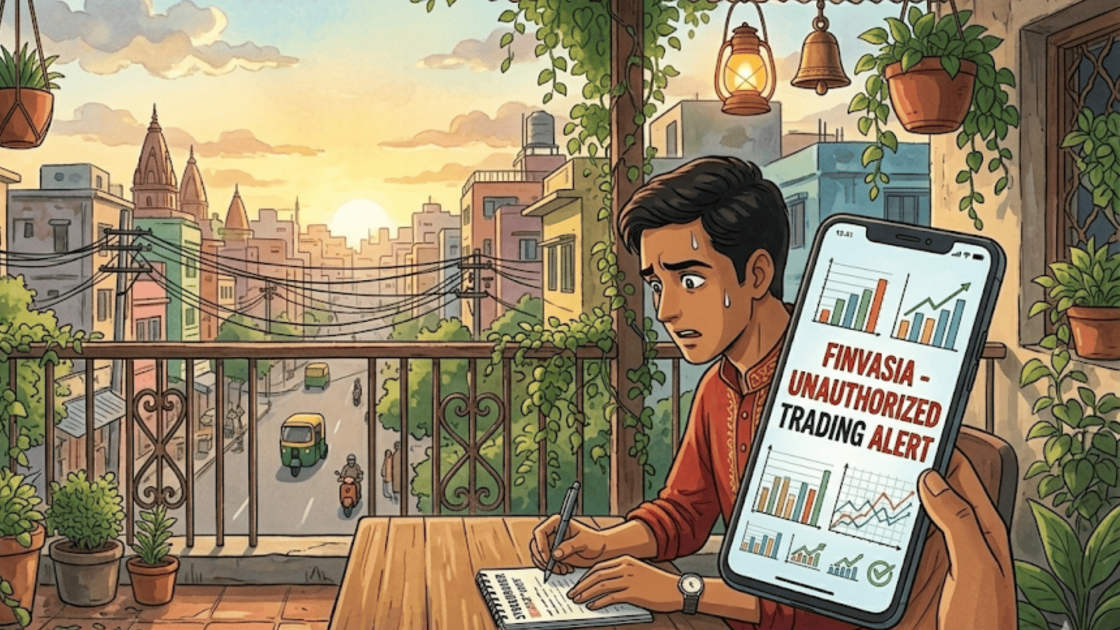
If you are searching for Finvasia unauthorised trading complaints, you’re probably not just comparing brokerage anymore. You’re thinking about safety.
Finvasia, known for its zero-brokerage model under the Shoonya HNI trading platform, attracts many retail traders.
But beyond pricing, one question matters more than anything else:
Has Finvasia faced unauthorised trading complaints?
Unauthorised trading is not about market losses. It refers to trades executed in a client’s account without proper consent or instruction.
Under SEBI regulations, brokers must maintain clear proof of client authorisation before executing any order.
In this blog, we analyse Finvasia unauthorised trading complaints based strictly on exchange-reported data.
No assumptions. No speculation. Just regulatory context, complaint trends, and what the numbers actually indicate for retail investors.
Because low brokerage may bring investors in, but trust in trade execution keeps them there.
Finvasia Unauthorised Trading Complaints
Finvasia is a SEBI-registered stockbroker, widely known for its zero-brokerage model through its Shoonya trading platform.
It offers trading services across equity, derivatives, commodities, and currency segments.
Over the years, it has attracted a large number of active traders because of its low-cost structure.
As with all registered brokers in India, Finvasia’s complaints are reported and classified by stock exchanges into distinct categories.
One such category is Type IV, which relates to unauthorised trading complaints.
Before interpreting the data, it is important to understand what that term actually means.
Unauthorised trading refers to a situation where a trade is executed in a client’s account without the client’s instruction or consent.
Under SEBI regulations:
- Brokers must have clear proof that a client placed the order.
- This proof can include app order logs, call recordings, registered emails, or other verifiable records.
- If a client disputes a trade, the burden of proof lies on the broker.
In simple terms, if a trade is questioned, the broker must show evidence that the client authorised it.
Complaints Data
Now, let’s look at the exchange-reported data for Finvasia complaints.
| Financial Year | Total Complaints | Type IV (Unauthorised Trades) | % of Complaints Under Type IV |
| 2020–21 | 68 | 5 | 7.35% |
| 2021–22 | 84 | 7 | 8.33% |
| 2022–23 | 97 | 6 | 6.19% |
| 2023–24 | 92 | 4 | 4.35% |
| 2024–25 | 101 | 3 | 2.97% |
| 2025–26 | 103 | 4 | 3.88% |
Let’s break this down clearly.
First, unauthorised trading complaints have appeared every year. There is no year with zero complaints in this category. That means such allegations do arise.
Second, the number of Type IV complaints ranges between 3 and 7 cases per year. In absolute terms, this is a limited number.
Third, look at the percentage trend:
- It peaked at 8.33% in 2021–22.
- After that, it gradually declined.
- In recent years, it has stayed around 3–4%.
This shows that there is no upward surge or escalating trend in unauthorised trading complaints. In fact, the proportion has generally reduced compared to the peak year.
At the same time, total complaints have increased over the years (from 68 to 103). Yet, the percentage of Type IV complaints has not increased along with it.
From a data perspective, this does not indicate a growing systemic problem. But here is the part retail traders must understand clearly. A small percentage does not mean a small impact.
When we read “3% of complaints,” it sounds insignificant. But for the investor who filed that complaint, it is not 3%.
It is their entire account, their capital, and their confidence at stake.
Retail investors often make one mistake: they ignore small percentages, thinking the risk is negligible.
That is not the right way to read complaint data.
The correct interpretation of this table is:
- Unauthorised trading complaints do exist.
- The volume is limited and not escalating.
- There is no visible pattern suggesting widespread misconduct.
- However, recurring complaints, even in small numbers, mean vigilance is necessary.
There is no reason for alarm based purely on these numbers. But there is also no reason for complacency.
Low brokerage may reduce your trading costs.
But monitoring your contract notes, checking daily trade confirmations, and reporting discrepancies immediately, that protects your capital.
When Can Action Be Taken Against a Broker?
In the world of finance, trust is the currency that matters most. When you hand over your hard-earned savings to a brokerage, you aren’t just buying stocks; you are buying into a system of rules.
However, many investors eventually find themselves asking: Can you trust a stockbroker implicitly, or does the system require constant vigilance?
While unauthorised trading is a grave allegation, the regulatory bodies in India, primarily SEBI and the stock exchanges (NSE/BSE), do not act on hearsay.
Under SEBI regulations and exchange grievance mechanisms, action can be taken against a stockbroker if the following situations arise:
1. The Broker Cannot Produce Proof of Authorisation
If a client disputes a trade and the broker fails to provide:
- App or system order logs
- Recorded phone conversation (if order placed through dealer)
- Registered email instruction
- Any verifiable record of consent
Then the broker may be held responsible.
Remember, the burden of proof lies on the broker. If they cannot show that the client authorised the trade, it becomes a regulatory issue.
2. There Is Evidence of Systemic Lapses
If exchanges or SEBI find repeated failures such as:
- Improper order recording
- Weak internal controls
- Repeated similar complaints
- Non-compliance with SEBI’s Master Circular on the prevention of unauthorised trading
Then, regulatory action can follow.
3. Arbitration Verdict Goes Against the Broker
If a dispute moves to exchange arbitration and the arbitrator concludes that the trade was indeed unauthorised, the broker may be directed to compensate the investor.
Repeated adverse arbitration findings can also trigger regulatory scrutiny.
A complaint alone does not automatically mean wrongdoing.
Exchanges classify complaints based on allegations raised by clients. Final responsibility depends on:
- Documentation
- Technical records
- Communication trail
- Arbitration outcome
This is why evidence matters more than emotion in such cases.
In short, action against a broker in unauthorised trading cases depends on one key factor:
Can the broker prove that the client placed the trade?
If yes, the case may not sustain. If not, the consequences can be serious.
How To Report A Complaint Against Broker in India?
If you notice unauthorised transactions or unusual deductions, such as unauthorised trading, it is important to document the transaction details before filing a complaint with the broker or regulatory authorities.
Here’s the correct step-by-step approach:
1. Immediately Inform the Broker
Keep everything documented. Avoid only verbal communication.
- Send an email from your registered email ID.
- Mention the trade date, order number, segment, and time.
- Clearly state that you did not authorise the trade.
- Ask for order placement proof (logs, call recording, etc.).
2. Preserve Evidence
Documentation strengthens your position if the dispute escalates.
- Download contract notes.
- Take screenshots of the order history.
- Save SMS and email trade confirmations.
- Keep your ledger and margin statements.
3. Escalate to the Exchange
If the broker’s response is unsatisfactory, file a complaint with the relevant stock exchange (NSE, BSE, MCX, etc.) through their grievance redressal mechanism.
The exchange will seek clarification from the broker and review supporting records.
4. File a Complaint on SCORES
If the issue remains unresolved, you can escalate the matter to SEBI through the SCORES platform.
SEBI will forward the complaint to the broker and monitor the resolution process.
5. Escalate Through Arbitration
If the dispute is still unresolved and involves financial loss, you can initiate arbitration through the stock exchange.
An independent arbitrator will examine:
- Order logs
- Communication records
- Compliance with SEBI regulations
Based on evidence, compensation may be awarded if the claim is upheld.
The moment you notice a suspicious trade, raise it immediately. The faster you act, the stronger your position becomes.
Need Help?
If you suspect unauthorised trading in your account, the first step is proper evaluation.
We help you:
- Review contract notes and order logs
- Assess whether the case qualifies under SEBI’s unauthorised trading framework
- Identify gaps in broker documentation
- Plan the correct escalation route (exchange, SCORES, arbitration)
If you want clarity on your case and the right next step, register with us for a structured assessment.
Act early. The right guidance at the right time makes a difference.
Conclusion
The exchange data shows that Finvasia has received Type IV (unauthorised trading) complaints over the years, but the numbers remain limited and there is no visible upward surge in recent periods.
The percentage has fluctuated, peaked earlier, and then moderated. From a data standpoint, this does not suggest a growing or systemic pattern.
At the same time, even a small number of complaints cannot be dismissed casually.
For the investor involved, it is not a percentage; it is their entire trading account.
That is why retail traders should avoid both extremes: neither panic based on isolated numbers nor ignore them because they appear small.
Markets demand awareness. Choosing a broker based on cost is one part of the decision.
Monitoring your trades, reviewing confirmations, and responding quickly to discrepancies is the other part.
Low brokerage can reduce expenses. Staying attentive protects capital.
In the end, trust in trading platforms is built not just on pricing, but on transparency, documentation, and responsible investor behaviour.