If you have moved your portfolio to a modern investment app, you probably did it for the convenience and the promise of lower costs.
Most of the investors assume these digital-first platforms are naturally more transparent than old-school brokers.
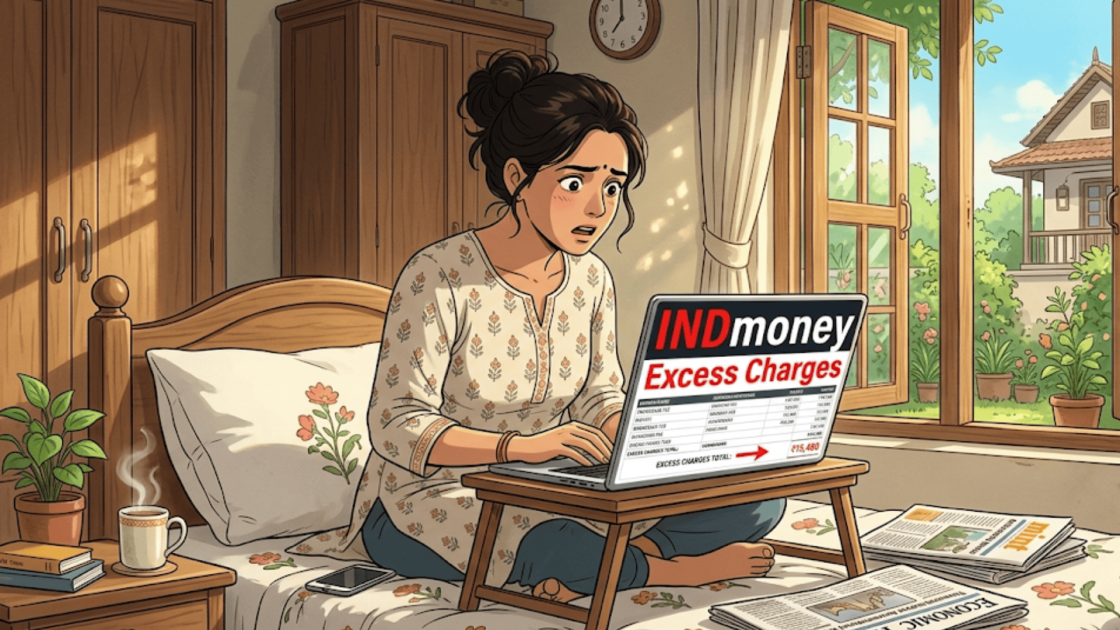
But lately, a lot of investors are opening their apps only to find a series of trades or charges they do not remember making.
This is where the concept of brokerage churning comes in, and it’s something every INDmoney user should have on their radar.
Brokerage churning is like a slow leak in your investment portfolio. It happens when a broker executes way more trades than your strategy actually requires.
The goal is not to help you hit your financial goals; it is to generate more transaction fees for the platform.
Even if the individual fees look small, they can become a lot in the long run.
In this blog, we are diving into the recent complaints regarding INDmoney excess charges and how to spot if you are being misled in terms of brokerage.
INDmoney Excess Charges Review
INDmoney is a popular, tech-heavy platform that lets you handle everything from Indian and US stocks to mutual funds and ETFs in one place.
It is designed to make investing feel digital-first and simple for everyone.
However, even with a slick app, you have to stay sharp.
Some users have started raising flags about a lack of clarity in how brokerage is charged, especially when it comes to complex trading like Nifty F&O.
For example, back in May 2024, a user pointed out that their account was being hit with large brokerage deductions without a clear breakdown of what was actually being charged per trade.
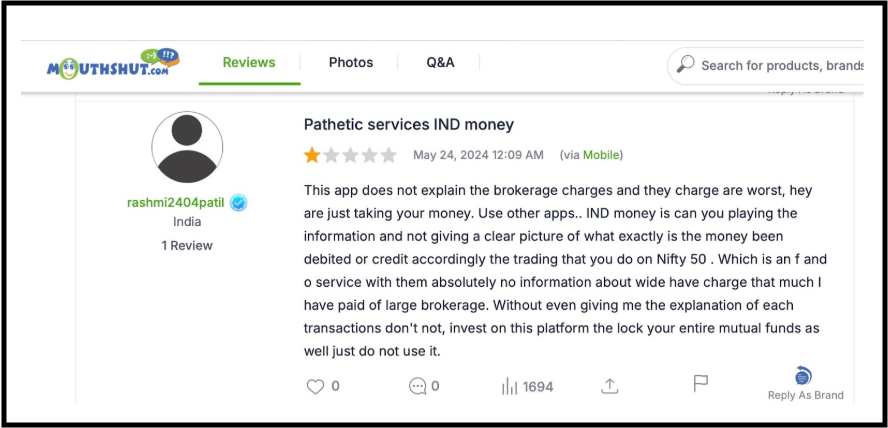
When you can not tell why money is leaving your account, or when debits and credits look confusing, it is a major red flag.
If your account is showing high activity that does not match your personal strategy often because of automated features or app suggestions, you might be paying a lot more in fees than you realise.
INDmoney Excess Charges Complaints
If you feel like your fees are higher than they should be, you are not alone.
There has been a significant surge in INDmoney complaints across various social media platforms and investor forums, specifically regarding transparency in fee structures
The complaint data from the last couple of years shows a very clear trend that should make any investor stop and think:
| Year | Total Complaints | Brokerage Churning Complaints |
| 2023-24 | 11 | Around 6 |
| 2024-25 | 143 | Around 73 |
That is more than a 10x jump in total complaints in just one year.
While a complaint does not automatically prove the broker is wrong, a massive spike like this usually points to a systemic issue.
When nearly half of all complaints are specifically about churning or excess fees, it is a sign that the platform’s trading practices are frustrating a lot of people.
More investors are becoming aware of these unusual charges and are finally speaking up about them.
Impact of These Complaints on Retail Investors
For the average retail investor, churning in the stock market is a silent profit-killer. It is never just about the brokerage fee itself.
Every unnecessary trade you make triggers a chain of friction costs: Securities Transaction Tax (STT), exchange transaction charges, SEBI turnover fees, and GST.
If you are a small-to-mid-sized investor, these daily deductions can easily wipe out a good day’s gains.
Over the long term, this makes it incredibly difficult for your money to compound, essentially turning your investment account into a revenue stream for the broker.
When Can Brokerage Churning Be Suspected?
Brokerage churning is designed to look like normal activity, but if you know what to look for, the red flags are quite consistent.
Here are three major signs that your account might be being manipulated:
-
Manipulation Through Frequent Trading Recommendations
Is your app sending you urgent alerts to move your money every other hour? While research is part of the service, it becomes a problem when it is used solely to drive volume.
If the app’s recommendations keep you in a cycle of constant buying and selling, you are the one paying for all the transaction taxes while the broker takes the fees.
If the advice leaves your portfolio value flat but your transaction bill high, your interests are no longer aligned with your broker’s.
This is the most serious violation there is. If you see buy or sell orders in your account that you did not personally approve or place, you have a major problem.
Always check the timing of your trades; if an order was executed while you were away from your phone or asleep, you need to report it immediately.
Also, watch the trade volume.
If the broker is executing trades that are much larger than your typical risk profile, they are likely trying to maximise the brokerage fee on that specific transaction.
-
Account Handling Without Clear Transparency
Many investors allow relationship managers or advisory tools to assist with their accounts, but this should not mean giving them a blank check.
If you notice that your account is flipping positions, selling a stock only to buy it back a day later, without a massive change in the market, you are likely being charged extra.
Ask for a written explanation for every move.
If the strategy sounds like a lot of buzzwords and does not result in actual profit after fees, the broker is likely trading just to generate their own commissions.
How to File a Complaint Against a Stock Broker in India?
If you believe you have been hit with unfair charges or unauthorised trades, do not just hope it stops.
You need to follow a formal process to get a resolution:
1. Gather Evidence
Download your official contract notes, bank statements, and transaction history.
If you have screenshots of tips from relationship managers or emails where you specifically asked them not to trade, keep those in a dedicated folder.
This documentation is your biggest weapon in a dispute.
2. Raise the Issue With the Broker
Your first official stop is INDmoney’s own support and grievance channel.
Send a formal email clearly listing the specific trades or charges. Demand a detailed breakdown of every fee.
Getting a ticket number for this complaint is vital, as it serves as proof that you gave the broker a chance to fix the mistake before you escalated the matter.
3. File a Complaint in SCORES
If the broker gives you a generic answer or ignores you for more than 15 days, take it to SEBI’s SCORES portal. This is the official government platform for investor grievances.
When you file a complaint in SEBI, it tracks the timeline, and the broker is legally required to provide a formal, documented response.
4. File Arbitration
You can also file an arbitration in the stock market.
These exchanges oversee the broker’s license to operate.
If they see a pattern of unfair trading or lack of transparency, they have the power to intervene and mediate a settlement.
Need Help?
It can be incredibly overwhelming to fight a large platform by yourself, but you do not have to.
If you suspect your account is being charged extra, we can step in and handle the heavy lifting for you.
Here is how we help:
- Professional Audit: We will go through your last six months of trade data to find hidden fees, unauthorised moves, and patterns of excessive trading.
- Evidence Gathering: We help you organise your screenshots and statements into a professional file that regulators can easily read and act on.
- Drafting Complaints: We assist in writing clear, firm, and technically accurate grievance letters so you do not get dismissed with a standard reply.
- End-to-End Support: We walk with you through every stage, from the first email to the final resolution on SCORES or the exchange.
Register with us to get help.
Conclusion
At the end of the day, brokerage churning is a quiet way for your hard-earned wealth to disappear into someone else’s pocket.
The recent spike in complaints against INDmoney shows that many investors are feeling the pinch of unclear fees and high trading volumes.
The best defense you have is to stay active and informed.
Do not let the convenience of a modern app lull you into a false sense of security.
Check your contract notes every week, verify every trade, and never hesitate to ask – why?
When you see a charge you didn’t expect. Your profits belong to you, not the broker.