
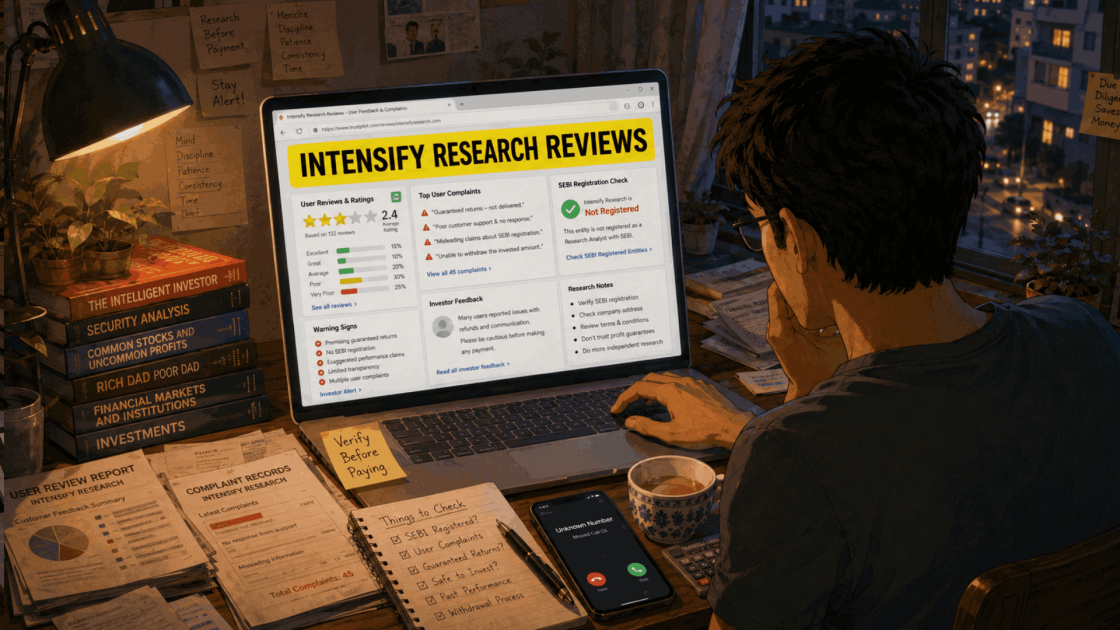
Five investors. Five different cities. Five different entry points. The same outcome: money lost, calls unanswered, and a firm pointing to a subscription agreement as the reason no refund is owed.
These are not isolated bad experiences; they are a documented complaint pattern.
If you are reading this because something already went wrong with Intensify Research, you are not the first person to be in this position.
The question is whether you act on it correctly.
The 5 Documented Intensify Research Cases
These are not random or selected complaints.
Each case is based on a publicly available user review that includes specific details such as the amount involved, the people mentioned, and the sequence of events described by the reviewer.
These reviews are publicly available and are shared here to help you make informed decisions.
Case 1. Sakshi Bisht: Guaranteed Loss Recovery, Then Silence
What happened: Sakshi Bisht was approached by a representative named Gurpreet.
She was told, specifically, that any losses she incurred would be recovered the very next day. Acting on this assurance, she followed his recommendation to take out calls.
The calls resulted in losses, not recovery.
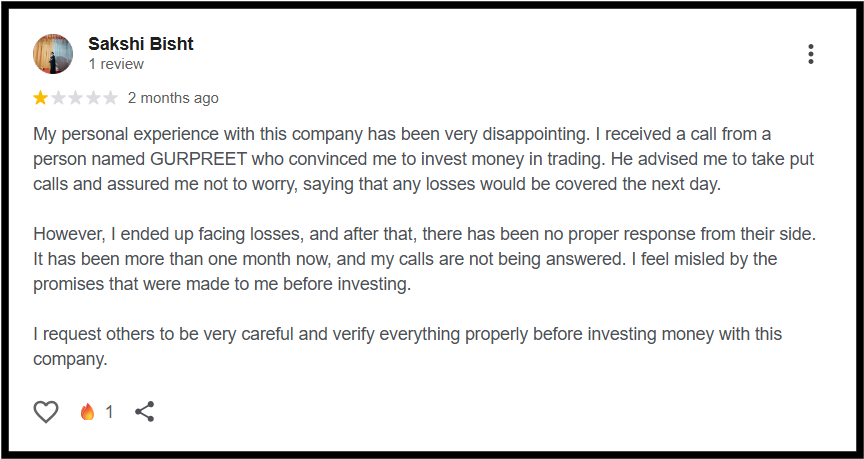
After the losses materialised, Gurpreet stopped answering her calls. She spent over a month trying to reach someone at the firm. No one responded.
The regulatory violation this represents:
SEBI Research Analyst Regulation 15(9) explicitly prohibits any registered RA from assuring profits or guaranteeing loss recovery.
“Losses will be covered the next day” is not a grey area; it is a direct, documentable regulatory violation. The name of the representative matters because it establishes which individual made the promise, which strengthens the complaint.
What Sakshi should have done the moment losses appeared: Screenshot every WhatsApp message from Gurpreet, note the date and content of every call, and file that same week.
Evidence of the guarantee is strongest immediately after the event.
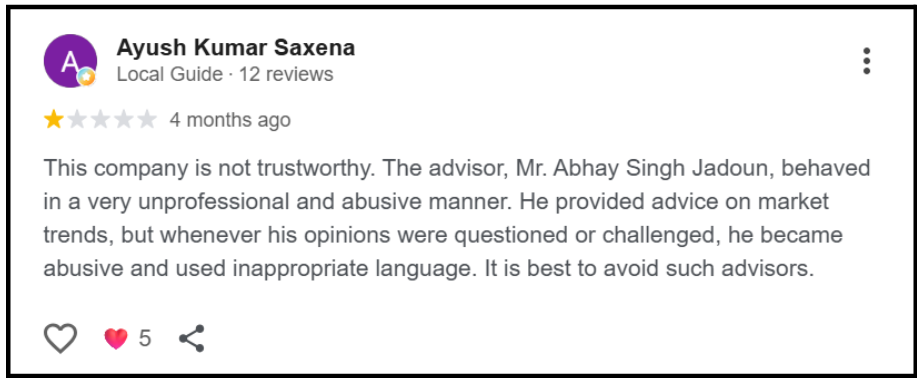
Case 2. Ayush Kumar Saxena: Abusive Conduct When Questioned
What happened: Ayush Kumar Saxena attempted to discuss market conditions with his assigned advisor. When he questioned the advisor’s position, the advisor became verbally abusive.
Ayush describes the conduct as deeply unprofessional and warns other investors to stay away.
The regulatory violation this represents:
SEBI’s Code of Conduct for Research Analysts requires firms to treat clients with fairness and professionalism.
Abusive conduct toward a client who questions advice is a conduct violation.
It is also a documented pattern that matters in the context of the broader complaint picture; a firm whose representatives turn hostile when questioned is a firm that may be concealing underperformance.
What makes this case important for other investors: If you have experienced similar conduct, being pressured, threatened, or spoken to abusively by an Intensify Research representative, your account of that conduct is relevant evidence in a complaint, particularly when combined with financial loss.
Case 3. Amit Meena: ₹3.5 Lakh Lost, Fees Escalated from ₹6,000 to ₹1,50,000
What happened: This is the most documented case in the Intensify Research review record. Amit Meena wrote a detailed Hindi-language review describing what happened to him step by step.
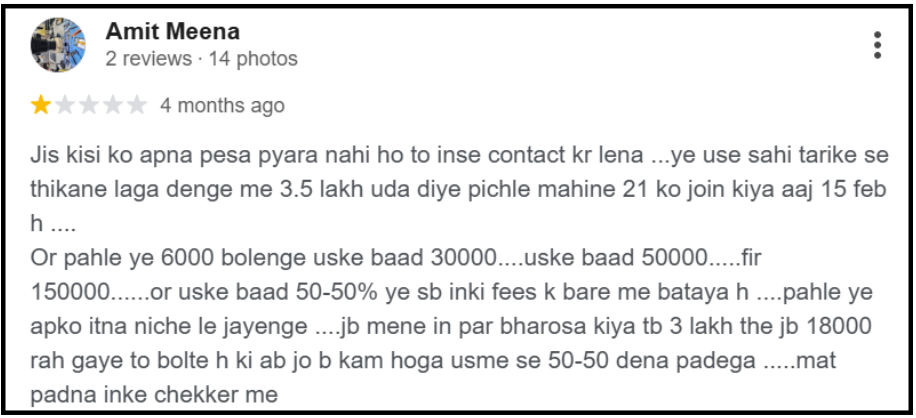
He joined the service with an initial fee of ₹6,000.
Within months:
- Fee escalated to ₹30,000.
- Then to ₹50,000.
- Then to ₹1,50,000.
- Then the firm asked for a 50-50 profit-sharing arrangement on whatever funds he had remaining.
His total loss: ₹3.5 lakh, within one month of joining.
The regulatory violations this represents:
Fee escalation beyond disclosed amounts violates SEBI’s requirement that RA fees be fixed and pre-disclosed in the service agreement.
If you paid ₹6,000 for a service and were then charged ₹30,000 without a new written agreement, the additional amount was collected without proper disclosure.
Profit-sharing demand is an explicit violation of SEBI Research Analyst Regulations.
No registered RA can take a percentage of a client’s trading profits as a fee. This is not a matter of interpretation; it is a prohibited fee structure.
What Amit’s case demonstrates for other investors: Even if you have already paid escalated fees, you may be entitled to recover the amount paid beyond what was originally agreed.
The original ₹6,000 contract is your benchmark. Every rupee charged above that without a properly disclosed revised agreement has a recovery basis.
Case 4. Anonymous Reviewer: Research Reports That Don’t Match Market Reality
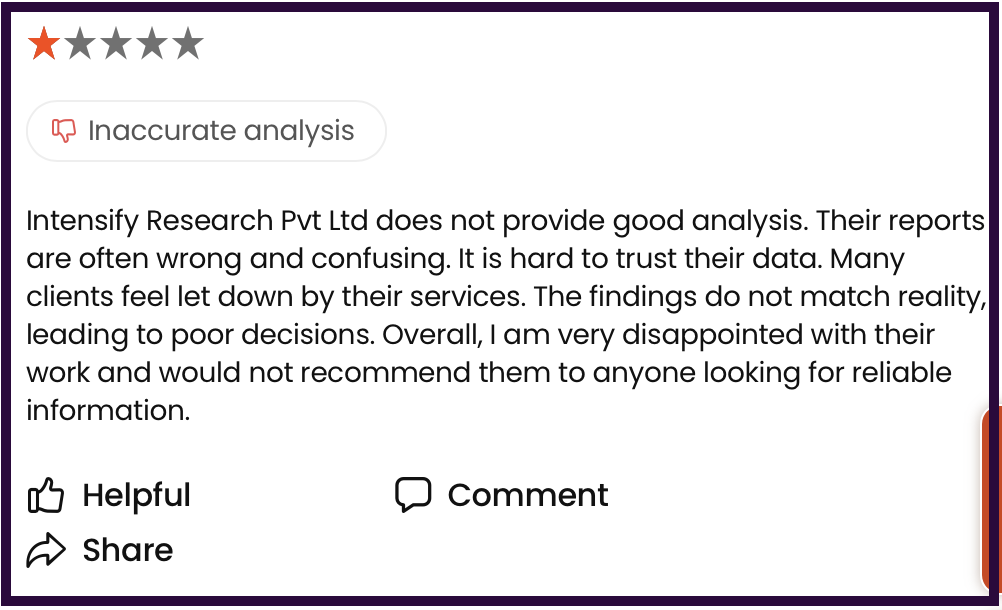
What happened: A reviewer without a named account describes a consistent pattern of research reports that are factually wrong and confusing.
The analysis, they say, does not match what actually happens in the market. They describe the service as unreliable for anyone seeking dependable information.
Why this matters beyond a bad experience:
SEBI’s Research Analyst Regulations require that research reports meet certain standards of accuracy and disclosure.
Consistently inaccurate research that is presented as professional market analysis and charged for accordingly can constitute a misrepresentation of service quality.
More importantly, if an investor has consistently followed the wrong research and incurred documented losses, the pattern of inaccuracy becomes supporting evidence in a complaint about financial harm.
Single wrong calls are not actionable; a documented pattern of inaccurate research bundled with a guaranteed return claim becomes a much stronger case.
Case 5. Boopathy: Profit-First Baiting, Then ₹90,000 Loss After Subscription
What happened: Boopathy describes a specific sales tactic in detail. During the first two trading sessions with Intensify Research, he saw profits.
The firm then used those profits as the basis for a subscription pitch. He subscribed.
Over the following two weeks, he lost ₹90,000.
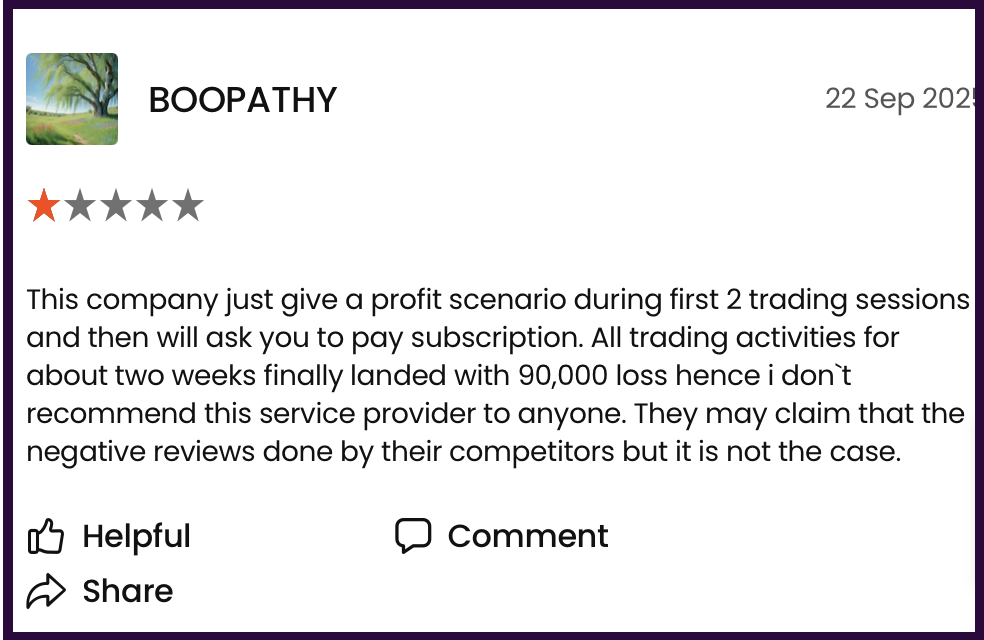
He makes a specific, important observation in his review: he had initially dismissed negative reviews about the firm, assuming they were written by competitors.
After his own experience matched the same pattern, he revised that view.
The regulatory issue this represents:
Selectively demonstrating profitable trades to induce a subscription, without disclosing the risk or the full performance record, is a form of misleading marketing.
SEBI’s advertising guidelines for research analysts prohibit using cherry-picked past performance to suggest future results.
Two winning sessions presented to a prospect who then subscribes and loses money is a documented pattern of inducement through selective performance showing.
What Boopathy’s warning means in practice: If someone you know is about to subscribe to Intensify Research because “the first few calls were profitable,” this is the most important case to share with them. It describes the exact sales mechanism.
The Pattern Across All 5 Cases
Reading these cases individually is useful. Reading them together reveals something more important: a systematic pattern that goes beyond individual representative misconduct.
- Fake Promises of Guaranteed Profits: They explicitly tell investors that any money lost will be recovered the very next day. (This is a direct violation of SEBI rules, which ban advisors from guaranteeing returns.
- Tricking People with Early Profits: They show a couple of successful trades right at the start to make the investor confident, and then use that excitement to push an expensive subscription plan.
- Massive, Hidden Fee Jumps: They start by charging a small fee (like ₹6,000) to get people in the door, but quickly pressure them to pay much higher amounts (scaling up to ₹1.5 Lakh) without proper paperwork.
- Illegal Profit-Sharing Demands: They ask for a 50-50 split of the client’s trading profits. Under SEBI regulations, registered research analysts are strictly forbidden from taking a percentage of your winnings.
- Bad Research & Wrong Calls: The stock market tips and research reports they provide are consistently inaccurate and don’t match what is actually happening in the real market, leading to heavy losses.
- Rude and Abusive Behavior: If an investor starts questioning their advice or asks why they are losing money, the advisors turn aggressive and verbally abuse them.
- Ghosting After Losses: The moment an investor suffers a major financial loss and tries to reach out for answers, the firm goes completely silent and stops answering calls or messages.
When the same violations appear independently across different investors, different entry points, and different time periods, that is not a series of individual failures.
That is how the firm operates.
If your experience matches any of the patterns above, you have a documentable complaint. Our team identifies the specific violations in your case, prepares the evidence package, and files on SEBI SCORES with the right regulatory references. Register for a free consultation today →
Turning Misconduct Into a Winning SEBI Complaint
Many investor complaints fail not because there isn’t enough evidence, but because the complaint doesn’t clearly explain what happened.
For example:
- Weak complaint: “I lost money by following their advice.”
- Strong complaint: “On 15 March, a representative named Gurpreet told me on WhatsApp that my losses would be recovered the next day. I have screenshots of the chat.”
The more specific your complaint is, the easier it is for the authorities to understand and review your case.
Below is a step-by-step breakdown of how to structure your complaint for specific misconduct patterns, transforming general frustrations into actionable points for the authorities.
1. Promised Guaranteed Returns & Documented Loss
-
The Situation: They told you your losses would be recovered the very next day, but you just lost more money.
-
What to do: File a complaint on SEBI SCORES and call out Regulation 15(9) (the rule that bans advisors from promising profits).
. If they reject your claim or fail to resolve it, your next logical step is to file a formal complaint in SMART ODR portal for online arbitration; you have a very strong case here.
2. Fees Charged Beyond the Original Agreement
-
The Situation: You agreed to one price, but they pressured you into paying way more later on.
-
What to do: File a complaint demanding a refund for the exact difference between the original price and the extra money they took.
This works best if you have a screenshot or email of that very first price agreement.
3. Demands for Profit-Sharing
-
The Situation: They asked for a 50-50 split (or any percentage) of your trading winnings.
-
What to do: This is completely illegal for Research Analysts.
Every single rupee you paid them as a “profit share” counts as an illegal fee, and you can demand it all back in your complaint.
4. Payments Sent to Unofficial or Personal Accounts
-
The Situation: They told you to send money to an individual’s name or an unofficial account instead of the company’s bank account.
-
What to do: This goes past breaking SEBI rules and moves into fraud. Don’t just use SCORES; go straight to the official cybercrime.gov.in portal and file a police complaint immediately.
If you want the complete details on the step-by-step process, check our guide: How to complaint against Intensify Research.
Is Intensify Research Safe Based on These Reviews?
The firm holds a valid SEBI registration (INH000009834) and is BSE-listed (5584). Complaint data shows 75 formal grievances filed between 2022 and 2025-26, with complaint volume growing every year.
To protect yourself, it helps to understand what their official status actually means.
You can read our full analysis on Is Intensify Research SEBI registered? to see what the registration covers and what it doesn’t protect you from.
It is also crucial to look into the background of who is running the firm; knowing the Intensify Research owner name and why Shoeb Pathan’s individual registration status matters can give you significant leverage when framing a formal complaint.
Conclusion
When you look at these five cases side by side, it becomes obvious that these aren’t just a few isolated bad experiences.
They show a clear, deliberate pattern of how the firm operates, using big promises to get you in the door, hitting you with hidden fees, and then cutting off communication the moment things go wrong.
It is important to remember that while the firm holds a valid registration, SEBI status doesn’t automatically protect you from misconduct happening behind closed doors.
However, you don’t have to just accept the loss. If your experience matches any of these warnings, you can take a stand.
Frequently Asked Questions
1. Are the Intensify Research reviews on public platforms genuine?
The five cases referenced on this page are sourced from public review platforms and contain specific names, rupee amounts, representative names, and described sequences of events, the markers that distinguish genuine investor accounts from generic feedback.
The complaint data from SEBI disclosure independently confirms the volume of formal grievances filed against the firm.
2. Can Intensify Research legally promise that losses will be recovered?
No. SEBI Research Analyst Regulation 15(9) explicitly prohibits guaranteed or assured return promises of any kind, verbal or written.
A representative saying “losses will be covered the next day” is in direct violation of this regulation.
That statement, documented with a screenshot or recording, is the basis for a SCORES complaint.
3. Intensify Research charged me more than the original fee. Can I recover the difference?
Yes, in many cases. If fees were escalated beyond the amount originally agreed in writing, the additional charges were collected without proper disclosure, a violation of SEBI’s fee transparency requirements.
The original agreement is your benchmark. Document all payments and the original fee confirmation before filing.
4. Is a profit-sharing arrangement with Intensify Research legal?
No. Profit-sharing fee structures are explicitly prohibited under SEBI Research Analyst Regulations.
If you paid any amount framed as a “profit share” or “performance fee,” that amount was collected through an impermissible fee arrangement and has a recovery basis in a formal complaint.
5. I have a screenshot of Intensify Research’s representative making a guarantee. Is that enough to file?
A screenshot of a guarantee is strong evidence and often the most important document in a complaint.
Pair it with your payment receipt, the original fee agreement, and a record of the losses incurred.
That package, submitted correctly through SEBI SCORES citing the specific regulatory violation, gives you the strongest possible starting position.
6. Intensify Research says my subscription agreement has a no-refund clause. Does that end my complaint?
No. A no-refund clause in a private subscription agreement cannot override SEBI’s regulatory obligations.
If the firm violated its RA registration scope through guaranteed return promises, profit-sharing demands, or fee escalation beyond disclosed amounts, the clause does not protect it.
SEBI adjudicators and arbitration tribunals have upheld investor complaints in exactly these circumstances.





 Add us as a preferred source on Google »

