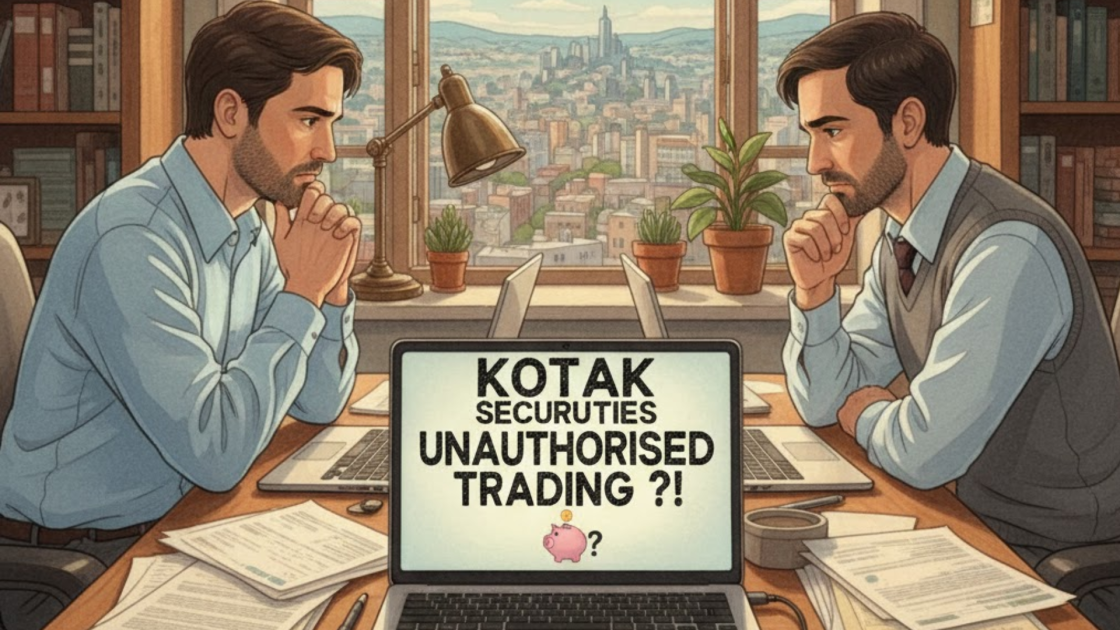
For many investors, trading is built on routine and trust. Orders appear on the screen, confirmation messages arrive, and transactions settle without much thought. Problems begin when investors notice trades they don’t recall placing or approving.
Such moments often lead to confusion, anxiety, and a troubling question: How did these trades happen?
In the Indian securities market, situations like these are commonly referred to as unauthorised trading.
With a large retail and institutional client base, Kotak Securities executes a high volume of trades daily across major stock exchanges.
It operates under the supervision of the Securities and Exchange Board of India and follows exchange-level compliance requirements.
Kotak Securities Limited is one of India’s established brokerage companies and is part of the Kotak Mahindra Bank group.
The firm offers services in equity trading, derivatives, mutual funds, IPO investments, portfolio management, and research advisory.
There have been instances where investors have raised concerns related to Kotak Securities’ unauthorized trading through formal channels.
Awareness empowers investors to monitor their accounts more closely, ask timely questions, and take responsibility for safeguarding their participation in the market.
Kotak Securities Unauthorised Trading Complaints
In accounts with brokers such as Kotak Securities, concerns may arise if investors notice trades they do not remember approving, sudden exposure in derivatives, or rapid buying and selling that was not clearly discussed.
Sometimes the issue is about the level of risk involved rather than a completely unknown trade.
The key issue is not whether the trade resulted in profit or loss. The real question is whether the investor understood and authorised the transaction before it was executed.
The table below presents a summary of Kotak securities complaints received over the past five financial years, along with the number and percentage of complaints specifically related to unauthorised trading.
This data helps in understanding trends, growth patterns, and the proportion of unauthorised trading concerns compared to overall complaints.
Summary table: Overall Complaints, Unauthorised trading complaints, % of unauthorised trading
| Year | No. of complaints | No. of complaints for unauthorised trading | Percentage of unauthorised trading |
| 2021-22 | 393 | 57 | 14.50% |
| 2022-23 | 605 | 66 | 10.90% |
| 2023-24 | 610 | 80 | 13.11% |
| 2024-25 | 1065 | 188 | 17.65% |
| 2025-26 | 644 | 122 | 18.94% |
The data indicates a noticeable rise in both total complaints and unauthorised trading complaints over the years.
While overall complaints increased significantly in 2024–25, the percentage of unauthorised trading complaints has also shown a steady upward trend, reaching 18.94% in 2025–26.
This suggests that unauthorised trading concerns are forming a growing proportion of overall grievances.
It highlights the importance of investor awareness, monitoring of trading activity, and timely professional intervention when irregularities are suspected.
Kotak Securities Unauthorised Trading Case Study
The disagreement began when the trader (complainant) altered his trading arrangements in March 2018, based on promises of active support, margin assistance, and controlled risk. 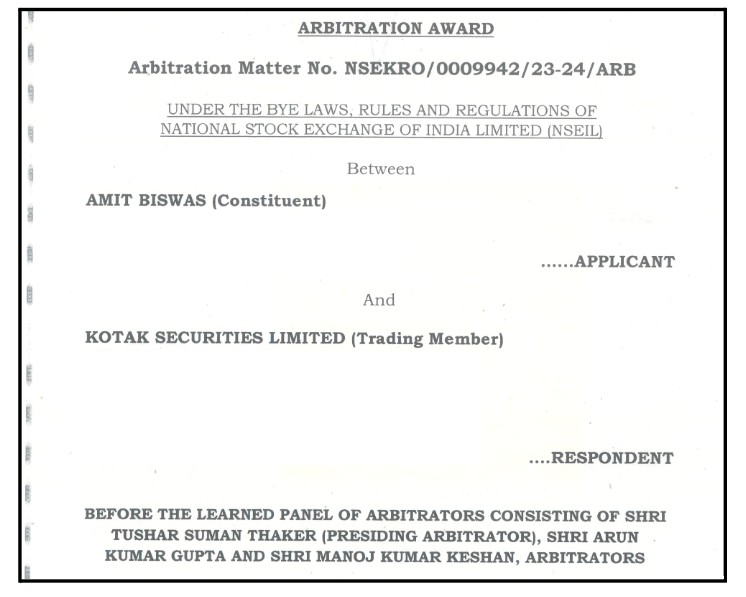 At first, he invested between Rs. 7,00,000 and Rs. 9,00,000, and later moved most of his existing shares into a Demat account held with the trading member.
He depended on statements that trading would only happen with his permission and that losses would be limited to the difference in prices.
However, over time, trading increased a lot without proper approvals being documented. The applicant later found out he had a total loss of Rs. 1,45,00,000 in his account.
The records also show that a lien was placed on his existing securities, and his account access was restricted, which stopped him from keeping track of or stopping the trades during important times.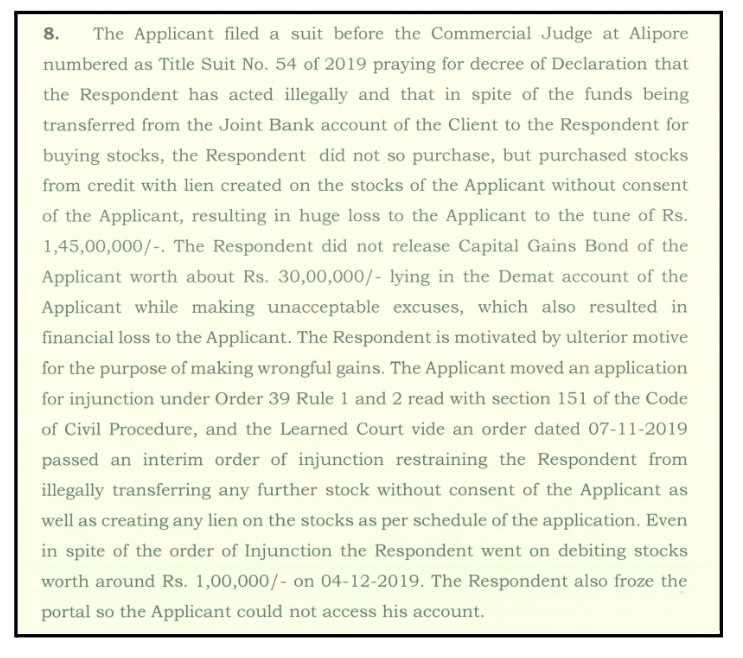 The financial loss went beyond just trading losses.
The applicant mentioned that Capital Gains Bonds worth Rs. 29,40,000 were not released and that stocks were sold even though there were court orders telling them to stop.
The records also show that stocks worth about Rs. 1,00,000 were debited even after an injunction was issued.
To calculate the total claim, the applicant asked for the return of shares valued at Rs. 1,01,11,230, Capital Bonds worth Rs. 29,40,000, and cash of Rs. 9,10,000, making the total amount claimed Rs. 1,39,61,230.
The respondent disagreed and said that some shares worth Rs. 95,08,774 had already been released, and sales of Rs. 46,62,550.15 were used to settle the debit balances.
The final decision does not include any order for financial recovery or returning the claimed amount to the applicant.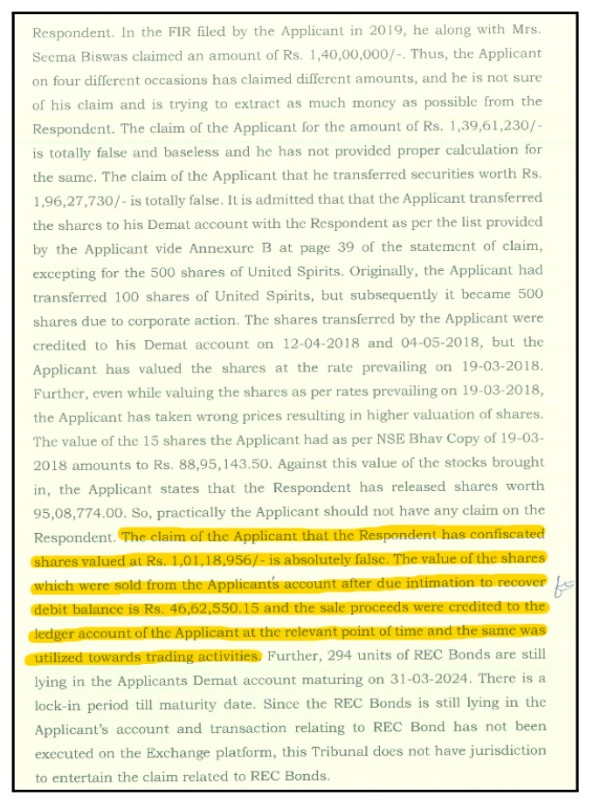 The process found several issues related to the following rules, based on documents, phone calls, and written submissions.
The records show that trades were carried out without proper written permission, a contested Power of Attorney was used for Demat account activities, and securities were sold even when trading was not allowed.
The documents also show that people advised on calls and recordings, even though rules say that traders can’t give advice or influence clients.
The case also includes information about interest charges on loans, selling assets because of a lack of funds, and late disclosures. All these points were used as the main reasons for the claims made during the arbitration.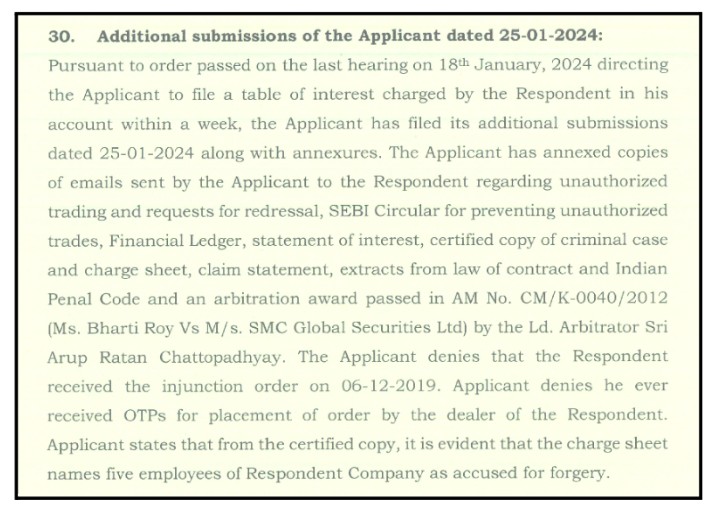 After considering the material available, the arbitration did not result in any direction for recovery, restitution, or replenishment of the amounts claimed by the applicant.
The matter, therefore, concluded at the arbitration stage without monetary relief being awarded, leaving the dispute resolved on record rather than through financial compensation.
The case shows the dangers that happen when someone has control over operations, access to credit facilities, and gives advice without proper written protections in place.
When Can Action Be Taken Against a Broker?
Brokers are expected to execute trades strictly according to the instructions provided by their clients. They should not place orders independently unless the client has clearly authorised them through approved channels.
If trades appear in your account without your consent, it may raise concerns about unauthorised trading.
Proper documentation becomes important in such situations.
Action against a broker may be considered if:
- Trades were executed without the client’s clear approval
- The broker cannot provide order logs, call recordings, or trade confirmations
- Trades were placed beyond the client’s agreed instructions or risk level
- Regulatory requirements, such as contract notes or proper records, were not maintained
Authorities typically review documents such as contract notes, communication records, and system logs to understand what actually happened.
These records help determine whether the broker followed the required procedures or acted improperly.
Clear evidence plays a key role in establishing a complaint.
How To File a Complaint Against Unauthorised Trading?
If you notice any activity in your trading account that seems unusual or unfamiliar, it is important to remain calm and take a structured approach.
Instead of reacting immediately, start by reviewing your records and collecting relevant documents.
Proper verification and documentation will help you understand whether the activity was authorised and will support you if you need to raise a complaint.
-
Carefully Review Contract Notes
Begin by downloading all recent contract notes sent to your registered email. Go through them carefully and check the date and time of execution, the quantity traded, the order type (market or limit), the price, and the brokerage charged.
This review will help you confirm whether each trade matches the instructions you remember giving.
-
Examine Margin and Ledger Statements
Next, review your margin statements and ledger reports in detail. Look for sudden increases in trading exposure, frequent buying and selling within a short period, or derivative positions that you do not recall approving.
Also, check whether brokerage or other charges appear unusually high compared to the amount you invested.
-
File a Formal Complaint with the Broker
If you believe that trades were executed without your consent, submit a written complaint to the broker’s designated grievance officer. Clearly identify the disputed transactions and explain why you believe they were unauthorised.
You may also request supporting documents such as order logs, confirmation records, or proof that your approval was obtained before the trades were placed.
4. Escalate the Complaint through SCORES
If the broker does not resolve your complaint satisfactorily, you can file a SEBI complaint, the official grievance portal of the Securities and Exchange Board of India.
This platform allows investors to formally lodge complaints against brokers and other market intermediaries. The intermediary must respond through the system within the specified time frame.
5. Complaint through SMART ODR
If the matter remains unresolved after filing a complaint, you may proceed through SMART ODR.
This platform enables investors and intermediaries to participate in online mediation or conciliation under the supervision of the stock exchange. It aims to resolve disputes in a structured and efficient manner.
6. Proceed to Arbitration if Necessary
If mediation does not lead to a satisfactory outcome, the dispute may be referred to arbitration in the stock market under the rules of the relevant stock exchange.
In arbitration, an independent panel reviews documents such as contract notes, communication records, order logs, and payment details.
Based on the evidence presented, the panel determines whether the broker has violated regulatory obligations and issues an appropriate decision.
Need Help?
If you are unsure whether your issue relates to unauthorised trading, miscommunication, or normal market risk, seeking professional guidance can help you assess your case properly.
Register with us, and we will help investors go through the right steps from filing a complaint to reaching arbitration, making sure everything is done in a clear and legal way.
Our main job is to support the process, make sure things are clear, and help with proper submissions at each stage.
We can help you with:
- Review your contract notes and transaction history
- Identify potential regulatory violations
- Understand complaint procedures with stock exchanges and regulatory authorities
- Prepare and file a formal complaint
- Represent your case during hearings or arbitration proceedings
If you need professional guidance, our team can assist you in evaluating your situation and guiding you through the appropriate course of action. Reach out to us for a confidential discussion about your case.
Conclusion
Trading involves risk, and market losses can occur even in well-planned strategies. However, execution without proper consent is a different matter altogether.
Unauthorised trading allegations are serious because they affect the trust between the investor and the broker.
Whether a specific case amounts to regulatory non-compliance depends on documentation such as contract notes, system logs, and communication records.
For investors working with firms like Kotak Securities Limited, the best protection is regular monitoring of your account and ensuring that every trade reflects your clear and informed approval.