
If you’ve spent any time on Instagram, Telegram, or YouTube looking for trading guidance, chances are you’ve come across Love Sharma.
He positions himself as a SEBI-registered Research Analyst offering structured trading batches, live sessions, and real-time market calls.
But what does that registration really mean for traders? And how do such services actually work in practice?
In this detailed Love Sharma trader review, we’ll examine his claimed SEBI registration status, advisory model, promotional style, and the broader implications for retail traders in India.
With the rise of social media trading influencers, it is crucial to separate marketing from regulatory reality.
Now, let’s take a closer look at Love Sharma and his trading services.
Love Sharma Trader Instagram Review
The most important factor when evaluating any trading influencer is regulatory registration.
In India, individuals offering paid stock market advice or research services must be registered with the Securities and Exchange Board of India (SEBI) either as a Research Analyst (RA) or an Investment Adviser.
Safety in trading advisory services depends on regulatory compliance and honest communication.
Certain types of social media claims directly conflict with those rules and should raise concern.
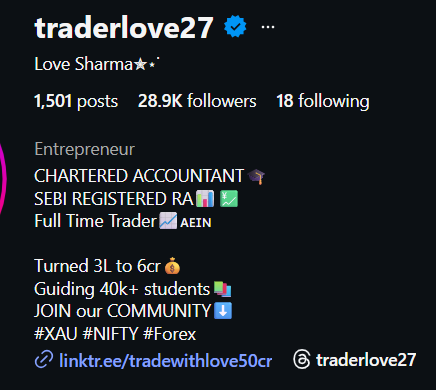
1. Promises Like “Turned ₹3L into ₹6Cr”
A SEBI-registered Research Analyst is not permitted to promise or imply assured returns.
Statements suggesting exponential capital growth, such as converting ₹3 lakh into ₹6 crore, create the impression of guaranteed or highly predictable outcomes.
Market-linked products cannot legally be marketed with return assurances.
Such claims require audited proof and balanced risk disclosure, which is rarely shown in promotional posts.
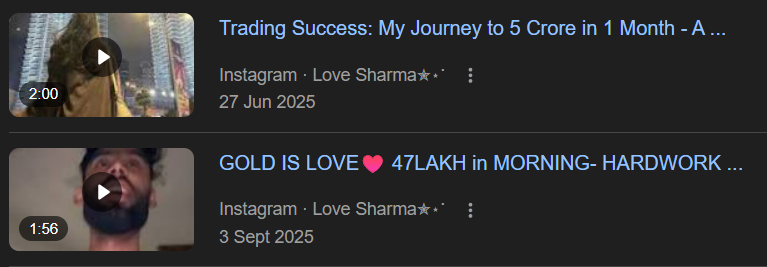
2. Claims of Earning “₹47 Lakhs in One Morning” and ” 5 crore in One Month”
SEBI regulations prohibit advertisements that imply fixed or extraordinary profits without full context.
Highlighting one-day or one-month profit figures without showing capital deployed, losses, drawdowns, and complete P&L records can mislead retail investors.
A Research Analyst must avoid communication that creates unrealistic expectations of consistent profits.
3. Assured or Risk-Free Profit Messaging
Under SEBI Research Analyst Regulations, no RA can advertise guaranteed returns, fixed income from trading, or risk-free strategies.
The stock market is inherently volatile. Any messaging that suggests certainty of profit conflicts with regulatory advertising norms.
4. Selective Display of Winning Trades
SEBI expects fair and balanced representation. Showing only winning trades while ignoring losses distorts performance perception.
Research communication must not exaggerate profitability or suppress downside risk.
5. Promotion of Forex Trading in Bio
A SEBI-registered Research Analyst is authorised to provide research in permitted securities markets. Retail participation in offshore forex trading platforms is restricted under Indian regulations.
If promotional material suggests forex trading opportunities or directs users toward offshore brokers, that raises regulatory red flags.
When a registered entity uses promotional language that appears to promise extraordinary profits or certainty, it contradicts the core compliance framework that governs research analysts in India.
Red Flags to Watch in Love Sharma Trader Promotions
When a trading educator presents himself as a SEBI-registered Research Analyst, higher compliance standards apply. Social media marketing in financial services must follow strict advertising and disclosure rules.
Certain promotional patterns, especially when repeated, deserve closer scrutiny from retail traders.
Below are specific red flags based on regulatory expectations and common investor protection principles.
- Exaggerated Capital Growth Narratives: Statements like turning a small amount into crores suggest extraordinary consistency.
For a SEBI-registered Research Analyst, implying predictable exponential growth contradicts regulatory expectations of balanced and risk-aware communication.
- High One-Day or One-Month Profit Highlights: Showcasing large single-day or short-term profits without full trade history, capital exposure, and loss data creates a skewed performance image.
Selective screenshots are not equivalent to audited records.
- Implied Assurance of Returns: Any messaging that hints at fixed income, “locked trades,” or highly reliable profits conflicts with SEBI norms.
Market returns are uncertain by nature, and no RA can legally guarantee outcomes.
- Large Student or Community Claims Without Verification: Quoting very high student numbers or community size without independent verification can be a credibility tactic.
Popularity does not equal performance consistency.
- Forex Promotion While Holding RA Registration: If a SEBI-registered RA promotes or directs users toward forex trading, especially via offshore brokers, it raises compliance questions.
Retail forex participation through overseas platforms is restricted under Indian regulations.
These red flags do not automatically establish wrongdoing, but they highlight areas where regulatory alignment and transparency should be carefully examined.
What Can Investors Do in Such Situations?
To protect yourself from misleading trading promotions or advisory risks, here are key precautions and red flags to watch for:
- Verify SEBI Registration RA – Always check the Research Analyst (RA) or Investment Adviser (IA) registration number directly on the SEBI website instead of trusting screenshots or claims on social media.
- Be Wary of Guaranteed Returns – No market-linked product can legally promise fixed or risk-free profits. Assured returns are a major red flag.
- Question Extraordinary Profit Claims – Claims like turning small capital into crores or earning lakhs in a single day should be supported by audited, verifiable records—not just screenshots.
- Avoid High-Pressure Sales Tactics – Urgency, such as “limited seats” or “offer ending today”, is often used to prevent proper verification.
- Check for Proper Risk Disclaimers – Legitimate advisors must clearly disclose market risks. Missing or vague disclaimers indicate non-compliance.
- Do Not Share Sensitive Information Casually – Never share OTPs, trading account passwords, or full financial details with any advisor.
- Keep Proper Documentation – Save payment receipts, chat records, promotional messages, and agreements in case you need to file a complaint later.
Staying alert to these red flags can significantly reduce your risk and help you make informed decisions before subscribing to any trading advisory service.
How to File a Complaint Against a Research Analyst?
If you are facing issues with how to complain to SEBI about a trading advisor, here are the official channels available:
1. File a Complaint on SCORES
You can submit your complaint through SCORES (SEBI Complaints Redress System), the centralised grievance portal managed by SEBI.
SCORES allows investors to file complaints directly against SEBI-registered intermediaries. Once filed, the entity is required to respond within a stipulated time.
Investors can monitor the progress of their complaint through the SCORES dashboard.
Generally, the concerned entity is expected to respond within 30 days, though complex cases may take longer.
2. Lodge a Complaint with Smart ODR
SEBI also offers Smart ODR (Online Dispute Resolution) for eligible cases. This platform allows faster, technology-enabled dispute resolution without traditional court proceedings.
Smart ODR can be a quicker alternative for eligible investor disputes.
Need Help?
If you are unsure about the complaint process or need assistance drafting a structured grievance, you can reach out to us.
We help investors organize evidence, understand regulatory procedures, and file complaints through the appropriate SEBI channels.
We also assist in tracking and following up on your case to ensure proper escalation where required.
Conclusion
Social media trading influencers like Love Sharma have gained massive visibility in recent years.
While Love Sharma SEBI registered status adds a layer of regulatory oversight, it does not eliminate trading risk or guarantee profitability.
Investors must carefully evaluate marketing claims, verify regulatory credentials independently, and remain cautious of guaranteed returns or exaggerated profit showcases.
In stock market trading, awareness and due diligence are your strongest protections. Always verify first, invest later.