Have you ever felt that sinking feeling when your hard-earned money takes a hit because of bad investment advice?
You’re not alone!
Many of us have been there, scrolling through portfolios, wondering if Manu Chhabra could be the guide to turn things around or just another story in the financial rollercoaster.
As a SEBI-registered investment advisor, Manu Chhabra promises to navigate the wild world of stocks, mutual funds, and more, but let’s chat about who he really is and what you need to know before handing over your cash.
Who is Manu Chhabra?
Manu Chhabra is a Bengaluru-based investment advisor with roots in financial markets, boasting over five years in equity derivatives, commodities, and currency trading from his time at Karvy Stock Broking.
He is a Chartered Market Technician (CMT) with a sharp eye for detail, offering services through Manu Financial Services and helping clients with structured products and risk management.
He is registered with SEBI as an Investment Advisor, and his registration number is INA200013992.
Having an SEBI registration doesn’t mean that mistakes never happen. Even a small mistake from an investment advisor’s side can put people’s money at risk.
So before you even think of investing, always have a look at various orders, arbitrations, and customer reviews.
Manu Chhabra Complaints
Picture this: You’re sipping coffee, reviewing your portfolio, when a Google alert pings about your advisor and SEBI in the same sentence. Scary, right?
That’s the reality for some clients of Manu Chhabra, and SEBI’s orders spill all the tea on what went down.
These aren’t just rumours, but they’re official docs from India’s market watchdog, packed with inspection details, fee slip-ups, and fines.
Curious?
Let’s have a look at the SEBI Order on Manu Chhabra.
Manu Chhabra SEBI Order
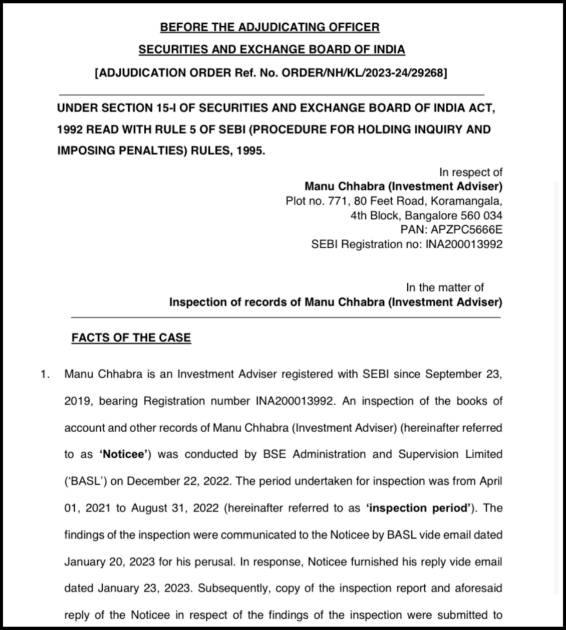
SEBI filed the adjudication order against Manu Chhabra after an inspection found serious rule breaks.
BSE Administration and Supervision Limited (BASL) checked his records on December 22, 2022.
The review covered April 1, 2021, to August 31, 2022.
SEBI found two main problems:
First, Chhabra charged one client, Mr. A. Saha, Rs 5,16,524 (without taxes) in January 2022. This was under the fixed fee mode. SEBI rules allow only Rs 1,25,000 per year per client. This broke Clause 2(iii)(B) of the September 23, 2020, SEBI circular and Regulation 15A of Investment Advisers Regulations.
Second, PAN details were missing for 157 clients. He collected Rs 36,79,844 in fees from them. This violated Clause 2(i)(e) and Regulation 22(5), which require PAN for client ID and activity separation.
What SEBI Did?
SEBI took firm steps. They studied BASL’s report and Chhabra’s reply. On August 30, 2023, SEBI sent a Show Cause Notice under Section 15EB of the SEBI Act. It asked why he should not face a penalty.
Chhabra replied on September 12, 2023. He admitted overcharging by Rs 3,91,524 due to mixing fixed and performance fees. For PAN, he said 50 were misplaced, 7 got no service, 13 had data issues, and 87 clients did not share details despite requests.
He later got some from CERSAI, but not all 107.
SEBI held a hearing on September 14, 2023. The officer rejected excuses like data corruption. Registered advisers must keep proper records for KYC and anti-money laundering.
On September 15, 2023, SEBI imposed a Rs 4 lakh penalty. No investor loss was noted, but the scale of 107 clients without PAN was serious.
What Others Can Learn?
This case teaches clear lessons for investors.
- Investors, always check if your adviser has a valid SEBI registration.
- Insist on full KYC, including PAN, before paying fees.
- Verify the fee structure matches SEBI caps with no excess or mixing. Use SEBI’s SCORES portal to check complaints or file your own.
- Always keep the documents as proof.
The media also covered the story. Moneycontrol and Outlook Money wrote about how he wrongly mixed performance and fixed fees. They said SEBI did not accept his excuses.
Some investor forums from 2023 talked about checks on investment advisors in general. But there are no clear public details on active complaints against him on SEBI’s SCORES portal.
The key point is simple: always check everything carefully before you work with any advisor.
What Can You Do in Such Cases?
If you feel wronged by services linked to Manu Chhabra and are confused about what to do next, structured action is better than silent frustration.
By registering with us, you get guided support so your complaint is prepared properly and reaches the right platform, whether it is an exchange, SEBI SCORES, or an online dispute‑resolution system.
1. Collecting and organising proof
Strong complaints are built on clear evidence. You will be helped to pull together and arrange:
- Trading and demat statements
- Ledgers, payment slips, and bank proofs of fee transfers
- Contract notes and advisory invoices
- Email conversations, WhatsApp / SMS screenshots, and notes of phone calls
- Any service agreements, risk profiles, or welcome letters
Putting everything in a logical timeline makes it easier for the regulator or exchange to see what was promised, what was delivered, and where the problem started.
2. Preparing the complaint
Regulators expect complaints to be specific and structured. Instead of sending an emotional or confusing write‑up, you get help to:
- Clearly explain how you came in contact with Manu Chhabra
- Mention what was offered (plans, returns, risk, refunds) versus what actually happened
- Quantify fees paid and losses suffered, as far as possible
- Fit the format and basic requirements of the forum where the complaint will be filed
This sharply lowers the chance of your complaint being rejected just because of poor drafting or missing details.
3. Filing and escalation route
Once the draft is ready, you are guided on:
- Which platform to approach first, depending on whether the dispute is advisory‑related, broker‑linked, or both
- How to fill online forms correctly, upload documents, and keep acknowledgements safely
- When to move from simple grievance to higher stages like mediation, ombudsman, or exchange‑level dispute resolution if your issue is ignored or poorly handled
You always know which door to knock on next, instead of guessing.
4. Support during follow‑up and arbitration
After filing, the real work is in follow‑up. You receive assistance to:
- Track response timelines and reminders.
- Draft replies if the adviser, broker, or regulator asks for clarifications.
- Prepare a concise case note and evidence bundle if the matter moves to counselling or arbitration in stock market.
- Go into any hearing better prepared and more confident, with your facts sorted and documents ready.
By registering, you reduce procedural errors, save time, and increase the chances that your complaint against Manu Chhabra is heard properly and taken seriously by the right authorities.
Conclusion
Navigating investments with advisors like Manu Chhabra can feel like picking a co-pilot for a bumpy flight. They show exciting potential, but it is better to check the credentials first.
His market experience shines on paper, yet the SEBI penalty reminds us no one’s perfect, and transparency matters. Always verify via SEBI’s site, match fees to rules, and keep records handy.
Ultimately, smart investing thrives on due diligence, not blind faith.
Whether Chhabra rebounds or not, empower yourself and use tools like SCORES, compare multiple advisors, and then decide on investing.