
You see an active Telegram channel with thousands of followers, a mobile app, YouTube videos, paid webinars, and multiple subscription plans. It looks professional. It feels legitimate.
You pay for a monthly plan, act on the calls, and then watch your account bleed.
This story plays out every day across India’s retail trading community.
Platforms that look polished on the outside often have very little regulatory backing on the inside. And when things go wrong, you realise you had no protection to begin with.
In this blog, we take a careful look at the Nifty Chacha Telegram Channel, who runs it, what kind of content it posts and the violations those posts represent, what real users have experienced, what SEBI has done to channels operating this way, and what you should do if you have already been affected.
Nifty Chacha Telegram Channel Review
The Nifty Chacha Telegram Channel, also known as NIFTY MASTER or NIFTY CHACHA / NIFTY MASTER, is one such channel that has built a sizeable following across Telegram, YouTube, and through its dedicated mobile app.
But follower counts and a working app are not the same as regulatory legitimacy. Every trader deserves to know the difference.
The Nifty Chacha Telegram Channel operates under the handle @NIFTYMASTERLIVE on Telegram and has accumulated approximately 16,000 subscribers on the platform.
The channel is associated with a person identified in the channel as Murthy Naidu Padam, also referred to as Nifty Master. the face of the operation across all platforms.
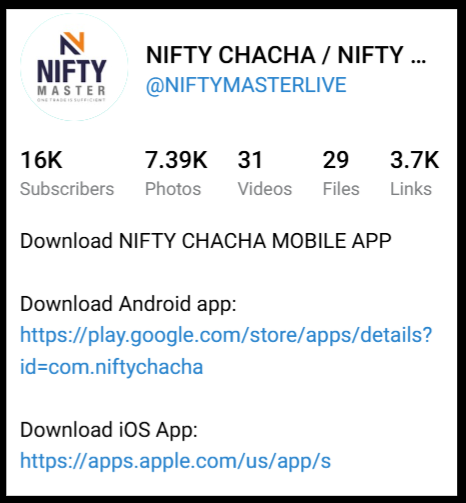
The operation spans a significant digital footprint.
There is a dedicated YouTube channel under @NIFTYMASTER offering trading analysis videos.
The channel also runs paid offline workshops, with events held at premium venues in cities like Hyderabad, where a full-day technical analysis workshop was conducted in January 2026 with a fee of ₹2,999 per attendee.
Multiple paid subscription tiers are offered, from a Beginners Pack to a Premium Education plan, a Pro Education pack, a NIFTY and Bank Nifty futures plan, and a Commodities plan, with monthly fees ranging from ₹1,500 to ₹6,999.
Payments are collected through Razorpay payment links shared directly on the Telegram channel.
Now that the scale of the operation is clear, let’s look at what the channel actually post, and why each category of content carries specific regulatory risks that traders must understand.
Nifty Chacha Telegram Channel Posts
Looking at the content posted on the Nifty Chacha Telegram Channel reveals a pattern that goes well beyond stock market education.
Each category of content raises a distinct regulatory concern, here is a breakdown of what is being shared and what violation it represents.
Category 1: Direct ‘Buy and Hold’ Calls on Specific Stocks
Posts saying ‘BUY AND HOLD’ followed by a list of named stocks (Adani Ports, Hindustan Unilever, Lupin, Voltas, Granules, UBL) are direct securities recommendations.
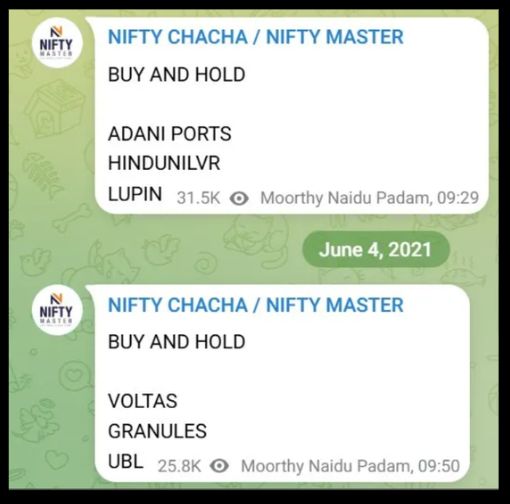
Under SEBI’s Research Analysts Regulations, 2014 and Investment Advisers Regulations, 2013, providing such recommendations requires mandatory registration, neither of which this channel appears to hold.
A ‘Buy and Hold’ instruction is not market commentary or general education. It is an explicit directional call on specific listed companies.
The posts reach over 25,000-31,000 views, which means this advice is being acted upon by a very large number of retail traders with no regulatory safeguard.
No risk disclosures, no research basis, and no SEBI registration number are included anywhere in these posts, all of which are mandatory for registered advisors.
Category 2: Profit Portfolio Screenshots – Selective Showcase of Wins
Sharing portfolio screenshots showing only green/profit positions is a classic selective disclosure tactic used by unregistered advisory channels.
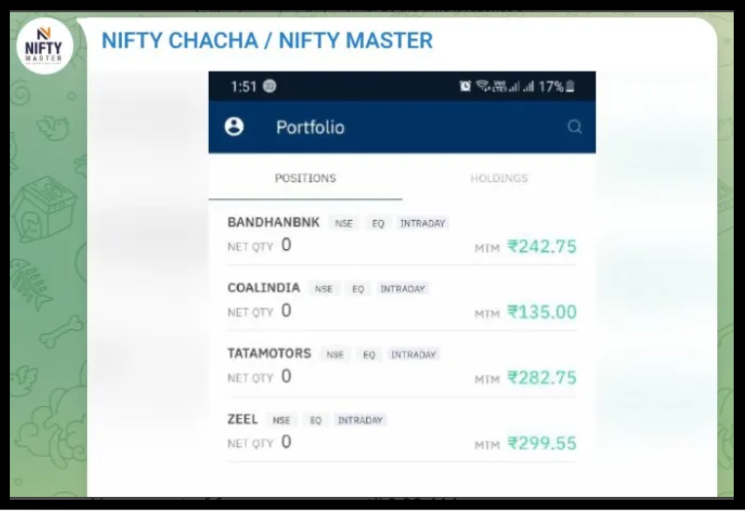
SEBI regulations explicitly prohibit advisory services, registered or unregistered, from misrepresenting their track record or projecting a false impression of consistent profitability.
Real trading involves losses. A channel that only shows winning positions is not showing you reality; it is showing you what it wants you to believe. This practice is directly cited as a prohibited behaviour in SEBI’s enforcement orders against Telegram channels, including the Intraday Jackpot case of April 2026.
Retail traders who see only profit screenshots are more likely to subscribe, pay, and then lose money following advice that has never been transparently tracked.
Category 3: Bundled Paid Subscription Offer – Trading Calls as a Product
This post offers ‘2 Intraday stock calls per day for 90 days’ as part of a paid subscription at ₹1,500 – a direct commercial advisory service.

Charging any fee for trading calls or investment recommendations without SEBI registration as a Research Analyst or Investment Advisor is a clear violation of law.
Bundling calls with ‘video classes’ and ‘gift books’ does not change the nature of the primary offering, paid securities recommendations. The payment link is a Razorpay link embedded directly in the channel post, indicating organised, systematic fee collection.
SEBI has consistently treated this exact model, free channel content combined with paid call subscriptions, as unregistered investment advisory activity subject to enforcement.
Category 4: Mobile App Advertising ‘Premium Calls Exclusively at Your Fingertip
The Nifty Chacha mobile app is the primary distribution platform for paid equity calls including ‘Equity Call 1’ through ‘Equity Call 4’ , visible in the app screenshot.
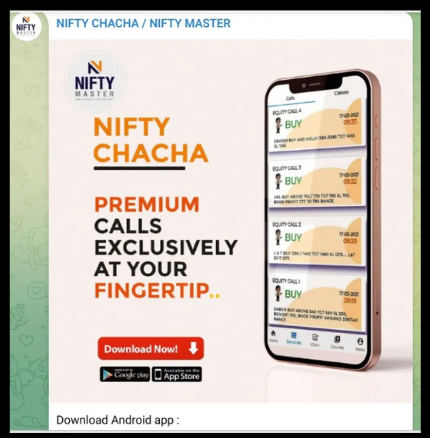
Building and operating a dedicated mobile application for the sole purpose of distributing securities calls is a formalised advisory operation, which requires SEBI registration under the RA/IA framework.
A mobile app monetising securities recommendations is held to the same SEBI standards as any advisory firm. The medium does not change the regulatory requirement.
Category 5: Tiered Paid Plans – Multiple Subscription Packages for Trading Calls
This post lists five separate paid packages: Premium Education (₹4,999/month), Super Pack (₹3,499/month), Pro Education (₹6,999/month), NIFTY/Bank Nifty (₹2,999/month), and Commodities (₹4,999/month).
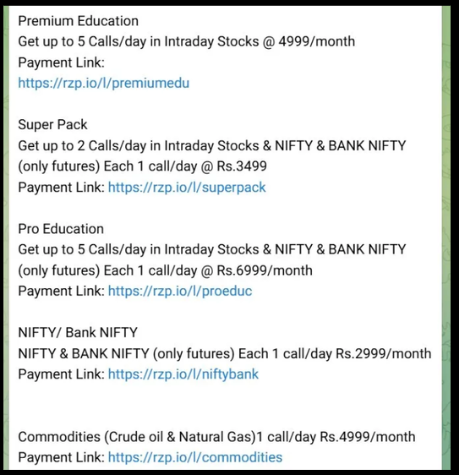
Offering a structured, multi-tier fee-based service for trading calls across equity, futures, and commodity segments constitutes a full commercial investment advisory operation.
All five payment links are Razorpay URLs embedded directly in the Telegram channel, indicating organised, systematic, and ongoing collection of subscription fees.
The breadth of instruments covered (Intraday stocks, Nifty, Bank Nifty futures, Crude Oil, Natural Gas) further establishes this as a broad advisory service, not casual market commentary.
SEBI regulations make it abundantly clear: any person or entity collecting fees for securities recommendations must hold a valid SEBI Research Analyst or Investment Advisor registration.
Category 6: Webinar Registration Urgency – ‘Limited Seats’ Pressure Tactics
The channel sends multiple back-to-back messages saying ‘Register soon only limited seats available,’ ‘Complete your registration immediately,’ and ‘Join now’, escalating urgency over several hours.
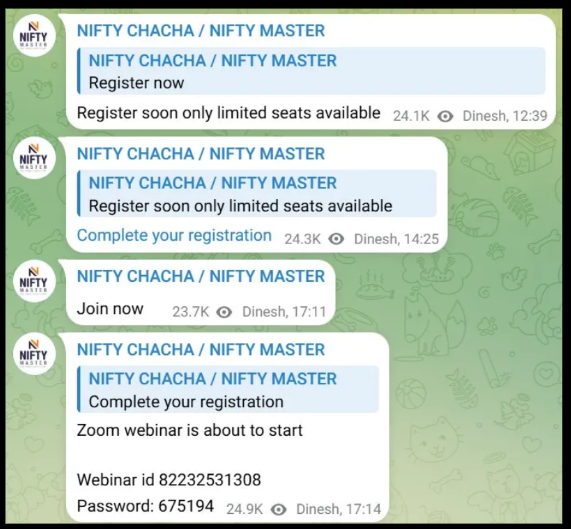
This tactic is designed to eliminate the time a trader needs to think critically, research, or verify whether the service is legally authorised to operate.
SEBI has specifically identified urgency-based messaging and artificial scarcity claims as tools used by unregistered advisors to rush investors into financial commitments.
Running a paid webinar or workshop on securities market topics through an unregistered channel constitutes solicitation for an unregistered advisory service.
The Zoom webinar being promoted, with paid registration required, falls under advisory solicitation activity, making it subject to the same SEBI registration requirements as any other paid advisory service.
Let’s take a look at what the users are saying.
Nifty Chacha Telegram Channel User Complaints
The Google Play Store reviews for the Nifty Chacha app offer a direct window into the experiences of people who subscribed and trusted this channel with their money.
The complaints follow patterns that are well-documented in the broader world of unregistered trading advisory services.
1. Paid for a subscription, then the app stopped functioning
One user reported that he paid for a one-month subscription, but the app stopped working in the second month, and showed a blank screen repeatedly.
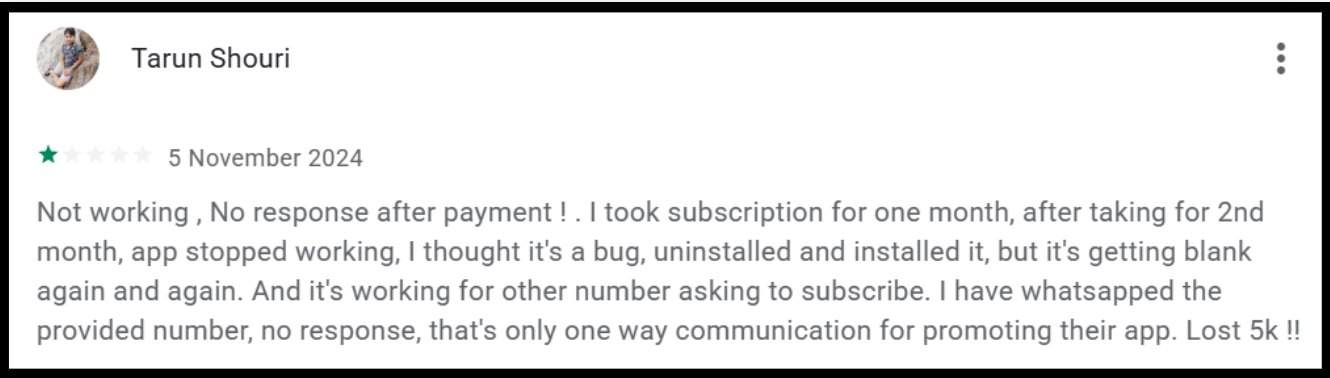
WhatsApp messages to the provided contact number received no reply. Describes it as ‘one-way communication’ for promotional purposes only. Financial impact reported: ₹5,000 lost with no service delivered and no recourse provided.
2. Calls displayed on the app arrive too late
Many users complained that calls displayed on the app arrive too late; by the time the notification reaches users, the market price has already moved. The ‘Calls All’ option reportedly does not function as described.
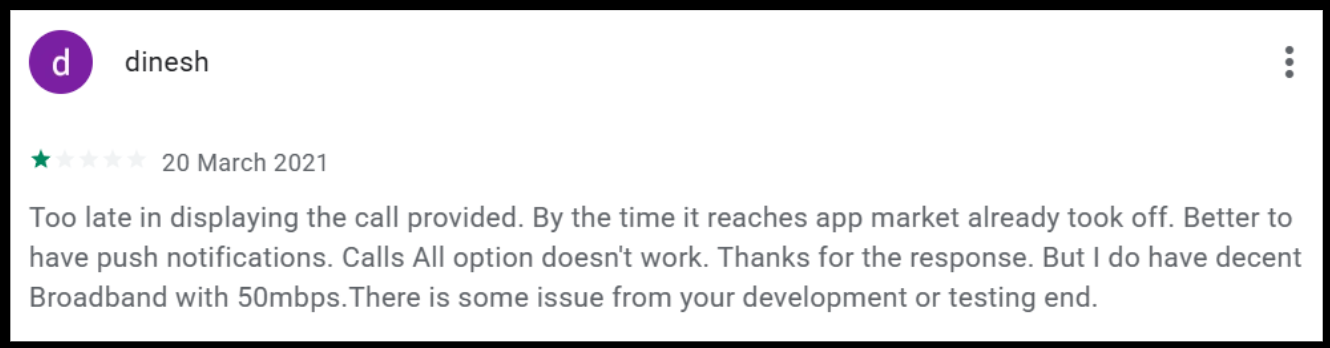
Notes there is an issue from the development or testing side, suggesting the platform was not reliably tested before being offered as a paid service.
3. Charges ₹1,000/month but following the calls resulted in losses
One user reported that they suffered losses exceeding ₹1,000 per day according by following their calls.
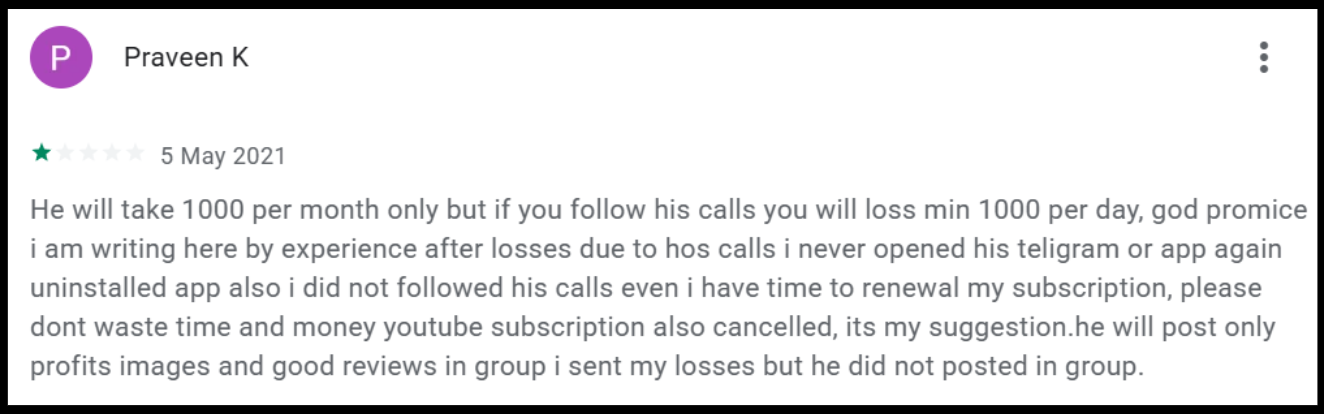
He explicitly states: the channel posts only profit screenshots in the group while ignoring loss screenshots sent by subscribers. Cancelled both app subscription and YouTube subscription after sustained losses. Advises others not to waste time or money.
4. No guidance provided on when to exit or sell positions
This is a critical omission in any legitimate advisory service. The user reported that the support calls go unanswered and describes the company as unresponsive to basic service queries.
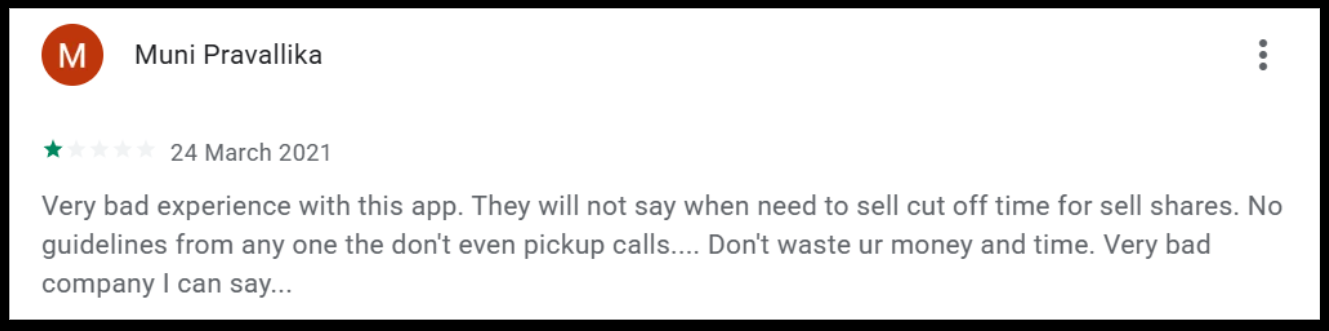
He summarises the experience plainly: ‘Don’t waste your money and time.
Read together, these reviews paint a consistent picture.
Subscribers paid for a service, the platform failed to deliver reliable calls in time, losses followed, customer support was absent, and loss screenshots were suppressed while only profit screenshots were shown publicly.
This is not a service with minor operational issues; it is a pattern of behaviour that SEBI has explicitly flagged and penalised in multiple enforcement actions.
These recurring complaints highlight a pattern that makes it important to understand what such channels are legally allowed to do, and where they may be crossing the line.
What SEBI Prohibits Telegram Channels From Doing?
Based on SEBI’s enforcement actions and its regulatory framework for investment advisors and research analysts, here is a consolidated picture of the prohibited activities across three categories.
- Giving specific buy, sell, or hold calls on individual stocks or index contracts without SEBI registration.
- Providing entry price, target, and stop-loss levels for intraday or positional trades as a paid service.
- Offering derivatives or futures-specific recommendations (Bank Nifty, Crude Oil futures) without the required registrations.
- Collecting subscription fees for trading calls through any medium, including apps, Telegram, or websites. without SEBI approval.
- Taking positions in stocks privately and then recommending them publicly to followers to inflate prices, pump-and-dump or scalping.
- Coordinating with stock insiders to drive up share prices while insiders offload holdings.
- Showing only profitable trades while hiding losses to simulate a false track record.
- Making claims of assured returns, guaranteed profits, or daily income targets.
- Using urgency tactics, ‘limited seats,’ ‘register now,’ ‘last chance, to rush subscription decisions.
- Routing fee payments through personal Razorpay links or UPI IDs without proper invoicing and compliance disclosures.
- Operating free content as a commercial funnel into paid services without upfront disclosure.
All of this brings us to the most important question: if you’ve already been engaging with such a channel, what steps should you take next?
What Should You Do If You’ve Been Following This Channel?
If you have been subscribing to the Nifty Chacha Telegram Channel or using the Nifty Chacha app for trading calls, here are the steps to take immediately.
Step 1: Stop acting on unregistered trading calls right now
No Telegram channel without a valid SEBI registration can legally offer investment advice of any kind. Following calls from such a source gives you zero regulatory protection and no recourse when losses occur.
Step 2: Verify registration status before trusting any advisory source
Check SEBI’s official Intermediaries Portal to verify whether any advisor or research analyst is genuinely registered. SEBI registration is issued to a specific named person or entity, not to a Telegram handle or mobile app. It is publicly verifiable.
Step 3: Preserve all evidence if you paid money and suffered losses
Collect and save everything: screenshots of calls you received, screenshots of payment confirmations, Razorpay receipts, UPI or bank transaction records, and any conversations with the channel operator. This evidence is essential for any formal complaint or recovery attempt.
With evidence in hand, the question most people then ask is: is there any realistic chance of getting my money back?
Can You Claim a Refund or Recover Your Losses?
This is the question that weighs on every trader who has already lost money. The truthful answer requires separating genuine hope from false comfort.
In many such cases, victims later start searching for solutions related to telegram stock market scam recovery, especially after realizing that the promises made by such channels were misleading or unverifiable.
SEBI does have the authority to direct refunds.
In the Intraday Jackpot case of April 2026, SEBI ordered the operators to jointly refund the full ₹9.02 crore collected from investors, a significant precedent for refund orders in Telegram advisory fraud cases.
The April 2023 scalping case resulted in disgorgement of ₹2.84 crore in unlawful gains.
However, the enforcement process takes time, requires SEBI’s investigation machinery to build a case, and depends on whether the accused party has accessible assets that can be directed toward refunds.
For individual investors, particularly those who paid smaller subscription amounts, full personal recovery is genuinely difficult to achieve.
There is still a ray of hope, recovery is more likely when many investors file coordinated complaints backed by documented evidence. Every piece of documented proof strengthens SEBI’s ability to build a case, seek disgorgement, and direct refunds.
SEBI’s Action Against Unregulated Telegram Channels
SEBI has taken decisive enforcement action against Telegram-based advisory operations across multiple orders. Two of the most directly relevant cases are described here, each one a close mirror of the patterns visible in the Nifty Chacha Telegram Channel.
Case 1: Scalping via Social Media & Telegram – April 2023
This landmark SEBI order established the legal framework for how scalping through Telegram channels is treated, and the financial consequences for those running such operations.
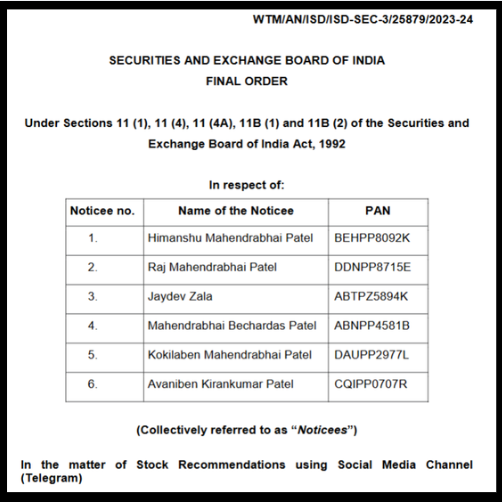
Channel operators built positions in specific stocks and then posted buy recommendations to their Telegram subscribers.
The resulting demand pushed prices up. The operators then sold their own holdings at the artificially inflated prices, a practice SEBI termed ‘scalping.’
The entire subscriber base was used as an instrument of price manipulation. SEBI characterised this as a fraudulent and unfair trade practice under the PFUTP Regulations.
Penalty of approximately ₹5.68 crore imposed on the noticees. Disgorgement of ₹2.84 crore in unlawful profits ordered. Entities held fully liable for fraudulent and unfair trade practices under SEBI law.
What makes this case vital is its direct applicability to any Telegram channel that builds a large following, posts buy calls, and has any financial interest in the stocks being called. The follower’s trust is the mechanism, and SEBI treats using that trust for personal gain as fraud.
Case 2: Safebulls Telegram Channel – Pump and Dump – April 2024
Safebulls looked, on the surface, exactly like the Nifty Chacha Telegram Channel, a large subscriber base, regular recommendations, and a professional appearance. What SEBI found beneath the surface was a different story entirely.
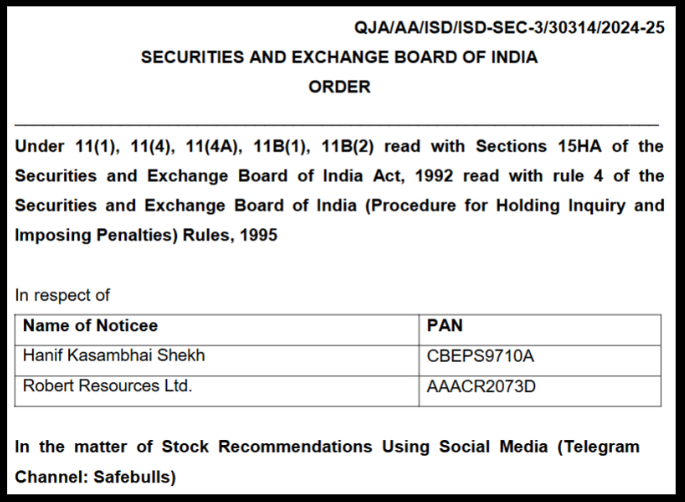
The Safebulls channel, with over 60,000 subscribers, was used to disseminate manipulative buy recommendations on specific stocks in which the operator had pre-loaded positions.
After follower demand drove up the price, the operator exited at a profit, a front-running and scalping scheme. The operation covered both cash market and derivative recommendations, amplifying the scope of manipulation.
One-year ban from accessing securities markets for both Hanif Kasambhai Shekh and Robert Resources Ltd. Penalty of ₹5 lakh each, payable jointly and severally. SEBI directed the immediate cessation of all advisory activities.
Safebulls is a direct reminder that subscriber count, a consistent posting history, and a working platform are not indicators of legitimacy. The only indicator that matters is SEBI registration, verifiable, public, and takes only two minutes to check.
These cases show what regulators do when they investigate. But the harder question for most people reading this is: what do you do if you have already paid, already lost money, and don’t know where to turn?
Need Help?
If you come across similar patterns, it is advisable to explore options for filing a complaint against unregistered telegram channel to protect yourself and others from potential financial loss.
You don’t have to go through this situation on your own.
We’re here to ensure your case reaches the right authorities and gets the attention it deserves.
Simply register with us and submit your details along with the supporting proof, we’ll take it forward from there.
Conclusion
India’s trading ecosystem has grown rapidly, and alongside it, a surge of so-called experts, tip providers, and advisory services across Telegram, YouTube, and apps. While a few genuinely focus on education, many operate without accountability.
SEBI has stepped up its oversight in response.
From 2024 onward, it has restricted registered entities from associating with unregistered finfluencers, mandated the display of registration numbers on market-related content, and worked with platforms to verify financial advertisers, moves aimed at reducing investor harm.
The case of the Nifty Chacha Telegram channel highlights a recurring trend: large follower base, polished branding across platforms, paid memberships, aggressive marketing, but no verified SEBI registration.
For traders, the simplest safeguard is to pause and ask: is the person SEBI-registered, and can you independently confirm it? If not, that itself is a clear signal to stay cautious.
Opportunities in the market will keep coming, protecting your capital should always come first.





 Add us as a preferred source on Google »

