

Quick Summary
An investor successfully recovered ₹65,788 from Alpha Wealth Research through the SEBI Online Dispute Resolution (ODR) framework and formal SMARTODR arbitration following issues with misleading return promises, improper fund solicitation, irregular fee collection, and unauthorized personalized advice. The sole arbitrator held the SEBI-registered Research Analyst accountable for regulatory non-compliance, resulting in a binding award for a 70% refund of the admitted service fees while clarifying that trading losses stemming from market risk remain the investor’s own responsibility.
Have you ever trusted a SEBI-registered advisor, only to watch a profitable start turn into mounting losses and unanswered questions?
That exact pattern is what one investor lived through with Alpha Wealth Research.
A small businessman from West Bengal, Mr. Sital Chandra Mandal, found himself trapped in a cycle of payments, promises, and losses he never expected.
This blog covers the recovery of ₹65,788 from Alpha Wealth Research, a case that went all the way through formal arbitration and ended with a documented, binding award.
How One Profitable Trade Turned Into a ₹1,10,900 Costly Trap?
It started in January 2025 with a WhatsApp message.
Representatives from Alpha Wealth Research, a firm operated by Mr. Syed Haris Ali under SEBI Registration Number INH000014650, reached out to Mr. Sital Chandra Mandal directly.
They shared screenshots showing profitable trades made by other clients.
The message was simple: see what our clients are earning.
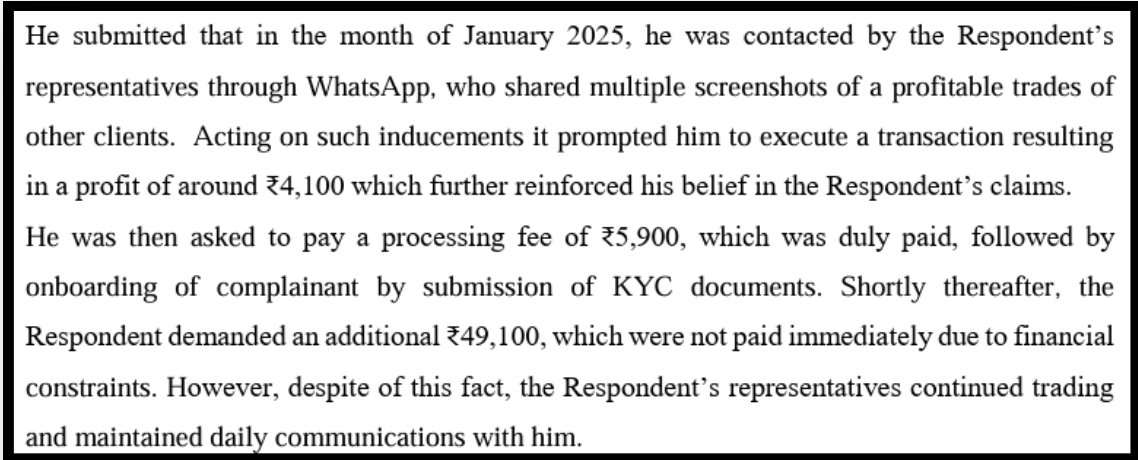
Acting on this trust, Mr. Sital Chandra Mandal executed one trade. It made a profit of around ₹4,100. That single profitable trade was enough to convince him this firm could be trusted.
Soon after, he was asked to pay a processing fee of ₹5,900. He paid it. KYC documents were submitted. Onboarding was completed quickly.
That early win became the hook. And once trust was established, the real pressure began.
Why Did the Payments Keep Increasing After Every Loss?
This is the part that should concern every investor reading this case.
Shortly after onboarding, the firm demanded an additional ₹49,100. Mr. Sital could not pay it immediately due to financial constraints.
But the trading continued anyway, with daily communication maintained throughout.
Eventually, ₹50,000 more was charged, bringing total payments to ₹70,900 at that stage. A legal-looking document was signed, formalising what Mr. Sital believed was a standard service agreement.
As trades began showing losses, instead of pausing or reassessing, the firm asked for ₹40,000 more. Cumulative payments climbed to ₹1,10,900.
Each time losses appeared, the response was the same: pay more, and recovery will follow. This pattern repeated until the situation became unsustainable for Mr. Sital.
So what exactly went wrong here from a regulatory standpoint? Let us break down the specific violations that emerged once this case reached arbitration.
What SEBI Violations Were Found in This Case?
When the arbitrator examined the full evidence, several clear regulatory breaches came to light.
These violations form the backbone of why the recovery of ₹65,788 from Alpha Wealth Research became possible.
1. Misleading representations of returns
The firm’s representatives shared selective screenshots of profitable trades and assured Mr. Sital that past losses would be recovered if he invested additional funds.
This directly violates Regulation 18 of the SEBI Research Analyst Regulations, 2014, which prohibits false or misleading statements.
It also breaches the SEBI Master Circular’s restriction on using past performance as a promotional tool.
2. Improper solicitation of funds
The firm repeatedly inquired about Mr. Sital’s available capital and pressured him to invest more money.
This kind of personalised financial capacity assessment falls outside what a Research Analyst is permitted to do and edges into Investment Adviser territory, a role for which the firm was not registered.
3. Irregular fee collection
Payments were charged in fragmented tranches, ₹5,900, then ₹15,000, then ₹50,000, then ₹40,000, without invoices clearly reflecting the actual service package or duration.
Services were marketed around equity trading, yet trades executed were largely in derivatives, creating a mismatch between what was advertised and what was delivered.
4. Personalized advice beyond permitted scope
The arbitrator found that the firm provided trade-specific guidance, including strike prices, quantities, and entry and exit timings.
This level of personalised direction is something only a SEBI-registered Investment Adviser can legally provide, not a Research Analyst.
These findings did not emerge from assumption. They were established through documented evidence, WhatsApp screenshots, call recordings, payment receipts, and the signed service agreement.
With these violations clearly established, the next question becomes obvious: how did this case actually move from complaint to a binding recovery?
From Complaint to Arbitration: How We Managed the Legal Process
Mr. Sital did not arrive at the arbitration table overnight, and he certainly didn’t have to walk that complex regulatory path alone.
When he first reached out to us, he was frustrated and stuck. We immediately stepped in to help him structure his case, moving it step-by-step through the formal regulatory channels.
The first critical milestone we tackled together was referring the matter to conciliation under the SEBI ODR framework via the SMARTODR platform.
We helped him prepare for the conciliation sessions, where the conciliator quickly picked up on the firm’s communication deficiencies and blatant regulatory non-compliance.
Seeing the walls close in during conciliation, the Respondent actually offered a 30% compensation payout directly to Mr. Sital.
While it felt like a small victory and was an implicit acknowledgment of their irregular conduct, we advised Mr. Sital that this pocket-change offer didn’t scratch the surface of his actual losses.
On our advice, he stood his ground and rejected the lowball settlement, allowing us to push the case forward to formal arbitration.
We managed the transition seamlessly, moving the dispute to an online arbitration hearing via the SMARTODR platform on September 25th, 2025.
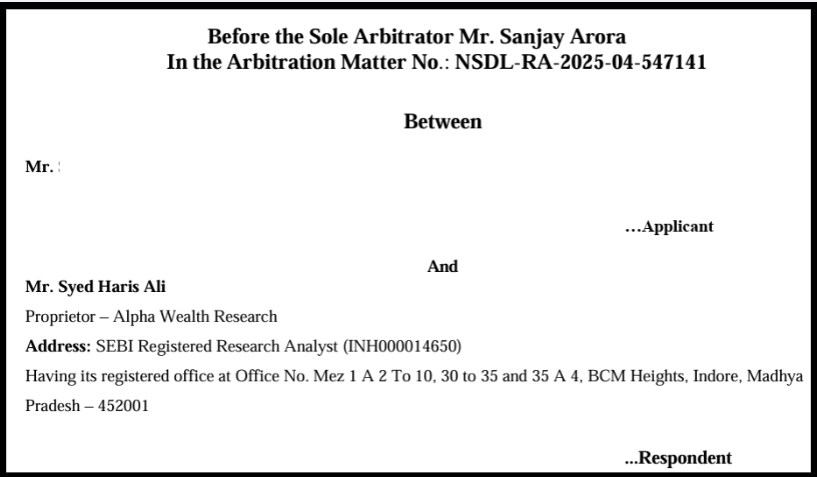
Presided over by the Sole Arbitrator, Mr. Sanjay Arora, we ensured all of Mr. Sital’s arguments, backed by airtight written submissions and evidence, were laid out flawlessly.
It was this rigorous, guided approach that ultimately turned a frustrating scam into a binding, successful recovery.
Alpha Wealth Research Arbitration Award
The final award balanced responsibility on both sides, and that balance matters for anyone trying to understand what realistic recovery looks like.
The arbitrator noted that Mr. Sital voluntarily subscribed to the service, continued trading even after an initial profit, and raised his complaint only after losses occurred.
This reflected an element of contributory negligence on his part, since markets carry inherent risk and profits are never guaranteed.
At the same time, the arbitrator found that Alpha Wealth Research engaged in conduct inconsistent with SEBI’s regulatory framework.
This included selective presentation of profitable trades, personalised investment guidance beyond permitted scope, persistent solicitation of additional funds, and irregular invoicing practices.
Because both parties carried some responsibility, the arbitrator ruled that while Mr. Sital’s trading losses could not be reimbursed, the firm also could not retain the entirety of fees collected under misleading and non-transparent circumstances.
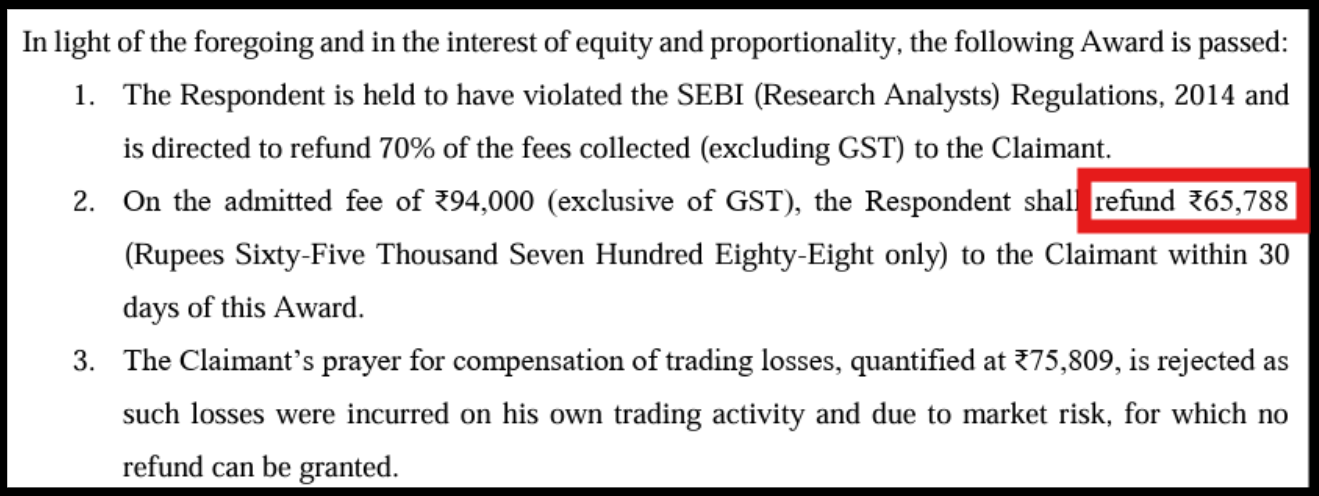
The result was a directed refund of 70 percent of the admitted fee of ₹94,000, exclusive of GST. That calculation produced the final award amount of ₹65,788, to be paid within 30 days of the order.
The claim for compensation for trading losses, quantified at ₹75,809, was rejected since those losses stemmed from market risk and Mr. Sital’s own trading activity.
The claim for interest on fees was also rejected for similar reasons.
This outcome shows something important. Recovery through arbitration is rarely about getting back every rupee. It is about holding a registered entity accountable for documented regulatory violations.
Now, if your situation feels familiar, here is what the path toward a similar outcome actually looks like.
How to Complaint Against Alpha Wealth Research?
If you have faced a similar pattern, fee pressure after losses, personalised trade calls, or assured recovery promises, here is the structured path forward.
Step 1: Collect Every Piece of Evidence
Save WhatsApp chats, call recordings, payment receipts, invoices, the service agreement, and any screenshots shared during your interactions.
This documentation is exactly what made the difference in Mr. Sital’s case.
Step 2: Raise the Issue With the Firm First
Submit a formal, written complaint to the entity directly.
Clearly state your concern, the amount involved, and the resolution you expect.
Step 3: Lodge a Complaint in SEBI SCORES
A complaint can also be filed on SEBI SCORES, citing the firm’s registration number and the specific regulatory violations involved.
Acting early and preserving documentation throughout the process strengthen your position significantly at every stage.
Step 4: Raise a Complaint with SMART ODR
If the firm does not resolve your complaint satisfactorily, the matter can be referred to conciliation under the SEBI ODR framework via the SMARTODR portal.
You can easily initiate this process by visiting the Smart ODR login page on the portal and registering your dispute.
Many disputes find partial resolution at this stage.
Step 5: Arbitration in Share Market
If no resolution is achieved, launching an arbitration against research analyst India becomes the final step, where a binding decision is issued.
This ensures both sides are heard properly, and a fair conclusion is reached.
Need Help With a Similar Case Against Alpha Wealth Research?
If your experience with Alpha Wealth Research or any similar Research Analyst mirrors what Mr. Sital went through, you do not need to navigate this process alone.
Our mission is to spread awareness about online and financial scams, support investors in reporting their cases, and guide them on the path toward recovering lost funds wherever possible.
Here is what we help with:
- Reviewing your documents and communication history to map out specific SEBI violations.
- Helping you draft a clear, regulation-backed formal complaint.
- Guiding you through SEBI SCORES and the SMARTODR conciliation process.
- Supporting you through arbitration proceedings, from filing to final award.
Mr. Sital’s case shows that structured documentation and the right regulatory channels can produce a real, binding outcome. Your case deserves the same careful approach.
Register with us today, and let us help you understand what recovery could look like for you.
Conclusion
The recovery of ₹65,788 from Alpha Wealth Research stands as a clear example of what formal arbitration can achieve when violations are properly documented.
Mr. Sital’s case involved misleading return promises, improper fund solicitation, irregular fee collection, and personalised advice beyond what a Research Analyst is permitted to provide.
Each violation was backed by evidence, and each one mattered in the final award.
The outcome was not a full refund. It was a balanced decision, recognising that both parties carried some responsibility.
But for an investor who once felt completely stuck, ₹65,788 represented real, verified accountability.
If you are facing a similar situation, know that the regulatory system does provide a path forward.
It requires patience, documentation, and the right process, but as this case shows, it can work.
Frequently Asked Questions
The arbitrator directed a refund of 70 percent of the admitted fee of ₹94,000, exclusive of GST. This calculation resulted in the final award of ₹65,788, payable within 30 days of the order.
No. The claim for ₹75,809 in trading losses was rejected, since those losses were attributed to market risk and the investor's own trading decisions, not a recoverable regulatory violation.
The arbitrator found violations, including misleading representation of returns, improper solicitation of additional funds, irregular and non-transparent fee collection. And providing personalised trade advice beyond the permitted scope of a Research Analyst.
The matter first went through conciliation under the SEBI ODR framework, where a conciliation report was issued in June 2025. After no settlement was reached, formal arbitration followed, with the hearing held in September 2025 and the final award published in October 2025.
Yes. If you believe a Research Analyst is engaged in misleading practices, fee pressure, or unauthorised personalised advice, you can raise a formal complaint. Escalate to SEBI SCORES, attempt conciliation through SMARTODR, and pursue arbitration if the matter remains unresolved.





 Add us as a preferred source on Google »

