

Quick Summary: On 4 September 2026, the National Stock Exchange (NSE) issued a public caution about a person named Vicky Dhakad, operating a YouTube channel called “Ai Trading Stock Market Broker” and a website, who is offering guaranteed returns, account handling, and dabba (illegal) trading services. NSE has confirmed this person is not registered as a broker or an authorised person of any registered broker. A police complaint has already been filed. If you have seen this channel, been messaged by this person, or are thinking of paying them, this page explains, in plain words, what the warning means, why these offers are illegal, and what you stand to lose if you get involved.
What Did NSE Say About the Ai Trading Stock Market Broker YouTube Channel?
Let us start with exactly what the exchange put on record, because the facts are simple and they matter.
NSE said it had come to its notice that a person named Vicky Dhakad, using a particular mobile number, was running a YouTube channel named “Ai Trading Stock Market Broker” along with a website.
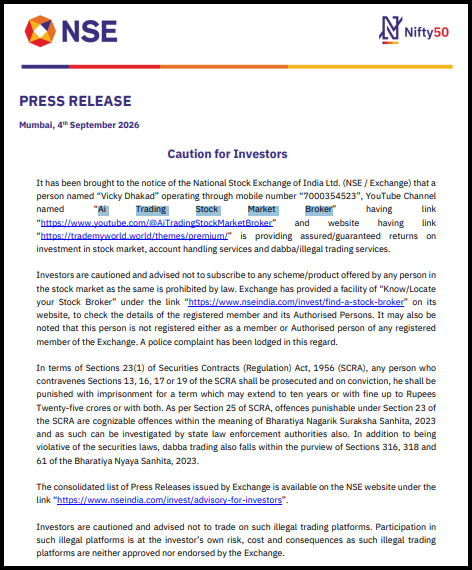
Through these, the person was offering three things: assured or guaranteed returns on stock market investment, account handling services, and dabba or illegal trading services.
The exchange then said the one thing that settles it. This person is not registered either as a member of the exchange or as an authorised person of any registered member.
In plain terms, he has no licence to offer any of this. NSE has lodged a police complaint, and it has advised investors not to subscribe to any scheme or product offered by him.
That is the whole caution in a sentence: a person with no registration is promising things no registered broker is even allowed to promise. Each of those three offers is a known trap, so let us take them one at a time.
Why “Guaranteed Returns” Is Always the First Red Flag
This is the promise that pulls people in, and it is the easiest one to see through once you understand a basic truth about markets.
Nobody can guarantee a return on a stock market investment. Not the biggest fund manager in the country, not a registered broker, not SEBI itself.
Prices move on things no one controls, so any promise of assured or fixed profit is a promise nobody can honestly keep. When someone guarantees it anyway, they are not offering you a better product.
They are lying to you, and the lie is the whole business model.
A registered adviser is legally barred from promising guaranteed returns, precisely because it is impossible. So the moment you hear “assured returns,” “fixed daily profit,” or “guaranteed X percent,” you are almost certainly not dealing with anyone legitimate.
The AI branding here does not change that. Slapping “AI” on the pitch just makes an old trick sound modern, and a smart algorithm still cannot promise the market will move your way.
If you want to see how this promise plays out in real life, our account of this dabba trading financial trap shows the exact path from a tempting guarantee to a wiped-out savings account.
Account Handling: Why You Should Never Share Your Login
The second offer in the NSE caution is account handling, and this one deserves close attention because it feels helpful and is anything but.
Account handling means the person offers to trade your account for you.
To do it, they ask for your login ID, your password, and often the OTP that comes to your phone. It sounds convenient, especially if you are new or busy. Someone experienced will just handle it and share the profits.
Here is the problem. The moment you hand over your credentials, you have handed over control of your money to a stranger who answers to no one.
There is no rule saying they must trade in your interest, no regulator watching what they do inside your account, and no easy way to prove what happened if it goes wrong.
Legitimate portfolio management is a separate, licensed activity with strict safeguards. A YouTube “broker” asking for your password is not that.
He is asking you to remove the one lock protecting your savings.
What Is Dabba Trading, and Why Is It Illegal?
The third service in the caution is dabba trading, and since NSE names it directly, it is worth explaining in the simplest possible way.
Dabba trading is trading that never actually reaches the stock exchange. You think you are buying and selling shares, but nothing you do goes to NSE or BSE.
The operator runs a private system, often a slick-looking app or website with real-time charts, and simply keeps a private ledger of your “trades.” Your profit or loss is whatever he decides to show you. Nothing is real, and nothing is on the exchange.
Because it happens entirely outside the regulated system, dabba trading is illegal in India. And the consequences are not small. Under the Securities Contracts (Regulation) Act, a person running this can face imprisonment of up to ten years or a fine of up to ₹25 crore, or both.
NSE’s caution also notes that dabba trading now falls under the newer criminal laws, the Bharatiya Nyaya Sanhita, so it can be treated as a cognisable offence and investigated by the police, not just the market regulator.
For you as the investor, the danger is even simpler than the law. If the operator disappears with your money, or shows you a fake loss and demands more, you have almost no protection, because you were never on a real exchange to begin with.
Our detailed guide on dabba trading walks through both the mechanics and the recovery routes if you are already caught in one.
How the Ai Trading Stock Market Broker YouTube Channel Trap Works?
The NSE caution names one operator, but the pattern behind it is always the same. Knowing the pattern is what protects you from the next one.
It starts with content. A YouTube channel or reel shows confident predictions, screenshots of big profits, and talk of a special AI system that beats the market.
It looks professional and knowledgeable. That is exactly the point.
Then comes contact. You are invited to message on WhatsApp or Telegram, or to join a private group.
The tone is friendly and urgent. A special opportunity, limited slots, act now.
Then the ask. You are told to put money into their app, or to let them handle your account, or both.
The first small return often shows a profit. That is bait, to build trust and pull in a bigger deposit.
Then the turn. Once you have put in real money, the story changes. A sudden loss appears, or your withdrawal will not process.
You are told to deposit more to “recover” or “unlock” your funds. And eventually the app, the channel, or the person goes quiet.
Every step is designed. The AI branding, the guaranteed returns, the account handling, the dabba app are all tools in the same machine.
Recognise the shape of it, and you can step off at the first stage, before any money moves.
How to Check If a Broker Is Real Before You Pay Anyone?
The most powerful thing NSE said is also the easiest to act on. The exchange runs a free tool to check whether a person is a genuine registered broker.
Before you trust anyone offering to trade for you or take your money, verify them. NSE’s “Know / Locate your Stock Broker” facility on its official website shows whether a person or firm is a registered member or authorised person.
If the name is not there, they are not registered. Full stop, exactly as the exchange found for this operator.
Build these four habits and almost no scam of this kind can reach you:
- Verify registration first, on the exchange’s or SEBI’s official website, before any money or credentials change hands.
- Treat any guarantee of returns as proof of a scam, because no honest party can make that promise.
- Never share your login, password, or OTP with anyone offering to handle your account.
- Be extra careful with YouTube-only operators, reached through a channel, a WhatsApp number, or a private app, with no registered office and no verifiable licence.
If you have already dealt with an operator like this and something feels wrong, our page on dabba trading complaints sets out the steps that have actually worked for others.
What You Lose the Moment You Step Off the Real Exchange
There is one part of the NSE caution people skip, and it is the most important protection you give up without realising.
When you trade through a registered broker on a real exchange, you are covered by a safety net. If something goes wrong, an exchange dispute resolution mechanism and an investor grievance system exist to help you.
These are the very tools our work relies on to help investors recover losses.
NSE was blunt about this. For disputes involving these illegal schemes, none of that protection is available to you.
No exchange dispute resolution. No grievance redressal. You are entirely on your own, because you were never on the regulated system where those protections live.
That is the real cost of an offer like this. It is not just the risk of losing a deposit.
It is that you step outside the entire structure built to protect you, voluntarily, in exchange for a promise that was never real.
The Bottom Line for Retail Traders
Strip away the AI branding and the polished videos, and the NSE caution describes something very old: an unregistered person promising the impossible and asking for your money or your password.
The exchange has done its part. It named the operator, confirmed he holds no registration, and filed a police complaint.
Your part is simpler. Do not subscribe. Do not deposit. Do not share your login.
And before trusting anyone in the market, check their registration on the official exchange or SEBI website. It takes a minute and settles the question completely.
A real opportunity survives a background check. A scam does not.
If you have already been drawn in, do not stay silent. Act quickly, and get the situation looked at properly.
Report. Recover. Stay Fraud Free.
Frequently Asked Questions
1. Is the Ai Trading Stock Market Broker YouTube channel run by a registered broker?
No. In its caution dated 4 September 2026, NSE confirmed that the person behind the “Ai Trading Stock Market Broker” YouTube channel is not registered as a member or an authorised person of any registered member of the exchange. NSE has filed a police complaint in the matter.
2. Why is offering guaranteed returns illegal in the stock market?
Because no one can actually guarantee returns; prices move based on factors nobody controls. Registered advisers are legally barred from promising assured profits precisely because it is impossible.
Anyone guaranteeing fixed or assured returns is therefore either unregistered, dishonest, or both.
3. What is dabba trading and what is the punishment for it?
Dabba trading is trading that never reaches a real stock exchange, run instead on a private ledger by an operator. It is illegal in India.
Under the Securities Contracts (Regulation) Act, it can attract imprisonment of up to ten years or a fine of up to ₹25 crore, or both, and it now also falls under India’s newer criminal laws.
4. Is it safe to let someone handle my trading account?
Sharing your login, password, or OTP so someone can trade your account is extremely risky and is a common feature of these scams. No genuine registered person needs your credentials to help you.
Legitimate portfolio management is a separate licensed service with strict safeguards, which a YouTube operator asking for your password is not offering.
5. How can I check if a stock broker is genuine?
Use the exchange’s official “Know / Locate your Stock Broker” tool on the NSE website, or check SEBI’s official records, before giving anyone money or account access.
If the person or firm is not listed as a registered member or authorised person, they are not authorised to offer broking services, and you should not deal with them.
6. If I lose money to such a scheme, can the exchange help me recover it?
NSE has made clear that for disputes involving these prohibited, illegal schemes, the usual protections, exchange dispute resolution and the investor grievance mechanism are not available, because the activity happens outside the regulated system.
This is why verifying registration before you pay is so important, and why acting quickly matters if you are already affected.


 Add us as a preferred source on Google »