
Quick Summary
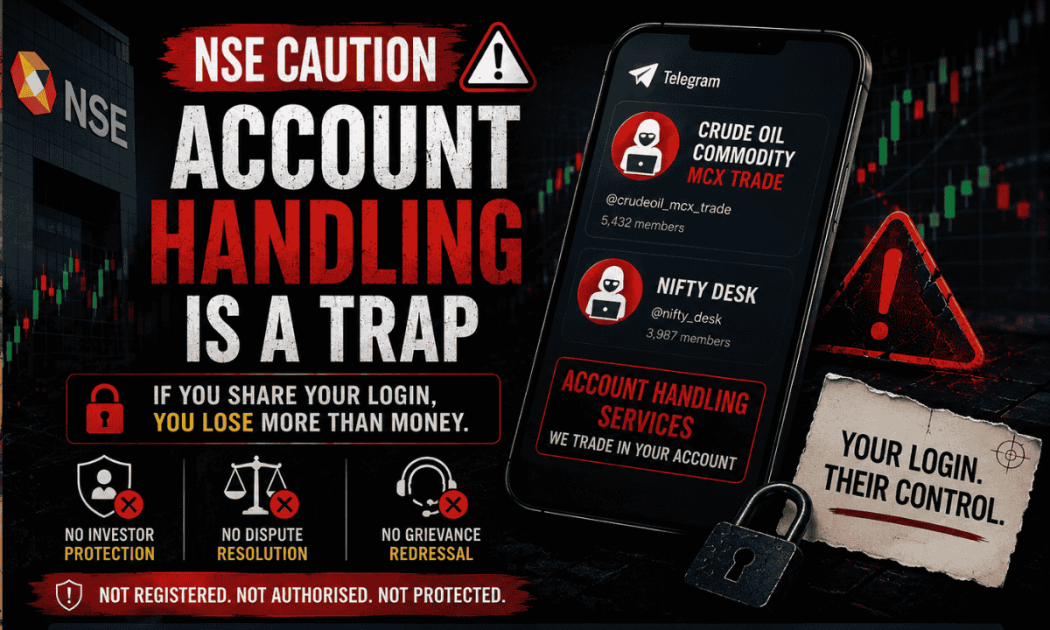
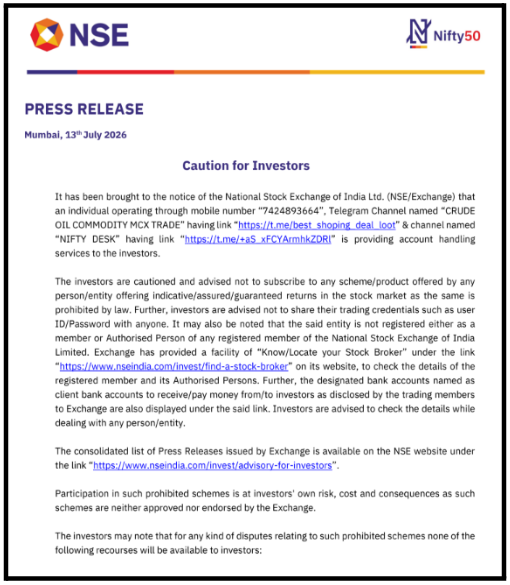
NSE issued a press release on July 13, 2026 cautioning investors about an individual operating two Telegram channels, “CRUDE OIL COMMODITY MCX TRADE” and “NIFTY DESK”, who is providing account handling services to investors. NSE states the entity is not registered as a member or Authorised Person of any NSE registered member. The part worth reading twice sits at the end of the release. NSE lists three recourses that will not be available in any dispute involving such schemes. That list is the whole document, and this page explains why.
Most people read an exchange caution and take away one thing. Avoid this channel.
That is the least useful thing in the document.
The useful part is the closing paragraph, where NSE lists what you lose. Not what the operator did. What you lose, permanently, the moment you hand over your login.
NSE’s press release dated July 13, 2026 names two Telegram channels offering account handling services. Here is what that phrase means, and why this specific caution is more serious than the ones about tips and calls.
NSE Caution July 13 2026: What the Exchange Warned About
The release is short, and it says three specific things.
One. An individual operating through a stated mobile number, running the Telegram channels “CRUDE OIL COMMODITY MCX TRADE” and “NIFTY DESK”, is providing account handling services to the investors.
Two. That entity is not registered as a member, or as an Authorised Person of any registered member, of the National Stock Exchange of India Limited.
Three. For any dispute relating to such prohibited schemes, none of the following will be available:
- Benefits of Investor Protection under the Exchange’s jurisdiction
- The Exchange Dispute Resolution Mechanism
- The Investor Grievance Redressal Mechanism administered by the Exchange
Note what NSE did not say. It did not say fraud occurred. It did not say anyone lost money. It said the entity is unregistered and it is offering account handling.
That distinction matters, and there is a section on it below.
What Account Handling Services Means in NSE’s Warning
This is the phrase that makes this caution different from a tips channel warning.
A tips channel sends you a call. You decide whether to act. Your money stays in your account, under your login, and you press the button.
Account handling is not that. Account handling means you give someone else your trading credentials and they trade your account for you.
Your user ID. Your password. Your OTP, often.
They log in as you. They place trades as you. Every trade the exchange sees is a trade you made, because it came from your credentials, from your account, with your authentication.
NSE addresses this head-on. The release advises investors not to share their trading credentials such as user ID/Password with anyone.
There is a narrow legal exception here that people miss, and it is worth knowing. Portfolio Management Services registered with SEBI can legally manage your money, and they carry a ₹50 lakh minimum.
Everything else is outside the rules. Our page on SEBI-registered account handling sets out where that line sits and what even a registered adviser is barred from doing.
Why the Recourse List is the Actual Warning
Picture the dispute after account handling goes wrong.
You go to the exchange. You say someone else made these trades and lost my money.
The exchange looks at the record. The trades came from your login. Your credentials. Your account. There is no unauthorised access, because you authorised it when you shared the password.
There is also no registered intermediary on the other side. You cannot complain against a broker, because the person handling your account is not one. NSE has already recorded that they are not a member, and not an Authorised Person of any member.
So the exchange has nobody to act against and nothing to act on. That is not the exchange being unhelpful. It is the structural consequence of the arrangement.
The three recourses NSE lists are the three doors a wronged investor normally walks through. Account handling with an unregistered person closes all three before anything goes wrong.
Is the Entity Registered or Not: The Check NSE Points To
The release points to the exchange’s own verification facility, and this is the practical part.
NSE runs a “Know/Locate your Stock Broker” facility on its website. It does two things, and the second is the one almost nobody uses.
First, it lists registered members and their Authorised Persons. If someone says they are attached to a broker, this is where you confirm it. Not their word. Not a screenshot they send you.
Second, it displays the designated client bank accounts that trading members have disclosed to the exchange for receiving money from investors.
That second function is the most useful check available to a retail investor, and it takes a minute.
Money going to a registered broker goes to a disclosed client bank account. If someone asks you to transfer to a personal account, a UPI ID, or a current account in an individual’s name, that account will not appear on the list.
If the receiving account is not on the exchange’s list, the money is not going to a broker. Whatever else you were told, that fact stands alone.
NSE also maintains a consolidated list of these caution releases under the investor advisory section of its website. Names appear there regularly. Worth a look before you pay anyone.
What This NSE Caution Does and Does Not Mean
Precision matters here, because precision is what protects you.
What it means. NSE has recorded that this individual and these two channels are not registered with the exchange in any capacity, and that account handling services are being offered. Registration status is verifiable, and NSE verified it.
It also means the exchange’s protection mechanisms do not extend to disputes arising from these schemes. That is a statement about jurisdiction, not about guilt.
What it does not mean. A caution is not a finding of wrongdoing. NSE is not a court, and this is not a judgment. The release does not allege fraud, does not name an amount, and does not say any investor lost money.
It also does not mean SEBI has acted. An exchange caution is separate from a SEBI order. If SEBI examines this and passes an order later, that order would carry findings, penalties, possibly refund directions. This release carries none of those, because that is not what it is for.
The value of a caution is timing. It comes out fast, before any investigation concludes, so people can act early.
Account Handling Complaints: What to Do If You Already Shared Your Login?
If you have handed your credentials to anyone running an arrangement like this, sequence matters more than speed.
Change your password now. Before you read the rest of this. If they still have access, everything else is theoretical.
Then check what else is linked to the account. Power of Attorney arrangements. Trading Preference settings. Bank mandates. Auto-pay setups. A password change does not undo a signed authorization.
Then document, before you contact anyone:
- Your full trade ledger for the period they had access, downloaded from your broker
- Your contract notes
- Bank statements showing every transfer, with dates and account numbers
- Complete Telegram chat history, exported rather than screenshotted
- Every payment reference, UPI ID or account number you sent money to
- Any recording or message where returns were promised, or a profit split was agreed
Export the Telegram history properly. These channels disappear, and a channel that vanishes takes your evidence with it if all you have are partial screenshots.
Then report:
- Your broker, in writing, immediately. Ask them to flag unauthorised activity, even though the trades came from your credentials. It creates a dated record.
- Cybercrime portal, if money went to an individual account. This is a financial fraud complaint, not a market dispute, and that framing is what gives it a route.
- SEBI SCORES, if any registered intermediary sits anywhere in the chain.
- NSE, through the contact route on its investor advisory section, so the exchange knows the channel is live.
The steps for gathering and filing are set out in full on our trading scam recovery page, including what evidence holds up and what gets dismissed.
An Honest View of Where You Stand
This is harder than a case against a registered intermediary, and pretending otherwise helps nobody.
You are not in a market dispute. You are in a fraud case. NSE has already told you the exchange’s dispute mechanisms do not cover this, and that is not a formality.
What you have instead is a money trail and a police route. If funds went to an identifiable bank account, that account can be traced and, in some cases, frozen. Speed decides that outcome, because money moves through layered accounts within days.
The NSE caution helps you. It is a dated public document from the exchange establishing that the entity was unregistered and offering account handling as of July 13, 2026. It supports your account of events. It does not create a claim, and it does not get your money back.
What decides your case is the trail and how fast you move on it.
Did someone else have your trading login when the losses happened?
Our team reconstructs your trade ledger against your chat and payment records, separates the trades you placed from the trades placed for you, and files the SCORES complaints in the order that keeps the money trail live. Register with us to get the support.
Two Details in This Caution Worth Noticing
The release carries two things that warrant a second read.
The link that does not match the channel. “CRUDE OIL COMMODITY MCX TRADE” runs on a Telegram address that reads as a shopping deals link. Nothing to do with trading.
That is not sloppiness. Channel addresses get recycled. An address built for one audience gets renamed and repointed at another, which is why the name on the channel and the address underneath it can tell completely different stories. If you are checking a channel, the display name is the least reliable thing about it.
Two channels, one operator. CRUDE OIL COMMODITY MCX TRADE targets commodity traders. NIFTY DESK targets index traders.
Same individual, two audiences, two entry points. Someone who ignores one may join the other without ever knowing it is the same operation.
The account handling model itself follows a script that rarely varies, usually arriving as a profit split rather than a fee. Our page on profit sharing scams traces how that pitch is built and why the split is always structured so the losses stay with you.
Conclusion
NSE’s July 13, 2026 caution names two Telegram channels and one unregistered individual offering account handling services.
The registration fact is verifiable, and the exchange verified it. But the sentence that matters is the last one, listing what disappears in any dispute: investor protection under the exchange’s jurisdiction, the dispute resolution mechanism, and the grievance redressal mechanism.
Those three protections are the reason a regulated market is worth using. Handing your login to an unregistered person surrenders all three. It happens at the moment you share the password, not at the moment you lose money.
A caution is a warning, not a verdict. Read it as one. NSE published this on July 13 so people could act before an investigation concludes, which is the only kind of warning that arrives in time to be useful.
Report. Recover. Stay Fraud Free.
Frequently Asked Questions
Only SEBI registered Portfolio Management Services can legally manage and trade your money, with a ₹50 lakh minimum. NSE's release states participation in such prohibited schemes is at the investor's own risk and that the entity named here is not registered as a member or Authorised Person.
A tips channel sends recommendations and you decide whether to trade. Account handling means you give someone your user ID and password and they trade your account themselves. Every trade then appears on the exchange record as yours, which removes the basis for most complaints.
No. NSE's release states that investor protection under the exchange's jurisdiction, the dispute resolution mechanism, and the grievance redressal mechanism are all unavailable for disputes involving such schemes. Recovery runs through cybercrime complaints and the money trail instead.
Use NSE's "Know/Locate your Stock Broker" facility on its website. It lists registered members and their Authorised Persons, and displays the designated client bank accounts disclosed to the exchange. If the person or the receiving account is not listed, they are not authorised.




 Add us as a preferred source on Google »

