
Quick Summary
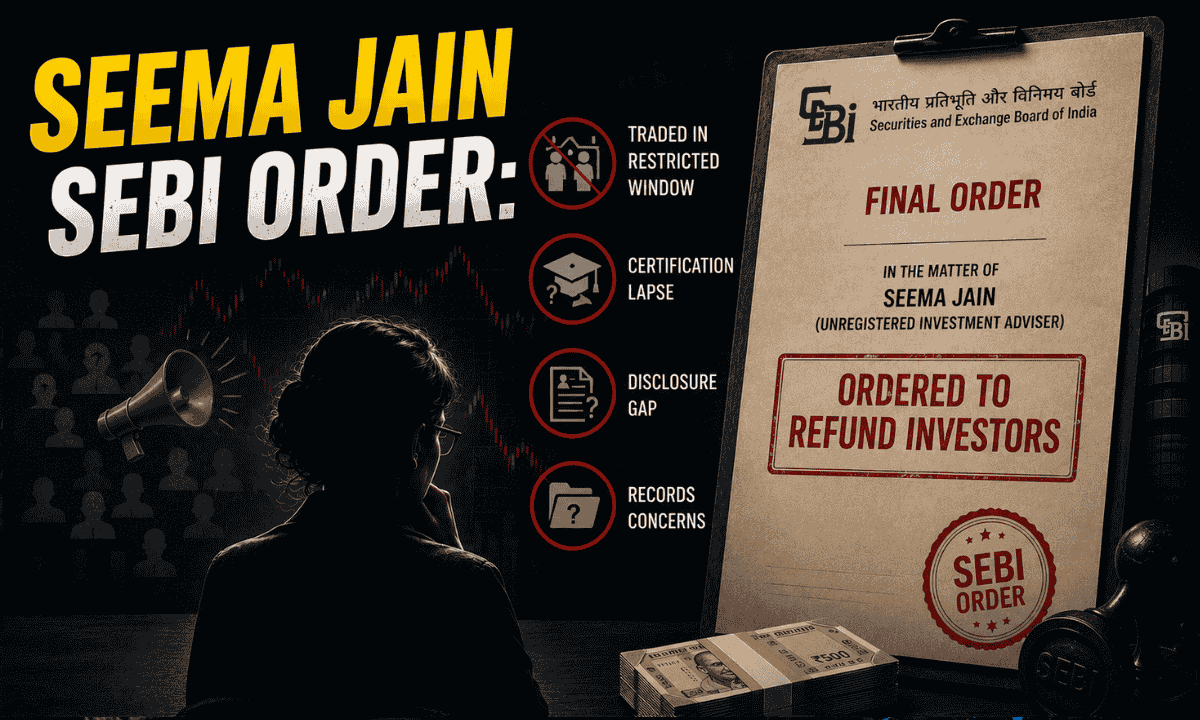
SEBI passed an order on March 18, 2026 against Seema Jain, a registered Research Analyst holding registration INH100006667. The inspection found she traded in the very stocks she was recommending, on at least 268 instances, inside the window when analysts are barred from trading. SEBI also found she gave recommendations through the StockPro Telegram and YouTube channels without maintaining proper records, without disclosing her financial interest, and without a valid NISM certificate for eleven months. The outcome was a one month ban on taking new clients. She had already paid a ₹5 lakh penalty in a separate order.
There is a rule that exists for one reason. A research analyst cannot trade in a stock 30 days before and 5 days after recommending it.
The reason is obvious once you say it out loud. Otherwise, the analyst can buy first, tell you to buy, and sell into the demand they created.
SEBI’s order dated March 18, 2026 found that Seema Jain did exactly what the rule prohibits. At least 268 times.
Here is what the order says, and what it means if you followed her calls.
Seema Jain SEBI Order: What the Action Unfolds
SEBI inspected her for the period April 1, 2021 to October 31, 2022.
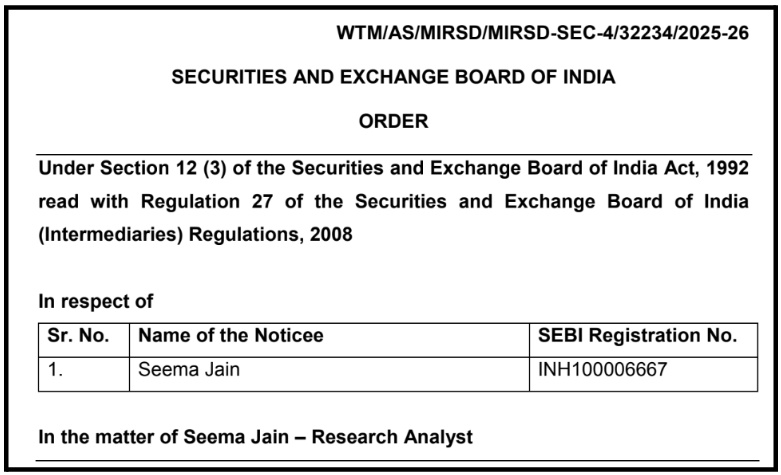
The inspection turned up seven separate categories of violation. Most are record-keeping failures. One is not.
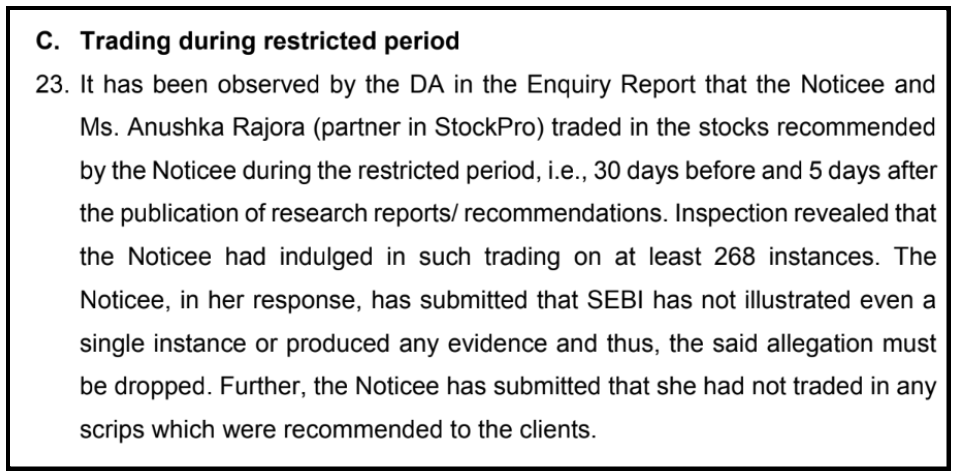
The 268 instances. SEBI found that Seema Jain and Ms. Anushka Rajora, a partner in StockPro, traded in the stocks she recommended during the restricted period. That window is 30 days before and 5 days after publication of a recommendation.
Her defence was that SEBI had not produced a single instance or any evidence.
The order calls that factually incorrect, in plain terms.
SEBI had sent her a letter on February 15, 2023, with the inspection findings. For all 268 instances, that letter gave her the name of the scrip, the date she made the recommendation, and the date she executed the trade.
She had the evidence for over three years. Her reply was that no evidence existed.
The NISM Certification and Disclosure Gap
No valid NISM certificate for eleven months. From April 2, 2022 to March 1, 2023, she did not hold a valid NISM certification.
Regulation 7(2) requires an RA to hold one at all times. She admitted this one and said she had mistakenly believed the certificate was a one-time requirement.
SEBI responded that the provision is clear and ignorance is no excuse. It did note she took corrective action and said she had not serviced clients during that gap.
This certification gap directly impacted the validity of her status as a SEBI-registered Research Analyst, which might make you question her overall SEBI registration.
While she does hold an official registration number INH10000666, you can go deep into the legitimacy of that registration in our detailed blog: Seema Jain SEBI Registered
No disclosure of financial interest. She was trading in the scrips she recommended; she was required to disclose that interest under Regulations 19 and 21.
She did not make any submission on this allegation at all.
You can see the wrinkle here that the order spends real time on, and it matters if you followed her calls.
Why the StockPro Firm Was Not a Shield
Seema Jain was registered as an individual Research Analyst. She was also a partner in StockPro, a partnership firm.
Her calls went out through StockPro’s Telegram group. Her market views went out through StockPro’s YouTube channel.
When SEBI raised the record-keeping failures, her defence was that StockPro is a different entity, engaged in educational work, and its research should not be clubbed with her own recommendations.
SEBI rejected that comprehensively.
The order records that during the inspection, she herself submitted that she was a partner in StockPro.
She answered SEBI’s pre-inspection questionnaire on StockPro letterhead. She admitted publishing her research on stocks through StockPro’s Telegram, Twitter and YouTube channels.
The finding:
“Accordingly, the association of the Noticee with StockPro is not in dispute and the recommendations made on the Telegram channel of StockPro shall be deemed to have been made by the Noticee.”
Everything StockPro put out was legally hers.
There is a second point buried here. SEBI found StockPro was an associate concern she should have declared when she applied for registration, under Clause 1 of Form A. She did not declare it.
The order corrects the regulation SEBI’s own notice had cited, and notes she was actually in breach of Regulation 3(2) read with the First Schedule.
This is the pattern to watch for. A registered individual, operating through an unregistered brand, arguing the brand is separate. It is not.
Seema Jain Research Analyst: The Records That Did Not Exist
Four record-keeping failures were established. Read them together and a picture forms.
Recommendations. SEBI asked for her records of recommendations. She gave an Excel file.
SEBI compared that file against what actually went out on the StockPro Telegram group, on two sample dates. The data did not match. Her records were incomplete.
Public appearances. She said she maintained records of her YouTube appearances and argued there is no requirement for such records to be signed.
SEBI’s DA analysed the Excel sheet she provided and found it was not reliable evidence, because it was not digitally signed and its authenticity could not be established. The order agrees, noting she “ought to have exhibited a higher degree of professionalism”.
Rationale for recommendations. This is the one that should concern anyone who followed her calls.
An analyst is supposed to record why they made a recommendation. She said she maintained the rationale for all of them, but shared only samples with SEBI, because it was not possible to attach seven years of records.
SEBI dismantled that. The order notes she never offered to furnish the complete records at any stage, never explained why they could not be shared electronically, and points out the data could have gone on a cloud link, a pen drive, or a disc.
“Merely because the data was voluminous, the Noticee cannot argue that she was justified in not sharing the entire data with SEBI.”
The Excel sheet she did provide had the same problem as the others. Not signed, veracity unverifiable.
The annual audit. She argued the RA Regulations set no timeline for the compliance audit, so she could not be late.
SEBI accepted that no timeline is specified, then held the regulation cannot be read to give intermediaries an indefinite window. The inspection happened more than six months after the relevant financial year.
And there was a contradiction. She told SEBI in her submissions she had completed all compliance audits.
But during the inspection, in an email dated October 26, 2023, she had told the inspecting authority she had not conducted the audit for FY 2022-23 and was in the process of doing it.
SEBI Order Against Seema Jain: The Penalty
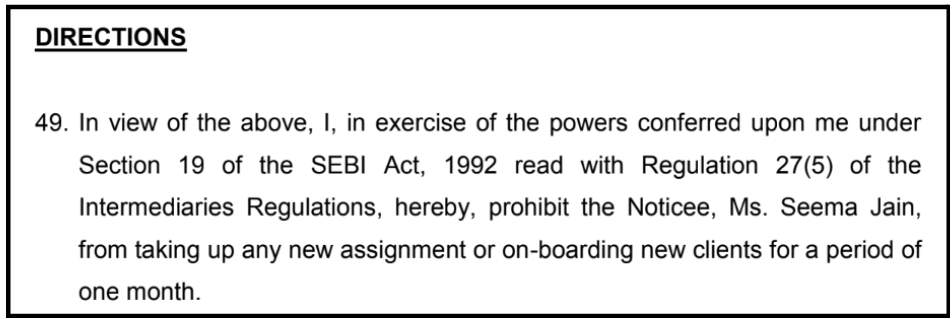
A one-month prohibition on taking up any new assignment or onboarding new clients.
That is it.
The Designated Authority had recommended suspending her certificate of registration for one month, which is heavier. SEBI declined.
The reasons given in the order:
- She had taken corrective measures, publishing the investor charter on her website and obtaining the necessary certifications
- An Adjudication Order had already imposed a ₹5 lakh penalty for a similar set of violations
She argued double jeopardy. That the penalty plus a suspension would punish her twice for the same thing.
There is a procedural detail worth noting. She asked for a personal hearing before the Whole Time Member and was refused, because under Regulation 27(4) a hearing is only granted where cancellation of the certificate is on the table. Suspension for one month did not qualify.
So: no ban on servicing existing clients. No cancellation. One month without new clients, and a penalty she had already paid.
Seema Jain Complaints: What to Do If Your Funds Are Trapped?
Two facts in this order matter more than the rest if you lost money following her calls.
Fact one. She was trading in the same scrips she told you to buy, 268 times, and never told you.
Fact two. SEBI found she was not maintaining the rationale for her recommendations. Meaning there is no documented basis for the calls you acted on.
Put those together, and you have a documented conflict of interest plus an absence of any recorded research behind the advice.
What the order does not do. No refund. No disgorgement or compensation. SEBI did not direct her to return money to anyone.
The ₹5 lakh penalty from the earlier adjudication order went to SEBI, not to clients.
What the order does do. It puts on record, with a date range of April 2021 to October 2022, that a registered analyst was trading against her own recommendations and could not produce a basis for them. That is a finding you can point to.
Your actual routes:
SEBI SCORES. She is registered, so she is inside the SCORES system and must respond to complaints filed there.
Worth knowing: the order establishes she has a history here. She did not obtain SCORES credentials until 2021, three years after registering, when she was required to get them within one month.
SMART ODR. Online dispute resolution for disputes with registered intermediaries. This is the route that can end in an award.
The complaint delays are documented. The order includes a table of four complaints she resolved late. One took 101 days. Another 66. Another 59. And another 44.
Those complainants existed. If you complained to her and waited, you were not alone, and the order proves the pattern.
Documents to Gather Now
- Your payment record to Seema Jain or to StockPro
- Screenshots of the StockPro Telegram calls you acted on, with dates
- The YouTube videos where a recommendation was made, if you can find them
- Your trade records showing what you bought and when
- Any complaint you already filed, with dates
The date overlap is what matters. If you acted on a call between April 2021 and October 2022, your experience sits inside the period SEBI inspected and made findings about.
An honest view of the odds. This is harder than a refund case, because there is no refund mechanism to join.
You would be arguing that you acted on a recommendation from an analyst who had an undisclosed position in the same stock, and that the recommendation had no recorded research basis. SEBI has established both facts. What SEBI has not established is that any specific client lost a specific amount.
That link is yours to build. The findings support it. They do not make it for you.
Did you buy a stock because a StockPro call told you to?
Our team matches your trade dates against the recommendation dates in SEBI’s findings, then files through SCORES or SMART ODR depending on your amount and timeline. Register with us to get the assistance.
Seema Jain SEBI Order: Timeline
The findings were serious, but they did not appear overnight.
This case moved through multiple stages: registration, inspections, notices, hearings, and finally the order, over several years.
Looking at the timeline makes it easier to understand not just what happened, but how long each phase of the regulatory process took before SEBI reached its final decision.
Here’s the complete chronology.
| Date | Event |
| December 14, 2018 | Registered as a Research Analyst. Required to obtain SCORES credentials within one month. |
| April 1, 2021 | Start of the inspection period. |
| Through 2021 | Obtained SCORES credentials, roughly three years late. |
| August 30, 2021 | Received a complaint that ultimately took 101 days to resolve. |
| April 2, 2022 | NISM certification lapsed and remained invalid for 11 months. |
| October 31, 2022 | End of the inspection period. |
| November 21, 2022 | SEBI carried out the inspection. |
| February 15, 2023 | SEBI shared its inspection findings, including all 268 instances with the relevant scrip names and trade dates. |
| March 1, 2023 | Obtained a valid NISM certification again. |
| October 26, 2023 | Informed the inspection team that the FY 2022–23 compliance audit had not yet been completed. |
| October 8, 2024 | SEBI issued the Show Cause Notice. |
| March 17, 2025 | Personal hearing before the Designated Authority. |
| May 23, 2025 | The Enquiry Report recommended a one-month suspension. |
| March 18, 2026 | SEBI passed the final order, prohibiting her from onboarding new clients for one month. |
| Overall | More than three years elapsed between the inspection and the final order, while the case itself stretched across over seven years from registration to conclusion. |
The timeline also explains why this order carries weight.
It was not the result of a single complaint or one inspection, but the culmination of years of regulatory scrutiny, evidence gathering, replies, and hearings.
Conclusion
SEBI’s March 18, 2026 order establishes that Seema Jain traded in stocks she was recommending 268 times, inside the restricted window. It establishes she had no reliable record of why she made those recommendations. And it establishes that everything StockPro published was legally hers, regardless of the brand on it.
The StockPro finding is the transferable lesson. A registered individual cannot put an unregistered brand between themselves and their recommendations. SEBI looked at the letterhead, the Telegram group, the YouTube channel, and attributed all of it back to her.
What the order does not give you is money. A one-month ban on new clients is not a remedy for anyone who already paid.
But the findings are public; they are dated April 2021 to October 2022, and they document a conflict of interest that was never disclosed to the people acting on her calls.
Report. Recover. Stay Fraud Free.
Frequently Asked Questions
Yes. SEBI prohibited her from taking new assignments or onboarding new clients for one month from March 18, 2026. Her registration INH100006667 was not suspended or cancelled, and she was not barred from servicing existing clients.
A research analyst cannot trade in a stock for 30 days before and 5 days after recommending it. The rule stops an analyst building a position, publishing a call, and profiting from the demand their own recommendation creates. SEBI found 268 instances where this rule was broken.
Seema Jain was registered as an individual Research Analyst, not StockPro. SEBI found StockPro was an associate concern she failed to declare when applying for registration, and held that recommendations made through StockPro's channels were deemed to have been made by her.
Yes, through SEBI SCORES or SMART ODR, since she is a registered intermediary. Your case is stronger if your trade dates fall within the April 2021 to October 2022 inspection period covered by SEBI's findings. Keep your payment proof and screenshots of the calls.



 Add us as a preferred source on Google »

