Trust plays a huge role in trading. When an investor opens a trading account, deposits hard-earned money, and follows a broker’s guidance, there is an assumption that every trade will be executed only with clear permission.
But problems begin when trades appear in the account that the investor does not fully recognise, did not approve, or never clearly understood.
That is where concerns around unauthorised trading start to surface.
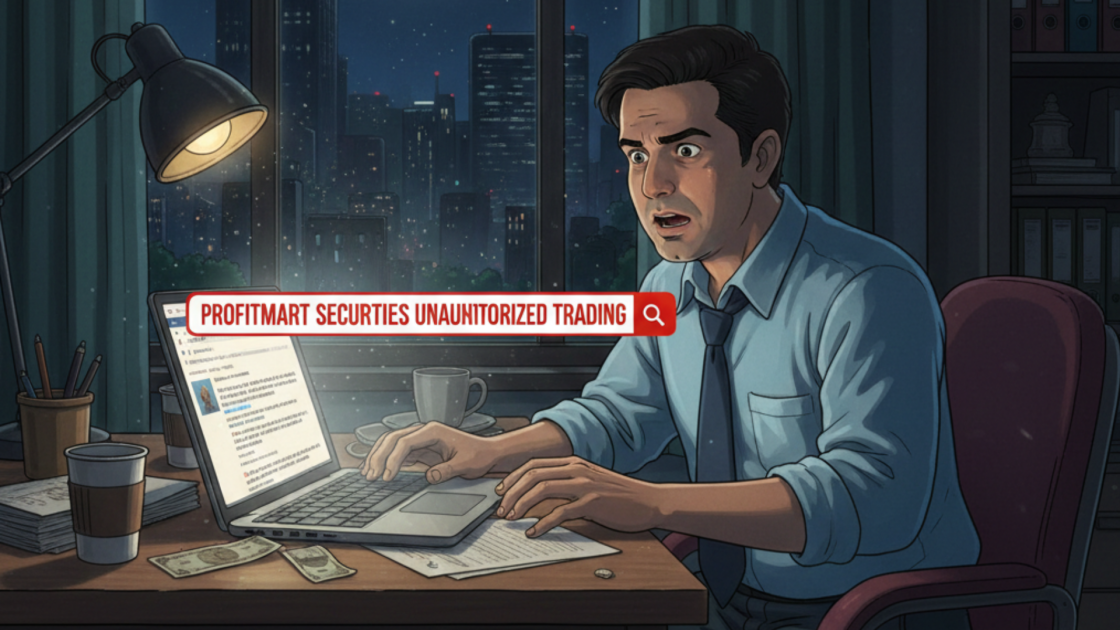
This blog takes a closer look at Profitmart Securities unauthorised trading complaints, how such situations usually arise, what the complaint data shows, and what investors can realistically do if they face something similar.
Profitmart Securities Overview
Profitmart Securities Pvt Ltd operates as a SEBI-registered stockbroker and offers trading services across multiple market segments.
Like many traditional brokerage firms, it provides access to equity trading, derivatives (F&O), commodities, and other exchange-traded products.
For retail investors, Profitmart typically offers:
- Online trading accounts
- Dealer-assisted trading services
- Access to NSE, BSE, and MCX segments
- Margin-based trading in derivatives
Officially, this setup looks standard. However, issues mainly arise from how trades are executed, how risk is explained, and how much control the client actually retains over their own account.
What is Unauthorised Trading?
Unauthorised trading does not always mean someone hacked an account or acted secretly in the dark. In many real cases, it happens in more subtle ways.
Sometimes, clients give a general verbal go-ahead but do not approve the exact quantity or risk exposure.
In some cases, trades are executed rapidly through dealer terminals without reconfirming each order.
Over time, trading volumes may increase sharply, which exposes the client to risks they never consciously accepted.
There are also situations where:
- Trades are placed without recorded consent.
- Position sizes exceed what the client discussed.
- High-risk derivatives are executed without a proper explanation.
- Excessive trading leads to heavy brokerage and losses.
Importantly, profit or loss does not decide whether trading was unauthorised. The key question is simple: Did the client knowingly and clearly approve the trade?
Profitmart Securities Unauthorised Trading Complaints
Complaint data is crucial because it gives useful context into how often unauthorised trading concerns are raised by investors.
Below is a year-wise snapshot showing total complaints versus unauthorised trading complaints.
|
Year |
No. of complaints |
No. of complaints for unauthorised trading |
Percentage of unauthorised trading complaints |
|
2025–26 |
22 |
5 |
22.73% |
|
2024–25 |
26 |
8 |
30.77% |
|
2023–24 |
19 |
6 |
31.58% |
|
2022–23 |
49 |
8 |
16.33% |
|
2021–22 |
93 |
20 |
21.51% |
While the absolute numbers are not very high, the share of unauthorised trading complaints remains noticeable across years.
For retail traders, even a single unauthorised trade can result in outsized losses, especially in derivatives.
When Can Action Be Taken Against a Broker?
A lot of investors believe that trading through a SEBI-registered broker automatically means everything happening in their account is legitimate. In reality, registration is not a free pass.
Brokers are bound by strict rules, and when those rules are not followed, investors have every right to question them.
SEBI introduced detailed guidelines specifically because unauthorised trading complaints were rising. These rules make it clear when responsibility shifts from the investor to the broker.
Here are the cases when you can file a complaint against the broker:
1. When There is No Evidence That You Gave the Go-Ahead
At the bottom of most disputes is a simple question: Did the client really approve this trade? If a broker cannot prove that you placed or confirmed the order, that trade can be challenged.
Approval is not assumed. Brokers are required to maintain verifiable records such as call recordings, emails from registered IDs, online order logs, or confirmed messages from registered mobile numbers.
If none of these exist, the broker can be held accountable.
2. When Trading Activity Exceeds What Was Discussed
Giving permission to trade does not mean giving unlimited freedom.
If they start taking larger positions, increasing volumes, placing extra trades, or trading much more frequently than what was explained to you, that goes beyond what you agreed to.
Any action outside that scope, especially without a proper explanation, can still be considered unauthorised trading.
3. When the Broker Fails to Back Up Their Claims
Once an investor raises a formal complaint, the expectation is clear: The broker must show proof.
If they can not produce order confirmations, call records, or system logs related to the disputed trades, regulators do not assume the broker is right.
In these cases, the lack of documentation itself becomes a serious issue.
4. When “System Glitches” or Dealer Errors Are Used as Excuses
Investors are often told that unauthorised trades happened due to technical problems or dealer-side mistakes.
SEBI has clarified that such explanations do not automatically excuse the broker.
Dealer access is tightly regulated, and any misuse, intentional or otherwise, can still attract action.
Operational errors are not the investor’s burden to carry.
Why This Matters for Everyday Traders?
One important thing many investors miss: Profits do not make unauthorised trades acceptable.
Even if the account did not suffer a loss, trades executed without proper understanding or approval can still be questioned.
These safeguards exist so retail traders are not pushed into risks they never signed up for, knowingly or unknowingly.
How To File a SEBI Complaint Against a Stockbroker?
If you think any such activity has happened in your trading account, you can take action. Here is what you can do step by step:
1. Secure Your Trading Account
Start by changing your login password, trading PIN, and disabling dealer access if possible.
This can prevent further trades while you review what has already happened.
2. Save All Communication
Save WhatsApp chats, emails, call recordings, payment proofs, and screenshots.
Once a dispute escalates, missing communication can seriously weaken your case.
3. Raise a Written Complaint With the Broker
Send a formal complaint to the broker’s grievance email.
Clearly mention disputed trades, lack of consent, and request order logs, dealer IDs, and proof of authorisation.
4. Escalating Through SEBI SCORES
If the broker does not resolve your complaint properly, you can escalate it on SEBI’s SCORES portal.
This is SEBI’s official platform where you submit details of unauthorised trades along with supporting documents.
SEBI then seeks an explanation from the broker based on regulatory compliance.
5. Approach the Exchange Grievance Cell
If the matter remains unresolved, you may escalate the complaint at BSE or NSE in grievance redressal mechanism.
The exchange may:
- Seek clarification from the broker
- Review trade logs
- Examine whether proper authorisation was recorded
In some cases, disputes may proceed to arbitration through exchange mechanisms.
6. File for Stock Exchange Arbitration
If the issue is still not resolved, you can approach stock exchange arbitration.
This is a formal process where trade records, consent proof, and communication logs are examined to decide whether the trades were authorised.
Need Help?
Many investors struggle to understand whether what they faced was unauthorised trading or simply market loss.
The difference matters, especially when filing complaints. We provide the professional clarity you need to protect your interests and take decisive action.
We help to:
- Understand whether their case qualifies as unauthorised trading.
- Organise contract notes and statements correctly.
- Draft structured complaints for brokers and regulators.
- Navigate exchange grievance and arbitration processes.
If you want guidance at any step, help is available. You can reach out to us now. Getting clarity early can prevent costly mistakes later.
Conclusion
Unauthorised trading strikes at the core of investor trust. Even when a broker is SEBI-registered, that registration does not override the fundamental requirement of clear consent, transparency, and documented approval for every trade.
The complaint data related to Profitmart Securities shows that unauthorised trading risk have appeared consistently over the years.
While markets are inherently risky, risk must be chosen, not imposed.
For retail investors, staying alert, reviewing trade records regularly, and acting quickly when something feels off can make all the difference.
In trading, silence and delay often cost more than losses themselves.